

The iron gate twenty pal.., p.1
The Iron Gate: Twenty Palaces, page 1


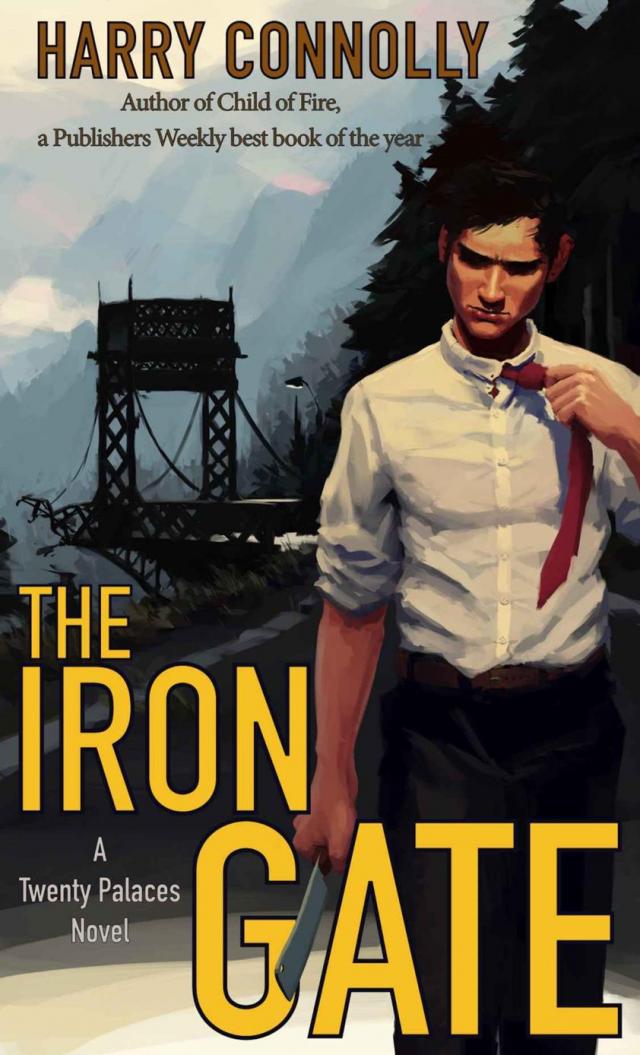
THE IRON GATE
A TWENTY PALACES NOVEL
HARRY CONNOLLY
ALSO BY HARRY CONNOLLY
The Twenty Palaces Series:
Twenty Palaces
Child of Fire
Game of Cages
Circle of Enemies
The Twisted Path
The Iron Gate
The Flood Circle
The Great Way Trilogy:
The Way into Chaos
The Way into Magic
The Way into Darkness
Stand Alone Works:
A Key, An Egg, An Unfortunate Remark
One Man: A City of Fallen Gods novel
Spirit of the Century Presents: King Khan
Bad Little Girls Die Horrible Deaths, and Other Tales of Dark Fantasy
Praise for the Twenty Palaces novels:
“[Child of Fire] is excellent reading and has a lot of things I love in a book: a truly dark and sinister world, delicious tension and suspense, violence so gritty you’ll get something in your eye just reading it, and a gorgeously flawed protagonist. Take this one to the checkout counter. Seriously.” — Jim Butcher
“Connolly doesn’t shy away from tackling big philosophical issues . . . amid gory action scenes and plenty of rapid-fire sardonic dialogue.”—Publishers Weekly (starred review), on Game of Cages
“An edge-of-the-seat read! Ray Lilly is the new high-water mark of paranormal noir.” — Charles Stross
Copyright © 2022 Harry Connolly
All rights reserved.
ISBN: 978-1-951617-02-8
This is a work of fiction. Names, characters, places and incidents are the product of the author’s imagination or are used fictitiously. Any resemblance to actual persons, living or dead, events or locales, is entirely coincidental.
For my sister, Donna, who taught me to love science fiction and fantasy. My life would not have had these joys without her.
I only wish I’d written this dedication one book ago.
Rest in Peace
RAY LILLY
CHAPTER ONE
What was I doing?
That question seemed to surface out of dark waters, and I seized on it. What was I doing? I didn’t know the answer, but the question—and the ability to ask it—felt like a precious gift that might vanish into darkness at any moment.
But that darkness was receding. Movement. Sweat. Light. Color. The world moved around me in a kaleidoscope of meaningless shapes.
Except they weren’t meaningless. My thoughts were coming back to me. Actual thoughts. My body was moving. I was doing something. I didn’t understand what it was or why I was doing it, but at least I knew it was happening.
This was bad.
It would have been one thing to wake up in a hospital. Or maybe even a jail cell. But to wake up on my feet, running?
My breath was hot against my face, and my vision was obscured. Rough burlap scraped against my cheeks and nose, and I realized someone—me?—had cut eyeholes in a sack and pulled it over my head.
I couldn’t stop running. I tried to make himself stand still, but I seemed to have forgotten how. I couldn’t adjust the eyeholes in the burlap sack, either. My legs were still churning, my arms raised over my head, an unhappy moan coming from my mouth. My body was doing this without any input from me and I couldn’t make it stop. Couldn’t grab a doorway as I ran through. Couldn’t stop moaning long enough to call for help. Couldn’t even flex my leg muscles to make them go rigid and fall flat on my face.
Screams echoed from the hallway ahead, and I turned my attention outward. I was in a room built from crooked slats and planks, which appeared to be made of brown plastic, or plastic that had been painted brown.
I went through a doorway—a passenger in my own body now, just a dumb motherfucker along for the ride—and turned left into the hall. There were more plastic slats here, but my heavy work boots made a wooden clunk sound against them. Cob webs hung in the corners of the ceiling.
The place looked like a prefab haunted house.
But it was the kids that really caught my attention. There were three of them: two boys of twelve or thirteen, in faded blue jeans and short-sleeved shirts with no pictures or logos I could see. Between them was a girl of the same age. She wore a pleated skirt and a top that looked like it came from a toddler’s sailor costume.
And behind them, as though it wasn’t fast enough to outrun a few kids, was a huge Marmaduke-looking dog. It was almost the size of a pony, and I would have stopped dead in my tracks if I had any control of my body. There was no way a dog that size dog should be running away from me. It should have spun around and turned me into lunch.
A new group of three kids crossed in front of the first group, and the dog chased them. The original three peeled off.
Steered by some unknown force or compulsion, my body followed this new group up a flight of stairs, then through turning corridors. After a short while, another group switched out to lead the chase, then another.
Soon my lungs were burning and my muscles ached, but my body kept up the pace. I ran, moaned like a specter, and waved my arms over my head. Someone had chosen this role for me, and they were going to make me play this part no matter how I felt about it.
The kids burst into a huge warehouse space. I followed.
It occurred to me that I might be dead.
Maybe I’d fucked up somehow, gotten myself killed, and landed in hell. Maybe that’s why I was running after these kids like a dad in a polo shirt.
We crossed to the loading dock, passing fake-looking wooden crates and cracked barrels. There were more cobwebs here, too, hanging around like Halloween decorations, and everything suddenly felt horribly familiar. Had I been there before? Had I pulled a sack down over my face and chased these kids before?
How long had I been riding around inside my own body, watching it do things I couldn’t control?
The kids skirted the edge of the loading dock and headed for a flickering EXIT sign. They hit the push bar on a metal door and went through. I caught a glimpse of moonlight on calm waters—a lake? A sheltered lagoon?—before the door swung shut again.
I wanted to stop. To turn away. If there was any place for an ambush, this was it. Those kids weren’t just running away. They’d been leading me somewhere. I could feel it.
But I couldn’t even slow down when I spotted the rope lying across the doorway, and I couldn’t change my stride when I tripped over it.
The next few seconds were disorienting, and I panicked at the thought that I might be losing consciousness again. I flew forward more than fell. When I struck the wooden deck, it spun on a center axle like a paddle wheel, and a railroad tie—a counterweight, maybe—swung in front of me, inches from my face.
Then I was in a net, swinging down toward the dark water. My arms and legs were held tight by the heavy cords, and the salt water was icy when I plunged into it.
Then the water was over my head. I couldn’t kick free. I couldn’t move my arms. I felt a sudden, agonizing stab of pain below my right collarbone but couldn’t imagine what had caused it. Maybe the railroad tie had clipped me after all.
Not that it mattered, because the net was holding me under, and there was nothing I could do to reach the air again. I kept trying anyway, but my body fought me. My breath was being held—at this point, I didn’t think I could take credit for a beating heart—but my body wouldn’t move a single muscle to survive. It wanted to die.
A moment before it would have gotten its wish, I felt myself being yanked upward. The net was on some sort of boom, and someone was swinging me back toward the dock. The burlap bag—which had stayed in place even after the plunge into the water—made it difficult to see who was operating it, but then they came into view.
Of course it was the fucking kids.
I tried to struggle free of the net, and my body did the same. I couldn’t tell if I was getting some measure of control back or not. Not that it mattered, because my body and I were both trapped.
A potbellied cop limped into my line of sight. At first glance, I thought he was an old white guy, well past retirement age, but a second glance showed there was no gray in his hair and only few lines on his face. I put him in his forties but with a crookedness to him that suggested he’d carried that leg injury for so long that it had changed everything about the way he moved.
He looked me over, tipped back his cap and scratched his head. “Welp, it looks like you kids did it.”
A big group of kids approached confidently. The dog towered over them.
“That we did, Chief,” said the smallest of the kids, the boy in a bright red shirt.
A second cop appeared behind the chief. She was a young woman with a big frame and a tidy black ponytail. The expression on her pudgy white face was pure befuddlement. “But… I don’t understand. How did you catch a ghost in an old fishing net?”
More people appeared behind the cops as though they were emerging from a fog. The men were dressed in polo shirts in neutral colors and the women wore simple dresses in blue and green. Victims was the word that came to me out of nowhere. They looked like they’d gathered just to watch this scene play out. Even the birds were settling on the telephone wires, and the squirrels on the railing of the dock. An orange tabby with some kind of locket dangling from its collar peeked out from between the chief’s legs.
“But he’s not a ghost!” the kid in red shouted, and I hated him just for the smug, triumphant tone of
his voice.
Everything about this suddenly felt familiar to me, although I was sure it had never happened to me before. Not while I was awake, anyway. But for no reason at all I was sure I knew what was about to happen to me.
The kid in red stepped forward. “The Phantom of Stormy Bay is actually…” He reached over and yanked the burlap sack off my head.
The crowd, in ragged unison, cried, “Handyman Carl!”
It was hard to talk, but I forced the words to come. “Fuck you,” I managed to say.
I was awake again. I was regaining control over my body.
It was a brand-new day.
The chief looked at me in shock. “Carl.”
“That isn’t my name. My name is…”
Shit.
I couldn’t finish that sentence. I didn’t know who I was. I’d forgotten my own name.
CHAPTER TWO
The kid accused me of some sort of convoluted real-estate scam involving the abandoned cannery we were all standing in. He was speaking ordinary English, but what he said was pretty much empty gibberish. I didn’t pay much attention after that. It was meaningless. Still familiar in some far-off way, but meaningless.
Someone had taken my name away. That wasn’t meaningless. That mattered. And so did the pain in my chest. And so did this big scary dog, who was leaning over the edge of the dock to growl at me as though it didn’t like harsh language.
Unmasking “Handyman Carl” was apparently an excuse to party. A little stage had been constructed on the end of the dock, maybe while I was holding my breath underwater, and a few of the kids took up instruments. Within minutes, they were belting out bubblegum pop—with the boy in red on guitar and vocals—and the whole town was dancing, even the cop with the ponytail. Only the chief and his bad leg were exempt. He stood near the boom that still held me prisoner, clapping along with a big grin.
Nearby, that big dog was up on its hind legs, dancing to the music. At Chino, I’d met a Haitian gun runner who claimed to teach his English setter to walk around on its hind legs, but I had never really believed it until now. Then a cat wandered too close—a little tuxedo cat with oversized gold tags on its collar—and the dog bolted after it. The two pets spent the rest of the song racing around the stage.
I suppose it was meant to be funny or sweet. I suppose it was meant to be endearing.
Not to me. I didn’t even know who I was. The only things I knew for sure were that I wasn’t a handyman and I had no interest in real estate. I was also in real pain from some kind of injury below my collarbone. Once I got out of this net, I wasn’t sure I’d be able to lift my right arm above my shoulder.
And I’d nearly drowned.
The band finished their song. How many times had they played it? I had the feeling that I’d heard it before. A dozen or so ordinary townsfolk gathered around the kids to congratulate them or whatever. In the comparative quiet, the chief said, “Watch your language, Carl. You aren’t here to cuss at little kids.”
Those kids didn’t look all that little to me. I was maybe a year older than them when I shot my best friend and ran away from home. But I couldn’t make myself say so.
The dog had returned. I didn’t know if it caught that cat, but it was standing behind the chief, glaring at me. It looked almost ready, finally, to have me for lunch.
Then everything went gray.
I opened my eyes without realizing I’d closed them.
The cannery, the docks, and the fishing net were gone, replaced by a run-down little room… It was nothing more than a squat, really. The floor and walls were planks of unfinished wood, but they looked like real wood rather than the weirdly painted plastic of the docks. I extended my hand—I had control of my body again, thank fuck—and ran my fingertips across it. It felt like real wood, too.
I sat up, wincing as I moved my right arm.
Damn. It still hurt like hell. I stood and went to the little mirror over the sink.
And stopped cold. I was wearing new clothes—black pants, white button-up shirt with collars the size of pie slices, and a red tie. Why did people think I was a handyman if I was wearing a tie? And why was I wearing a fucking tie, anyway? I may not have known my own name, but I knew I didn’t want to walk around with a noose around my neck.
With my left hand, I loosened the tie and pulled it over my head. My bed was little more than an unrolled pad in the corner. I threw my tie on top of it. Then I worked at unbuttoning my shirt, which taught me that I was right-handed, because it should not have been such a challenge.
There were tattoos on my chest and over the backs of my arms and hands—how had I not noticed my hands before?—from my knuckles to my elbow. I ran my fingers over them, sometimes tracing the black squiggles and sometimes moving across them to feel for an edge. I didn’t feel any edges, of course, but I couldn’t feel anything else, either. I scratched my skin, pinched it, tugged on it… I felt nothing. Nerve damage, maybe.
But there was one exception. Below my right collarbone was a little nest of black squiggles that looked a little like a rib cage or maybe a security gate, and it ached like holy shit. It felt like someone had put a lit charcoal under my skin. I touched it to see how tender it was. I didn’t know where I was born, but I knew that fresh tattoos could get infected and turn red and hot to the touch.
But this tattoo wasn’t new, apparently. It wasn’t swollen or red, and no matter how much I poked at it, the pain didn’t get better or worse.
Which meant I was a passenger again. This might have been my body, but some asshole had carjacked it. Body-jacked. I couldn’t feel my own skin, not even to hurt myself. Something—or someone—had done this to me, and the idea made me so furious that I wanted to hunt them down and kill them, whoever they were.
“My name is Ray Lilly,” I said to the empty room.
There it was. I’d remembered my name, and with it came the realization that I had come to this place, whatever this place was, to find someone—no idea who at the moment—and kill them.
I was doing a shit job of it, though. Looking around the room, I saw the bedding was rumpled and split at the seams. The floor was littered with creased, battered paperbacks I didn’t remember reading.
How long had I been here, not murdering my target?
A lonely chair stood in the corner beside a narrow table. There was nothing on them but an old-fashioned pen and dried-out inkwell, and a single sheet of unmarked paper. Beside that was the only window. I looked through the dirty glass and saw an empty street corner. It could have been Anywhere, USA. The window had been painted shut.
This place felt like a cell.
I turned back to the mirror and examined myself. I couldn’t spot any gray hairs, so maybe I hadn’t been stuck here for decades. There was a scar on my face—maybe from a knife—but not much in the way of wrinkles.
Then I noticed something else. My jaw was smooth. I’d been dressed like an old sailor when I went into the seawater, but when I’d come around on the bed—woken up? It didn’t really feel like waking up—my clothes had been changed. I rubbed my face. Bad enough to have someone dressing me, but my skin felt freshly shaved. In fact, it was smoother than it had ever been since puberty.
I stepped back and looked down at myself. My shirt was buttoned up and my tie was back on.
That fucking tie was supposed to still be on the bed where I tossed it. Had I blacked out and put it back on? Had someone come in and dressed me?
I scanned the room for some sign of an intruder, but there was nothing. My hands were shaking and my thoughts jumbled. Bad enough that someone had dressed me. I imagine a nurse or someone changing my clothes with impersonal professionalism, and while I fucking hated that thought, it didn’t bother me half as much as the idea of strangers touching my face.
I put my hand on the doorknob—if it was locked, I was going to tear this place apart—and the door swung open easily.


