

Wages of sin, p.1
Wages of Sin, page 1


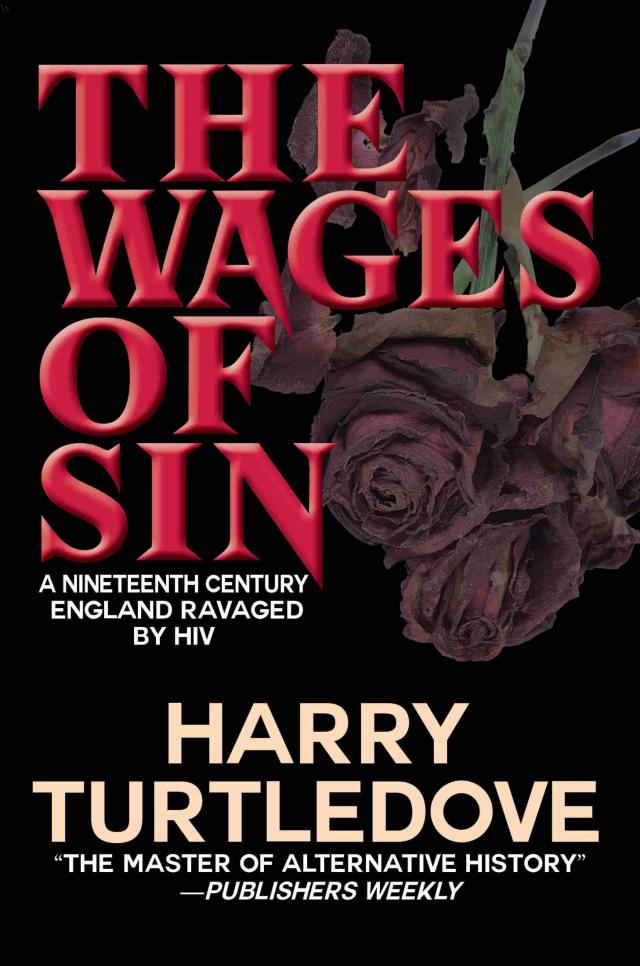
The Wages of Sin copyright © 2023 by Harry Turtledove. All rights reserved. This book may not be copied or reproduced, in whole or in part, by any means, electronic, mechanical, or otherwise without written permission except short excerpts in a review, critical analysis, or academic work.
This is a work of fiction.
ISBN: 978-1-64710-093-3
First Edition. 1st Printing. December 2023
1 2 3 4 5 6 7 8 9 10
An imprint of Arc Manor LLC
www.CaezikSF.com
www.BookBale.club
Unlimited Reading Journeys, Zero Strings Attached!
You could have gotten this book (and thousands more) for free with a monthly membership for less than a price of a cup of coffee!
www.BookBale.club
Contents
I
II
III
IV
V
VI
VII
VIII
IX
X
XI
XII
XIII
XIV
XV
XVI
XVII
XVIII
I
IN THE BEGINNING: 1509
Filipe Sousa and Pedro Alves squelched through the muddy streets of Boma. The trading village—the biggest one this side of the rapids that kept boats from going very far up the Congo—was claimed by Portugal, but no one took that seriously. Dutch and English slave dealers and other merchants also operated here.
White men had been trading in these parts for almost thirty years now. The Africans in Boma had come to take them for granted, which wasn’t true everywhere. Blacks who’d never seen a man from Europe before often took him for a ghost—how else could he be so pale?
“Bom dia!” called a bare-breasted woman with a big pot and a wooden dipper. “You want some banana wine?” The question was a mishmash of Portuguese, Dutch, and two or three of the local languages.
“No, thanks, sweetheart. Not now.” Sousa’s answer came from the same stew of tongues. Nobody would ever write poetry in the trade lingo. As long as the natives and the strangers from across the sea could tell each other what they wanted and how much they’d give for it, they were content.
“Mother of God, but that’s horrible swill,” Alves said, pitching his voice low so the hawker couldn’t hear. “Drink a couple of dippers and you’ll wish your head would fall off.”
“How do you know?” Sousa grinned at his bosun.
The stocky little man grinned back. “Same way you do, Senhor.”
A man with a missing front tooth used a stick to stir a big iron pot mounted above a fire. “Bushmeat stew?” he asked. He poked something with the stick and held it up so the Portuguese traders could see it: a hand as big as a man’s, but with longer fingers and a shorter thumb. “Special good—got shimpanse in it.”
Not trusting himself to speak, Sousa shook his head and walked on. He’d seen live shimpanses. They looked too much like people for him to want to eat them. The Africans saw things differently. Cattle and sheep and horses couldn’t live in these parts. They died of tropical sicknesses even faster than Europeans did, which was saying something. Without domestic animals, you got your meat from whatever you could catch.
A half-grown boy displayed skewered grubs on a wide, bright green leaf. “I think I’d sooner eat those than shimpanse,” Sousa said.
Alves shuddered. “I don’t want the bugs, and I don’t want the critter, either.”
“Remind me why you came to Africa,” Sousa said with a chuckle.
“Same reason you come here—to see if maybe I can get rich.”
“Fair enough.” The merchant-adventurer paused and pointed. “There’s Njoya’s compound. Whatever he has in his pot, we’ll eat it and we’ll make like we like it.”
“I know.” By Alves’ face, the knowledge did not overjoy him.
A guard with an iron-tipped spear stood outside Njoya’s hut. He wasn’t just for show; people here, like people anywhere, would steal anything not nailed down. Sousa’s rowers guarded the boat they’d hauled out of the Congo and up onto the riverbank. They wore morions on their heads and swords on their belts, which impressed the locals. And they had arquebuses, which frightened the Africans. The natives had swords of their own, and they could see how helmets worked. But firearms seemed like magic to them.
The guard ducked into the hut. A moment later, Njoya came out with him. The African trader was in his mid-forties, with broad shoulders and a big, firm belly that said he’d eaten well for a long time. Portly men were no more common here than in Europe. You had to be smart or lucky or—usually—both to get that far ahead of hunger.
Njoya folded first Sousa and then Alves into a sweaty embrace. “Filipe! Pedro! Good to see you both!” he boomed in pretty good Portuguese: no lingua franca for him. He could also get along in English and Dutch and several of the local languages. He even knew some Arabic.
“Good to see you, too, you old thief,” Sousa said. Njoya held that big, firm belly in both hands and laughed out loud, for all the world as if the white man were kidding. Dryly, Sousa continued, “What’ll you try and palm off on us today?”
Njoya looked so wounded, he could have been a bad actor. “I don’t need to palm nothing off on you, Senhor Filipe.” His Portuguese was good, but not perfect. “I got a cousin who come here from up the Songha River with a good bunch of people his folk capture.”
Cousin, here, probably meant something like somebody I’ve done business with before. Sousa had heard of the Songha. It was one of the rivers that flowed into the Congo somewhere beyond the rapids. He thought it ran down from the north, but he wasn’t sure. No white man had ever seen it.
“Well, you and your cousin can show them to us if you want to,” he said. You never seemed too eager. Bargaining rules among blacks differed not a copper’s worth from those among whites.
“In a while, in a while.” Njoya acted as if the slaves didn’t matter to him, either. “You can come inside first. You meet my cousin. We eat, we drink, we talk. Then you can look at those stupid people. Must be stupid, hey? Otherwise, they don’t get catched.”
“That’s about the size of it,” Sousa agreed. Africans of the not-stupid variety sold slaves to the European traders who came to these parts in ever greater numbers. The market was taking off like a flushed partridge now that Spain and Portugal had found those new lands beyond the Atlantic. And the Africans who wound up on the wrong side of a war or a raid? That was their hard luck.
He and Alves ducked into Njoya’s hut. One of the black man’s wives was tending a stewpot. She smiled at the whites. She wasn’t pretty, not to Sousa’s eyes, but she was as well fed as her husband. A centipede as long as a man’s middle finger scuttled under some junk. The merchant-adventurer suppressed a grimace. Africa was hell for bugs.
Another woman—a girl, really—dipped out cups of banana wine and shyly offered them to the two Portuguese and to Njoya. A tall, scrawny, very black man of about thirty came in from the back. “This is my cousin. He calls himself Maigari,” Njoya said. He switched to an African language to introduce Sousa and Alves to the newcomer.
The girl gave Maigari banana wine, too. He coughed a couple of times as he dipped his head to the merchant-adventurer and the bosun. “Good to meet you, friends,” he said in the mixed-up trade lingo they spoke in Boma. He used more native words and fewer from Europe than some who lived here would have, but he managed. The way he stared at Sousa and Alves argued he hadn’t seen many white men till now.
“You eat,” Njoya’s wife said, and filled bowls from the pot. The spoons were made of wood. Sousa ate. Christ only knew what the meat was—no shimpanse hands, anyway. Some of the vegetables were squashes. One was okra, which was seedy and slimy but tasted all right. Sousa didn’t know the names of the rest, or of the spices that went into the stew. He emptied the bowl anyhow, washing down the food with sips of the too-sweet banana wine.
Emptying your bowl was good manners. Alves followed suit. Njoya smacked his lips as he made his stew disappear. Maigari ate more slowly, slowly enough to make Njoya’s wife frown. “You don’t like?” she asked.
“No, no. Is good, is good,” said the skinny man from up the Songha. “Just not big”—he ran out of words and patted his belly to show he meant something like appetite—“lately.”
Sousa wondered if he was well. The way he coughed, the way his eyes bulged, made the Portuguese doubt it. But what could you do except go on? Doctors in Europe talked a much better game than they played. It was bound to work the same way here.
However sweet the banana wine was, it packed a punch. By the time Sousa got to the bottom of his third cup, the tip of his long, pointed nose went numb—a sure sign he’d had his share and then some. Alves, Njoya, and Njoya’s wife wore glassy-eyed smiles. Even Maigari looked less afraid he’d fall apart in the next hour or two.
Slapping at a buzzing fly, the Portuguese reminded himself of business. The sooner he bought the slaves, the sooner he took them down the river to Sonho, the sooner the São Paulo sailed for Lisbon, the better his chances of not coming down with anything horrible himself. He touched the brim of his hat to Maigari. “Do you want to show me your wares?” he asked. The man from up the Songha didn’t follow wares. Sousa tried again: “The people you brought here to sell?”
Maigari got that. “Oh, yes. You come with me,” he said.
Come with him Sousa did. So did Alves and Njoya. Njoya’s wife and the girl who’d served them banana wine—another wife? a daughter? a slave?—got their own bowls of stew then. They’d drunk with the men, but they hadn’t eaten with them.
Behind his hut, Njoya had a slave pen: an enclosure whose fence posts were set touching one another, driven deep into the ground, tied together with leather lashings, and sharpened to points on top. The gate had a stout bar—also secured with lashings—and brass hinges that had probably come up the Congo in trade. Sousa wrinkled his nose. Numb or not, it could tell that a lot of people had been pissing and shitting in the pen for a long time.
Njoya nodded to Alves. “You close it behind us and stand watch, hey?”
“Sim, Senhor,” the bosun said, drawing his sword.
Into the pen went Njoya, Maigari, and Filipe Sousa. Inside squatted a dozen or so miserable-looking black men and women. Their hands were bound behind them. A long rope noosed around each one’s neck held them together. Anybody who tried to break away would choke himself and his partners in captivity.
“Tell them to stand up so I can look them over,” Sousa said to Maigari, eking out the words with gestures. The upriver man nodded. He spoke to the captives in a language Sousa didn’t know. Catching one another’s eyes, they rose in not too ragged unison.
Three or four were men in their prime. One had a half-healed wound in his thigh. That whoreson did some fighting before they got him, Sousa thought. Have to keep an eye on him. A couple of other men were older, their close-cropped woolly hair going gray. Most of the women seemed pretty ordinary. The last one, though, the one at the end of the line …
Sousa’s breath hissed out sharply. The first thing that crossed his mind was the verse from the Song of Solomon: I am black, but comely. She was more than comely. Black or not, she was the most stunning woman Sousa had ever seen. That his wife waited an ocean away only made him feel it more strongly.
The African girl was within a year either way of seventeen. Perfect round breasts, a big handful apiece. Narrow waist flaring out to hips made for bearing children. When he walked around in back of her, he found the grabbable behind he’d expected. Her nose might be low and broad, but she had kissable lips, fine white teeth, and gorgeous eyes—frightened now as her head swiveled to watch him.
“Well, well,” the merchant-adventurer murmured, and then again: “Well, well!”
Maigari obviously knew what he had. He spoke in another language Sousa couldn’t follow. Njoya could. Chuckling, he translated: “He say she cost you plenty, you bet.”
“I believe it,” Sousa said with resigned regret. Whatever she cost, he’d pay it. He knew he’d make plenty when he got her back to Lisbon. He patted that smooth, warm backside. She flinched, but not too badly. He wouldn’t be the first man who’d rested his hand there since her tribe lost its fight. He asked, “Is she as good as she looks?”
He used the trade speech of Boma. Maigari had enough to get his meaning. The skinny man rocked his hips forward and back. Sousa understood some of his answer, but not all of it. Njoya filled him in on the rest: “He screw her every day since he get her, he and his brothers.”
“Brothers?” Sousa hadn’t heard about them before.
“Three brothers, sim. They somewhere in the village, screwing more or getting plastered. They strong, they not smart,” Njoya said dismissively. “Maigari here, him you got to watch for. He’s no dope.”
“Too bad,” Sousa said, which made Njoya laugh. He translated for Maigari, who also chuckled and then coughed again. Sousa went on, “So she’s broken in to screwing, then?”
“That’s right,” Maigari said, mostly through Njoya. “Somebody had her before I got her, so my brothers and me, we enjoyed her, too.”
Filipe Sousa nodded. “Fair enough.” The price he could have got for her if she were a maiden! But there were compensations. Once he bought her, he could take her himself whenever he pleased. Alves would want a taste of that sweetness, too. And he could lend her to Marco Lopes, the São Paulo’s skipper, once he got her down to Sonho.
Maigari coughed once more, this time purposefully. “How much you give for her and the rest? I don’t like your price, maybe I keep her for myself. I not make so much then, but I smile all the time.”
He didn’t look like a man who would smile all the time no matter how happy he was. But he did look like a man who meant what he said. Quickly, Njoya said, “What say you settle for the others first? You finish that, then you talk about the girl.” He’d get a cut from whatever Sousa paid Maigari. He had an interest in making sure things went smoothly.
“You got manillas?” Maigari asked the Portuguese.
“Oh, yes.” Sousa took one out of his belt pouch. The stout copper bracelet weighed nearly a pound. It made up more than three quarters of a circle; the ends flared out. Manillas were the “coins” European traders used all through West Africa. Holding this one so Maigari could inspect it, Sousa added, “Plenty more back at my boat.”
Maigari looked a question at Njoya. The local nodded. He set a hand on Sousa’s shoulder, as if to say he was an honorable man. “Is good,” Maigari said. “We dicker.”
“Then you dick her,” Njoya said to Sousa, and went into gales of laughter at his own wit. He nudged the merchant-adventurer. “I been in there, too. She the best.”
“We’ll do the others first, the way you said,” Sousa replied. The young, strong men fetched fifty manillas each. Sousa carefully examined the leg wound the one of them bore. It was healing well, and wouldn’t leave him crippled. Sousa didn’t try to get a break on his price. He bought the older men and the women for thirty to forty manillas apiece. He didn’t haggle so hard as he might have; he wanted to keep Maigari as sweet as he could. Pretty soon, only the girl remained unsold. Sousa nodded her way. “How much?”
Maigari held up both hands. He slowly opened and closed them, fingers splayed wide, twenty times. “Two hundred?” Njoya said, awe and alarm in his voice. That was a lot of copper. Well, she was a lot of woman.
“I’ll give you half—one hundred,” Sousa said.
A brusque shake of the head showed what the man from up the Songha thought of that. “You meet my price or I keep her,” he said.
Filipe Sousa studied him. He sounded like a man who meant what he said, too. The Portuguese eyed the girl again. Those tits seemed to smile back at him. Just imagining what she’d be like made his trouser snake stir. He wouldn’t get to keep her all that long, but Lord Jesus, he’d have fun while he did! “Maybe you’ll take a hundred and fifty?” he asked hopefully.
“Maybe I won’t, too,” Maigari said.
“Ah, vai-te foder,” Sousa said without heat. Njoya clicked his tongue between his teeth, but sensibly didn’t translate that. Sousa spread his hands, accepting defeat. “Two hundred it is,” he agreed. He pointed toward the girl. “Can I try her out now?”
Maigari shook his head. “After you pay.” Sousa only shrugged. He’d hoped, but he’d expected no different.
When he came out of the compound, Pedro Alves asked, “How much do we have to bring back from the boat?”
Sousa totted things up on his fingers to make sure he had it all straight. “Six hundred fifty-four manillas,” he answered.
“By the Virgin! That’s a lot of copper—two trips’ worth,” the bosun said. “How many?”
“Only a dozen. But one’s a girl in ten thousand.” Sousa shaped an hourglass with his hands. “Wait till you see her! Worth all I paid and more besides. The gold she’ll bring in …”
The two white men hurried back to the boat. Some of the rowers were half drunk on banana wine. Sousa counted out copper bracelets till he had enough. “So many?” an oarsman said. “We’ll break our backs lugging all those.”
“Got to be done. I’ll carry, too.” To get his hands on the girl as soon as he could, Sousa dropped his officer’s dignity. And if he hauled like an ordinary rower, Alves couldn’t very well hang back. They did make two trips, though; they had to leave some men behind while the rest carried the wooden chests of manillas.


