

The complete fiction, p.1
The Complete Fiction, page 1


Jerry eBooks
No copyright 2020 by Jerry eBooks
No rights reserved. All parts of this book may be reproduced in any form and by any means for any purpose without any prior written consent of anyone.
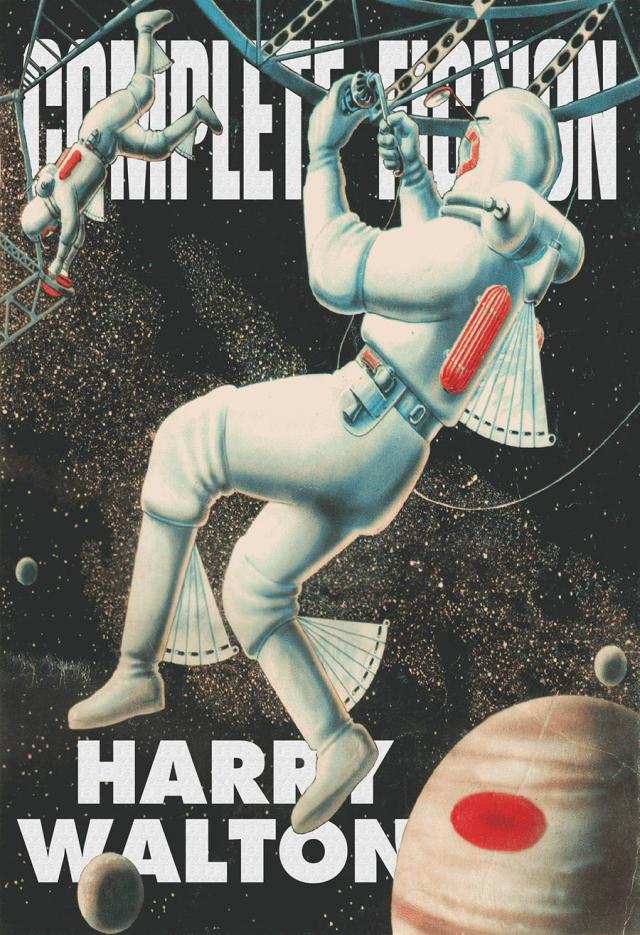
The Complete Fiction
Harry Walton
Cover
Jerry eBooks
Title Page
About Harry Walton
“PS’s Feature Flash”
Bibliography
A SUITOR BY PROXY
QUICKSILVER, UNLIMITED
BELOW—ABSOLUTE!
THE CACHE
EPISODE ON DHEE MINOR
SWAMP TRAIN
BOMB FROM BERANGA
ASTEROID H277—PLUS
THE CRYSTAL HORDE
THE TIMELESS ONES
MOON OF EXILE
DOOMSHIP
THE SCRAMBLER
SUBCRUISER
SPACE PIRATE
FATAL ASTEROID
IN THE ANCIENT WAY
SPAWN OF THE VENUS SEA
RADIATION TRAP
THE MAN WHO DIDN’T BREATHE
CROSS OF MERCURX
WAR GOD’S GAMBLE
BOOMERANG
SCHEDULE
DEAD MEN DON’T LAUGH
HOUSING SHORTAGE
INSOMNIA, INC.
THE HOLLOW WORLD
A STAR FALLS ON BROADWAY
INTELLIGENCE TEST
THE DIMENSIONAL TERROR
Harry Walton is a science-fiction writer who unostentatiously writes science-fiction for relaxation, yet is important enough in his own right to he included in the 1953 edition of WHO’S WHO. A graduate of San Diego State College, where he majored in journalism, Walton was self-educated in the sciences. Today he is the mechanics and handicraft editor of famous Popular Science Magazine.
Originally appeared in Science Fiction Plus, May 1953
PS’s Feature Flash
FLASHING you the highlights on the men you’ve met in the preceding pages—those cosmic-minded writers and illustrators who help to nourish Planet Stories.
HARRY WALTON, author of “Asteroid H277—Plus,” is the living refutation of the old adage concerning rolling stones. By the time he was five years old, he had, with the help of a nomadic family, beaten a path between the Continent, England and New York. He couldn’t have stayed in the last place long because six years later finds this Rlohe-trotting minor in Berlin, Vienna and Dresden—reading Buffalo Bill and Nick Carter in German. He acquired his education on the run, and it seems to have been a rather hectic acquisition. Concerning the last laps, Mr. Walton says:
“Commuted between so many schools in New York and California that they finally lost my record and graduated me. Educational experiments continued at U.C.L.A. and San Diego State, where I specialized in fencing, journalism and short story writing. Won sixth place in a one-act play contest, hut have always suspected there were just six entries.”
His fiction career was inspired by telling his young brother wild tales about the Katzenjammer Kids, which he considered slightly better than those published. From this fictional cocoon burst a butterfly in the shape of a harrowing story about a transatlantic tunnel. It fluttered pretty feebly for a time, then died unwept and unsung.
But all that was long ago. Now Mr. Walton devotes his full time to story-writing and his artistic wife. When he feels the need of a spiritual pick-me-up, and just to keep his hand in, he drives back and forth to California. We suspect it’s just force of habit; but so long as he can send us stories like “Asteroid H277—Plus,” we don’t care.
Originally appeared in Planet Stories, Summer, May 1940
BIBLIOGRAPHY
A Suitor by Proxy, Wonder Stories, April 1935
Quicksilver, Unlimited, Astounding Stories, July 1937
Below—Absolute!, Astounding Science-Fiction, June 1938
The Cache, Astounding Science-Fiction, April 1939
Episode on Dhee Minor, Astounding Science-Fiction, October 1939
Swamp Train, Unknown, January 1940
Bomb from Beranga, Famous Fantastic Mysteries, March 1940
Asteroid H277—Plus, Planet Stories, Summer, May 1940
The Crystal Horde, Weird Tales, July 1940
The Timeless Ones, Super Science Stories, July 1940
Moon of Exile, Astounding Science-Fiction, August 1940
Doom Ship, Astounding Science-Fiction, January 1941
The Scrambler, Astounding Science-Fiction, April 1941
Subcruiser, Astounding Science-Fiction, May 1941
Space Pirate, Action Stories, June 1941
Fatal Asteroid, Thrilling Wonder Stories, June 1941
In the Ancient Way, Thrilling Wonder Stories, August 1941
Spawn of the Venus Sea, Planet Stories, Fall, August 1941
Radiation Trap, Astonishing Stories, September 1941
The Man Who Didn’t Breathe, Astonishing Stories, November 1941
Kill I Must, Uncanny Tales [Canada], February 1942
Cross of Mercrux, Super Science Stories, February 1942
War God’s Gamble, Super Science Stories, February 1943
Boomerang, Astounding Science Fiction, June 1944
Schedule, Astounding Science Fiction, June 1945
Dead Men Don’t Laugh, Esquire, December 1946
Housing Shortage, Astounding Science Fiction, January 1947
Insomnia, Inc., Astounding Science Fiction, August 1947
The Hollow World, Fantastic Adventures, September 1952
A Star Falls on Broadway, Fantastic, March/April, March 1953
Intelligence Test, Science-Fiction Plus, May 1953
The Dimensional Terror, Science-Fiction Plus, June 1953
A SUITOR BY PROXY
l In 1932 Epaniinondas T. Snooks, D.T.G., wrote for us a yarn entitled “Why the Heavens Fell.” In 1933 we had “The End of Tyme” by Hasse and Fedor, and in 1934 we were honored by Kenneth Sterling’s “The Brain-Eaters of Pluto.” All of the above stories were burlesques, and all were so well received, with anxious clamoring for more of the same nature, that we feel an occasional burlesque puts a little spice into the magazine.
The present story, though not slapstick, contains some wholesome humor and can be favorably compared to the best comic science-fiction tales of the past.
But here is the story for your perusal—read it and smile.
l Of two things, Professor Job Ohmpere, Dean of Physics at Eastmore University, was very proud. The first, properly enough, was his motherless daughter, Madeleine, and the second was his paper in the American Scientist, “The Illusion of the Physical World.” Among male students, at least, Madeleine ranked far above this second pride of the Professor’s life.
The article in the Scientist had aroused a hornets’ nest of controversy, most of it in humorous vein. Needless to say, every student in the Professor’s classes had digested “The Illusion of the Physical World,” upon pain of failing in the forthcoming finals if the elements of this paper were not thoroughly absorbed. Its bold theories were nevertheless held in widespread, if subdued, contempt by the student body, if in this group we except a certain credulous junior.
Benjamin Spindledrift was by no means a typical student. Studious and bookish by nature, he seemed to revolve in a self-contained orbit of his own, with ambitions and desires known only to himself. This apparently content and mild-mannered young man, reading his instructor’s absurd conclusions, clutched wildly at the straw this improbable article held out to him. After classes that very day, he visited Professor Ohmpere in the latter’s private study.
“Professor,” he said without preliminary, “you state here that our sensation of matter through the five senses, and matter’s effects in the physical world, is due entirely to the etheric stresses or vortexes set up by the motion of atomic systems.”
“Would you care to dispute that?” growled Ohmpere, submerged in a mountain of correspondence pertaining to his unfortunate article, “or is it amplification that you want? In short, if I hit your head with a hammer, the resultant blow and pain are not the result of hitting your head with a hammer.”
“No?” inquired Spindledrift mildly.
“The hammer does not exist!” bawled Ohmpere.
“Of course not.”
“It is the close contact of the atoms forming the material of your skull, and of others which constitute the physical property we associate with iron, which causes the sensation of being hit with a hammer.”
“Astounding,” said Spindledrift heartily.
“The atoms themselves do not exist!” howled Ohmpere, warming to his subject. “I declare them to be merely suppositional. In reality, they are mere vortexes in space, etheric vacuums, if you will, where the universal substance has been temporarily wrenched out of place.”
“And which vacuums, on coming together, combine in action to produce a painful sensation on my cranium,” mused Spindledrift, “Is that right?”
“The opposed forces of the atomic systems, upon approaching too closely each other’s magnetic fields, are repulsed with terrific energy, so that we are deceived into thinking we deal with solid matter, much as a spinning flywheel seems solid by virtue of its motion. That much,” finished Ohmpere malevolently, “should be clear even to your absurdly limited comprehension.”
“Perfectly clear, Professor. But that was not what I wanted to see you about.”
A violet blush slowly suffused Ohmpere’s face, even to the pinkish bald spot on his grizzled head.
“I beg your pardon, Professor,” resumed the student with desperate courage, “but what I really want to know is—can it be done?”
“Can what be done?”
Spindledrift took a deep breath.
“Can you do what the article suggests—project a wireless image of a solid body which will to all appearances be that solid body?”
“Matter is an etheric disturbance. Electricity is an etheric disturbance. Essentially they are the same. Electricity can be transmitted without wires, hence matter can also be so projected. To prove this to you or others too dense to accept reasonable conclusions I have neither time nor inclination. If you are finished with your absurd questions you might clear out.”
Spindledrift swallowed hard.
“Professor, you’ve got to help me. I’m going to work on this line, and like it or not, you must help me.”
Ohmpere laid down his papers. Very deliberately he leaned back in his chair, an ominous calm descending upon him like a mantle.
“Must?” he asked.
“Must!” Spindledrift was magnificently firm. “Professor, I’ve been bashful, a recluse all my life. I’d die if a woman spoke to me first. I have never experienced emotion or—or passion. And it is impossible for me lightly to break the habits of a lifetime.”
“Which signifies—?”
“Professor, I am in love.”
“Ah!”
“With a woman who is more than all else of creation to me, etheric or otherwise—a woman whom I must win though I die for it—a woman whom I dare not address in my proper person, far less woo in the manner to which women the world over have become accustomed.”
Ohmpere swung back to his desk.
“I would suggest a psychiatrist. Close the door gently as you leave.”
Spindledrift was on his feet. “Therefore,” ignoring Ohmpere’s remark, “I shall project my image through space to the side of my beloved, to woo by proxy as I dare not in person. It is my only hope in all the world. You must—you shall help me—”
Ohmpere looked long into the desperate intentness of the young man’s eyes, then slowly drew paper and pencil to him. When Spindledrift left, it was far into the night. In his fist he clutched a great sheaf of papers, and his face shone with a great and hopeful light.
l The campus took no notice when Benjamin Spindledrift moved to unknown quarters in the city, nor did it remark the fact that he spent no more time in study halls or library after lectures. Somewhere in the town proper, however, a landlady eyed dubiously the feverish young man who stormed up and down four flights of stairs many times daily, and carried with him to his chambers bulky boxes of great weight.
Very different was the attitude of the student body after the evening of the Junior Prom. Alan A. Dair, popular escort of the charming Madeleine Ohmpere, was dancing with that young lady under a canopy of shaded lights when both were startled by a voice, courteously firm.
“May I cut in?”
Dair later swore that the dancers were so crowded on that part of the floor that he could never understand how the fellow made his way to them, but the fact remained that Benjamin Spindledrift, tuxedoed and suave, stood at his elbow. Dair swore under his breath and surrendered his partner, to watch her gliding away in the arms of a transformed Spindledrift.
There was a superb aplomb in his bearing, a swagger of just the right quality to lend a handsome, insolent confidence to his carriage. Alan Dair gaped at this man whom he had mentally relegated to a group known collegiately as “bookworms.” That this particular bookworm should be at the Prom was in itself miraculous. That he should cut in on the dazzling Madeleine Ohmpere was not merely incredible, but impossible.
Yet, there he was.
It was two dances later, so great was his amazement, that Dair picked his way to the couple.
“May I cut in?” he requested, with a slight stress on the pronoun, crowding Spindledrift from his place.
“Sorry, old chap, we’re not cutting.”
Dair, arrested, turned to Madeleine. She was smiling, one slim hand on Spindledrift’s shoulder, and made no effort to remove it. Whereupon Dair became angry, and edged ever so slightly closer to Spindledrift.
There were interested witnesses now, and all, comparing notes later, agree on one point. Spindledrift did not move, did not strike Dair. Some claim that he faded from sight for an instant, that the trim tuxedoed figure became momentarily blurred, but if so it was for an imperceptible instant. Certain it is that there was a thud as of colliding bodies, and that Dair was suddenly hurled to the floor in a tumbled heap, as if he had been struck, not by a fist, but by a flying tackle as on the football field.
Dair rose. But for the intervention of others, there might have been fisticuffs. Friends pointed out to Dair that only a fool would strike a man. who had not struck him. Spindledrift made no move to escape trouble, but stood his ground, vaguely smiling. And much later that evening it was he who saw Madeleine Ohmpere to her home.
l On leaving the Ohmpere residence, Spindledrift was followed at a discreet distance by another, Dair kept to the shadows until both were some distance from the Ohmpere home, confused though he was by the movements of his prey. The figure of Spindledrift was at times vague and blurred. At others it seemed to drift oddly, like a matterless ghost, through the thin wisps of fog which had settled in the streets. Dair cursed the rapid movement of this fugitive will-o’-the-wisp. Exasperated, he sought to close in on the swiftly moving figure.
As though guessing his intentions, Spindledrift paused under the full glare of an arc light. Too angry to be surprised, Dair furiously confronted the transformed Bookworm.
“We have something to settle here and now, Spindledrift!” he exploded. “I’ll pass up your striking me at the Prom. But I want it understood that you are to pay no further attentions to Madeleine—Miss Ohmpere.”
Spindledrift looked at him keenly.
“A bit muddled, aren’t you, Dair? I really don’t recall striking you. You haven’t been drinking?”
Dair sputtered. Only the astonishing change which had come over the Bookworm, the unguessed coolness of the other, held him in check.
“I suppose you didn’t leave Madeleine a moment ago? I suppose you didn’t fetch me one at the Prom this evening. Why—why—
Spindledrift sighed patiently, the gesture of a man who knows himself master of the situation.
“Sorry, Dair, but I really don’t know what you’re talking about. Look here, old man—of course we all get this way at times—but why not go to bed and sleep it off?”
Dair’s patience snapped. With an explosive curse he shot out at the other, a straight, hard driving blow. His knuckles struck Spindledrift full in the face. The sound of the impact was like that of flesh on firm wood. Dair moaned and dropped his mangled hand.
“Better have a doctor attend to that,” urged Spindledrift solicitously. “You can explain that you struck a lamp-post in the dark.”
He made no move of pain or anger.
“A dose of bromide, I’ve heard, should be good for what ails you,” continued the Bookworm. “You’re in no shape tonight to see things clearly. I shouldn’t wonder if you suspect yourself of having nightmares, come morning.”
He looked about coolly.
“It’s a bit late. If you don’t mind, Dair, I’ll leave you to your own thoughts. Try another brand next time. Hallucinations are a bad sign.”
“Hallucinations?” muttered Dair blankly, gaping at his broken hand. He stared suddenly into Spindledrift’s mocking face. The features of the Bookworm blurred oddly. Dair swept his good hand over his eyes. The trim tuxedoed figure was gone. The arc light swept full on bare grey pavement, and from the depths of drifting fog, as from a distance, came the merest ghost of a thin chuckle.
l Followed three days during which Dair kept to his room, and the campus knew him not. When he reappeared, gaunt and thoughtful, with a hand lumped in bandages, it was to make his way directly to the office of the Dean of Physics. The author of “The Illusion of the Physical World” eyed him suspiciously.


