

A viscount for the egypt.., p.1
A Viscount for the Egyptian Princess, page 1


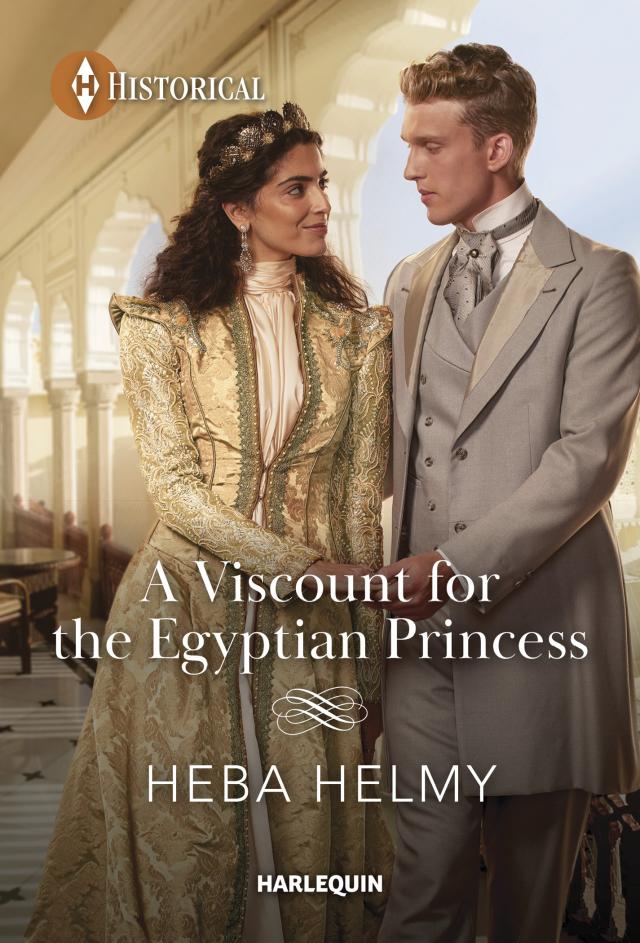
Louis could barely contain his curiosity. “May I see this crown and painting before I retire for the evening? Meet your princess cousin, as it were?”
Hussam nodded and the servant withdrew the sheet on the life-size canvas.
Louis nearly gasped, but not because of the magnificent jewel set upon a crown on top of her head. It was because hers was the same beautiful face he’d been sketching for weeks. The wide-set eyes. The dark auburn curls. The heart-shaped face.
The one Louis hadn’t stopped thinking about.
Princess Mervat was the young lady he’d met at the Louvre!
Author Note
Mervat and Louis’s is a love story, but it is one inspired by the contention around cultural artifacts. Who decides what is or is not worthy of being categorized as one? How has this decision-making process historically marginalized certain populations, rendering them as “uncultured”? This is a novel with a lush palace setting, but Mervat is a conscientious princess who deeply feels the disparity between classes. She wants to open a museum so all will have access to the artifacts only held at court (like the fictional Cleopatra Cerulean!), but she is also a mild-mannered woman, awkward. Until Louis, she is a lonely one, too, friendless in her mission. It seems to me that the stories of such people, those “behind the curtains” of cultural endeavors, are rarely told. In researching the novel, I was surprised to learn that Verdi’s Aida was commissioned by an Egyptian khedive and first performed in Cairo—but Verdi himself didn’t consider that as the opera’s debut, giving that distinction to its European production in Milan months later. Having Mervat be there was exciting because it allowed me to suggest that the genealogical explorations of which she is so passionate are exercises that can, even today, inspire us to reflect on the complexities, appropriations and sometimes downright misinterpretations of artifacts. If we can better understand and are aware of their origins, we can tell stories about them in ways that might, even a little, reclaim them for people who were previously (and unjustly) considered uncultured.
A Viscount for the Egyptian Princess
HEBA HELMY
Egyptian born and Canadian raised, Heba Helmy holds an MA in English literature and a PhD in language and literacies (both from the University of Toronto). She is a former high school teacher and current part-time university professor. Her academic practice focuses on culturally sustaining narratives—and her creative one is all about storytelling that centers love. She lives far too much in her own head, but you might find her online at hebahelmy.com.
Books by Heba Helmy
Harlequin Historical
The Earl’s Egyptian Heiress
Look out for more books from Heba Helmy
coming soon.
Visit the Author Profile page at Harlequin.com.
For M and A,
the finest daughters a mother could have
Contents
Prologue
Chapter One
Chapter Two
Chapter Three
Chapter Four
Chapter Five
Chapter Six
Chapter Seven
Chapter Eight
Chapter Nine
Chapter Ten
Chapter Eleven
Chapter Twelve
Chapter Thirteen
Chapter Fourteen
Chapter Fifteen
Chapter Sixteen
Chapter Seventeen
Chapter Eighteen
Chapter Nineteen
Chapter Twenty
Chapter Twenty-One
Chapter Twenty-Two
Chapter Twenty-Three
Chapter Twenty-Four
Chapter Twenty-Five
Chapter Twenty-Six
Chapter Twenty-Seven
Chapter Twenty-Eight
Chapter Twenty-Nine
Excerpt from How Not to Propose to a Duke by Louise Allen
Prologue
The Louvre,
April 1873
Mervat Abbas told herself that one did not come to the grandest museum in the whole of Europe—after a very covert operation to escape the not very watchful eye of her mother—to listen to a talk about antiquities found in one’s home country. Yet, she found her feet, in the simple slippers she’d brought from Egypt and smartly hidden beneath the ruffles of the only non–haute couture dress acquired for her during this trip, doing just that...following the viscount who’d told her of the event only moments ago.
Mervat had been standing before Psyche Revived by Cupid’s Kiss, notebook in hand, when said viscount had sidled next to her. She’d been solemnly transcribing details of the sculpture in her accumulated pastiche of languages—the Arabic of her father, the Turkish of her mother, the English and French of her tutoring—when the scent of his cologne wafted over her.
Her body stilled like an unsure rabbit realising it was not alone. Then, frustrated with her own timidity, Mervat closed her eyes to draw a steely breath. What if her anne had woken from her nap to notice her daughter missing and sent one of their guards to find her?
She swivelled, slowly opening her eyes.
A foreigner.
The deep-set eyes that met hers were a startling blue. They were richer than Nile waters on the sunniest day, his golden lashes failing to dim them in any absolute way. But his brows—those were a perfect frame, long and just the right thickness. They were a golden brown, a shade darker than his wavy blond hair and his sparse moustache and beard. Tall and thin but with broad shoulders, he was dressed casually in dark chequered trousers and a simple but well-tailored white chemise.
He was, quite possibly, the handsomest man Mervat had ever seen.
‘Mademoiselle is a writer.’ He spoke in French, looking down on her with a smile that was, Mervat decided by the visceral flutter in her chest, a most charming one. He waved the notebook in his hand. ‘Moi aussi.’
A formal note in his tone alerted her to the fact he might not be French, and since it was not the language she was most comfortable in, she chanced to answer him in English. ‘Not a writer, I am afraid. I am more of a stenographer, not in any formal capacity, only in that it satisfies my interests in the genealogy of museum artifacts.’
He nodded knowingly, but then frowned sheepishly. Meeting her English, he said, ‘I haven’t a notion as to what that might entail.’
Mervat explained, ‘I like to discover the layers of an item’s history. Puzzle it out. Hold it up to the light and look at it from all its angles so it tells me its secrets. I trace an artifact’s life backward, how it has been perceived in the past and how it came to be where it is now. Then, I try and consider what knowledge it can gift to people for the future.’
Mervat didn’t need much encouragement when it came to talking about her passion and perceived the interested look on the Englishman’s face as her cue to continue. ‘Take, for instance, this very sculpture. Depending on one’s ideology, Psyche Revived by Cupid’s Kiss is either about the perils of a woman’s curiosity or how a great love can conquer the darkest of times. Yet, there is much more to this piece! It was completed by the Italian Antonio Canova, a man who started working with marble at the age of ten. Though his father had died when his mother remarried, he was raised by his paternal grandfather, a stonemason who taught him the trade. Under the tutelage and mentorship of other greats, Antonio attended the finest art academy in Venice and won accolades that would lead him to Rome. Beyond Florence, those two cities were central to the Renaissance period. This piece was first commissioned by a Welsh baron, one John Campbell, in 1787. But—’ here, Mervat held up a finger ‘—he never received it.’
‘No?’
‘Baron Campbell was a proud collector with fine aristocratic tastes, but he often spent more than his allowance permitted. Perhaps because he could not pay, the baron gave too much leeway with regard to a deadline for the finishing of the sculpture. There are letters from Antonio to the baron, ones laden with excuses and apologies for the delay despite his gratitude for the patronage. Nevertheless, when it was finally completed, Antonio sold it to Joachim Murat, the brother-in-law of Napoleon himself rather than give it to the baron. Why? If I had to guess, it was the treacherous political games which are wont to happen in royal courts that turned Antonio Canova into a traitor to a man his letters prove that he admired.
‘Then, of course, if we consider that the sculpture emerges from the mythology around Cupid, the Roman god of love and desire...’
Mervat bit her lip. She could talk incessantly of her interests with anybody willing to listen—and any who would listen were rare—but Cupid was naked before them, his hand cupped to Psyche’s breast. To prattle on about an emotional moment between lovers to a complete stranger of the opposite sex would be in poor taste.
Yet, for his part, the stranger didn’t seem to notice.
‘Brilliant! Where does it say all this?’ He circled the sculpture, but she knew he would only find a small plaque with the sculptor’s name and the date on which Psyche Revived by Cupid’s Kiss had come into the Louvre’s possession.
‘It is from my research. Hence, the genealogy of artifacts.’ Mervat spread her hands wide as if she could gather it all in her arms: the history of the Louvre palace as a whole and this room in which they stood. This was t he Salle des Cariatides, with four sombre statues of the caryatids holding up the musician’s gallery like women forced into hard labour then turned to stone only to be gazed upon or ignored by gawkers. ‘I came here to observe a few pieces in the flesh which I had already studied in the pages of books. This is one of those pieces.’
He tossed her a quizzical look and lightly teased, ‘No Mona Lisa for you?’
Mervat smiled through the thumping in her belly, as if the startled rabbit she’d felt like before now happily hopped there, unencumbered. She managed to toss back, ‘There is a bit too much mystery around her for my tastes. Is that unreadable gaze of hers a smile or a frown?’
The man chuckled in an easy manner, making it seem like they were more friends than strangers who had met only moments ago.
‘Would it be terrible for me to admit,’ he questioned with a slight grimace, ‘that I only happened here on chance? Lost on my way to the Egyptian Pavilion, I saw a lone lady so clearly in awe I had to see for myself what captured her ardent attention. My grandfather taught me never to let an opportunity pass one by.’
‘Lucky you then. I would have been in the library, but it has not reopened since the fire of 1871.’
‘Are you at the Louvre alone then, Miss...?’
Mervat stepped back, her senses finally registering what a ‘stranger’ could entail in a shadowy, lone corner. Without the guards assigned them from the embassy.
But he, immediately sensing his faux pas, held up a hand. ‘Please do not feel obliged to share your name. It is only that I have been in Paris for weeks and have yet to cross an English lady. If your chaperone is near or an...um, husband, then I should very much be inclined to introduce myself.’
He bowed graciously, a gesture overflowing with charm. ‘Louis Wesley, Viscount of Allenborough, at your service.’
A gentleman, then.
Mervat’s cousin had spent his school days at Eton, said the friends he made there were good fun, a mostly honourable sort. Still, she could not disclose to the viscount her name or title for it might get back to her mother and those tasked with protecting the Egyptian royal family outside of the country. Besides, if her brown eyes and olive skin were not indicative of the fact that she was not an English lady, then she saw no reason to correct him.
‘It is a pleasure to meet you, Lord Wesley,’ she said, surprised at how much she meant it. Mervat didn’t have many friends and she couldn’t think of any who would genuinely listen to her as he had just done. ‘I am in France on a shopping trip with my mother who, alas, would rather attend to fashion houses than entertain my...interests.’
That, at least, was the truth. She wouldn’t tell him her anne had spent most of Mervat’s twenty years ignoring her daughter for court intrigues or that while she had hoped this excursion to Paris would be a way to make up for lost time, she now believed her mother had an ulterior motive for suggesting it in the first place. A motive which Mervat had yet to deduce.
She pointed to the notebook in his hand. ‘You haven’t told me what you write in yours.’
He folded his arm behind his back, almost shyly. ‘Nothing as detailed or smart as yours. Scribblings of what I see, hear, smell. Sketches sometimes. A collection of my memories, as they happen.’
He stopped abruptly, as if embarrassed to share too much despite it being only a little and especially considering how long Mervat had spoken about the sculpture.
He cleared his throat before speaking again. ‘Which reminds me that I have come to the Louvre to attend a talk by the famed Orientalist Mr Richard Henries. He will speak about his time in the Middle East, and in keeping with the mystery around the Mona Lisa, he will speak of a jewel or crown or some such thing he’s recently come to be aware of. It is called the Cleopatra Cerulean. Have you heard of it?’
Mervat pictured the crown in her mother’s rooms back home. She’d never thought to trace the rare jewel at its centre, the one she herself would inherit on her own wedding day.
Rather than lie, she lowered her gaze demurely. ‘I should like to learn more about it.’
‘I am certain even a famed Orientalist cannot provide genealogies to meet your standards, but you are most welcome to join me.’
Lord Wesley spoke unironically, as if he were truly impressed by her and she felt a surge of warmth, a confidence she’d rarely had occasion to feel.
And that was how Mervat Abbas first found herself following and then sitting next to a handsome viscount she was certain to never see again, listening in on a talk about an antiquity she definitely knew to be located in her home country.
Chapter One
May 1873,
Cairo
Louis
The Nile riverboat quivered beneath Viscount Louis Wesley as he disembarked onto the harbour deck. He relished the scene before him, revelling in the moment, beholding the particulars so he might recall and make note of them later.
Dusk. In the wide burnished apricot sky, the sun bowed low. Pillars from mosques or castles, some stately and latticed, others domed and lustrous, rose high and were blanketed in its glow. Everywhere, palm trees swayed gently, their immense leaves like floating keys of a pianoforte. And there, in the far distance, three otherworldly triangles.
‘The pyramids,’ Louis heaved.
‘Lord Wesley, marhaba! Welcome to Egypt.’ Louis had been addressed by a fellow, one of three who marched towards him. They wore maroon suits, matching fez hats and the brightest of white gloves. They moved as if they’d been plucked from a royal parade but, as the one who had spoken explained, they were servants from the khedive’s palace. ‘Prince Hussam eagerly awaits your arrival.’
Louis hadn’t expected his old friend to show such care, when, as far as he knew, he was the only one of their mates from Eton to accept Hussam’s invitation. Everyone had mostly gone their separate ways after they had left school seven years ago.
The prince’s letter mentioned that his father had built a new royal palace, Sesostris, and was looking to inaugurate it with a marriage ceremony. Hussam’s.
There should be a wedding before summer’s end.
Although his friend hadn’t sounded absolutely sure in his letter, Louis had done his own research and knew that Hussam’s father, the khedive of Egypt, hoped to bring his country into the modern era and what better way than with an occasion witnessed by other royal dignitaries from across Europe? The khedive was eager Egypt should separate itself from the Ottoman Empire which had long regulated political powers here. With the Turks gone, the chasm of influence left in their wake would be fought over by the French and English.
Louis could potentially secure a diplomatic position with the latter. Why shouldn’t he be an ideal candidate for the British Embassy in Cairo? He was, after all, a nobleman and friends with the prince.
What most people wouldn’t know was that he was also a twenty-seven-year-old man with few career prospects and only a meagre allowance from the Allenborough estate. And although his father was also doing his best to modernise, looking into purchasing new farming equipment and attracting tenants with more forward-thinking ideas, one seemed to need money to make money.
Plus, his younger half siblings had needs. Futures they had to be set up for. Louis could not afford to spend the summer visiting Egypt and waiting for a wedding to happen, but he had determined to turn this visit into a permanent, well-paying post, and he was hoping Hussam would help him in this endeavour.
‘I am most eager to see him, as well.’
Louis watched the khedive’s servants transport his luggage from the riverboat and hoist it onto a hidden compartment atop the handsomest of carriages, led by two beautiful black stallions.
‘Is that all, sir?’
‘’Tis.’ The chest and two suitcases were in fact all Louis had had with him in Paris when the letter from Hussam had arrived. As he’d read it, he could almost hear the ghost of his grandfather encouraging him to Egypt post-haste.
It may be a chance to make something of yourself, Louis! A boon for our family name beyond the symbolism in the title, a fortune to help your father, and for your brothers a model of enterprise.


