

A question of belonging, p.1
A Question of Belonging, page 1


Copyright © the heirs of Hebe Uhart
Published originally in Argentina by Adriana Hidalgo in 2020
English language translation © Anna Vilner, 2024
First Archipelago Books Edition, 2024
All rights reserved. No part of this book may be reproduced or transmitted in any form without the prior written permission of the publisher.
Library of Congress Cataloging-in-Publication Data available upon request.
“The Preparatory School” appeared in The New Yorker, and “A Memory from My Personal Life,” “Inheritance,” and “Good Manners” appeared in The Paris Review.
Archipelago Books
232 3rd Street #A111
Brooklyn, NY 11215
www.archipelagobooks.org
Distributed by Penguin Random House
www.penguinrandomhouse.com
ISBN 9781953861801
Ebook ISBN 9781953861818
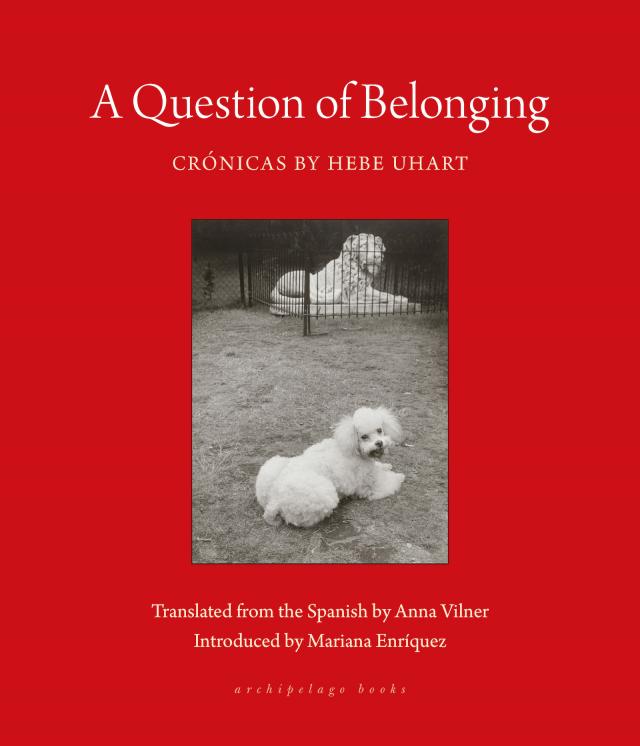
Cover art: Photograph by Hans Hammarskiöld
© Hans Hammarskiöld Heritage
Frontispiece photograph: Nora Lezano
This work was made possible by the New York State Council on the Arts with the support of the Office of the Governor and the New York State Legislature.
This publication was made possible with support from the National Endowment for the Arts, the Nimick Forbesway Foundation, the Hawthornden Foundation, the Carl Lesnor Family Foundation, the Jan Michalski Foundation and the New York City Department of Cultural Affairs.
This work has been published within the framework of the Sur Translation Support Programme of the Ministry of Foreign Affairs, International Trade and Worship of the Argentine Republic.
Obra editada en el marco del Programa Sur de Apoyo a las Traducciones del Ministerio de Relaciones Exteriores, Comercio Internacional y Culto de la República Argentina.
a_prh_6.3_147032500_c0_r0
CONTENTS
Introduction by Mariana Enríquez
A Memory from My Personal Life
A Trip to La Paz
The Preparatory School
Good Manners
Animals
Inheritance
Two Ladies in Their Place
My Time on the Divan
Irazusta
Kilometer Eighty-Nine
I Didn’t Know
Fabricio
This is a Humane Country
Around the Corner
The Land of Formosa
Río is a State of Mind
The Jungles of Lima
Not Meant to Be
Off to Mexico
A Question of Belonging
Corrientes Casts a Spell
New Year’s in Almagro
The North American Professor
Inside the Circus
A Suit with an Extra Pair of Pants
My Bed Away from Home
INTRODUCTION
HEBE UH ART LOVED to travel. Born in the town of Moreno, in the Buenos Aires province, she considered herself a writer of the outskirts. Her childhood home had been a sad one. An aunt who had severe psychiatric problems. A brother who died young. A little cousin, who she lost to a heart condition; another cousin, to a plane accident. Her mother suffered from depression. The hecatomb of grief. At a very young age, she became a rural school teacher. She’d bring the kids reading material; she would also bring them clothes. The school only offered primary education, and it was out in the country. One-story houses, this was back in the 70s. It was there, she told me in an interview, where she learned about the “things of life.” “I was quite fickle and restless, I believed I could do things I couldn’t. I had fits of wanting to do extraordinary things. Going to the country school helped me mature. I realized that I’d had my head in the clouds, dreaming of scholarships, of travels to Paris.
And I realized there were others who made sacrifices, who supported their homes. Who hitchhiked because they couldn’t afford to take the bus. I was ashamed of my own thinking, of being so self-centered. It was then when I started to ripen. Some people never ripen, not even at 40. They go on demanding things and blaming their parents.”
This was also when the urge to travel came over her, and she began doing so with her students. When she could, she traveled alone: to Bolivia by train, as a teenager, a journey not many girls would have taken at the time, but Hebe was so unlike most people I have met in my life: she was brave, curious, carefree, sure of herself. Yet, as a traveler, she didn’t like going to big cities – they unsettled her (despite having visited many, of course). She preferred small towns. Places that were easy to get to know. Because what she loved was talking to people. These trips, day trips, in general (she referred to herself as a “domestic” chronicler) were a search for different ways of expression, a search that would take on the contours of the place itself.
Hebe Uhart’s work as a collector of expressions and turns of phrase is a fortunate one for us, and important, because she is not merely a collector of the curiosities she observes, but a writer. Sometimes she learns things. In “Off to Mexico” she goes around Guadalajara, trying to understand the “thousands of things I’d read about and didn’t understand, for example ‘ni madres,’ which is another way of saying, ‘no way.’ ‘Ese viejo se las truena’ (he’s high) or ‘vete a la chingada,’ (you’ll be sent off to some distant, indeterminate place).” In the crónica “Río is a State of Mind,” she notes: “Cariocas do not seem to care for categorical definitions, and they are not eager to point out the difference between how things are and how they should be. My conversations went more or less like this: ‘There should be a crosswalk on this street, it’s a dangerous intersection.’ Someone in Portuguese: ‘There should be one, yes, but there isn’t.’ ”
Her fascination with language is not limited to the spoken: she roams around cities and towns taking note of shop names, ads, and graffiti, a routine that is repeated in almost every crónica. In “The Land of Formosa,” a newspaper helps her understand the place’s humor: “I only manage to read the literary supplement written by readers of the paper. One person has written an ode to his eyeglasses, praising their usefulness. The final line: ‘Little lens, I love you so!’ A celebratory and grateful spirit abounds.”
She is also concerned with the types of orality closest to literature and another vital source is television. If Hebe Uhart had to be characterized in one way, it would be by her complete lack of pretension and artificiality, by her extreme discomfort when asked to carry out the rituals of the consecrated writer. It would have never occurred to her to discount television: such attitudes astonished her. One rainy day in the capital city of Paraguay, Asunción, a city she adored, she writes from inside her hotel: “The reporter on the bilingual channel appears, speaking Guarani again. He blends it with Spanish and says ‘satélite intersat.’ He’s clever like you wouldn’t believe and moves around like an eel, or as if he had ants in his ass.”
As traveler and chronicler, Hebe Uhart has her routines. She considers the hotel a refuge. If she goes to a neighboring city, for example, going back to the hotel is, for her, like going home. Another indispensable place is the café; if she doesn’t spot one right away, she sets out on a desperate search. The café acts as a road stop: a place to light up a cigarette, flip through a newspaper, observe the regulars and those who pass by her window or table, if she happens to be sitting outside. She’s stealthy, as well, and stays only for a short while: there is so much to absorb, no time to lose. Nevertheless, there is no sense of urgency in her crónicas. Her relationship to the places she visits and their people is easygoing: she knows that her presence is a curiosity, but she takes care not to intrude.
Whenever possible, she visits a residence, a school, a library; she talks to artists and local historians and looks for books that help her understand the place. A list of her cited authors and references would be endless; it would also be extremely eclectic: Charles Darwin and Domingo Faustino Sarmiento are usual referents; Alejandra Costamagna, Diego Zúñiga, and Alejandro Zambra, young Chilean writers, and friends of hers, show up in Santiago; she gives cameos to Peruvians Alfredo Bryce Echenique and Julio Ramón Ribeyro for being her favorites. In Asunción, she relies on Rafael Barrett and the great poet Elvio Romero; in Bariloche, local writers Luisa Peluffo and Graciela Cros; in Minas, Uruguay, her beloved Juan José Morosoli; in Guadalajara, the Popol Vuh. She barely mentions, however, her greatest influence: Fray Mocho, writer and journalist of the second half of the 19th century and the beginning of the 20th, who recorded popular porteño speech and the changing customs brought on by the population boom, and observed – with a sharp eye, playfully and without pretension – the society that fascinated him.
In interviews and library visits, Hebe Uhart consults local historians, those great forgotten or undervalued ones with whom she identifies. She buys their books and familiarizes herself with pioneer chroniclers and specialists, from Clifton Kroeber, author of River Trade and Navigation in the Plata Region to Miguel Donoso Pareja, who wrote Ecuador: Identity and Schizophrenia. She consults hundreds of books like these, both contemporary and academic, written by chroniclers from the 18th and 19th centuries. Uhart is voracious but offers all of this information considerately; she does not wish to overwhelm her readers, but to draw their attention to that which – due to its closeness – may have gone unnot
I remember an anecdote, its setting a small town in the Buenos Aires province. This was where we became friends. I was, of course, a lot younger than she was. I don’t feel as though I was the “chosen one.” A lot of her friends were younger. She liked spending time with writers outside her generation. And it was easy to get to know Hebe because she enjoyed talking about flowers or politics more than literary prizes. Back to the anecdote: A tour guide from a town in the Buenos Aires province, one of those enthusiastic types she was drawn to, was leading her through the rooms of a country house. The guide was describing the climate and fauna of the region, showing her a pamphlet on local history. Hebe, her notebook near her face, was taking down notes with a pencil; her attention was fixed although her gaze seemed scattered, she was so curious and wanted to see everything. Once the tour was over, she thanked the guide warmly. When she left the house, her only comment was: “Did you hear how she referred to the indigenous people? She said they were completely tame Indians.”
She found the guide’s statement wrong, racist, of course. But she also found it interesting. And she didn’t judge. She knew that the most important thing, always, was to try to understand.
In the final years of her life, the oeuvre of Hebe Uhart received a very particular kind of recognition. Her story collections and novellas moved from independent presses to corporate publishing houses such as Alfaguara. When it came to her nonfiction, she chose to stay loyal to smaller publishers and, if she had an unedited piece, she preferred to send it to a press run by young people. There was a waiting list to get into her writing workshop and her stories were adapted into theater performances. She seemed to be unfazed by it all and went on having barbecues on her terrace. Ricardo Enrique Fogwill, one of the finest and most renowned (and unruly) Argentine writers, once said: “Hebe is the best writer in Argentina,” and everyone agreed wholeheartedly (and whoever didn’t yielded to the charismatic Fogwill). I told her this in her apartment in Almagro, while she served us limoncello, a gift from a student in her narrative workshop. She opened the window to her balcony, which was filled with gorgeous plants, azaleas, bougainvilleas, and said:
“Bah.”
Followed by:
“If you write, and your writing’s good, soon enough you’ll be recognized. Look, how could I be the best writer in Argentina – what does that mean? Nothing.”
Writer and teacher Pía Bouzas, a former student of Hebe’s and one of her closest friends, has a theory about the renaissance of her work, which came after years of being overlooked:
“Beyond her effort and perseverance, I believe that readers came to her. Younger writers began to observe the world as she did, to consider the details, the off-kilter, to go off the beaten track of the born-and-bred writer. She found a path outside this masculine Argentine tradition, which isn’t only referring to male writers, but also to a way of using language. This is aligned with her search for younger writers. She deals with important themes – immigration, family, the Argentine – but she does so with a lighter touch.”
Hebe Uhart shared her autobiography in small doses. At times it was simply a remark, other times she offered something personal. But she never wrote, for example, about the death of her brother. She was reticent about her financial situation, too. It is necessary to point out that Hebe Uhart was not a writer endowed with resources, she did not plan these trips on a big budget. On certain occasions, she was invited to a book fair or a writers’ conference or some university talk: she left a record of these invitations not only as a thank you to her hosts but also to emphasize that we are dealing with a precarious writer. Some are trips she had been sent on. Others she paid for herself, and she didn’t hesitate to comment on the modesty of the hotels she stayed in. She was also over 70: she wandered, chatted, and saw as much as her body would permit, and she was not one to hide these limitations. We do not encounter an adventurous travel writer taking on the wildness of nature, of institutional violence or crime, but rather a writer and philosophy professor who needed to take inventory of her obsessions.
For the Argentine writer and journalist María Moreno, “the best question is the one that seems to appear from nowhere; it provokes something in us, and it is only through the provocation that we discovered that it was the right question asked at the right time.” Hebe Uhart discovered that this sudden question, in her case, was almost always tied to animals. Partly because it helped break the ice, but also because the writer found what she was looking for in the answer: ways of expression she’s never heard before. And the language of those surrounded by animals is utterly delightful. Don Roque from “Irazusta” in the Entre Ríos province, says: “Our animals are very clever. The cows moo like crazy when something serious happens; they moo if they lose a calf or miscarry, and the others surround the mother gently…Baby goats cry like children.” And often her follow-up question would be about politics or some local attribute that seeks confirmation or denial.
I remember a strange encounter between Hebe and an animal. It was at the Frankfurt Book Fair, in 2015, I believe. Hebe had prepared and neatly printed out all of her lectures. But she didn’t stay at the fair the entire day; a wanderer, curious as she was, she wanted to see the city. The Argentine delegation was staying at a hotel across from the train station, and we ended up spending a lot of time there: she liked the market inside, with its Turkish stalls, the very friendly man selling beer and trying to make himself understood, the Chinese food counter. A station is a contained world and Hebe Uhart liked contained worlds, with their own rituals and languages, although everyone spoke German and not being able to understand them exasperated her a little. One evening before returning to the hotel, after a very abundant dinner, we paused in front of a boy of around twenty who appeared to be living in the street and sleeping at the station with his pet ferret, that animal with a pointed snout and affectionate eyes, domesticated but slightly wild. Hebe stopped in front of the animal, and pointed:
“Cuis!” she said, loudly.
The boy stared at her, bewildered.
The cuis is an animal from the Argentine pampas, similar to a ferret, maybe more like a mouse.
“Cuis!” she repeated, clearly this time, as if this would facilitate their communication. “Is it a cuis, yes or no?” She was let down when she found out that no, it wasn’t. She stayed for a while, playing with the little animal and attempting to chat to its owner. Hours later, very early in the morning, she found a taxi to take her to the zoo. She couldn’t convince any of the other writers to go with her, not even me, who, victim of my own obsessions, went to see the cemetery. But Hebe Uhart wasn’t offended by things like that. Her visit to the monkey house, she told us when she returned to the hotel at noon, had been fabulous.
In the last years of her life, Hebe Uhart read as much fiction as nonfiction, but she preferred writing crónicas, she used to say, because she felt that what the world had to offer was more interesting than her own experience or imagination. This gesture is a political one: to go outside oneself, to encounter others. The gesture was accompanied by a subtle frustration when she felt that others, in some way, were being robbed of their dignity. The political stance of these crónicas is apparent: their Latin American anchor, the recovery of ignored or undervalued stories – local histories, everyday wisdom, ways of expression – and at the center, often, is one of her favorite subjects: the indigenous peoples of the continent.
In “The Land of Formosa,” for example, she visits a school in the Toba community, and later a university. She wants to see how bilingual and bicultural education is carried out, but more than that, Hebe Uhart believes in institutions. She was a teacher all of her life and this progressive imprint is evident. “I spoke with two literature students; one of them, Victor, was ethnically Toba. Victor wrote poetry in both Spanish and Toba, with epigraphs by Aristotle and Sartre. He hesitated for a while before sharing his writing with me, observing me with his large dark eyes while he rustled around in his backpack, as if he were buying himself more time.”


