Dont stop the carnival, p.1
Don't Stop the Carnival, page 1
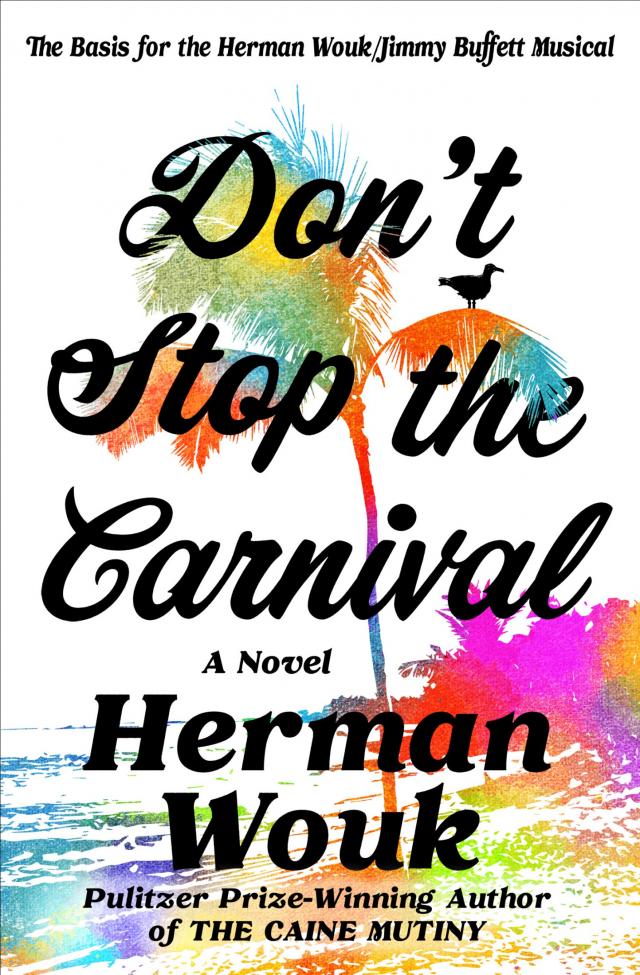


Don’t Stop the Carnival
A Novel
Herman Wouk
Author’s Note
There is no island of Amerigo, or “Kinja,” in the Caribbean Sea. In this tale of imaginary people on an imaginary island, fictional freedoms are taken with calendar dates, political and theatrical events, astronomic occurrences, and the like. The book contains no intended portraits of, or references to, actual individuals living or dead; any such resemblance that may be discerned is a coincidence, and without intent on the author’s part. Where celebrated public personages are mentioned or seen, no historical accuracy concerning them is intended. Finally, regarding the native dialects in this story: Calypso accents vary from island to island, and even from one part of an island to another. The intent here is only a general indication of the West Indian patois.
Introduction
Jimmy Buffett Meets
Norman Paperman
Jimmy Buffett landed in my Palm Springs retreat like a long-haired Peter Pan in denim. “Jimmy,” he said with a beguiling smile, sticking out a hand. I have never met anybody more likable at first glance. He had come to obtain the rights for a musical based on Don’t Stop the Carnival, and we sat out under a tree in my garden to discuss his idea. Soon we were deep into the creative problems, and by the time my wife called us in for a brunch of bagels and lox, a musical show by a very odd couple, Herman Wouk and Jimmy Buffett, had been conceived. Its gestation would take an elephantine time, but eventually it would be born in a rousing tryout which broke the house records at the Coconut Grove theater of South Miami.
A word about the origin of Don’t Stop the Carnival. Uniquely in my fiction, this novel is based on a true story. “Norman Paperman” is a made-up name for a Broadway press agent I knew who tried to run a hotel in the Caribbean and encountered ludicrous disaster. I first met him at a party on Fire Island, where he was convulsing some showbiz friends with an account of his fiasco. He was a superb raconteur, especially good at laughing at himself. Afterward I took him aside and advised him to write a book, but he demurred, saying he had no literary talent. So together we visited the Virgin Islands, the scene of his experience, on the notion that I might one day write the story.
Now comes the cream of the jest: I myself caught island fever. I sold a New York apartment (which today would be worth millions), and moved lock, stock, and barrel with my young family to St. Thomas, where we lived for six sunlit zany years fraught with the sorts of misadventures that lace this tale. It was a fine place for writing, to be sure, and I worked on several books in that semi-isolation. Don’t Stop the Carnival was a sort of jeu d’esprit about my bizarre surroundings, jotted down at odd times during three years of research for The Winds of War and War and Remembrance, which I wrote after I left the island.
And here is the cream of the jest on Jimmy Buffett’s side. When he read Don’t Stop the Carnival, Norman Paperman’s adventures so fascinated him that he actually bought a Caribbean hotel, and helped run it for some ten years until it burned down. Our collaboration was sparked no doubt by this shared susceptibility to the lure of the tropics, plus a flare of unlikely personal chemistry between two men thirty years apart in age, and worlds apart in background. Jimmy’s raffish existence as choir boy, rock star, author, aviator, fisherman, and sailor is pictured with amusing candor in his autobiographical bestseller, A Pirate Looks at Fifty. It took this pleasure-loving freebooter a while to get used to my reclusive Jewish ways. In time he learned, for instance, that a telephone talk on Friday had to end well before the sun set in Palm Springs.
Jimmy is a man of wealth and assured talents. My métier is social portraiture in large-scale fiction works. Neither of us needed a musical success for reputation or royalties, and neither of us had ever written a musical. We just plunged in for the fun of it. My draft of the libretto went to him scene by scene, and in short order back came tapes of original songs, written and performed by Jimmy Buffett, decidedly Caribbean in flavor, and wholly faithful to my book. An exciting business!
But also rather daunting, it turned out. I had had one great advantage in writing my play, The Caine Mutiny Court-Martial; the entire story of the novel was retold in the court-martial scenes. There was no such shortcut in Don’t Stop the Carnival. Still, I figured that if Victor Hugo’s colossal Les Misérables could be fined down to a musical, this thing had to be manageable. I found that much as I hated to do it, I had to discard the young lovers—Paperman’s sexy daughter, her pompous English professor and seducer, and the Israeli frogman who rescues her from his clutches—and even so, my first draft ran a frightening four hours. Writing a libretto is a specialist’s task, and I had my nerve taking it on. For that matter, Jimmy Buffett had his nerve taking on the score of the musical. Our target was Broadway, and we knew the odds, but as I say, at bottom we were both in it for the fun.
The Encyclopaedia Britannica, current edition, says my fictions deal with “moral dilemmas.” To borrow from Mark Twain, anybody who finds a moral dilemma in Don’t Stop the Carnival will be shot. It is a farce comedy of pain, the pain of oncoming middle age, and of the desperate doomed attempt of one man to arrest the sands of time. Its purpose is to give pleasure by showing a funny side of that sad truth. Maybe as my pirate friend approached fifty, he responded to that element of Don’t Stop the Carnival. Who can say?
At any rate, humor was my original bent, and I return to it with zest when I come on merry themes. I earned my first dollars writing radio comedy, and before the Second World War, I worked on scripts of the great comedian Fred Allen for five years. In a less grisly time, I might well have passed my days happily in what Molière called “the strange occupation of making honest folks laugh,” instead of writing my grim war epics. And there you have the secret, I think, of this scherzo interlude in my sober existence. It was not only a refreshing change, it was a return to the vein of my youth, before my years as a naval officer in wartime turned me into a novelist, a career I never dreamed of in my joke-writing days. In those days, truth to tell, I dreamed of writing musical comedies. Jimmy Buffett offered me a drink from Ponce de Léon’s fabled fountain of youth. I downed it and loved it.
They say in showbiz, “If Hitler is alive, I hope he is producing a musical out of town,” so horrid is the experience supposed to be. Friends like Harry Belafonte would visit us in rehearsal and ask, “How come you two are still talking?” We had our differences, to be sure, some of them sharp. Successful though the show was—sell-out audiences and a regional award as best new musical—the reviewers agreed that it needed work before venturing to Broadway. So it did, but Jimmy went out on his road tours, performing to crowds of twenty thousand and more, and I returned to a difficult new book I am just now completing. To use navy parlance, Don’t Stop the Carnival, the odd couple’s musical, is currently in mothballs.
Meantime, honest folks, here is the tale of Norman Paperman, compounded of his misadventures and mine in the illusory paradise of a tropical island. When I was writing it, I had in mind the feel of a Chaplin movie: one funny incident piled on another, in the framework of a sad and gallant clown’s fight against his fate. When I glance again at these pages, I hear the seductive thumping of steel bands, I taste the dirt-cheap white rum, and I see the blue Atlantic and Caribbean glittering on either side of our mountaintop house, which we built with even crazier experiences than are recounted here. Though my wife and I at moments almost went out of our minds, we think back now on those island years with wry fondness. Much of the time we laughed like hell, and so survived. I trust that what is mainly preserved here is the laughter.
As for the mothballed musical—well, World War II battleships came out of mothballs for later conflicts, and their firepower proved handy. I think our show has firepower. The audiences were generous, and at the final curtain, night after night for six weeks, they stood up to applaudand cheer. They were out-of-town audiences, of course. If our show comes out of mothballs it will certainly need work. But Jimmy Buffett and I not only had fun, we created something lovely and alive. My sail with the pirate was a tonic. I wouldn’t have missed it for anything. He is a Cheshire cat sort of collaborator, with a vexing way of appearing and disappearing unpredictably at long intervals; but when melting away, he always leaves behind a beguiling smile.
HERMAN WOUK
Palm Springs
October 1998
PART ONE
The Smartest Man in New York
Chapter One
Lester Atlas
1
Kinja was the name of the island when it was British. Now the name on the maps and in the Caribbean guidebooks is Amerigo, but everybody who lives there still calls it Kinja.
The Union Jack flew over this enchanting green hump in the blue ocean for almost two hundred years. Before that the island was Danish; before that, French; before that, cannibal. Smoky gun battles between sailing ships and the old stone fort went with these flag changes; whizzing cannon balls, raiding parties, skirmishes, and an occasional death. But the fort guns have been silent for more than a century. The United States acquired the island peaceably in 1940, as part of the shuffling of old destroyers and Caribbean real estate that went on between Mr. Roosevelt and Mr. Churchill. The Americans ended up in this instance not only with the submarine base in Shark Bay—now gone back to tall guinea grass and catch-and-keep, the piers sagging and rotting, the rusty Quonset huts all askew—but with the whole island. The details of the transaction were and are vague to the inhabitants. They were not much interest ed.
Keen-ja was the short, musical native version of the actual British name, King George the Third Island. Obviously this was a bit awkward for an American possession, so somebody in the Department of the Interior thought of Amerigo. The new name is used mainly on official stationery and in the school classrooms. There the pupils docilely scrawl themes and recite facts about Amerigo, but in the streets and playgrounds they call the place Kinja, and themselves Kinjans. All through the Caribbean they still say of a native of this island, “He fum Kinja.”
The West Indian is not exactly hostile to change, but he is not much inclined to believe in it. This comes from a piece of wisdom that his climate of eternal summer teaches him. It is that, under all the parade of human effort and noise, today is like yesterday, and tomorrow will be like today; that existence is a wheel of recurring patterns from which no one escapes; that all anybody does in this life is live for a while and then die for good, without finding out much; and that therefore the idea is to take things easy and enjoy the passing time under the sun. The white people charging hopefully around the islands these days in the noon glare, making deals, bulldozing airstrips, hammering up hotels, laying out marinas, opening new banks, night clubs, and gift shops, are to him merely a passing plague. They have come before and gone before.
Long ago they came in their white-winged ships, swarmed over the islands, slaughtered the innocent cannibals, chopped down magnificent groves of mahogany that had stood since the Flood, and planted sugar cane. Sugar was money then, and it grew only in warm places. They used the felled mahogany to boil molasses. Those were the days of the great stone plantation houses and sugar mills; of seasick slaves hauled in from Africa, the ancestors of the Kinjans; of wealthy landowners with pink cool wives back in England, and warm black concubines on the premises. Then the sugar beet, which can grow in the north, came in, and black slavery went out. Bankruptcy and insurrection exploded along the island chain. The boom collapsed. The planters left. The plantation houses fell in. Today the natives put tin roofs over one nook or another in the massive broken walls and live there.
The West Indians do not know what will cause the frantic whites to leave next time. Perhaps a bad earthquake: the entire chain of drowned mountains rests on a shaky spot in the earth’s crust. Or a tidal wave; or a very bad hurricane; or an outbreak of some dormant tropical disease; or the final accidental blow-up of the white man’s grumbling cauldron in the north, which will send the Caribbean white remnant scurrying to—where next? Tasmania? Tierra del Fuego? Unlike the natives they cannot subsist, if the ships and planes stop coming, on crayfish, mangoes, coconuts, and iguanas.
Meantime, in a fashion, Amerigo is getting Americanized. The natives like the new holidays—Thanksgiving, Fourth of July, Presidents’ birthdays, and the rest—added to the old British holidays and the numerous religious days, none of which they have abandoned. The work calendar has become a very light and unburdensome thing. The inflow of cash is making everyone more prosperous. Most Kinjans go along cheerily with this explosion of American energy in the Caribbean. To them it seems a new, harmless, and apparently endless carnival.
2
Two men came out of Prince of Wales Street into the white sunshine of the waterfront, on a November morning in 1959. One was a big oysterpale fellow in a rumpled black silk suit, with a thick bald head like half a bread loaf rising out of fat shoulders. He was bawling, “Trade winds, hey? All right, here’s the waterfront and where’s your goddamn trade winds? That’s what I want to know, Norman. This whole island is one god damned furnace. This island is hell with palm trees. How the Christ can a white man breathe in this hole?” He was holding a can of beer in one hand and a cigar in the other, and he gestured with both, scattering ashes and splashing beer.
The other man, who kept making pleading, soothing noises, was smaller, slighter, and tanned. He had a well-brushed head of silvering hair, and a lean face of young middle age; he looked perhaps forty-five. He wore a navy linen blazer, gray slacks, an open turquoise shirt, and a gray-and-yellow silk scarf tied inside the shirt. The costume was faultless for a color advertisement in Holiday. After a while one learns that in the Caribbean only tourists or homosexuals wear such clothes. The little man was a fastidious dresser, but new to the West Indies.
The big man yelled, “Okay, okay, I know I’m in a strange place. Strangest goddamn place I’ve ever been in. Now where the hell is this Gull Reef Club?”
“They said we could see it from the waterfront—ah, Lester, just look at all this, why don’t you? Just look at where you are! It’s like landing in another century. Look at that church! It must be two hundred years old. I bet those walls are seven feet thick. That must be for hurricanes.”
“I wish one would start blowing,” bellowed Lester. “Cool the place off. This beer! It’s piss!” He hurled the can spraying and clattering across the cobbled plaza. “Don’t they even have refrigerators here? I bet they don’t, you know something? I bet they cool the beer with the goddamn trade winds.”
The smaller man was looking around, with the air of a child just come to a birthday party—at the clumsy old island schooners tied up at the water’s edge, with red sails furled; at the native women in bright dresses and the black ragged crewmen, bargaining loudly over bananas, coconuts, strange huge brown roots, bags of charcoal, and strings of rainbow-colored fish; at the great square red fort, and at the antique cannons atop its slanted seaward wall, pointing impotently to sea; at the fenced statue of Amerigo Vespucci, almost hidden in purple, orange, and pink bougainvillea; at the houses of Queen’s Row, their ancient arching plaster façades painted in vivid colors sun-bleached to pastels; at the old gray stone church, and the white-washed Georgian brick pile of the Sir Francis Drake Inn.
“It’s beautiful,” he said with sudden loud firmness. “It’s the most beautiful place I’ve ever seen in my life. If you don’t think so, you ought to get your head examined.”
The patio of the Sir Francis Drake Inn, an old brick yard shaded by two gigantic mahogany trees, stretched to the edge of the water along one side of the square. The only people in the patio at the moment were the Tilsons. They had the neat, flushed, freckled, corded, dried-out look of long-time white dwellers in the tropics. The Tilsons usually sat immobile and silent as lizards over their first three white rum-and-tonics, scarcely blinking. But when Tom heard the little man talk, he turned his white-and-pink head heavily toward his wife. “New York,” he said. “Both of them.”
She nodded. “And in November. This island has had it.”
The Tilsons did not speak another word, but they watched the two invaders with vague hostile interest. A tall colored boy in old slacks and a ragged shirt approached the men, taking off a flat broad straw hat with dangling red and yellow ribbons.
“Mistuh Papuh?”
The little man smiled in relief. “Paperman. I’m Norman Paperman.”
“I de Gull Reef boatman.” He led them to an odd little vessel with a curving, comb-like prow, and the long rounded shallow black hull of a gondola, abruptly trailing off into a plain shabby rowboat, with a square stern and uncushioned thwarts.
The big man stared skeptically. “Is this thing safe?”
“It safe.” The boatman took the two suitcases from the boy who sauntered up.
“Where are we going?” said Paperman, stepping into the boat “Where’s the Club?”
The boatman flicked a thumb toward the harbor. “Dah.”
Out in the harbor, beyond the red slanting mass of the fort and separated from it by a couple of hundred yards of green shallows, Paperman saw a small island feathered with palm trees; and through the trees, a rambling white terraced building. The man called Lester stepped into the sawed-off gondola. The boat sank a foot, rocking; Lester cursed and waved his arms, the boatman sprang to him and grabbed his elbow, and down on the seat beside Paperman he dropped with a splintering thud.
“Christ, this thing’s worse than a canoe. Is that it, that white building?” The boatman nodded, and pushed off with an oar. “Well, if this isn’t ridiculous. Why don’t they build a bridge?”