

Tom stoppard, p.1
Tom Stoppard, page 1


Also by Hermione Lee
The Novels of Virginia Woolf
Elizabeth Bowen
Philip Roth
Willa Cather: Double Lives
Virginia Woolf
Virginia Woolf’s Nose: Essays on Biography
Edith Wharton
Biography: A Very Short Introduction
Penelope Fitzgerald: A Life
As Editor
Stevie Smith: A Selection
The Hogarth Letters
The Mulberry Tree: Writings of Elizabeth Bowen
Anthony Trollope: The Duke’s Children
The Secret Self: Short Stories by Women
Rudyard Kipling: Traffics and Discoveries
The Short Stories of Willa Cather
Virginia Woolf: A Room of One’s Own and Three Guineas; To the Lighthouse; The Years; On Being Ill; The London Scene
Lives of Houses (with Kate Kennedy)
this is a borzoi book
published by alfred a. knopf
Copyright © 2020 by Hermione Lee
All rights reserved. Published in the United States by Alfred A. Knopf, a division of Penguin Random House LLC, New York, and distributed in Canada by Penguin Random House Canada Limited, Toronto. Originally published in hardcover in Great Britain by Faber & Faber Limited, London, in 2020.
www.aaknopf.com
Knopf, Borzoi Books, and the colophon are registered trademarks of Penguin Random House LLC.
Permissions credits appear on this page following the acknowledgements.
Library of Congress Cataloging-in-Publication Data
Names: Lee, Hermione, author.
Title: Tom Stoppard: a life / Hermione Lee.
Description: New York: Alfred A. Knopf, 2020. | This is a Borzoi book published by Alfred A. Knopf. | Includes bibliographical references and index. |
Identifiers: LCCN 2020023897 (print) | LCCN 2020023898 (ebook) | ISBN 9780451493224 (hardcover) | ISBN 9780451493231 (ebook)
Subjects: LCSH: Stoppard, Tom. | Authors, English—20th century—Biography.
Classification: LCC PR6069.T6 Z74 2020 (print) | LCC PR6069.T6 (ebook) | DDC 822/.914 [B]—dc23
LC record available at https://lccn.loc.gov/2020023897
LC ebook record available at https://lccn.loc.gov/2020023898
Ebook ISBN 9780451493231
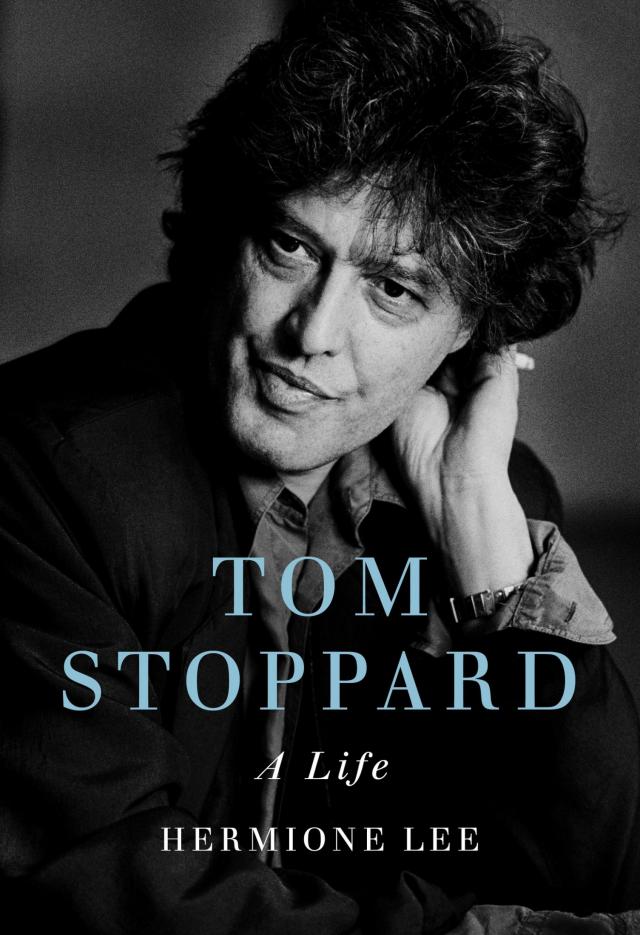
Cover photograph © Mike Abrahams
Cover design by John Gall
ep_prh_5.6.1_c0_r0
For John Barnard
It’s wanting to know that makes us matter. Otherwise we’re going out the way we came in.
Contents
Stoppard Family Tree
PART I
1. First Acts
2. In Transit
3. Englishness
4. The Newcomer
5. Brennus
6. Walking on Water
7. On the Scene
8. Rosencrantz and Guildenstern Are Dead
PART II
9. Success
10. Miriam
11. “Tom Stoppard Doesn’t Know”
12. Acrobatics
13. The Home Team
14. Travesties
PART III
15. Terra Firma
16. Prisoners of Conscience
17. The Fourth Estate
18. Undiscovered Countries
19. The Real Thing
20. Crossing
PART IV
21. Doubles
22. Script Doctor
23. Changing States
24. Arcadia
25. Mother and Son
26. Reinventions
27. The Scar of Time
PART V
28. Sir Tom, OM
29. Utopia
30. Commitments and Engagements
31. Rock ’n’ Roll
32. Parade’s End
33. Circumspice
34. The Eightieth Year
35. A Charmed Life
Illustrations
Acknowledgements
Chronology of Works by Tom Stoppard
Abbreviations and Bibliography
Notes
Illustration Credits
Stoppard Family Tree
PART I
1
First Acts
G: What’s the first thing you remember?
R: Oh, let’s see…The first thing that comes into my head, you mean?
G: No—the first thing you remember.
R: Ah. (Pause.) No, it’s no good, it’s gone. It was a long time ago.
G: (patient but edged): You don’t get my meaning. What is the first thing after all the things you’ve forgotten?
R: Oh I see. (Pause.) I’ve forgotten the question.
The first thing he remembers, he thinks, comes from the winter of 1940 or 1941, when he was three or four. There was a man dressed up as a devil with a forked tail who was making the children frightened. They had to promise to be good, and all the children received a present: a tin boat, was it? This would have been St. Nicholas’s Eve, 5 December, when the Czech Santa Claus, Svatý Mikulāš, appears with two figures, an angel who rewards every good boy with favours and a devil who frightens the bad children to make them be good. He was Tomáš, or Tomik, Sträussler. His baby words would have been in his natal language, which he would soon forget. These children were not in Czechoslovakia. They were a little group of exiles, war refugees and survivors, in transit. They were in Singapore; and this is one of his very few memories of being in Singapore. Another was of being on a beach with his family. His father must have been there. But he couldn’t remember his father. He had disappeared from memory.
Children like these from Czechoslovakia were being scattered all over the world—to India, Kenya, Canada, Argentina, the United States, England. History seized them and chucked them about. Their lives would be shaped out of random acts of fate. Language, family, home, histories would survive, or be lost and erased, and sometimes eventually re-found, on the throw of a coin.
When asked, all his life, about his “Czech-ness,” Tom Stoppard’s answers have varied. When he suddenly became famous in the late 1960s, and all the interviewers asked him about his past, he said he was a “bounced Czech.” He told them he couldn’t speak Czech and he’d been speaking English for almost as long as he could remember. When the USSR invaded Czechoslovakia in 1968, and his first wife thought he should be taking it more personally, he said that he “used to be Czech” but he didn’t feel Czech. When he went to Prague in 1977 to “do his bit for Charter 77,” he “felt no identification at all.” From then onwards, though, his friendship with Václav Havel, his involvement with human rights causes in Russia and Eastern Europe, his plays on those subjects, and, in the 1990s, his discoveries about his family, and his mother’s death, altered the way he talked about being Czech. In the 2000s, receiving an honorary doctorate at the University of Brno, and reminiscing with pride about his parents, he spoke with tender feeling about his origins: “I grew up far away, knowing that Moravia was where I come from and where my mother and father came from.” In a speech on the stage of the Czech National Theatre, when the Czech Republic entered the European Union in 2004, he talked about his “patriotic pride” in the Czech flag “when I and my elder brother and our mother were still a Czech family far from home.” And he ended the speech: “Some things are ineradicable.” Among these things, too, was his Jewishness, which, he came late to recognise, was also ineradicable.
As with the world histories that encircle and forge the destinies of characters in his plays, plays such as The Coast of Utopia, Rock ’n’ Roll and Leopoldstadt, behind his English life stands the history of Central and Eastern Europe: two hundred years of war, national conflicts, pogroms, exile and shifting borders. The ideological and national forces at work in the course of these centuries—imperialism, Nazism, Communism—also shaped the lives of his ancestors and his family, and composed his “ineradicable” origins.
The story goes back to territories right in the heart of Europe, the ancient lands of Bohemia (capital, Prague) and Moravia (capital, Brno), bordered by Poland, Germany, Austria, Hungary and Silesia. It goes back to a mixed ancestry of Czechs, Austrians and Germans, with Czech and German speakers living in the same towns, Jews and Catholics often linked in families by marriage. It goes back to generations of hard-working, bourgeois professionals, bringing up their families, keeping the peace, none of them artists or actors or musicians or philosophers, but earning their living on the railways or in shoe factories or in hospitals or schools, moving across borders between Vienna and Prague, Brno and Zlín, the city of Tomáš Sträussler’s birth in 1937.
Tomáš Sträussler’s name would change, and all the names have changed. Bohemia and Moravia were part of the Austro-Hungarian Empire in the nineteenth century and into the twentieth, until its demise at the end of the First World War. In 1918, Czechoslovakia became an independent nation under its first president, Tomáš Masaryk. The Austro–Czech borders shifted. Part of Austria becam
Tom Stoppard’s father, Eugen Sträussler, born in 1908, had a quite common Austrian surname. A well-known early-twentieth-century Austrian neuropathologist, for instance, called Ernst Sträussler (no relation), was born in Moravia and worked in Prague and in Vienna. Eugen’s family, who were all Jewish, similarly crossed borders. His paternal grandparents, Lazar Sträussler and Fani (née Spitzer), and his maternal grandparents, Josef Bechynski and Hermine (née Stein), had a mix of Austrian and Moravian surnames.
Eugen’s father, Julius Sträussler, the son of Lazar and Fani, was born in 1878 in Březové, an ore-mining town in south-eastern Moravia. He worked on the rapidly expanding Austro-Hungarian railway network, and rose to be superintendent. He was, according to his future daughter-in-law, an autocratic and bossy character. He married twice, the second time to Eugen’s mother, Hildegard, daughter of Josef and Hermine Bechynski. They moved between Prague and Podmokly, in the north-west of Bohemia, on the Austrian border, where Eugen was born, and Vienna, where Eugen grew up and where his sister, Edit, was born. Julius Sträussler did his military service for the cause of the Austro-Hungarian Empire, from 1914 to 1918. (The future president, Masaryk, saw his people “answering the call-up in horror, as if going to the slaughter.”) Julius survived the war and took his family back to the newly independent Czechoslovakia in 1918, to live in Brno, on Francouzská Street, and take up the lucrative position of head of the Czechoslovak State Railways. In Brno, Eugen was a student in the newly established Medical Faculty of Masaryk University, and his sister, Edit, met and married Frantisek Hevelka, a law student who, decades later, would become a “Judge of the People’s Court” in Communist-ruled Brno. She worked in an office and had no children. The young Sträusslers were Czechs of the new, post-imperial, post-war world, full of aspiration and energy.
While Eugen was still a medical student, he took holiday jobs as a trainee doctor in the hospital at Zlín, about seventy kilometres away. There, on a skiing trip with some fellow students, he met a beautiful, dark, lively young woman called Marta (or Martha) Becková, who was training as a nurse and doing secretarial work for what she, and everyone else, called “The Firm.” They were both in their twenties; she was three years younger than him.
The Becks were less well established and comfortably off than the Sträusslers. Like the Sträusslers, they were Jewish Czechs, but they came from a different part of the country, and they made marriages, like many Czechs of the time, which intermixed Jewish and Catholic families. Marta’s father, Rudolf Beck, was a teacher, so the family had to move whenever he was appointed to another school. His parents, Marek and Anna, came from northern Bohemia, on the Sudeten–Czech border, near the town of Ústí, which when the Germans annexed the Sudetenland was renamed Aussig (and was infamous for a massacre of native Germans in 1945, at the end of the war). Rudolf Beck was born in 1874 in a town in the Sudetenland called Lovosice. Both parents died young, and he was brought up by an aunt and had to make his own way. His daughter Marta remembered him as a hard-working, kind and decent man, bringing “stacks of marking” home every day, smoking his pipe and doing the crossword for relaxation.
His wife, Regina Ornstein, came from a Bohemian family. Her three sisters lived in Prague and after her marriage she would visit them once a year; Marta remembered being told, as a regular item of family gossip, that “two of them did not speak to each other for years; they had a cat and spoke to each other via the cat.” But the eccentric Prague aunts were living in another world; the Becks hardly ever went there. Between 1898 and 1911, moving between small towns in the heart of Czechoslovakia, they had six children—one son, Ota (or Otto), and five daughters. Marta, born on 11 July 1911 in Rosice, near Brno, was the baby. When Marta was a teenager, the family moved to Zlín. Her mother, Regina, a much more demanding character than Rudolf, dominated the household; she was jealous of her husband, somewhat fussy and over-protective and given to making occasional scenes. By her sixties she was an invalid, suffering from heart disease. But for as long as she could, she worked non-stop, bringing up the children, doing the housework, cooking, and in her spare time reading the papers cover to cover—as her youngest daughter would, all her life.
Marta led a sheltered life, going to a bilingual and then a Czech school before starting work, and always accompanied by her mother as chaperone when she went out to a dance. The expectation was that the girls would live at home and then get married. The eldest, Wilma (or Vilemina), married a country doctor, Antonín, who died young. Berta married a German, Arnošt Kind, but the marriage did not last. Irma married Bartolomei Cekota, who would move his family to Argentina before the war, where he worked for Bata and became an extremely wealthy man. Only Anny, the middle daughter, stayed single.
Eugen kept coming over from Brno to Zlín to see Marta, on free first-class rail tickets provided by his father—who withdrew the favour when he found out his son was going to visit a girlfriend rather than for his medical education. But Marta was accepted by the Sträusslers—Hildegard, Eugen’s mother, was very kind to her. By the time Eugen graduated from Brno, in 1933, they had decided to get married. The custom was that the bride and her family paid for the wedding. Marta and her family were saving like mad, but Eugen knew there would be no dowry. A photograph of Marta in 1927, shown to her younger son many years later, made him understand what her standard of living had been: “The fact that my mother was beautiful had escaped me and the realisation was shocking, and then touching when I saw that the dress had obviously been run up at home, and the coat was a poor girl’s best.” Unlike many young Czech men of the time, Eugen was marrying for love, not for money. Looking back, she would consider this “heroic.”
Somehow her parents managed to provide them, as the custom was, with a furnished house, “carpets, curtains, everything from the first day, all table and bed-linen hand-embroidered.” Eugen got a job with “The Firm,” as a doctor in the hospital at Zlín, with the aim of becoming a heart and lung specialist. On 23 June 1934, he and Marta were married in Zlín. An enchanting photograph shows a warmly smiling, dark-eyed Marta looking joyously at the camera, wearing a lacy cream suit and jauntily tilted hat, with her husband gazing at her adoringly. He is wearing thick black spectacles and a formal suit, and has dark receding hair, a big toothy smile and huge ears. He looks very young, very intelligent and very much in love.
They settled down to a life in Zlín, living near the river Dřevnice on a pretty, leafy street called Zálešnà III, one of a grid of twelve identical, numbered Zálešnà streets, in a small square red-brick house (number 2619), with a flagstone path running through a little front garden, very like its neighbours, “with exactly 193 square feet for a living room, a bathroom and a kitchenette, and upstairs another 193 square feet for the bedroom.” There were minor variations—slightly larger houses for the doctors or managers, houses placed at an angle to each other for privacy and to break up the straight lines. But in each one there was a cellar for storage, a tiny kitchen and living room, two or three small bedrooms on the upper floor, and a garden. The houses were called batovky, because, like almost everything else in Zlín, they belonged to “The Firm.”


