

To kill a mocking brit a.., p.1
To Kill a Mocking Brit: A Libby Cord Mystery, page 1


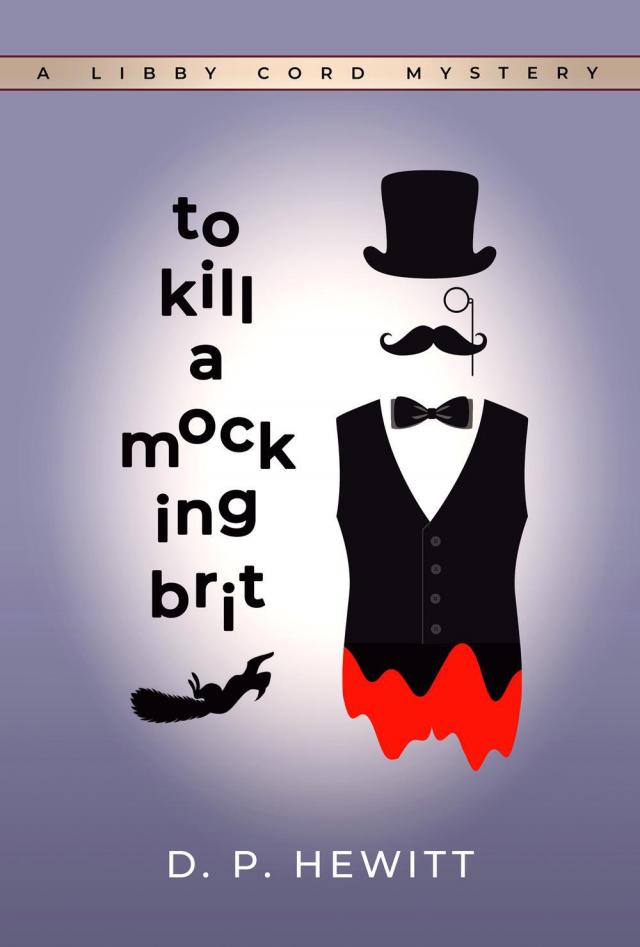
To Kill a Mocking Brit
A Libby Cord Mystery
by
D. P. Hewitt
To cozy mystery readers everywhere
CHAPTER ONE
Early Spring, 1999
I tried to warn them about him, I really did. We were all there at the town meeting, Mary and Greg Rose, and Ben and I, sitting about halfway back in the high school gym on the right-hand side. Mavis Wilton was at the podium on stage, as she always was. It didn’t matter what the occasion was; Mavis always had to be in charge. Of course, nobody else wanted to be in charge, which is why Mavis could always be found behind the podium. She, on the other hand, thought it was her sterling leadership qualities that caused people to follow her. Leadership qualities, my aunt Fanny. Mavis Wilton couldn’t lead a bunch of lemmings off a cliff. But I digress.
As I was saying, I tried to warn them. I was rolling my eyes as Mavis waxed eloquent on the merits of Clive Woodward.
“He used to work in an art gallery in London, and then he met our own Deborah Voss, who some of you probably remember grew up here. After they got married, he accompanied her when the Navy reassigned her to Italy, Miami, San Diego, and Norfolk. He always worked with the local arts community, helping to put on plays at the theaters, arranging painting classes, organizing concerts, and so on. Just what we need here!” Mavis clasped her pudgy hands enthusiastically. “And, if that weren’t enough; to top it all off, he’s English!”
This was where I had to step in. Amid a murmur of approving “oohs” and “aahs”, mainly from the female members of the audience, I stood up.
“For all of you who think being English automatically means being cultured,” I said, “I have only two words: Benny Hill.”
The murmuring stopped briefly while all heads swiveled in my direction, but then the oohing and aahing started again. Disgusted, I sat down.
“These people,” I muttered to my husband Ben, on my left, “are hopeless. They think everybody who’s British takes tea with the Queen and talks like Richard Burton.” He patted my hand but didn’t say anything. What would have been the point?
At the podium, Mavis smiled condescendingly. “Yes, well, we all know Libby Cord’s been to Europe,” actually, I had lived in Europe, “and worked for the federal government and all, and now she writes that sweet little column in our weekly paper,” (Sweet? “Coopers Curmudgeon” was sweet?) “so she likes to think she knows better than all us poor local people....”
I started to stand up again, in order to protest the injustice of this last remark, but two hands pulled me down into my seat again: Ben’s on my left, Greg’s on my right. I looked at them indignantly.
“I do not think I know better than everybody else,” I protested.
“Yes, you do,” said Greg.”Sit down and shut up.”
I scowled at him. “Some best friend you are. I don’t think I always know everything, do I, Mary?” I appealed to his wife on Greg’s other side.
I’ve never actually seen a deer in the headlights, but if I had, I’m sure it would have looked exactly as Mary did at that moment. Frantically, her eyes searched the room until she found a savior.
“Oh, look, there’s George Twomey! I need to ask him about the cake he ordered for his daughter’s wedding. Be right back!”
“Chicken!” I called to Mary’s retreating back. I do not always think I know better than everybody else. Not always. But sometimes I do. And so I try to show people where they’re about to go wrong. Like with Clive Woodward.
“It’s so fortunate that Deborah has decided to come back here now that she’s retiring from the Navy,” Mavis was enthusing once more. In the military, you don’t usually retire when you’re sixty-five. After you put in twenty years, you’re eligible for retirement. Deborah had enlisted in the Navy about the same time I’d joined the Air Force, in the late Seventies. I’d done my four years and gotten out; Deborah had stayed, and after twenty years was finally ready to call it quits. And she was coming back here with her husband. Well, why not? I had done that, too, although several years ago and not immediately after getting out of the Air Force. And maybe Clive was all right; I’d never met him. I just objected to the wholesale adoration of all things British. I used to live in England, and, believe me, it’s not all culture and garden shows. But obviously nobody was going to listen to me, so I just sat and scowled.
The meeting broke up shortly thereafter, with a practically unanimous (one dissent, three abstentions––guess) vote to offer (read: beg) the new position of culture coordinator to Clive Woodward when he arrived. He could make it whatever he liked, since he had no predecessor, as long as it was cultural. What they all meant by “cultural”, I have no idea. I don’t think they did, either. I thought it was a very bad idea to offer carte blanche to someone they’d never met, solely on the basis of his nationality. But, as I’ve already said, nobody was listening to me.
Mavis, of course, couldn’t let me escape quietly. She had to chase us down in the parking lot to do it, but that’s Mavis.
“Beeen! Libby!” she trilled, puffing across the gravel in high heels that were obviously too small for her feet. Just as she reached us, she stumbled, and Ben reached out to catch her.
“Oh, thank you, Ben,” she gasped, gazing at him adoringly. I rolled my eyes. I’m used to other women gazing adoringly at my husband. He’s tall and good-looking, with light brown hair, sapphire-blue eyes, and a distracted, absent-minded air that women of all ages find irresistible. Ben, one of the world’s foremost experts on Shakespeare, is a professor of English literature at Cornell University in upstate New York. Since his mind usually inhabits Renaissance England, he never notices the women falling at his feet. He only noticed me because I pushed him down the stairs at the university library––but that’s a story for another time.
“There you go, Mavis,” he said, righting her and glancing down at her shoes. “Maybe you need to wear more sensible shoes. Libby always wears sneakers or hiking boots.”
I smiled as I twirled a well-worn Dexter in front of her. She glared at me. One of the many things Mavis will never forgive me for is marrying Ben. First of all, he’s considerably older than I am––about Mavis’s age. Also, Mavis was a high school English teacher––she’d been my high school English teacher––so she assumed that she and Ben should single-handedly (or would that be quadruple-handedly?) support the cause of the Arts. I was just in the way. She’d resented my marriage to Ben from the moment she’d set eyes on him.
“I do hope you’re not too upset by being out-voted on Clive Woodward, Libby,” Mavis cooed, smiling the fakest sweet smile I’d ever seen.
“Not at all,” I replied, smiling my fakest sweet smile in return.”That’s democracy in action. I’m a firm believer in democracy. It’s the only way to make sure that people get what they deserve.”
Ben started to laugh, quickly turning it into a cough. Mavis looked blank, suspecting that there was something inappropriate in my remark, but unable to figure out what it was. I’d always been able to out-think Mavis, even back in high school. I was never her favorite student.
“Of course,” she said, deciding to ignore my comment, since she didn’t understand it anyway.
“Are you all right, Ben?” She took him solicitously by the arm.
“Fine.” He gently pulled his arm away. “Just a––um––mosquito.”
Mavis batted her eyes at him. I noticed her bright blue eye shadow was creased in her eyelids. “Really? I thought it was a little too early for mosquitoes. Anyway, I wanted to ask you, Ben, if, when we get the Arts Center going, would you be so kind as to give some lectures on Shakespeare's plays? We might even be able to offer you an honorarium, but I can’t promise anything.”
Of course she couldn't promise anything. At the moment, the Arts Center consisted of a disused brick warehouse across the street from the library. But she knew Ben. Offering to let him lecture on Shakespeare was like offering to let an arsonist play with matches. He’d lecture for free. I just hoped no one at the university ever found out.
“I’d be happy to, Mavis,” he said. “I can do it now, if you want. At the library.”
Mavis looked alarmed, as if she thought he meant right this very minute.”Oh, no, Ben, we couldn’t have that. A distinguished professor such as yourself needs a proper auditorium, such as we’ll have in the Arts Center.”
“Well, if you’re sure.” Ben sounded disappointed. Actually, he probably would have done it right that very minute. “But what if Clive Woodward has other plans?”
“Oh, Ben,” Mavis flapped her hand at him and tittered. “Don’t be silly. Of course, he’ll want you to do it. You’re an eminent professor, for goodness sake.”
Benny Hill, I was thinking, but didn’t say anything. I tugged surreptitiously on Ben’s sleeve.
“Gotta go, Mavis,” he said. “Just give me a call when you and Clive are ready.”
I let out my breath in a long sigh as we climbed into the car and watched Mavis teeter off across the parking lot. Pig in pumps, I thought uncharitably.
“I hope she doesn’t fall again,” said Ben.
“She won’t. She only falls when you’re there to catch her.”
“She does?” He sounded genuinely surprised. I rolled my eyes again.
“Yes, Ben. She’s had the hots for you ever since we moved here. If I ever turn up dead, it’ll probably be because Mavis killed me to get her chubb
y little hands on your body.”
Ben looked down at the arm she’d touched and made a face. “Ewgh,” he said.
CHAPTER TWO
I saw Deborah Woodward before I met her husband, which was probably a good thing. I was in Scott’s Office Supplies, buying some paper for our printer and picking up a couple toner cartridges for Andy Zaebriski, the editor of The Cooper Crier, and my boss, at least for the time it took me to write my weekly column, “Coopers Curmudgeon”. Incidentally, I was picking up the latest gossip as well, from Terri and Donna, who worked at Scott’s and knew everything that went on in Coopers Crossing. More than once Andy had grumbled that having a newspaper in this town was superfluous, because everybody knew the news before the paper came out just by stopping in at the office supply store. It’s not as strange as it sounds, really. Cooper County is pretty rural; Coopers Crossing is the big town, even though only about ten thousand people live there. So everyone comes here to shop, and everyone buys their office supplies at Scott’s––the police, the fire department, the judges, the realtors––you get the picture. Nothing happened in Coopers Crossing without Donna and Terri knowing all about it.
“Here’s your paper, Libby,” said Donna, sliding it across the counter. “And you tell Andy if he doesn’t get in here to pay his bill, I’m not letting him have any more toner.”
“Oh, is that why he asked me to pick it up for him?” I asked.
“That’s why. I yelled at him the last time he was in here, and he doesn’t want to get yelled at again, the big chicken, so he sent you.”
“Who’s a big chicken?” Terri asked, coming down the stairs in the back of the store.
“Andy Zaebriski, sending Libby over to pick up stuff for the paper so I won’t yell at him.”
“Cookies!” came a voice as the back door of the store banged open. Mary Rose walked in carrying a large plate covered with aluminum foil. “Chocolate-filled, right out of the oven. And I need another box of cash register tapes.”
Terri rummaged around behind the counter to retrieve the tapes for Mary while Donna ripped the foil off the plate, practically drooling. “Mm, my favorite. See, Libby, if Andy bribed me with cookies, maybe I wouldn’t yell at him so often for being late with his payments.”
Mary looked apologetic. “I know we’re behind, but the girls all had the flu last week, and I forgot––”
Donna waved her hand and talked around a mouthful of cookie. “Forget it, two weeks is nothing. Andy’s about two months behind, and it’s just because he’s too lazy to write a check. Besides,” she swallowed, “for these cookies I’d forgive a lot.”
The rest of us nodded in understanding. What Mary could do with a little flour, sugar, and butter was no less than pure enchantment. Her husband Greg, one of the town’s cops and also my best friend since we were both six years old, baked the bread, but anything with sugar was Mary’s territory. My stomach growled. I reached for a cookie.
The back door banged open again. “I need some appointment pads,” announced Alice Shepherd, the town’s veterinarian. “Oh, good, cookies!”
Donna walked around the counter and grabbed a fistful of appointment pads off the shelf.
“Anything else?”
“Probably,” Alice said, swallowing a mouthful of cookie, “but I’m not organized enough to make a list before I come over here, so I’ll just be back next time I run out of something.”
At that point, Laurie J. Kipling entered the store, through the front door. This was more unusual than you might think. Although Scott’s Office Supplies fronted on Main Street, the parking lot was behind the store, so most people came in through the back door, unless they were running errands on foot. Laurie J. Kipling––everyone always referred to her by her full name––wasn’t running errands on foot. Not in those shoes. But Laurie J. Kipling was not a back door type of person; I doubted she even used the back door of her own house, unless it was to let the cat out. There were only two realtors in town: Laurie J. Kipling and Harvey Krumbacher. Harvey sold mostly the low-end properties, the dilapidated Victorian fixer-uppers and boxy ranch houses. Laurie J. Kipling sold “estates”, which is to say the already fixed-up Victorians and the enormous tract McMansions in the development west of town. Laurie J. Kipling always dressed as if expecting Warren Buffett to appear and express interest in buying a home in Coopers Crossing, and, believing resolutely in her persona as real estate tycoon, never entered a building through the back door.
“Where’s Scott?” she demanded, striding up to the counter in her stiletto heels with long,pointed toes. What were they for? I wondered. To stomp on roaches in corners?
“He’s making a delivery up in Waterville," Terri said. “What’s the matter?”
Laurie J. Kipling hungrily eyed the plate of cookies, but would never take one unless it was offered. Of course, no one offered any. “My printer is broken again. It’s the third time in six months, and I’m tired of always having to get someone out to repair it. I want a new one, and I don’t think I should have to pay for it, since the old one hasn’t worked right since I bought it. I have a business to run––”
Mary picked up the cookies and offered them to Laurie J. Kipling, much to everyone’s relief. No one wanted to hear for the twentieth time how important Laurie J. Kipling’s business was to the economy of Coopers Crossing. The strategy worked. Laurie J. Kipling picked up a cookie and took a bite. “Mm, still warm.”
“I’ll tell Scott to give you a call when he gets back,” said Terri.
Laurie J. Kipling nodded. “Okay. Thanks for the cookie, Mary. By the way, I just sold the house next door to yours.”
We all looked at her with interest, but I had a feeling I already knew who had bought it.
“Percival House?” said Mary, her face brightening. Percival House had been a bed-and-breakfast until one of the owners died and his widow didn’t feel up to running it all alone. Rose’s Bakery had supplied all the breads and pastries for Percival House, so Mary had lost a steady customer when it closed.
“Mm-hm,” said Laurie J. Kipling, around another bite of cookie. “Deborah Woodward and her husband bought it.”
So I was right. “Are they going to open up the B&B again?” Mary asked hopefully.
“That’s what she said. They want to redecorate a little and fix up the gardens a bit, but Deborah said she’d like to open it in about six months or so.”
The back door opened again and Mary and Greg’s middle daughter, Belinda, came in.
“Mom, we’re completely out of cash register tape. Annie’s writing receipts on napkins.”
Mary grabbed the tapes and headed for the door. “Put it on our account, Donna?”
“No problem. And I’ll bring your plate back tomorrow for a refill.”
As Mary and Belinda exited the store via the back door, the front door opened again to admit a tall, slender woman with long, straight dark hair. I hadn’t seen her in years, but I recognized Deborah Woodward instantly.
“Here’s Deborah now!” Laurie J. Kipling trilled. “You just missed meeting your new neighbor, Mary Rose. She runs the bakery next door to your new house.”
I held out the plate, one cookie left. “Hi, Deb. Welcome back to Coopers Crossing. Mary baked these. Try one, they’re indescribable.”
Her brown eyes looked at me for a moment before a shadow crossed her face. It was gone so quickly I thought I must have imagined it, and she smiled in recognition. “Libby, hi. I heard you’d moved back here, too. Nice to see you again.” She bit into the cookie. “Yum, these are great.”
“Mary used to bake all the pastries for Percival House,” I said. “You’ll probably want to have her do it again, there’s nobody better than Mary.” The others nodded in agreement.
“Well, I’ll have to ask Clive,” Deborah said. “He might want to do something else. But I’ll certainly mention it to him.”
An awkward silence fell. None of us could imagine getting pastries from anywhere else than Rose’s. And if you were right next door...well, maybe Clive was one of those men who liked to be consulted on everything, just so he could feel he was in charge.
Boy, did that turn out to be an understatement.
CHAPTER THREE


