

I jacqueline, p.1
I, Jacqueline, page 1


To
CHERRY KEARTON
with my thanks
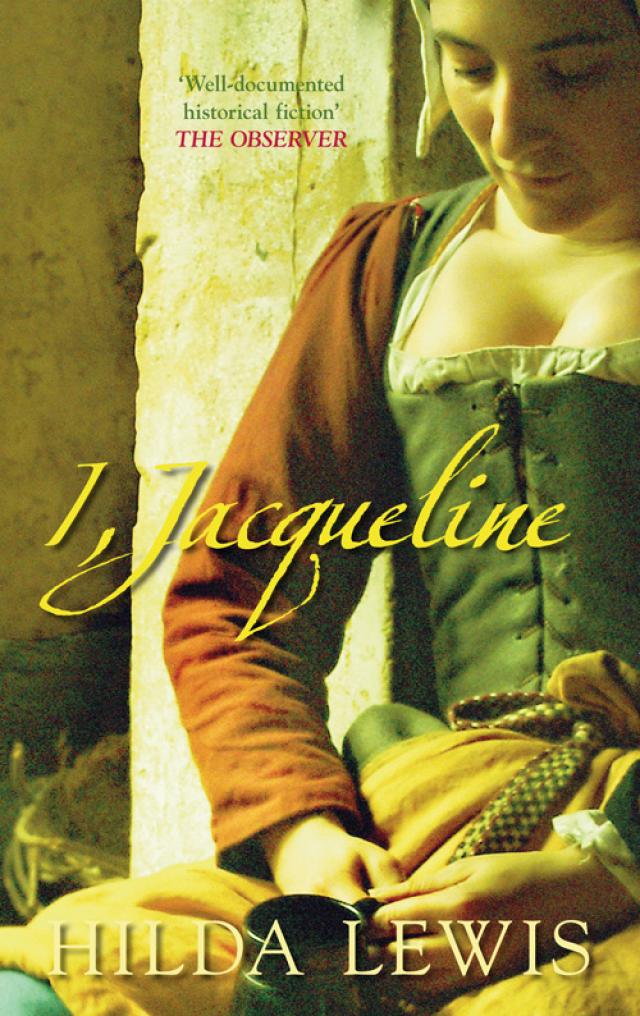
Cover illustration: John Foley/Archangel Images
AUTHOR’S FOREWORD
Our story opens in Holland in fourteen hundred and seventeen—nearly two years after Agincourt.
In England, the victorious Henry V is on the throne; in France the mad King Charles VI is soon to be succeeded by Joan of Arc’s Dauphin.
Count William VI, hereditary Prince of Holland, Hainault, Zealand and Friesland, is nearing his death. His heir is his young daughter Jacqueline; and his last days are tormented by this question: Will she be accepted as undoubted prince in his place?
The land is torn in two by quarrels. Certainly his own party, the Hooks, will support her; but what of the Cods, enemies of his house?
The sudden death of Jacqueline’s husband—the heir to France—leaves her without her natural protector. A new marriage must be made at once. Whom shall the young princess marry?
With this death and with this question we begin the story of Jacqueline.
Epitaph for Jaqueline
L’amour pour quatre fois me mit en mariage,
Et si n’ay sceu pourtant accroistre mon lignage,
Gorrichem j’ay conquis contre Guillaume Arklois,
En un jour j’ay perdu presque trois milles Anglais.
Pour avior mon mary de sa prison deliver,
Au Duc de Bourgoingnons tous mes pays je livre.
Dix ans regnay en paine; ore avec mon ayeul
Contente je repose en un mesme cercuil.
Four times in wedlock heart and hand I gave
And though my ancient line ends in this grave
Gorcum I won from William Arkels’ host.
Three thousand English in one day I lost.
My husband from his prison to set free,
My kingdoms all I gave to Burgundy.
Ten years I reigned in grief; content am I
In my ancestral tomb at last to lie.
PRINCIPAL CHARACTERS
IN HOLLAND
The Countess Jacqueline, Hereditary Prince of Holland, Hainault,
Zealand and Friesland.
Count William VI, her father.
Margaret of Burgundy, her mother.
John of Touraine, Dauphin of France, her first husband.
John the Fearless of Burgundy, her mother’s brother.
John the Pitiless of Bavaria, bishop-elect of Liége, her father’s brother.
John of Brabant, her second husband.
Philip the Good, her cousin; son to John of Burgundy.
Beatrix van Vliet, her half-sister.
Frank van Borselen, stadtholder of Holland; leader of the Cods.
William van Brederode, captain of her forces; leader of the Hooks.
IN ENGLAND
Henry V, King of England.
Catharine of Valois, his wife.
Henry VI, their son, the infant King.
John of Bedford, brother to Henry V, commander of the English forces in France.
Humphrey of Gloucester, his youngest brother, Protector of England.
Henry Beaufort, half-uncle to Henry V, bishop of Winchester, Cardinal of England.
Eleanor Cobham, Gloucester’s mistress, later his wife.
IN FRANCE
Charles VI, the mad King of France.
Isabeau, his wife.
Charles VII, their youngest son; Joan of Arc’s Dauphin.
CONTENTS
Title
Dedication
Author’s Foreword
Principal Characters
Chapter I
Chapter II
Chapter III
Chapter IV
Chapter V
Chapter VI
Chapter VII
Chapter VIII
Chapter IX
Chapter X
Chapter XI
Chapter XII
Chapter XIII
Chapter XIV
Chapter XV
Chapter XVI
Chapter XVII
Chapter XVIII
Chapter XIX
Chapter XX
Chapter XXI
Chapter XXII
Chapter XXIII
Chapter XXIV
Chapter XXV
Chapter XXVI
Chapter XXVII
Chapter XXVIII
Chapter XXIX
Chapter XXX
Chapter XXXI
Chapter XXXII
Chapter XXXIII
Chapter XXXIV
Chapter XXXV
Chapter XXXVI
Chapter XXXVII
Chapter XXXVIII
Chapter XXXIX
Some Books Consulted
About the Author
Copyright
I
It was my mother who thought of the black ribands. She had always a strict sense of what was proper; habit would lead her to seemly behaviour though the heart remained cold. That my young husband was suddenly, shockingly dead seemed to weigh less with her than that no one had thought to find me a black gown or even to tie a mourning riband about my arm. As for myself, I was so bewildered by the suddenness that I had had no time as yet to feel my loss.
But it is like me, impulsive as I am told I am, and as I must believe I am—though the years have disciplined me more than a little—to plunge into the middle of my tale without telling my name or my parentage.
Well then, I am called Jacqueline—of Bavaria, or of Hainault, or of Holland, whichever you choose. Yes, I am that Jacqueline who, ill-fortune pursuing, set all Christendom by the ears with scandal in high places.
My father was William VI, Count of Holland, of Hainault, of Zealand and the free Islands of Friesland; my mother, Margaret of the house of Charolais, from which are sprung the great dukes of Burgundy. My father, lively and loving with his friends, could yet lay a heavy hand upon his enemies. He was renowned for his prowess in the fight—and with women. He was a friend to scholars and to poets; and in his court the laws of chivalry lingered still.
My mother is a true de Charolais—hardheaded and ambitious; she has always put the honour of her family first—the de Charolais. And she is a true de Charolais in her looks; of low stature, the eyes pale grey, not overlarge nor lustrous; but the mouth is thin rather than full and she holds it tight-pressed and did, even when she was a young woman. Whether she ever loved my father, I don’t know. She did her wifely duty but without generosity. And, perhaps one cannot blame her; for she never forgave him his women. A gentler wife might have won him; but her pride was set hard. Everyone knew about his mistresses and his bastards—and she with one child and that one a mere girl!
She never quite forgave me, either, that I had not been born a boy. She was no unnatural mother but she was not a loving one. When I behaved ill I was not only whipped but threatened also with the name of the great duke, her brother. Your uncle of Burgundy will be after you! she would cry out. Or, I am sending to my brother John. And that was worse than any whipping. For a whipping is soon forgotten; but fear breeds in the dark places of the heart. John of Burgundy was my childhood bogey and so remained throughout my life … and good cause, too. Although it was the last thing my mother desired, it was she herself that had bred in me this fear and distrust.
I feared my mother and I loved my father. He was my sun that shone. Whatever disappointment he may have felt that I was not a boy he never showed it. He loved me because I was his child; he enjoyed my childish company because my answers came pat, and my laughter, too. But most of all he was pleased because I was pretty in the Dutch style rather than in the Burgundian. When I was nine years old or thereabouts, Master Jan van Eyck painted a picture of me and my father wore it about his neck. It is lost now, like most of my treasures; but like many a lost treasure it is safe in my heart.
I see it as clearly, as though I held it before me—the round-faced child with rosy cheeks and light-brown curling hair. The eyes are dark blue—and Master van Eyck has caught the expression marvellously; they are trying not to laugh and the little mouth is buttoned up with the same desire. The small creature is well aware of the seriousness of the occasion; but for all that it is certain that the laughter must come bursting through. The chin is round and very determined for so young a child; the nose is delicate, a little tip-tilted. Altogether if I may say it of that far-off child—a pretty creature.
I cannot remember when I was not an important person. I had arrived late in the married life of my parents, though my mother was barely thirty; but sixteen years is a long time to wait and they had given up hope. I was three years old when my father succeeded to the throne of the Counts of Holland; and so I became Daughter of Holland and his sole heir.
In any court, even a small court like my father’s, a young prince is flattered and fêted; and so it was with me. Sycophants would run fawning with presents and with pretty speeches; but they turned their backs quickly enough when the wind blew cold.
I must mention one other person who played a great part in my life—Beatrix van Conengiis, my favourite woman and constant companion. My mother disliked her and would have sent her packing; but Beatrix held her position at my father’s command. He told me himself, when I was eleven or twelve perhaps, that she was his daughter—and, indeed, she had his handsome look. He desired, he said, at least one loving heart about me during his many absences; and he desired, also, her own advancement. And so it turned out. She had not been about my person but a little while when she caught the eye and the heart of the Lord of Conengiis—a
I cannot remember further back than my fifth year—the year of my betrothal. I was carried by mother to Compiègne to be betrothed to the second son of the King of France. There were feasts and music and masques though, shut away in the nursery with Beatrix, I never saw any. But, one thing I do remember, and that was a fit of passion in which I screamed because my father had not come. He had promised; and he was not there. It was only afterwards that I knew why he had not kept his promise to me, the only promise he ever broke. He had been bitten by a dog on his way thither. Always a lover of beasts, he had stooped to a strange mastiff in the courtyard of an inn and the creature had sprung and bitten him in the leg. And, though he sent me pretty gifts and loving messages, I would neither look nor listen but still cried out and beat upon the floor and would not be comforted.
There were many to whisper behind their hands that nothing good could come of this betrothal, for my betrothed’s father was absent as well as my own—Charles VI of France had been left behind in Paris to howl in his madman’s cell. The excitement had been overmuch for his frail body and the ever-dreaded sickness had fallen once again. But I knew nothing of that. I only knew that my father’s place was empty; and that Madam Queen Isabeau sickened me with her smell of stale perfume and sweat. My mother used no perfume at any time; and she had fallen into our good Dutch habit of soap and water. Courageous as I was and high-spirited, I was frightened of Queen Isabeau for all her handsome looks. It was not only the smell that went with her—at the French court my mother was almost alone in the sweetness of her body—but because she was tall and heavy and towered above me like a dark tree; and because her mouth was red as blood and it shut down like a trap, and her eyes flicked like a whip to make you do whatever she commanded.
John Duke of Touraine, my betrothed, was seven years old; that is three years older than I. He was good and gentle; and he showed no sign of his elder brother’s weakness in character. Louis the Dauphin, in spite of his tender years was already known for stubbornness and for spiteful ways. But John did, alas, show signs of that other weakness that would not let Louis ride a horse or even sit long in a litter without swooning. But our good Dutch food would make all well, my father used to say.
When we returned home after my betrothal John went with us to learn the ways of the people he would one day help me to govern; and I was the happiest child in the world. I did not know what a betrothal might be; but I did know that it had given me—a lonely child—a most loving companion. He would do whatever I wanted. It was I that suggested our games and he that followed. When he did not follow quickly enough I would stamp and catch hold of his dark hair; and he would gently uncurl my fingers, careful not to hurt me rather than to spare himself. When we did things that were forbidden—walk in the river when the March winds blew cold from the sea, or chase the sheep so that they ran in all directions, bleating madly—it was John that took the edge of my mother’s tongue, and the whipping, too.
I was fourteen and he seventeen when we were put to bed together. There was a great ceremony in the Hague chapel and a great feast to follow. My mother had hankered after the French custom of putting the bride to bed, seeing that John was of France and she, herself, of Burgundy. But my father would have none of it, and that was a weight off my heart.
So John and I went to bed soberly. I was old enough to understand the nature of marriage; but surely marriage with John was different. For ten years we had played together, lain together in the hot sun and beneath the cool shade of trees. We were brother and sister; why should marriage alter that … for the present at least?
But when I was waiting in the great nuptial bed, I was not so sure. John stood there his too-thin body trembling beneath the bedgown, and there was a new look in his eye. I would not let myself be afraid of this new John.
‘All this playacting!’ I said. ‘Dear God, how tired I am—half-asleep already. Come to bed. Heaven be praised it’s wide enough for half-a-dozen.’
I saw how he flushed; but the old habit of obedience to my whims, held good. He came quiet into bed and lay brotherly next to me. The long day had been much for him; he was a delicate lad, and soon he was asleep. I knew perfectly well—even if my mother had not seen fit to remind me—my marriage duties as Child of Holland. But I was not yet ready. I was fourteen and just beginning to learn the nature of my own body. Had John been a stranger, excitement might have driven us together. Or, had I been given time, I should, I think, have come to love John the husband as dearly as I loved John the brother. But we were not given time.
The next day, seated in our chairs of State, we received the gifts of our nobles and churchmen and burghers. And then at last, our thanks being given, we were allowed to depart for Hainault, to spend what we Dutch call the white bread nights. And glad I was to leave the searching eye of my mother and her blunt questions. I had feared to the very last she would come with us.
In Hainault, among the childhood haunts where we had played as brother and sister, it was not hard to keep John from his husband’s rights. Soon, I would say, soon. He was not a lusty youth and soon he came no more to my room than to say Good-night. We were both of us young and time seemed to stretch endless before us.
And so the pattern of our new life was established before we returned to the Hague; and, for all the blessings of the church and the sharp tongue of my mother and the encouraging jests of our friends, there was no bedplay between us that first night or any other.
And so our pleasant life meandered on. John was gentle as ever. Sometimes it seemed to me that he was lower in spirit than he should be; but then, I told myself, he was delicate and easily tired. The truth is I was too young, and too selfish, to understand the strain I put upon him. Now that I understand the nature of the bond between men and women, I grieve—though it is all of twenty years ago—that I showed so little kindness.
I wore my new title Madam the Duchess of Touraine; but it meant little to me. I am Dutch in my ways—though there’s little more than a trickle of Dutch blood in me. For the rest I am Burgundian through my mother and Bavarian through my father. But I am Dutch in my thinking; and so I never thought of France, that it might one day be my home and I its Queen.
There was little to disturb these pleasant early months of my marriage except the usual quarrels between our noblemen which took my father away from home. Hooks and Cods the parties called themselves. Hooks and Cods. The very names are all-but forgotten now, though for years they spelled bloodshed and heartache; and to no one more than to me.
I must tell you how the quarrel began. My greatgrandfather was the Emperor—Louis of Bavaria; his wife was Margaret Countess of Holland from whom I inherit my lands. Many Dutch lords—Cods they called themselves because of the grey speckled livery they wore—hated the Bavarian blood of my family. But the Hooks—hooks to catch the Cods—stood loyally by my family.
For three generations now there had been continual quarrels between the two parties. My grandfather had managed to keep the Cods down; and so did his son after him. But it was a great annoy-ance to my father and a great worry, too. From the time I was a little child he worried about me, wondering what I—a woman—would do against the rebel lords when my own time came.
And then, suddenly, the pleasant order of my life broke; and everything was changed.
Louis, heir to the throne of France, died suddenly; and no true-born child to inherit the crown.
John was utterly cast-down. It was not so much affection—the brothers hardly knew each other. I doubt whether they had met since my betrothal ten years ago; and Louis had never been easy to love. It was an unwillingness, yes and a fear also, to step into the empty place. France was dark with bloodshed; not only the blood shed by Henry of England, but with that spilt by noble against noble; bloodshed and treachery. Treachery; there were ugly tales that Louis had been poisoned. And then, too, there was the mad King and the wanton Queen to reckon with, each incalculable; Louis might well have been poisoned between them! If John was afraid, it was no wonder.
In trying to rouse his spirits I had little time to think of myself and what Louis’ death was going to mean to me. But soon I began to notice deeper bows and curtseys and a greater running after me with compliments and gifts. Moreover my mother treated me with a new formal courtesy; but for all that I should not cease to be her obedient child. It was the prescribed respect paid to the future Queen of France—even though that Queen happened to be one’s own daughter. My mother rarely transgressed the rules of etiquette.


