

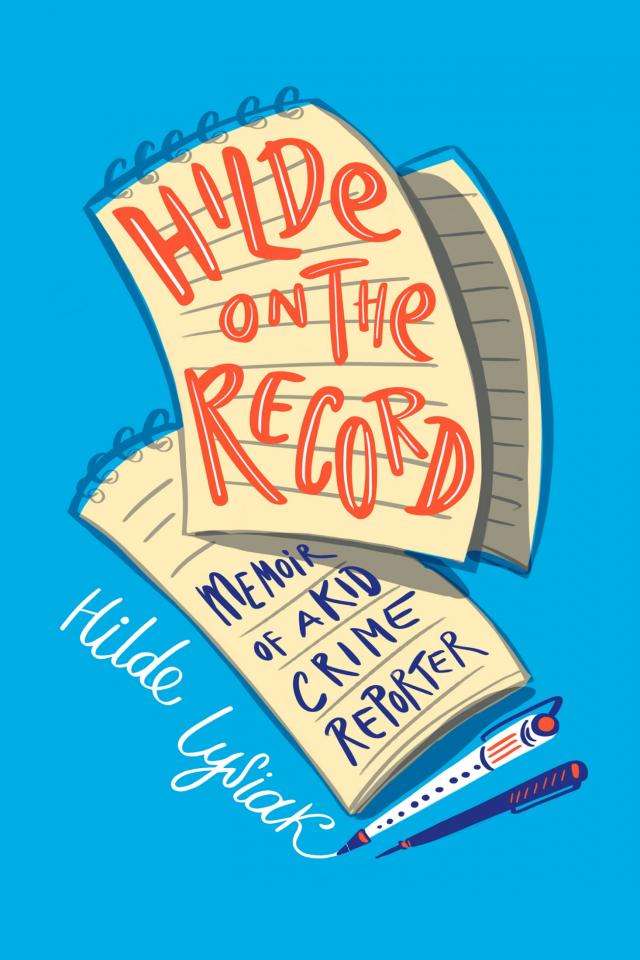
Hilde on the record, p.1
Hilde on the Record, page 1


Copyright © 2022 by Hilde Kate Lysiak
All rights reserved
Published by Chicago Review Press Incorporated
814 North Franklin Street
Chicago, Illinois 60610
ISBN 978-1-64160-584-7
Library of Congress Cataloging-in-Publication Data
Names: Lysiak, Hilde, 2006– author.
Title: Hilde on the record: memoir of a kid crime reporter / Hilde Lysiak.
Description: Chicago: Chicago Review Press, 2022. | Audience: Ages 8–12 |
Summary: “Young crime reporter Hilde Lysiak shares, for the first time,
how she started her own newspaper, the Orange Street News, and how she
was able to not only survive the ups and downs of her youth but emerge
from it all with a renewed sense of purpose and confidence”—Provided
by publisher.
Identifiers: LCCN 2021052943 (print) | LCCN 2021052944 (ebook) | ISBN
9781641605816 (cloth) | ISBN 9781641605823 (adobe pdf) | ISBN
9781641605847 (epub) | ISBN 9781641605830 (kindle edition)
Subjects: LCSH: Lysiak, Hilde, 2006– —Juvenile literature. |
Journalists—United States—Biography—Juvenile literature. | BISAC:
JUVENILE NONFICTION / Biography & Autobiography / General | LCGFT:
Autobiographies.
Classification: LCC PN4874.L975 A3 2022 (print) | LCC PN4874.L975 (ebook)
| DDC 070.92 [B]—dc23/eng/20211122
LC record available at https://lccn.loc.gov/2021052943
LC ebook record available at https://lccn.loc.gov/2021052944
All images are from the author’s collection
Typesetting: Nord Compo
Printed in the United States of America
5 4 3 2 1
This digital document has been produced by Nord Compo.
For my mom, Bridget Reddan Lysiak
CONTENTS
Preface
1 The Beginning
2 Another Language
3 Life's No Parade
4 Change of Plans
5 A Small Silver Lining
6 The Last Teacher on the Stage
7 The Long One
8 The Bridge
9 An Adventure
10 Chocolate Chip Pancakes
11 Settling In
12 Tuesday Nights
13 The Some Times
14 The Orange Street News
15 “The Worst Day of My Life”
16 The First Issue
17 Gathering Speed
18 “Where Are Your Parents?”
19 The Last
20 The Saddest Tuesday
21 The Aftermath
22 Carrying On
23 School's Out (for Good)
24 Home Again
25 Meet the Plant Vandal
26 Exclusive: Murder on Ninth Street
27 Haters Gonna Hate
28 In The News
29 Return of the Plant Vandal
30 Truth to Power
31 Losing Perspective
32 Help
Afterword
Acknowledgments
Preface
When you are a little kid, truth is simple. You may not always speak it, but you know it. I’m fourteen now and it feels more complicated. Take memories, for example. When I think back about starting my newspaper, there are the things that I remember, but then there are the stories I have been told. In my case, these stories have not only been passed on by my family and friends; they have also been told by hundreds and thousands of newspapers, magazines, and television shows. Everyone’s version of what happened is slightly different from the next.
I spent much of my first six years following my dad around New York City as he reported for the New York Daily News. The earliest lesson he taught me was that reporters should never put themselves in the story. That can be avoided by interviewing as many people as possible and asking them the five basic questions: who, what, where, when, and why. The goal is always to present the reader with enough information to know the truth.
But what happens when the people being interviewed have different descriptions of the same event? Perspective refers to the way things are seen from a particular point of view. Two people could witness the same event yet report two different stories. This is not necessarily because either person is lying but rather because they have different perspectives of the event. Take a car accident, for example. A person standing on the right side of the street, slightly behind a tree, may report events much differently from the person watching from the other side of the street without a tree in their way. Even when a reporter does a fantastic job of presenting many people’s stories, in the end, the reader is left to decide what they think happened.
Hilde, twelve, searching for leads on her bike.
I find myself in a strange position in writing this book. This is the first time I will be putting myself in the story, although it won’t be the first time I have been written about. When, at age nine, I found myself going viral for being the first to report on a homicide in my town, I was confronted head-on by the challenge of people’s perspectives. Here is a list of ways my reporting was described in the following days:
• Precocious
• Sensationalist trash
• Heroic
• Complete joke
• Indecent
• Disrespectful
• Brave
• Innovative
• Refreshing
• Embarrassing
In addition to these adjectives, I was praised for empowering girls but also told that I should be home playing with dolls and having tea parties. So yeah, perspective. Millions of people read or watched my news coverage with almost as many different reactions.
This book is my attempt to tell the story from my perspective. In the end, what you think is up to you.
I have tried to re-create events, locales, and conversations from my memories of them. To protect privacy, in some instances I have changed the names of individuals and places. I may have changed some identifying details such as physical characteristics, occupations, and places of residence.
1
The Beginning
Snuggly, calm, joyful, affectionate, peaceful, imaginative, nature loving. These are words my parents use to describe me as a young child. My memories of this time are just three-dimensional versions of the photographs in frames around our house. I remember my early childhood in almost the exact way my family retells it, just with more color and movement.
For the first five years or so, I wore little more than my waist-long hair and multicolored rain boots. I had a thing with texture. I only liked fabric that felt smooth and flat. I could only touch one side of the special blanket my older sister gave me as a baby, and even though the right pair of leggings felt OK against my skin, I preferred not to wear clothes. I have always had a lot of hair, and by the time I was two, it hung all the way down my back. Even though I was born in the big city, I always felt best when I was able to run barefoot in the grass and dig in the dirt. This all earned me the joking reputation of “flower child,” “free spirit,” or “hippie.” It is funny all these years later to compare those words to the ones the media would eventually use to describe me—words like “precocious,” “spitfire,” “rebel,” or even “bada**.” Although they never quite felt like me, it is interesting to think about how I went from laid-back nature girl to crime-solving sleuth.
I was born in Brooklyn, New York, on November 2, 2006. I lived with my mom, dad, and three-year-old sister, Izzy. We were a happy foursome but quite different from one another. Izzy was my polar opposite. She was loud and bold and actually cried hysterically the first time her bare feet touched grass. Not only did she refuse to play dolls with me, she disliked most toys. While I would disappear for hours creating new worlds with my toys, Izzy would practice for the day she would become a famous singer. She would occasionally play with me as long as she could be the teacher and I, her student. She was bossy. I don’t think she’d mind me saying, she still is. But it worked for us because I was usually happy to be the student. This has served me well in life.
My mom was the creative type. She loved books and poems and movies and music. She read to us often and played her songs loudly so that we could dance. She was less concerned with how many words we could read and more focused on the stories we could tell. Even though she was trained to be a high school English teacher, she and my dad made the decision that she would stay home with us instead of working. This would become especially important as my dad’s career took off.
My dad was a reporter for the fifth-biggest newspaper in the country—the New York Daily News. Crime doesn’t keep a schedule. Natural disasters don’t necessarily happen between nine and five. This meant my dad’s work routine was never predictable. While most of my friends’ parents left for work after breakfast and came home for dinner, my dad might be home for hours in the daytime but then called away at a moment’s notice, sometimes for a week or two, to report on something that could be all the way on the other side of the country.
One summer when I was little, my parents wanted to get us out of the city for a while. My dad had been traveling a lot for work, and our family desperately needed time together. We rented a beautiful cabin on a lake in Maine for three weeks. The first ten days or so were amazing. We swam every day, hiked and explored, played endless rounds of gin rummy, and sat around the fire each night, usually with my dad telling the ghost stories Izzy and I loved best.
But 1,600 miles away, a hurricane was brewing. On the seventh anniversary of the devastating Hurricane Katrina, Hurricane Isaac threatened to bring destruction again to the city of New Orleans. Isaac did not care that without my dad, no one would tell ghost stories (my mom hates scary stuff). His bosses at the New York Daily News did not think about how much Izzy and I needed to spend the rest of our vacation with him or how my mom hated to drive long distances by herself. There was a huge national story about to break, and my dad was the best reporter they had. So, ten days into our lovely little lake vacation, we drove the hour to the Portland airport and watched as my dad went off to cover a hurricane.
Watching my dad go made me feel split in two. On the one hand, I was very sad to see him leave. It felt like we needed more family time. That had been the whole purpose of the trip, yet he left. Again. Looking back now, I think my dad was also really sad to leave. I think he may have felt guilty too. On that particular trip, I remember him giving my mom a bunch of money to take us to the big mall in Portland after we dropped him at the airport. I have to admit, it was a good distraction at first. We went to Build-A-Bear (a place my mom usually avoided like the plague) and got to make any stuffed animal we wanted, complete with all the accessories. My favorite part was the heart they sewed in at the end. Afterward, we ate a big meal where my mom, who usually only let us drink water, ordered us lemonades.
On the drive back to the cabin, listening to the sound of my new bear’s heartbeat, I couldn’t help but think about what my dad was doing. There was a part of me that was worried about his safety, but the biggest part felt excitement. My dad was an adventurer! A kind of superhero. Without much notice or knowledge of the situation, my dad would fly into areas and have to figure out what was going on. He was like the eyes and ears for millions of people around the country who needed to know what was happening. Imagine if someone you loved lived thousands of miles away in a city where a hurricane was about to strike. At first, you would be able to talk to them on the phone to know they were safe. But eventually, if the hurricane was bad enough, it might become difficult to communicate with them. You would most likely feel very scared and concerned for their safety. You would have many questions. Were they able to evacuate? Are the dams holding? What kind of emergency help is available in the area? A reporter could be the link that answers those questions and keeps you updated.
Riding in the back of the car to our cabin, I had so many questions. I realized if I could interview anyone in that moment, it would be my dad. I thought about how he did it. I imagined how brave he would have to be to go into those dangerous situations, how calm he would have to stay in order to figure out what was happening. But how?
I also knew that many times, the stories he covered had very sad endings. Even though my dad was almost always smiling and joking, there were times when he came home and was quiet or even cranky. I wondered if it was because he felt sad about some of the things he saw while working. Was he ever scared? Did he ever worry that he wouldn’t make it back home to us?
As I snuggled my bear to sleep, I vowed to get those answers as soon as my dad returned home.
2
Another Language
“I can’t believe I had to leave vacation for that.”
“Yeah, but if it was worth leaving for, that would mean a city was destroyed.”
“Yeah, you’re right. I guess I was looking at it pretty selfishly.”
My parents were in the living room having coffee talk on the first morning my dad was back. Hurricane Isaac had spared the city of New Orleans, changing at the last minute to a tropical storm and passing to the west of the city. That was great news for the people of New Orleans, but it was not exactly great news for the paper. I was in my playroom a few feet away pretending to build a castle with my blocks so I could listen in.
“Well,” my mom said, “I get it. It stinks that you had to go. The girls say they don’t care, but I can tell it’s on their minds. Hilde didn’t let go of that bear the rest of the trip.”
“Yeah, I wish I had a few days off to be with them here,” Dad said. “At least I just have to cover that parade today. Shouldn’t take too long.”
Hearing that, I saw my opening.
“Can I go with you?” I asked as I accidentally knocked my blocks over trying to make a graceful entrance into the living room. (Notice “graceful” was not one of the words used to describe me.)
It’s not like Izzy and I hadn’t gone reporting with my dad before. We had been lucky enough to accompany him on some of his out-of-town trips. When the New York Daily News needed him to cover something in a different part of the country, it would pay for his hotel for as long as he needed to be there. There were times when this location was someplace super cool, like the beach or Martha’s Vineyard. If my dad thought he might be there for a while, he would ask my mom to bring us. On these trips, we might be exploring the area as a family, but my dad would get a call and need to stop somewhere to interview someone. Izzy and I would always have to stay in the car with our mom, but I would try my hardest to listen to what was happening outside. Later, if the story wasn’t too upsetting, my dad would give us some of the details he had uncovered.
It was the same way back in New York. Sometimes, one of our family outings would be detoured because my dad had to report on something. Because of this, my sister and I got to see many different neighborhoods all across New York City. These weren’t the tourist areas. These places were where the everyday people lived and worked. Izzy and I have sat for many hours inside little neighborhood restaurants with my mom, passing the time eating the local food while my dad was off interviewing people. We tried patties in Jamaica, Queens; dim sum in Sunset Park; Hungarian food on the Lower East Side; Russian food in Brighton Beach; and some of the best Italian food on Arthur Avenue in the Bronx. There was even a neighborhood where a little old lady would lower a basket down to the street. You would put your money in, she’d raise the basket, and then lower it again with delicious homemade Italian ice. This, of course, was my favorite.
Reporting was just a way of life for all of us. It’s like growing up with a grandmother who speaks another language. It may sound weird to one of your friends who comes over, but to you, it is just normal. And even though no one is trying to teach you to speak that language, you probably know some words just because you’ve been around it, listening. But I was done just being in the background, listening. I wanted to see my dad in action from start to finish. I didn’t want to be around the corner eating Korean chicken wings (so good, by the way!). I wanted to be next to him while he was asking the questions. Plus, it would give me alone time with him to ask all my questions.
My parents, a bit startled by the crashing blocks, looked at me and then at each other.
“Oh, Hilds, you can’t—” my mom started.
“Sure,” my dad interrupted.
The two of them turned to each other, my mom with a confused look on her face.
“Ah—why not—it’ll be fun. It’ll give us some time to catch up. It’s just a parade,” my dad said.
Neither one of us was prepared for just how wrong he would be.
3
Life’s No Parade
Traffic was light on this Brooklyn Saturday. I sat in the back of my dad’s beat-up Hyundai Elantra as it careened through the city streets. We were headed to the West Indian Day Parade in the neighborhood of Crown Heights. Every year on the first Saturday in September, anywhere between one and three million people crowded the streets to celebrate West Indian heritage.
“This should be super fun, Hilds,” my dad said. “But it’s going to be really crowded, so you need to stay by my side at all times.”
That wouldn’t be a problem for me. I couldn’t wait to spend the day right next to my dad, watching him in action. As we came closer, my dad rolled the windows down. The sound of steel drums filled the car.


