

Split scream, p.1
Split Scream, page 1
part #4 of Split Scream Series
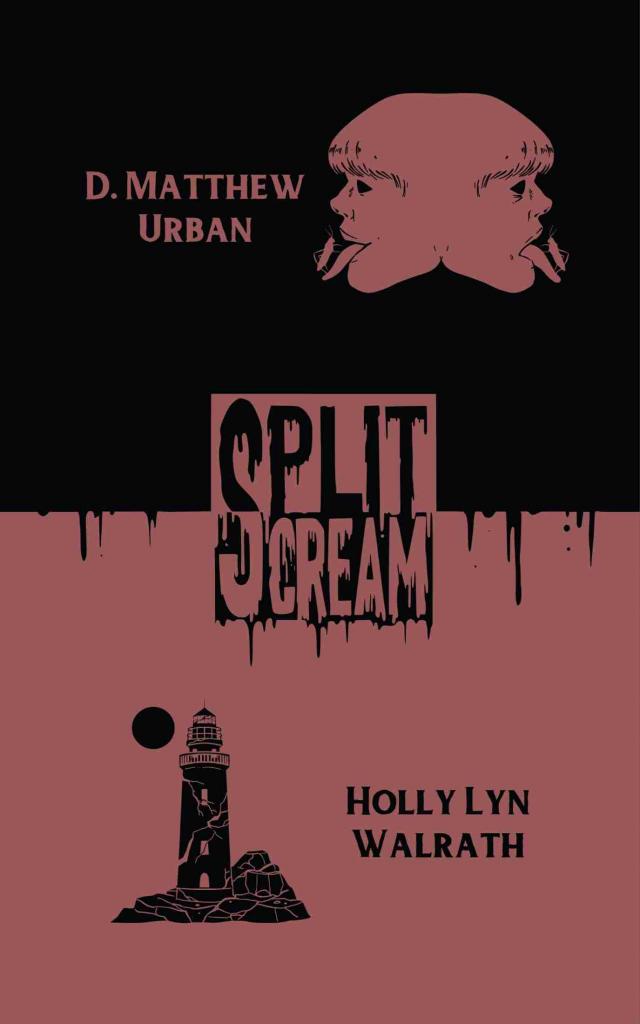


Volume Four
Featuring:
D. Matthew Urban
&
Holly Lyn Walrath
SPLIT SCREAM, Volume Four © 2023 by D. Matthew Urban, Holly Lyn Walrath, Alex Ebenstein, and Tenebrous Press
All rights reserved. No parts of this publication may be reproduced, distributed or transmitted in any form by any means, except for brief excerpts for the purpose of review, without the prior written consent of the owner. All inquiries should be addressed to tenebrouspress@gmail.com.
Published by Tenebrous Press.
Visit our website at www.tenebrouspress.com.
First Printing, October 2023.
The characters and events portrayed in this work are fictitious. Any similarity to real persons, living or dead, is coincidental and not intended by the author.
Print ISBN: 978-1-959790-12-9
eBook ISBN: 978-1-959790-11-2
Cover illustrations by Evangeline Gallagher.
Interior illustrations by Echo Echo.
Cover and interior design by Dreadful Designs.
Edited by Alex Ebenstein.
For the ones sticking with us.
INTRODUCTION
The novelette has been dismissed and disparaged. Some dictionaries don’t even define them as a unique form, listing only short stories, novellas, or novels. Others write them off as being “too sentimental” or “trivial”.
This is silly, of course, and, with little effort it’s easy to see the novelette has a purpose and value.
What makes a novelette, then? Exact word counts vary, but these stories are longer than a short story and shorter than a novella. In this case, between ten and twenty thousand words; or, horror you can devour in about an hour or two.
Sound like another form of storytelling?
I’m not saying a novelette is a movie is a novelette. And I’m not saying written fiction needs to be like movies. But… But they are kind of like movies in terms of length and threads, right? If you’re willing to accept that premise, at least for the moment, may I present to you…
SPLIT SCREAM
A Novelette Double Feature
Truly, what better way to present these stories than as a double feature? Do you have to read them back to back in a single Friday night after dusk? Certainly not. But could you? Absolutely.
Shall we?
First, we go back to school with D. Matthew Urban. The dark halls of ancient history academia in “Nonsense Words” are filled with myth and mystery, the undeci-pherable worlds of the cosmos. Careful trying to imagine what those words and worlds mean. Then, we go back in time with Holly Lyn Walrath to “Bone Light,” a haunted lighthouse on a cursed rock in the 19th century New England seas. If you can see past the ghosts, you just might find a love story.
Okay. Are you ready? Grab some popcorn, turn the lights low, and don’t be afraid to scream.
This is Volume Four of the SPLIT SCREAM series, the first to come from Tenebrous Press. Don’t worry, same series, just different logo on the spine and back. We’re thrilled to be a part of the 10p cult.
If you read any of the first three volumes, thanks for sticking with us. If not, I do hope you enjoy, and that you seek out more.
Long live the novelette!
Alex Ebenstein
Tenebrous Press
Michigan, USA
September 2023
Contents
NONSENSE WORDS
D. Matthew Urban
BONE LIGHT
Holly Lyn Walrath
ABOUT THE AUTHORS
ABOUT THE ARTISTS
ACKNOWLEDGMENTS
CONTENT WARNINGS
NONSENSE WORDS
D. Matthew Urban
As far as most people are concerned, only one fact about me is interesting. Years ago, in the academic catacombs beneath the grounds of a small Midwestern liberal arts college, I occupied the office across from that of Dr. Paul Duncan. You may know of Dr. Duncan as the Faculty Fiend, or the Campus Cult Caligula, or perhaps Professor Butcher (though Assistant Professor Butcher would be more accurate), but I knew him as Paul, and during the few years between his arrival at that institution of learning and his permanent remandment to another sort of institution, he and I became good friends. I knew his lovely wife, his adorable daughters. On numerous occasions, I visited their house on Somerset Street—that house—and dined, all unaware, in the jaws of hell.
There is one other fact about me that I ought to state at the outset. I am by training and disposition a scholar, by title Professor Emerita of Pre-Classical Studies. That is to say, I am a termite burrowing in tombs, my life is shelved among the dead, and my dead are generally deader than others’ dead. Even as a little girl, I dreamed of ruins, crypts, and indecipherable alphabets. The effects of all this will be apparent.
The first thing I heard about Paul was that he'd given a stunning job talk. I’d skipped it. Indeed, I skipped that whole batch of talks. After almost three decades of tenure, I paid little mind to such formalities.
Paul’s talk was the third in a series of four. The Department of Pre-Classical Studies sought a specialist in one or more of those numerous nations that the great empires of the ancient world had annihilated. We wanted an expert in the history of people who’d left almost no historical records.
About the first talk I heard nothing good. The speaker was described to me as a large thirtyish man with a Chicago accent and a PhD from a little-known university in Wales. He’d attempted to reconstruct certain ritual practices of the Celts who ruled northern Italy before the Romans came. The big Welsh Chicagoan spun wild fantasies of mystic revels, leaf-crowned villagers smearing themselves with sacrificial blood while getting blitzed on hallucinogenic berry wine. The speaker spewed forth this flood of babble with an air of growing agitation, almost panic, as if he were the star witness in a murder trial and had realized, in the course of his testimony, that he himself had committed the crime.
The second talk was no better. A dour Eastern European in her late forties spent half an hour describing the contents of an archaeological dig in southern Turkey: soot-blackened temple walls, insectoid figurines with laughing mouths, every detail embalmed in lethally impeccable scholarship. In her talk’s final minutes, without warning or transition, the speaker delivered a rhapsody of incomprehensible metaphysics and shaky syntax. One of my bewildered colleagues transcribed this fragment: “What here we find, my friends, when downwards we trace these roots of humanity, when we scrape into this dust of what abides oldest under earth, let me suggest, my friends, what here we find is the rootless sub-root, the inhuman sub-human, the sub-word without sense whose saying unspeaks all sense.”
After such dismal showings, any display of simultaneous competence and clarity would have been a relief. Everyone who heard the third talk, Paul’s talk, assured me it was more than that—it was a revelation.
Paul began by presenting a brief inscription, half Latin and half nonsense, found carved into a fragment of paving stone unearthed near the Roman ruins of Sabratha, on the Libyan coast.
NOCTIS REX / VOCTIS NEX / ROCTIS VEX
What did it mean? The Latin half presented no difficulty.
KING OF NIGHT / ? SLAUGHTER / ? ?
As for the rest, Paul rattled off a series of conjectures based on hypothetical dialects, words the Roman colonizers might have pilfered from their Phoenician neighbors.
KING OF NIGHT / SLAUGHTER OF VOICE / BORNE BY VERMIN
KING OF NIGHT / SLAUGHTER OF MULTITUDE / THE MANY THAT GNAW
And so forth. Of course, Paul remarked, given a bit of research and a healthy imagination, such pseudo-translations could be fabricated ad infinitum. It was simply a matter of inventing plausible meanings for the unknown words.
At this point, the talk changed course. Paul began to speak not of words but of letters, lines and curves carved in stone. How were those characters inscribed? Who carved them, and when? According to the team that studied the fragment (Paul himself, he modestly noted, had been amongst its members), the incisions had been made with an iron spike, dull and rusty, most likely around 250 CE, not long after the Romans built the massive theater that so visibly proclaimed their rule. Based on the force of the strokes, the shape of the letters, and the angle at which the spike struck the stone, it appeared the author of the inscription was a child.
Drawing on various sources, Paul spun a glittering web of theory around this clue. He cited studies of rhyming games, nonsense games, games of secret language, and childhood multilingualism. Of the flow of words and sounds between languages, between peoples, and the spontaneous formation of new languages among children in contact zones. He discussed rites of passage and their imitation or mockery in children’s games and jokes. He charmingly recalled seeing his own young daughters tossing a ball back and forth while chanting in unison, “Odd and even / You’re in heaven / Even, odd / I am God.” He referred to his own work in progress, a comparative study of the use of invented words in cultic initiations. All this he adduced with a virtuosic lightness, as if in building up this scholarly edifice he was, himself, at play: a child building a pillow fort, not too concerned if it should collapse and bury him, since he could easily escape the wreckage.
The talk concluded with an image and a suggestion. Picture, Paul invited his audience, a child crouching in the shadow of an amphitheater, scratching at the pavement with an iron stylus. She has paused on her way home from school. She is the child of a Phoenician mother a
“NOCTIS REX. VOCTIX NEX. ROCTIS VEX,” Paul said in conclusion. “I don’t know what that means. I don’t know if it means anything at all. But whatever those words say, I suggest, they speak to us from the world of those not yet stamped with the seal of mastery. That is a strange world, uncertain and perplexing, a shadow world. But if we seek to study the vanished and destroyed, to imagine the history of what has been erased from records, expelled from archives—what does not live in the sunlight—we must be willing to step into the shadows. That is where lost things are most likely to be found, lost words most likely to be spoken. And I suggest that the study of nonsense, of games and jokes and all such childish practices, offers perhaps our best chance of catching a glimpse into the shadows where the conqueror’s words ring hollow, where the only emperor is the king of night.”
There was a fourth job talk, by all accounts a fine performance entirely eclipsed by the brilliance of its predecessor. The speaker, a doctoral graduate of a well-respected coastal university, had no striking qualities that anyone could recall.
Paul always insisted that he and I met at a faculty reception a week before the fall semester began, but I confess I have no memory of that event. Did I attend the reception only to forget it entirely? Quite possible. That summer was the bitterest season of my marriage’s collapse, and I can easily imagine the scene. I run out of the house, my hands clamped over my ears to silence the idiocies slopping from Michael’s repulsive mouth; I drive to campus in a haze of rage and sorrow; I wander among my colleagues as if lobotomized; I return home no less befogged, remembering nothing, steeling myself for a long night in hell.
I can equally imagine myself skipping the reception to spend the evening alone in a bar.
In any case, to the best of my own recollection, I first met Paul in the hallway between our offices, the day before classes began. He was carrying a cardboard box sealed with brown tape, the word RELIQVIAE—relics—written in blue marker on one side. From the top stroke of the terminal E, elongated rightward like the crosspiece of a gallows, a red spider dangled by a green thread.
Nothing from that first (second?) meeting now presents itself more vividly to me than that box, a cube perhaps eighteen inches to a side, with its arachnoid decoration. What relics did it enclose? I can’t say. I saw only the box, the word, the spider.
Paul and I exchanged greetings and entered our respective offices. A few minutes later, as I sat at my desk finishing my notes for the next day’s class, Paul knocked on my half-open door with a bottle of whiskey in one hand, two tumblers in the other.
“Want a drink, professor?” he said.
“God yes, assistant professor.”
He laughed, sat down across from me, poured both glasses full to the brim.
“The quantity seems presumptuous,” I said. Raising a tumbler, I eyed Paul across the level plane of liquor.
He grinned and raised the other glass. “As my great-grandfather used to say to my great-grandmother, I’d rather ask your forgiveness than your permission.”
He was thirty-five years old at the time, I sixty-four and in no mood for flirtatious nonsense. Summoning the force of all my seniorities to wither him, I fixed his blue eyes with my black ones. But what I saw in those eyes took me aback, filled me first with doubt, then with surprise, then delight and goodwill.
Dr. Paul Duncan’s eyes were shining with innocence, pure and undeniable. The eyes of a child, an angel.
Disarmed, I smiled. “To your great-grandmother.” I drank. The whiskey was very good.
“And to the hellfire my great-grandfather is roasting in.” He drank.
We drank and talked for a long time. When I told him I’d heard great things about his job talk, he blushed and demurred. “All showmanship, not scholarship,” he said. He asked about my early work, my “path-breaking” work he graciously called it, on human sacrifice in pre-Roman Italy. Brushing that cobweb aside, I talked instead about my more recent research into the so-called Tyrsenian languages of the Mediterranean, the archaic tongues of Etruria, Rhaetia, Lemnos. Paul, as it happened, had his own interest in Lemnos, and we gabbed about that island’s points of scholarly interest: the Lemnos stele with its mysterious inscription; the forge of Hephaestus said to be located there; the Lemnian labyrinth mentioned in Pliny’s Natural History; the Lemnian women of myth who slaughtered their faithless husbands and left no man on the island alive.
“They knew how to do it back then,” Paul said, drunk and laughing, haloed in innocence.
I ventured a few thoughts on those bloodthirsty women of Lemnos, conjectured a historical basis upon which a later age’s bad memory might have built their legend. Festivals of inversion, rites of purgation, that kind of thing. Paul laughed. “And here I had you pegged as a serious scholar. I figured you were into facts, records, solid grounds for argument. Not speculations and daydreams like me.”
It was obvious that Paul was not speaking from bitterness, not reproaching me for hypocrisy or himself for dereliction, but simply laughing—at me and himself and all things. We were both drunk, and the world was nothing but nonsense.
Even so, laughing too, I tried to justify myself, to make my views clear. “For one thing, I am a drunk old woman with tenure. I am speaking irresponsibly and off the record. For another, I keep my facts and my nonsense separate. My inscriptions and attested records stay in one world, my myths and fantasies in another. You”—I pointed at him in mock accusation—“you cite inscriptions to validate myths. You put footnotes in your fantasies. One world at a time, Paul!”
He shook his head. “That’s one too many for me.”
We finished our drinks. The bottle sat empty. Paul staggered a bit as he left, but I imagine he made it home without incident; he and his family lived in faculty housing that year, just a few blocks from campus. As for me, I called my husband to tell him I wouldn’t be home and slept on the couch in my office. Sometime in the night I woke up, stumbled to the bathroom and back, emailed my students and teaching assistants to say the first day of class was cancelled, and went back to sleep. I was well past caring what any of them might think of me.
That fall semester, Paul taught three courses: a freshman survey of ancient history, a junior-level class on the archaeology of ritual, and a senior seminar on undeciphered scripts. Three concentric circles of hellfire, some might say, but Paul swam in the flames like a salamander, quickly becoming one of the most popular and beloved teachers in the university.
I was never a gifted teacher. My students never loved me. I confess that, by mid-semester, I envied Paul a great deal.
One day in early October, as I was walking from the library to the dismal warren of offices which Pre-Classical Studies shared with Classics and Anthropology, I saw Paul crossing the campus green in the company of two students and his younger daughter. The students, a young woman and a young man, walked to the left and right of him, while four-year-old Maddy rode on his shoulders, her chin resting on her hands atop her father’s head as though she were his crown, he her throne.


