

Blood work, p.1
Blood Work, page 1


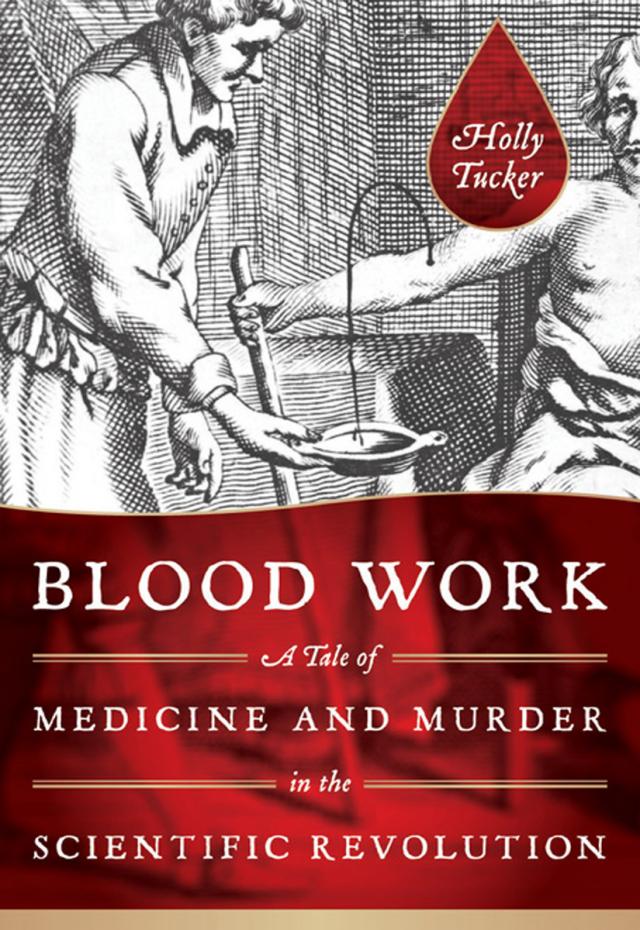
BLOOD WORK
ALSO BY HOLLY TUCKER
Pregnant Fictions:
Childbirth and the Fairy Tale in Early-Modern France
BLOOD WORK
A Tale of Medicine and Murder in the Scientific Revolution
HOLLY TUCKER
W. W. NORTON & COMPANY
New York • London
Copyright © 2011 by Holly Tucker
All rights reserved
For information about permission to reproduce selections from this book, write to Permissions, W. W. Norton & Company, Inc., 500 Fifth Avenue, New York, NY 10110
Library of Congress Cataloging-in-Publication Data
Tucker, Holly.
Blood work: a tale of medicine and murder in the scientific revolution / Holly Tucker.—1st ed.
p.; cm.
Includes bibliographical references.
ISBN: 978-0-393-07055-2
1. Blood—Transfusion—Europe—History—17th century. 2. Denis, Jean Baptiste, d. 1704. I. Title. [DNLM: 1. Denis, Jean Baptiste, d. 1704. 2. Blood Transfusion—history—Europe. 3. History, 17th Century—Europe. 4. Homicide—history—Europe. 5. Human Experimentation—history—Europe. 6. Public Opinion—Europe. 7. Science—history—Europe. WB 356]
RM171.T787 2011
615’.39—dc22
2010046340
W. W. Norton & Company, Inc.
500 Fifth Avenue, New York, N.Y. 10110
www.wwnorton.com
W. W. Norton & Company Ltd.
Castle House, 75/76 Wells Street, London W1T 3QT
For Audrey, heart and soul, moon and stars,
always and forever…
Very many maintain that all we know is still infinitely less than all that still remains unknown.
—William Harvey, De motu cordis (1628)
Blood is a juice of a very special kind.
—Johann Wolfgang von Goethe, Faust, Part 1 (1808)
Contents
Note on Translations
Dramatis Personae
Prologue
Chapter 1 THE DOCTOR AND THE MADMAN
Chapter 2 CIRCULATION
Chapter 3 THE AGE OF VIVISECTION
Chapter 4 PLAGUE AND FIRE
Chapter 5 PHILOSOPHICAL TRANSACTIONS
Chapter 6 NOBLE AMBITIONS
Chapter 7 “HOW HIGH WILL HE NOT CLIMB?”
Chapter 8 THE KING’S LIBRARY
Chapter 9 THE PHILOSOPHER’S STONE
Chapter 10 THE BLOOD OF A BEAST
Chapter 11 THE TOWER OF LONDON
Chapter 12 BEDLAM
Chapter 13 MONSTERS AND MARVELS
Chapter 14 THE WIDOW
Chapter 15 THE AFFAIR OF THE POISONS
Chapter 16 CHIMERAS
Epilogue
Blood Transfusion: A Chronology
Acknowledgments
Notes
Bibliography
Illustration Credits
Note on Translations
In all circumstances, I have first relied on period translations of the original foreign-language texts cited. In the absence of a period translation, the remaining translations are my own. The source of the quote (printed translation or translated original) is indicated in the notes that accompany the text. Minor changes have been made to regularize spelling or typography, but these do not impact the original meaning.
Dramatis Personae
France
England
Louis de Basril
(dates unknown)
outspoken lawyer in the Paris parliament
Robert Boyle (1627–91) chemist; founding fellow of the
Royal Society, corresponded with Richard Lower
Jean-Baptiste Colbert (1619–83)
prime minister to Louis XIV
Charles II (1630–85)
king of England; restored to the throne in 1661 after the execution of his father and the subsequent rule of Oliver Cromwell
Jean-Baptiste Denis
(c. 1635–1704) physician and transfusionist
Timothy Clarke (died 1672)
physician; founding fellow of the Royal Society, performed human infusion experiments with Christopher Wren
René Descartes (1596–1650) philosopher; espoused the theory of mind-body dualism and the idea that the body was a machine
Thomas Coxe (c. 1640–1730) fellow of the Royal Society; replicated Lower’s canine transfusions at the Royal Society with Edmund King
Paul Emmerez (died 1670) surgeon; Denis’ assistant
Arthur Coga (dates unknown) first transfusion patient in England
Nicolas Fouquet (1615–80) Louis XIV’s superintendent of finances; former political heir apparent to Prime Minister Mazarin
William Harvey (1578–1657) physician; announced discovery of blood circulation in 1628
Pierre Gassendi (1592–1655) philosopher; Descartes’ intellectual rival, member of the Montmor Academy
Robert Hooke (1635–1703) architect, microscopist; founding fellow of the Royal Society; former assistant to Thomas Willis, performed air-pump experiments on animals with Robert Boyle
Christian Huygens (1629–95) astronomer, mathematician; former member of the Montmor Academy, founding member of Louis XIV’s Academy of Sciences
Edmund King (1629–1709) replicated Lower’s canine transfusions at the Royal Society with Thomas Coxe
Guillaume Lamy (1644–83) physician; member of the Paris Faculty of Medicine; outspoken critic of transfusion
Richard Lower (1631–91) physician; fellow of the Royal Society, performed first transfusion experiments in England
Louis XIV (1638–1715) king of France, also called the Sun King; began personal reign in 1661, following the death of Prime Minister Jules Mazarin
Henry Oldenburg (1619–77) German-born diplomat and natural philosopher; secretary of the Royal Society
Henri-Martin de la Martinière
(1634–76)
physician; once a doctor on corsair (pirate) ships; outspoken critic of transfusion
John Wilkins (1614–72) founding member and first secretary of the Royal Society, with Henry Oldenburg
Antoine Mauroy (died 1668) Denis’ famous patient; died following a transfusion in April 1668
Thomas Willis (1621–75) physician and anatomist; fellow of the Royal Society, studied the human brain with the help of Robert Hooke and Christopher Wren
Perrine Mauroy (dates unknown)
wife of Antoine Mauroy
Christopher Wren (1632–1723) architect, astronomer, mathematician; founding fellow of the Royal Society; performed blood infusion experiments with Thomas Willis
Henri-Louis Habert de Montmor
(c. 1600–79)
nobleman; founder of the Montmor Academy for the Sciences
René Moreau (1587–1656)
physician; member of the Paris Faculty of Medicine
Claude Perrault (1613–88) physician, architect; member of the Paris Faculty of Medicine, founding member of Louis XIV’s Academy of Science; performed canine transfusions in the king’s library
Nicolas de la Reynie (1625–1704) first police chief of Paris; appointed by Louis XIV
Samuel de Sorbière (1615–70) permanent secretary of the Montmor Academy
Prologue
On December 14, 1799, America’s first president awoke with a sore throat, which was soon accompanied by a fever. At six that morning, George Washington’s doctors agreed it was time for a bloodletting. Eighteen ounces of blood later, the patient’s condition had not improved, and he was bled twice more. Not long after, Washington was unable to breathe—medical historians believe that he suffered from an infection of the epiglottis—and a tracheotomy was performed. A fourth round of bloodletting followed, to no avail. Washington gasped for breath like a drowning man and died late that evening, around ten o’clock.1
Though we will never know whether Washington died of his illness or of the severe bloodletting he suffered during his “treatment,” many historians would bet on the latter. His body was laid out in the family’s formal parlor so that prominent visitors could pay their respects. Yet as the nation prepared to mourn its first president, others wondered if there was a way to bring him back to life.
When Washington’s granddaughter, Mrs. Thomas Law, arrived the next morning, she brought with her a man who suggested the unthinkable. Dr. William Thornton, best known as architect of the U.S. Capitol, speculated that the president could be revived if both blood and air were returned to his corpse. Dr. Thornton suggested that Washington be warmed up “by degrees and by friction” so his blood might be coaxed to move once again through his body. Then Thornton proposed to “open a passage to the lungs by the trachea, and to inflate them with air, to produce artificial respiration, and to transfuse blood into him from a lamb.”2
Thornton’s idea of transfusing the dead president was swiftly rejected by Washington’s family. They did not quibble with the doctor as to whether resurrection by transfusion could be possible. Instead they declined on the grounds that it was better to leave the memory of George Washington’s legacy intact as “one who had departed full of honor and renown; free from the frailties of age, in full enjoyment of every faculty, and prepared for eternity.”3 Death was preferable to any extraordinary attempt to resurrect the president using animal blood.
Thornton was not the first to propose blood transfusion as a miraculous cure, nor was he the first to consider animals as donors. More than 130 years earlier, between 1665 and 1668, all of Europe was abuzz with excitement over the possibility of blood transfusion. French and English scientists were locked in an intense battle to master blood’s secrets and to perform the first successful transfusion in humans. Members of the British Royal Society began by injecting any number of fluids into the veins of animals: wine, beer, opium, milk, and mercury. Then they turned their sights on transfusions between dogs—large ones to small ones, old ones to young ones, one breed to another. The French Academy of Science followed suit with its own canine transfusion experiments but to its dismay was unable to replicate English successes.
Then, seemingly out of nowhere, a young physician named Jean-Baptiste Denis surprised the scientific world when he performed the first animal-to-human blood transfusion to great acclaim—and even greater controversy. On a cold day in December 1667, Denis transfused lamb’s blood into the veins of a fifteen-year-old boy. The result was stunning: The boy survived. But fate would not be kind to Denis for long. Flushed with success, Denis tried his next, and last, round of transfusions—this time on a mentally ill, thirty-four-year-old man named Antoine Mauroy. The doctor cut open the vein of a calf and rigged a rudimentary system of goose quills tied together with string. He then transfused just over ten ounces of calf’s blood into Mauroy’s arm. By the next morning signs looked promising that the experiment was going to work—or, at the very least, not be fatal. Several days and several transfusions later, however, Mauroy was dead. And Denis was soon accused of murder.
In a dramatic turn of events, a Paris judge cleared Denis of all accusations on April 17, 1668. Still, the madman’s death signaled an end not only to Denis’ career as a transfusionist but also to transfusion entirely. In its judgment the French court mandated that no future human transfusion could be performed without prior authorization from the Paris Faculty of Medicine. And this was very unlikely to happen, given that the medical school had made no secret of its hostility toward the procedure. Two years later, in 1670, the French parliament banned transfusions altogether; transfusion experiments were also stopped in England, Italy, and throughout Europe, not to be taken up again for 150 years.
This book views the story of the Denis trial through two different lenses. First, it is a microhistory that traces the little-known and captivating tale of the rise and fall of the transfusionist Denis, and blood transfusion more generally, over a period of about five years during the seventeenth century. But, perhaps more important, it is also a macrohistory that traces the confluence of ideas, discoveries, and cultural, political, and religious forces that made blood transfusion even thinkable in this era before anesthesia, antisepsis, and knowledge of blood groups. This story is, then, as much about the scientific revolution—its greatest minds and most calculating monarchs—as it is about blood transfusion itself.
The term “scientific revolution” has long been a matter of debate among historians, and I should pause briefly here to explain the use of it in my subtitle and at various moments throughout the book. Beginning in the late 1940s with the work of such legendary historians as Alexandre Koyré and Herbert Butterfield, the scientific revolution was understood as the unequivocable birth of modern science—the decisive moment at which science heroically supplanted superstition and never looked back. This is not how I use the term. Instead I join more recent historians who have worked diligently to nuance our understanding of the scientific revolution as, explains Steven Shapin, “a diverse array of cultural practices aimed at understanding, explaining, and controlling the natural world, each with different characteristics and each experiencing different modes of change.”4 If we can be certain about one thing when it comes to the scientific revolution, it is that there were no easy answers, no clear consensus. Natural philosophers—as scientists were called then—tussled with one another to unlock nature’s truths, and more often than not they disagreed, sometimes violently.
The early chapters of this book begin across the Channel, in England, where the foundations for the Frenchman’s history-making transfusions were laid. Here, men like Christopher Wren, Robert Boyle, and Robert Hooke performed experiments to test William Harvey’s recent discovery of blood circulation. This foray into the larger, international context of early science—fascinating and drama-filled in its own right—lays the foundation for what was, in the end, a showdown between France and England in the fight for scientific dominance.
At the core of this battle lay the race to solve enigmas about both earthly and divine worlds that were as complex as they were controversial. In the early decades of the seventeenth century, Harvey turned understandings of the human body upside down when he announced his discovery of blood circulation. René Descartes had also made his radical pronouncement, “Cogito ergo sum [I think therefore I am],” claiming that the mind—and the soul—were independent from the body, which he argued was little more than an ingenious machine. In a Europe still recovering from the ravages of religious wars, natural philosophers tried to make sense of the broad implications of these and other theories that had so unsettled traditional understandings of science and the body.
A perfect storm had been brewing in Europe, between France and England, Catholics and Protestants, and, especially, science and superstition. And transfusion sat at the heart of it all. It is through this larger cultural and political narrative that Denis’ experiments must be told. The early story of transfusion is not just about an ambitious man whose efforts met with resounding failure; it is the story of a world undergoing radical transformation as science and society changed at a pace never before imagined.
As novelistic as this world of early science may seem, however, this book is a work of nonfiction. My narrative approach to history frames what is, above all, a study of historical documents, manuscripts, medical manuals, personal letters, and illustrations—some well known and many esoteric, even obscure. Still, to research and to write about history also means coming face-to-face with any number of conundrums, contradictions, and archival gaps. Confronted by those moments, I have relied on what I know intimately about the time period, its actors, and its power structures as a professor of early medicine and culture. Yet, as imperfect as our knowledge about any moment in the past necessarily is, the lines between fact and fanciful speculation must nonetheless be firmly drawn. In this regard I am indebted to cultural historians such as Carlo Ginzburg, Natalie Zemon Davis, Robert Darnton, and David Kertzer, whose scholarship guided my own efforts to make history’s stories come alive—responsibly and in ways that breathe life into a chapter of early science that might otherwise be lost to general readers.
History books rarely mention early transfusion, primarily because it does not fit at all neatly into the larger narrative of the “revolutionary” triumphs of science in the seventeenth century. As one scholar wrote, “It is probably fortunate that blood transfusion took a nap for over one and a half centuries. Ignorance of antisepsis, asepsis, and immunology would have resulted in countless disasters.”5 This is likely true. The few historians who have studied early transfusion argue that the procedure was outlawed in France, England, and Italy in the wake of the Denis trial because it was too deadly.6 And when I first learned about the Denis case several years ago, I was inclined to agree. However, the more I researched contemporary accounts of the experiments and the court case that followed, the less this argument held up.
It does not take an advanced degree in immunology to imagine how transfusing animal blood into human veins could be dangerous, or even lethal. But surely if mortality concerns alone were at the heart of the initial prohibitions against transfusion, many other procedures would also have been banned. Bladder stones, for example, were frequently removed through penile extraction or by cutting so deeply into the perineum that the barber-surgeon could reach his whole hand into the patient’s body. The operation was so painful that the Renaissance surgeon Ambroise Paré explained that it took four strong men to hold his patients down during the operation. The procedure was also notoriously fatal—so much so that the English diarist Samuel Pepys put his stone on display and celebrated each anniversary of his own procedure, exceedingly grateful that he was still alive.7


