Edward lee, p.32
Daisy and the Unknown Warrior, page 32


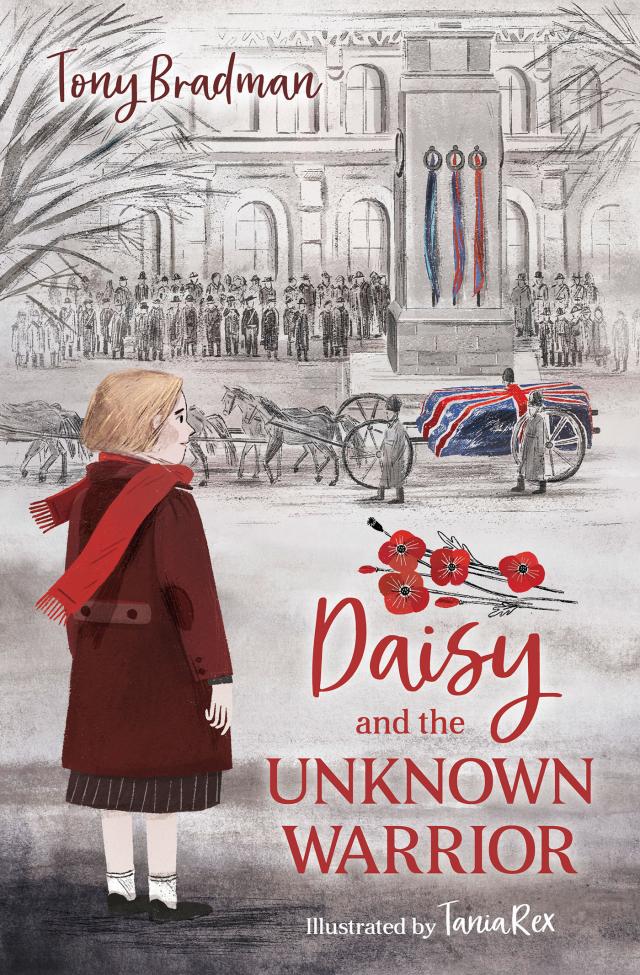
First published in 2020 in Great Britain by
Barrington Stoke Ltd
18 Walker Street, Edinburgh, EH3 7LP
This ebook edition first published in 2020
www.barringtonstoke.co.uk
Text © 2020 Tony Bradman
Illustrations © 2020 Tania Rex
The moral right of Tony Bradman and Tania Rex to be identified as the author and illustrator of this work has been asserted in accordance with the Copyright, Designs and Patents Act, 1988
All rights reserved. No part of this publication may be reproduced in whole or in any part in any form without the written permission of the publisher
A CIP catalogue record for this book is available from the British Library upon request
ISBN: 978-1-80090-004-2
For the fallen - and their families
CONTENTS
Chapter 1
Chapter 2
Chapter 3
Chapter 4
Chapter 5
Chapter 6
Historical Note
Chapter 1
It was a cold morning at the end of October 1920, and Daisy Robinson was taking her two younger brothers to school. She had to go to school as well, of course, so you could say they were on their way together. But Daisy was in charge.
“Oh, for heaven’s sake, you two, hurry up!” she said. “Mr Jones will be ringing the bell soon, and he’ll be cross if we’re late.”
“Don’t blame me,” snapped William. “It’s Albert who’s hanging about.”
“You shut up, William!” said Albert. “You’re horrible and I hate you!”
A tram went rattling past on its way to Highgate Hill. The streets of North London were full of people on their way to work and school under a gloomy sky. There had been an overnight frost, the first of the autumn, and the pavement glittered with tiny stars of ice. The air was foggy with the coal-fire smoke that curled up from all the chimneys. The war had been over for two years, but London and the people who lived there still looked grey and tired.
William and Albert had stopped and were having another argument. Daisy sighed. Her brothers could be so irritating. William, with dark hair, was eight, three years younger than her but nearly as tall, and he always argued back. Albert was six; he had fair hair like Daisy. He was also tall for his age, and he was always worrying about things. Daisy wished she didn’t have to spend so much of her time looking after them, but Mum really needed her help.
“Right, last one to school doesn’t get any tea tonight,” said Daisy at last. She ran down the street but not too fast so the boys kept up with her and weren’t left behind. They ran into Mafeking Road, and then Daisy let her brothers beat her to the school gates.
When she got there, they were waiting for her, out of breath and laughing, happy once more.
“We’re the winners!” said William. “So it’s no tea for you tonight, Daisy!”
“Oh well, I’ll just have to go hungry then, won’t I?” said Daisy with a shrug. “Now you’d better run along and line up with the rest of your class.”
William grinned and dashed into the open yard beyond the school gates. They called it the playground, but really it was just a courtyard covered in black tarmac. The school was five storeys high: a dirty, sooty red-brick building with two doors. One was for BOYS, and the other was for GIRLS – the words were on the stone lintels above the doors. Children were lined up in front of them, waiting to go in.
“I don’t want you to be hungry, Daisy,” Albert said softly as he slipped his little hand into hers. His face was full of worry. “I’ll share my tea with you tonight.”
“Thanks, Albert,” said Daisy, ruffling his hair. “That’s very sweet of you, but there’s no need. We were just joking. Now you’d better run along and line up too.”
Albert smiled up at her and did as he was told. Daisy watched him line up. Both her brothers wore the same kind of clothes as the other boys – thick jackets, woollen jumpers, grey shorts, long socks and thick boots. Daisy wore a thin coat and an old dress, short white socks and her only pair of shoes. Everything was a bit small for her, but Mum didn’t have the money to buy new clothes.
Daisy walked into her bit of the playground just as Mr Jones, the headmaster, came out of the school. He was short, round and bald, and was carrying a hand bell. He rang it – CLANG-A-LANG-A-LANG – and that was the signal for everyone to go in, class by class.
Daisy nodded to her friends but looked over at her brothers, smiling to herself at how much they looked like Dad … Thinking of Dad made her smile vanish. She wished she hadn’t thought about him just then, and now it was too late. She’d be thinking about him in class now and not listening to the teacher.
As she went into the classroom and sat at her desk, all her old sad feelings flooded in. Dad had been dead for two years, and she was more upset than ever about it. She was angry too. Why had he joined the Army and gone off to fight in such a stupid war? He should have stayed at home with her and Mum and William and Albert …
Daisy knew, though, that couldn’t have happened. She’d been just five years old when the war began in 1914, and she didn’t really remember those days. But Mum had told her what that time was like. Most people were excited about the war, and lots of men were keen to fight the Germans. Dad wanted to join up as soon as possible. Mum had been expecting Albert, though, and she’d made Dad wait.
In the end, Dad signed up in the summer of 1915, and from then on they didn’t see him much. Daisy remembered the last time he’d come home on leave, in 1918. He was thin and very tired. Yet he’d still sung her his favourite song, the one she’d been named after: “Daisy, Daisy, give me your answer, do, I’m half crazy, all for the love of you …”
Three weeks later they were told he was missing, presumed dead.
Like thousands of other soldiers in the war, Dad’s body had never been found. So they’d never had a funeral for him, and to this day they didn’t know where his body was. Daisy often wished they could have said goodbye to him somehow …
“Are you all right, Daisy?” she heard somebody say, breaking into her thoughts. Their class teacher, Miss Wilkins, was standing in front of Daisy’s desk, looking worried.
“Yes, Miss,” said Daisy.
Miss Wilkins nodded and got on with starting the day for her 45 pupils. They chanted their times tables, did some mental arithmetic and listened to a Bible story. Daisy liked school and tried her best to concentrate, but nothing could make her feel better today. Sadness hung over her like a dark cloud.
Then Miss Wilkins told them something, and she started to pay attention.
Chapter 2
Miss Wilkins was young and pretty, but she was always sad too, and everybody knew why. The young chap she’d been going to marry had also joined the Army and, like Daisy’s dad, he hadn’t come back. Miss Wilkins still hadn’t got over it.
At the end of every day she asked the class to sit, and they all said prayers for the men who had died in the war. She did the same today, but instead of letting the children go home when they’d finished their prayers, Miss Wilkins asked them to stay in their seats.
“I’m sure most of you have heard the marvellous news,” she said, her blue eyes shining. She kept her long brown hair tied in a bun, and as usual she was wearing a black dress. Like she’s going to a funeral, Daisy thought.
“For those who haven’t,” Miss Wilkins went on, “you should know there’s a plan to make this year’s Armistice Day even more special than last year’s …”
The war had ended in November 1918, when Germany admitted it had been defeated. The “Armistice” was the agreement to stop the fighting between the Allies including Britain and France on one side, and Germany on the other. The guns fell silent on 11 November – at the eleventh hour, of the eleventh day, of the eleventh month of the year. From then on, 11 November was set aside as a day to remember the people who had been killed in the war.
The first Armistice Day was on 11 November 1919. There was a two-minute silence at eleven o’clock that morning. Everyone in the country stopped what they were doing and stayed silent for two minutes to think about the men and women who had been killed in the war, and say a prayer for them.
Daisy remembered that first Armistice Day very well – it had been strange and upsetting. It was a Tuesday, so she’d been at school. Nobody knew what to expect. Just before eleven o’clock, rockets were fired all over London as a signal that the two-minute silence should begin. For Daisy the bangs made her think about bombing raids in the war, but the silence afterwards made her think about Dad. By the time it was over she was sobbing, and so was everyone else.
Miss Wilkins told them that this year the government planned to find the body of an unknown soldier who had died in France or Belgium and bring him to London. They would bury the body at Westminster Abbey, the ancient church opposite the Houses of Parliament. There would be a special service at Westminster Abbey, and a new monument to remember all the unknown soldiers had also been built in Whitehall. King George V was going to be there, and the Prime Minister, and many other important people.
Daisy listened hard to everything Miss Wilkins said. She knew about the “unknown soldiers”. All British soldiers wore name-tags on strings around their necks so that if they were killed, the Army could keep a record of their names. But often the tags got lost in the battles, and there was no one left to know who the dead men were. The Army would bury the body, but they couldn’
t put a name over the grave. There were thousands of graves in the battlefields marked with simple wooden crosses that just said, “An Unknown British Soldier”.
Mum had done her best to find out about Dad from the Army, but they hadn’t been much help. They did tell her that Dad’s battalion was fighting near the Belgian border with France when he was killed. The Germans were pulling back, and Dad had probably died in battle in early November, only a few days before the Armistice agreement. The Army didn’t know how he had died or where he was buried.
It made Daisy very sad that she and Mum and her brothers could never visit Dad’s grave.
As she listened to Miss Wilkins tell them that an unknown soldier was going to be dug up and brought home, Daisy felt excited. Hang on, she thought … What if the unknown soldier is Dad?
Miss Wilkins was still talking. Daisy heard her say there would be seats in the Abbey for the families and loved ones of some of the unknown soldiers. “People have to write and apply for tickets,” she said. “There won’t be that many, but I hope I can go.”
“Please, Miss!” said Daisy, putting up her hand. “How will they decide which soldier to choose? I mean, do you know where they’ll be looking for him?”
The letter the Army had sent said that Dad’s battalion had been fighting in France and Belgium. If that’s where the government ordered a search for the body of an unknown soldier, there was a chance Dad might be the one they found.
“No, Daisy, it will be done in secret.” Miss Wilkins sometimes didn’t remember the name of every child in the class, but she always remembered Daisy. “No one will ever know who the dead soldier was. His body will be there to represent all who gave their lives.”
Miss Wilkins let the class go, and Daisy went to collect her brothers. They ran out of school, and Daisy plodded down the street after them, brooding on what Miss Wilkins had said. Perhaps the unknown soldier who was going to end up in a grave in Westminster Abbey might be Dad. But she’d never know for sure, would she? That felt worse than knowing it definitely wasn’t him.
Just then, a baker’s delivery boy rode past her on his bike. He was whistling Dad’s song. It was her song too: “Daisy, Daisy”. She stopped, and her head suddenly filled with memories of Dad dancing with her as he sang it, both of them laughing, Mum and her brothers laughing too.
Daisy’s eyes filled with tears. She walked on after a while, but now she felt strange. Had it been a sign?
Was Dad reaching out to her, telling her he was going to be the one they chose?
What a daft idea, she told herself. But she couldn’t get it out of her mind.
Chapter 3
Daisy got the boys home and settled them down with cups of tea and some buns that Mum had made a few days before. They were only a bit old and stale. William and Albert sat at the table in the kitchen, munching and slurping away.
The Robinson family lived in a flat on the second floor of an old building in Archway. They had two bedrooms, a living room with gas lamps on the walls, and a kitchen just big enough for a table and chairs and a gas cooker. Mum and Daisy slept in separate beds in one bedroom, and the boys shared a bed in the other. When Mum was in a good mood, she said the flat was “cosy”, but it was a tight fit for the four of them.
Mum wasn’t in a good mood very often, though. She missed Dad terribly, just like Miss Wilkins missed her chap. Daisy remembered the awful day when a boy from the Post Office had brought the telegram telling them that he had died. Mum cried for hours. She’d pulled herself together at last – for Daisy and the boys, she’d said – and she’d stayed strong in front of them ever since. But Daisy knew she sometimes cried in bed at night.
Mum was fed up about other things too. Dad had worked on the railways before he’d gone to fight. His job was at the ticket office at the big station in King’s Cross. When he joined the Army, he got paid much less. Mum had found herself a job to make up the difference, and to help the country. Family and friends had stepped in to look after the boys until Daisy was old enough to help.
With so many men away at war, women had to fill in for the men’s jobs. Mum worked on the trams. Each tram needed a driver, and also a conductor to take fares from passengers and hand out tickets. There were very few women drivers, so Mum worked as a “conductorette”. She loved it, and the wages were good. Daisy and her brothers got free rides on Mum’s tram, which they loved too.
Then the war ended, and the men who survived wanted their old jobs back. The tram company sacked Mum – and that meant they lost their home because they couldn’t afford it any more. They’d been living in a nice little house Mum and Dad had moved into after William was born. Now the rent was just too much to pay, so they’d ended up in the flat in Archway. Mum hated it from the day they moved in.
After a while, she found another job, washing and ironing clothes at a laundry. The government gave her a pension because of Dad being killed while he was in the Army. But the laundry job didn’t pay much, the work was really hard, and the pension was even less than Dad had been paid in the Army. So they never had enough money to pay the rent and buy everything they needed.
Mum worked long hours and Daisy had to help, especially by looking after her brothers. William and Albert were sometimes irritating, but Daisy loved them. That’s why she still took them to school even though they were old enough to go on their own. She’d been the same age as Albert when she’d started going to school by herself.
Daisy lit a fire in the living room. She made sure she didn’t use too much coal, of course. It had got much more expensive since the war. Like most things, thought Daisy.
Just then she heard Mum’s key in the front door. “Hello, everybody!” Mum called out. The boys had finished their cups of tea and buns and were in the living room. William was reading a comic, and Albert was playing with his toy soldiers. Mum shut the door and sighed, happy to be home at last. Albert looked up and ran to give her a hug; William and Daisy got up too.
“Fancy a cuppa, Mum?” Daisy said. “I’ll make it. You go and take it easy.”
“Thanks, love,” said Mum. “I really don’t know what I’d do without you.”
Mum had dark hair like William, and she was only a little taller than Daisy. She was pale and thin and always looked tired, but Daisy thought she’d been even more weary than ever these last few weeks. She had dark rings under her eyes, and her hands were red and sore from being in water so much at the laundry. Now she sat in front of the fire, still in the old dress she wore for work, her shoes off, her feet stretched towards the flames.
Daisy took Mum her cup of tea, then just stood there. She was bursting to tell Mum about what Miss Wilkins had said. But she didn’t know where to start or whether it was even a good idea. Sometimes Mum was grumpy when she got home from work, and talking about Dad could upset her. It couldn’t be helped, Daisy decided. She had to speak up – this was too important.
“Miss Wilkins told us something interesting today, Mum …” she began.
Mum smiled at her, and Daisy gabbled away. She told Mum what Miss Wilkins had said to the class. “We have to apply for tickets to be at the Abbey,” Daisy blurted out. “Because it might be Dad, and that means we can say goodbye to him, and …” Daisy stopped talking suddenly. Mum wasn’t smiling any more.
“I heard all about it,” Mum snapped. “In fact it was the only thing anyone was talking about at work today, and I’m fed up with it. What makes you think they’ll let in the likes of us? Trust me, those tickets will go to the toffs – the people who started the war. And there’s no chance it will be your dad, so you’d best forget the whole thing.”
“But, Mum, I …” Daisy began.
Mum was having none of it.
That night they ate their tea in silence and went to bed early.
Chapter 4
Over the next few days, Daisy tried to talk to Mum about the unknown soldier and the service at Westminster Abbey. Mum ignored her, and in the end she got cross. “Oh, for heaven’s sake, Daisy, give it a rest, will you?” she said one evening. “I don’t want to hear another word about it!”