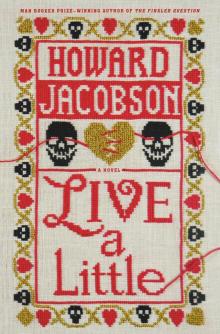
Live a little, p.24
Live a Little, page 24


“No, but I fear I will be.”
“That’s the very fear that adrenaline cancels out. You’ll be too high on the excitement of performance to notice it.”
“No performance of mine was ever exciting. It’s lasting out that worries me. And then there are the social issues.”
“What social issues?”
“Meeting people.”
“Meeting people sends you to the john?”
“Meeting these people will.”
“Why? Who are they? Hollywood moguls? Talent scouts?”
“In a manner of speaking, Doctor, talent scouts are exactly what they are. They’re elderly widows.”
“Then they’ll be rushing to the john too.”
“That won’t help me. Please, can you just prescribe me something?”
“What’s wrong with what I gave you last time?”
“I want to shock my body with something new.”
“And the Widows won’t do that?”
Shimi throws him the look of a thousand-year-old man.
Dauber writes him a prescription for oxybutynin chloride. “Don’t overdose on them,” he warns.
“Why? What will happen?”
“You’ll get confused.”
Shimi adds another hundred years to his expression.
“All right—more confused.”
* * *
—
THEY DON’T GO together to the Widows’ Ball, as the Princess now insists on designating it. Shimi has to be there early for sound checks and the like. The Princess follows with Nastya providing an arm to lean on, should an arm to lean on be necessary, but she isn’t planning to lean on anybody. She is once more the belle of the ball. She would have preferred the company of Euphoria but it’s Nastya’s turn to be on duty and the girl will not be denied the opportunity to dress up. “Don’t expect there to be any dukes there,” the Princess warns her. Nastya puts on her shortest dress just in case.
The Princess, too, has given thought to her wardrobe. It dismays her that she’s losing memory of the clothes she owns. Every time she slides open a wardrobe door it is as though she is entering an enchanted place. What are these garments? Such occasions they must have graced! Slowly, as recognition dawns—more painfully when it doesn’t—she is pulled back into sadness. So this was her, was it? Her past, when she doesn’t have her diaries to consult, is like dancing with skeletons. To see again the dresses in which she did dance with them only adds to the ghoulishness. They hang, in her imagination, as though from wasted shoulders. But she is resolute. One by one she pulls them out, all the way back to engagement parties and weddings and May Balls. The more sardonic her recollections, the better able she is to see the figure she cut. In this one she refused a proposal of marriage. In that one she discovered the father of one of her children—maybe—pleasuring another woman in the bushes. Seeing him, again, bent as though over a wheelbarrow, with his trousers down round his ankles, brings back to her how fine she looked in plunging black velvet with a diamond choker round her throat.
Oh, the elegance and absurdity of the long life she’s lived. Her sadness vanishes. Yes, she will find something that is dead right and she does—a ceremonial furisode kimono that is a replica of that worn by the soprano Birgit Nilsson when she sang Turandot at Covent Garden. For a chill Princess a still icier Princess’s robe. The story of how she came by it has been amplified over time, but what she will tell the Widow Wolfsheim is that she admired the furisode at a post-gala performance dinner some time in the 1960s or maybe even the 1950s, whereupon the soprano, examining her from head to toe, declared she’d make a better Turandot than her. “I cannot sing,” Beryl Dusinbery replied, but Nilsson swept that consideration aside. “Your appearance alone would riddle a man to death,” she said. And Beryl Dusinbery returned the compliment. “Were I the Prince of Persia I would have died at your hand rather than find my way out of the labyrinth of your desires,” she said. The women exchanged chaste kisses. They must have looked like snowy egrets embracing. A copy of the gown arrived in a chauffeur-driven Bentley a week later.
She is gratified by Nastya’s appreciation of her when she’s dressed.
“You look million dollars.”
“Then let’s go before I depreciate.”
“I take chair?”
“Only if you intend to sit in it.”
The girl takes a photograph of the Princess with her mobile phone. And then a selfie of them together.
* * *
—
SHIMI DOESN’T APPEAR until everyone is seated. He has stipulated no stage. He will go from table to table and describe the cards he deals so that even those unable to see can participate in the drama. He says a few words about the ancient art of cartomancy—its origins in China, its passage through the Middle East to southern Europe, the significance of some of the key cards—which to watch for, which to welcome, which not to—and why it’s forbidden ever to defile the pack by performing conjuring tricks with it. Divination, he explains, is more august than magic.
Shirley Zetlin has heard all this before. The most boring and insulting night of her life. But if she’d been inclined to heckle she is constrained by the immediate proximity of Wanda Wolfsheim, who is not going to let anything untoward take place. To that end she has seated Hilary Greenwald on the same table. Next to Beryl Dusinbery, who has not found a headdress to complement her furisode but has put her hair up and slid a pencil through it. The Turandot reference is not lost on Wanda Wolfsheim. Without doubt it’s overdone, but when did that ever bother a man?
Shimi is well served by his abstractedness. He notices little of the room, the flower arrangements, the guests. The cards engross him, as does the matter about which he consulted Dr. Dauber and for which he has swallowed more pills than is recommended on the box, but then the box doesn’t know the stress he’s under. So far so good, but the evening has just begun. He pushes back the sleeves of his jacket, as though to demonstrate he is concealing nothing, but it is a gesture designed more to show off his cuffs than prove his probity. His wrists are the part of him he likes best. They are manly he thinks, not scrawny but strong, and yet refined. He has countless pairs of cufflinks, many with his initials engraved on them. Tonight he is wearing a simple gold pair, oval with chain links. The Widow Wolfsheim has bought him cufflinks very similar, but these were a present from his mother.
At the Widow Chomsky’s table the ace of clubs is the first card up. “Ah!” Shimi exclaims as though the devil or the god of love has come among them. The Widows gasp in mock collusion. Shimi’s explanation that the ace of clubs is the card of matrimony evokes great mirth. “I think there’s been enough of that at this table,” the Widow Chomsky mutters in a loud aside. It is all, he explains, about combinations. For example, the three of hearts, which he deals next, combines with the ace of clubs to denote a beauty parlour. The Widow Chomsky’s friends laugh again. They all spend too much time in beauty parlours already. “Perhaps you are about to inherit one,” he tells the Widow Chomsky. But when a six of spades appears, which either promises a new car or warns of problems with a mobile home, followed by a two of spades, the card that augurs employment difficulties, a little of the sparkle leaves the table. Has Shimi forgotten to bring his A-deck? There will be a raffle before the evening ends and Wanda Wolfsheim has asked him to ensure he leaves the guests in open-handed spirits. Shimi lowers his voice to a guttural Russian and finds cards that presage the fulfilment of secret wishes, faraway places, romantic journeys, good health, great-grandchildren. He is not a comedian or a flirt, but he feels confident with the cards in his hands and his wrists on show. He diffuses an old-fashioned courtliness, reminding the Widows of their fathers, so that when he conjures felicity or fortune from the cards, they see no reason not to believe him; but he is also Ivan the Terrible, so at the mention of a journey the Widows see themselves in a speeding troika, scarfed against the snow but exquisitely vulnerable to temptation.
He visits a couple more tables before he finds himself at Wanda Wolfsheim’s. It takes him a moment or two to realise who else is sitting with her. And once he does, a wave breaks over him and he is flooded with a panic indistinguishable from sorrow. Why are there women here who, with good reason or not, think the worst of him? Why them, of all people? What is this trick Wanda Wolfsheim has played? What are these poisons that will never leave his body? It is as though the hour of judgement is at hand and he is being read to from the Book of Past Transgressions. It wants only his mother to be here and he would fall on his knees and beg forgiveness.
The wave tosses him to and fro. He can’t, he realises, go on with the cards. He puts a hand on the table. Eyes are on him, but none he wants to look back into, except perhaps—there is always a perhaps—Beryl Dusinbery’s, and she is too grandly attired to be a comfort to him. Yes, he thinks again, it only wants his mother to be here, and in his confusion—for things are losing their distinctness quickly—he sees her. His mother with a pencil in her hair…
He puts another hand out to keep himself upright, feels a surge of terror whose source he thinks is his bladder, notices his cuffs and is pleased at least that they have not disgraced him…perhaps if he can keep them above the rising tide…and then crashes to the floor.
It is the Princess who cries the loudest—like a scream from a Greek tragedy, the Widow Wolfsheim thinks disconsolately—the Princess who, indifferent to the rustiness of her joints and the cumbersomeness of her garment, is the first to leave her seat, the Princess who is the first to kneel by him, the Princess who cradles his head.
There was no need for hospitalisation. She took him back to her apartment and put him in the guest bedroom. He was confused still but not so confused that he didn’t, at the threshold, pause to ask whether there was an en suite.
“Of course there’s an en suite. What kind of place do you think you’re coming to? You’re on the right side of the Finchley Road now. In my apartment the en suites have en suites.”
“I won’t stay here long,” he promised her.
She promised him he would.
“I’m as right as rain,” he told her when he next opened his eyes.
“How long do you think you’ve been here?” she asked him.
“Twenty-four hours.”
“Then you’re not as right as rain. You’ve slept for forty-eight.”
It suited her that he didn’t know what day it was. She’d found the sharpness of his faculties uncanny. It equalised things between them a little that he should be bewildered as to time. A man who remembers everything and a woman who remembers nothing—that wasn’t quite the way it was: she recalled plenty when she chose to; but it was near enough to being true to worry her. She had put her trust in no man. The present she commanded—no one did the present quite as she did—but she couldn’t with equanimity gift him everything before that. It left her back uncovered.
“It would suit me if you had a little fall more often,” she said.
A “little fall” was how they described what had happened to him.
“Why is that? So you can go on looking after me?”
“Don’t call it that. I am not a mother-hen.”
“What should I call it, then?”
“Extending our opportunity.”
“For?”
“It would be gross to name it.”
“And how would whatever it is be helped by my having a ‘little fall’ more often?”
“It would mean we’d be hazy about the same things. You remember too well. You don’t surprise yourself often enough.”
“Why should that be a problem between us?”
“Who said it was?”
“You implied it.”
“No, you inferred it.”
“You should try a little fall yourself, Mrs. Dusinbery. It might render you less pedantic.”
She waved the criticism away as though it were a tiny flying insect. “I don’t need a fall. I’m hazy enough. But you—you could do with some blurring at the edges. A man who knows the course of his life so well that he is never a surprise to himself shuts down the future. You too often have the air of someone who knows how it will end.”
“Then I give a false impression. What you see is fear. I dread the candle going out without ceremony or fuss. Just pfft…I dread it ending in a little nothing.”
“Then we must make certain it’s a big nothing. I haven’t moved you in for something small.”
“So you admit you’ve moved me in?”
“For the time being.”
He looked at his watch. “Time being!”
“There’s the faint-heartedness I’m talking about. You think you’re coming to the end because you’ve told the same, unvarying story to yourself a thousand times. Risk another story. Risk another end. For me, if not for you. I refuse to allow you to know me as you know yourself.”
“Then I would be better living across the road.”
“That doesn’t follow. Aren’t we in this for the challenge? Anyone can spring a surprise when you see them only once a year. Real genius is taking someone’s breath away when you’re with them every hour.”
“You’re asking a lot of yourself.”
“And of you.”
“I am more surprisable than you think. I might not strike you as sizzling with expectancy but I am not closed to the future. Right this minute I would call myself suspenseful.”
“This must be the consequence of your little fall.”
“Not so. I inherited it. My mother and her sisters were like musical instruments, a xylophone orchestra of women, each waiting for the hammer to hit the others. Dread was the only music they heard. Something going wrong for one of them meant something going wrong for them all. I’m past the age of waiting for something to go wrong. It already has. So now I’m on edge waiting for the opposite assurance—not that everything will suddenly turn out right—it was only a little fall—but that there’s a shape to it all, like the end of a good mystery story, when you see why everything happened as it did.”
“Please don’t tell me you’re waiting for a blinding flash.”
“Blinding, no. A gleam, that’s all. A glimmer.”
“Of truth?”
“I wouldn’t go that far. Just some gentle reassurance.”
“What of?”
“I don’t know. If I knew, maybe I wouldn’t need it. I can only put it in opposites. The opposite of dying like that oyster in your embroidery, vanishing down an open throat. With no one listening.”
“I’ll listen.”
“That’s not enough. I want to be told something. I want to hear my name. I want an old-fashioned blessing.”
“Then I’ll bless you.”
“And I will receive your blessing with the deepest gratitude. But you’re an interested party. You can’t speak for impersonal nature. And anyway you don’t believe any of that.”
“You mustn’t make assumptions about what I believe from my embroideries. They’re fictions.”
“We’re all fictions,” he said, without quite knowing what he meant. “Maybe all I’m waiting for is someone to tell me that I’m not. A kindly acknowledgement of my reality. Noted in passing. My presence ticked, as in an attendance register. Shimi Carmelli? ‘Here, miss.’ Only of course I won’t be here, I’ll be gone. But at least, if I’m ticked…”
“What?”
“I’ll be happy.”
“Personally happy?”
What was she asking him to say? That he was happy with her? That she made him happy? He could almost say it—almost, almost say it—but he couldn’t quite.
What he did say was, “Yes, that as well. But would you believe me if I said metaphysically happy. Accepted into the scheme of things. You aren’t an aberration, Shimi. What you did you did because that’s what people do. Even what people are expected to do. With all your faults you are of humanity. You aren’t here today and gone tomorrow—”
“Well you’re certainly not that.”
“Laugh all you like, but you know what I mean. I’m looking for that great assurance—You aren’t that oyster, Shimi.”
“You make me regret I embroidered it.”
“Don’t say that. It doesn’t become you to regret anything. If there are to be regrets they should come from the other side. God, nature—whatever you call it. Sorry for how we made you. That’s what I’m hanging on for—a celestial apology. A gesture of understanding at least. A pair of hands coming down from out of the clouds to hold my head.”
“Your head? Don’t you mean your hand?”
“No, my head.”
“Why your head?”
“I don’t know. To stop stuff falling out. To make sure I go with everything still in there.”
“Hasn’t keeping stuff in there been the cause of all your sorrows? I’d have thought you’d want to have it shaken out of you at the end.”
“No. I want to go whole, full of me, to nice music. Maybe Horowitz playing Schumann.”
“If your head is being held you won’t be able to hear any nice music.”
“I’ll hear it in my soul.”
She looked rather longingly at him. Sad for him. Sad for her. Did she want to hear him say it would be her he’d be listening to as he finally floated away? Not the Music of the Spheres, but the Music of Her?
He could almost say it.
“With the arm of the universe around you?”
He could almost say no, with the arm of you. But he repeated what he’d said already. “With the hands of the universe holding my head.”
She knew her limits. She couldn’t compete with the universe. But she took responsibility for him anyway. “Then I have my work cut out,” she said.
* * *
—
HE OFFERED TO move back across the road, but she assured him that would not be necessary. Here/there, life/death—same difference.
“That’s the very fear that adrenaline cancels out. You’ll be too high on the excitement of performance to notice it.”
“No performance of mine was ever exciting. It’s lasting out that worries me. And then there are the social issues.”
“What social issues?”
“Meeting people.”
“Meeting people sends you to the john?”
“Meeting these people will.”
“Why? Who are they? Hollywood moguls? Talent scouts?”
“In a manner of speaking, Doctor, talent scouts are exactly what they are. They’re elderly widows.”
“Then they’ll be rushing to the john too.”
“That won’t help me. Please, can you just prescribe me something?”
“What’s wrong with what I gave you last time?”
“I want to shock my body with something new.”
“And the Widows won’t do that?”
Shimi throws him the look of a thousand-year-old man.
Dauber writes him a prescription for oxybutynin chloride. “Don’t overdose on them,” he warns.
“Why? What will happen?”
“You’ll get confused.”
Shimi adds another hundred years to his expression.
“All right—more confused.”
* * *
—
THEY DON’T GO together to the Widows’ Ball, as the Princess now insists on designating it. Shimi has to be there early for sound checks and the like. The Princess follows with Nastya providing an arm to lean on, should an arm to lean on be necessary, but she isn’t planning to lean on anybody. She is once more the belle of the ball. She would have preferred the company of Euphoria but it’s Nastya’s turn to be on duty and the girl will not be denied the opportunity to dress up. “Don’t expect there to be any dukes there,” the Princess warns her. Nastya puts on her shortest dress just in case.
The Princess, too, has given thought to her wardrobe. It dismays her that she’s losing memory of the clothes she owns. Every time she slides open a wardrobe door it is as though she is entering an enchanted place. What are these garments? Such occasions they must have graced! Slowly, as recognition dawns—more painfully when it doesn’t—she is pulled back into sadness. So this was her, was it? Her past, when she doesn’t have her diaries to consult, is like dancing with skeletons. To see again the dresses in which she did dance with them only adds to the ghoulishness. They hang, in her imagination, as though from wasted shoulders. But she is resolute. One by one she pulls them out, all the way back to engagement parties and weddings and May Balls. The more sardonic her recollections, the better able she is to see the figure she cut. In this one she refused a proposal of marriage. In that one she discovered the father of one of her children—maybe—pleasuring another woman in the bushes. Seeing him, again, bent as though over a wheelbarrow, with his trousers down round his ankles, brings back to her how fine she looked in plunging black velvet with a diamond choker round her throat.
Oh, the elegance and absurdity of the long life she’s lived. Her sadness vanishes. Yes, she will find something that is dead right and she does—a ceremonial furisode kimono that is a replica of that worn by the soprano Birgit Nilsson when she sang Turandot at Covent Garden. For a chill Princess a still icier Princess’s robe. The story of how she came by it has been amplified over time, but what she will tell the Widow Wolfsheim is that she admired the furisode at a post-gala performance dinner some time in the 1960s or maybe even the 1950s, whereupon the soprano, examining her from head to toe, declared she’d make a better Turandot than her. “I cannot sing,” Beryl Dusinbery replied, but Nilsson swept that consideration aside. “Your appearance alone would riddle a man to death,” she said. And Beryl Dusinbery returned the compliment. “Were I the Prince of Persia I would have died at your hand rather than find my way out of the labyrinth of your desires,” she said. The women exchanged chaste kisses. They must have looked like snowy egrets embracing. A copy of the gown arrived in a chauffeur-driven Bentley a week later.
She is gratified by Nastya’s appreciation of her when she’s dressed.
“You look million dollars.”
“Then let’s go before I depreciate.”
“I take chair?”
“Only if you intend to sit in it.”
The girl takes a photograph of the Princess with her mobile phone. And then a selfie of them together.
* * *
—
SHIMI DOESN’T APPEAR until everyone is seated. He has stipulated no stage. He will go from table to table and describe the cards he deals so that even those unable to see can participate in the drama. He says a few words about the ancient art of cartomancy—its origins in China, its passage through the Middle East to southern Europe, the significance of some of the key cards—which to watch for, which to welcome, which not to—and why it’s forbidden ever to defile the pack by performing conjuring tricks with it. Divination, he explains, is more august than magic.
Shirley Zetlin has heard all this before. The most boring and insulting night of her life. But if she’d been inclined to heckle she is constrained by the immediate proximity of Wanda Wolfsheim, who is not going to let anything untoward take place. To that end she has seated Hilary Greenwald on the same table. Next to Beryl Dusinbery, who has not found a headdress to complement her furisode but has put her hair up and slid a pencil through it. The Turandot reference is not lost on Wanda Wolfsheim. Without doubt it’s overdone, but when did that ever bother a man?
Shimi is well served by his abstractedness. He notices little of the room, the flower arrangements, the guests. The cards engross him, as does the matter about which he consulted Dr. Dauber and for which he has swallowed more pills than is recommended on the box, but then the box doesn’t know the stress he’s under. So far so good, but the evening has just begun. He pushes back the sleeves of his jacket, as though to demonstrate he is concealing nothing, but it is a gesture designed more to show off his cuffs than prove his probity. His wrists are the part of him he likes best. They are manly he thinks, not scrawny but strong, and yet refined. He has countless pairs of cufflinks, many with his initials engraved on them. Tonight he is wearing a simple gold pair, oval with chain links. The Widow Wolfsheim has bought him cufflinks very similar, but these were a present from his mother.
At the Widow Chomsky’s table the ace of clubs is the first card up. “Ah!” Shimi exclaims as though the devil or the god of love has come among them. The Widows gasp in mock collusion. Shimi’s explanation that the ace of clubs is the card of matrimony evokes great mirth. “I think there’s been enough of that at this table,” the Widow Chomsky mutters in a loud aside. It is all, he explains, about combinations. For example, the three of hearts, which he deals next, combines with the ace of clubs to denote a beauty parlour. The Widow Chomsky’s friends laugh again. They all spend too much time in beauty parlours already. “Perhaps you are about to inherit one,” he tells the Widow Chomsky. But when a six of spades appears, which either promises a new car or warns of problems with a mobile home, followed by a two of spades, the card that augurs employment difficulties, a little of the sparkle leaves the table. Has Shimi forgotten to bring his A-deck? There will be a raffle before the evening ends and Wanda Wolfsheim has asked him to ensure he leaves the guests in open-handed spirits. Shimi lowers his voice to a guttural Russian and finds cards that presage the fulfilment of secret wishes, faraway places, romantic journeys, good health, great-grandchildren. He is not a comedian or a flirt, but he feels confident with the cards in his hands and his wrists on show. He diffuses an old-fashioned courtliness, reminding the Widows of their fathers, so that when he conjures felicity or fortune from the cards, they see no reason not to believe him; but he is also Ivan the Terrible, so at the mention of a journey the Widows see themselves in a speeding troika, scarfed against the snow but exquisitely vulnerable to temptation.
He visits a couple more tables before he finds himself at Wanda Wolfsheim’s. It takes him a moment or two to realise who else is sitting with her. And once he does, a wave breaks over him and he is flooded with a panic indistinguishable from sorrow. Why are there women here who, with good reason or not, think the worst of him? Why them, of all people? What is this trick Wanda Wolfsheim has played? What are these poisons that will never leave his body? It is as though the hour of judgement is at hand and he is being read to from the Book of Past Transgressions. It wants only his mother to be here and he would fall on his knees and beg forgiveness.
The wave tosses him to and fro. He can’t, he realises, go on with the cards. He puts a hand on the table. Eyes are on him, but none he wants to look back into, except perhaps—there is always a perhaps—Beryl Dusinbery’s, and she is too grandly attired to be a comfort to him. Yes, he thinks again, it only wants his mother to be here, and in his confusion—for things are losing their distinctness quickly—he sees her. His mother with a pencil in her hair…
He puts another hand out to keep himself upright, feels a surge of terror whose source he thinks is his bladder, notices his cuffs and is pleased at least that they have not disgraced him…perhaps if he can keep them above the rising tide…and then crashes to the floor.
It is the Princess who cries the loudest—like a scream from a Greek tragedy, the Widow Wolfsheim thinks disconsolately—the Princess who, indifferent to the rustiness of her joints and the cumbersomeness of her garment, is the first to leave her seat, the Princess who is the first to kneel by him, the Princess who cradles his head.
There was no need for hospitalisation. She took him back to her apartment and put him in the guest bedroom. He was confused still but not so confused that he didn’t, at the threshold, pause to ask whether there was an en suite.
“Of course there’s an en suite. What kind of place do you think you’re coming to? You’re on the right side of the Finchley Road now. In my apartment the en suites have en suites.”
“I won’t stay here long,” he promised her.
She promised him he would.
“I’m as right as rain,” he told her when he next opened his eyes.
“How long do you think you’ve been here?” she asked him.
“Twenty-four hours.”
“Then you’re not as right as rain. You’ve slept for forty-eight.”
It suited her that he didn’t know what day it was. She’d found the sharpness of his faculties uncanny. It equalised things between them a little that he should be bewildered as to time. A man who remembers everything and a woman who remembers nothing—that wasn’t quite the way it was: she recalled plenty when she chose to; but it was near enough to being true to worry her. She had put her trust in no man. The present she commanded—no one did the present quite as she did—but she couldn’t with equanimity gift him everything before that. It left her back uncovered.
“It would suit me if you had a little fall more often,” she said.
A “little fall” was how they described what had happened to him.
“Why is that? So you can go on looking after me?”
“Don’t call it that. I am not a mother-hen.”
“What should I call it, then?”
“Extending our opportunity.”
“For?”
“It would be gross to name it.”
“And how would whatever it is be helped by my having a ‘little fall’ more often?”
“It would mean we’d be hazy about the same things. You remember too well. You don’t surprise yourself often enough.”
“Why should that be a problem between us?”
“Who said it was?”
“You implied it.”
“No, you inferred it.”
“You should try a little fall yourself, Mrs. Dusinbery. It might render you less pedantic.”
She waved the criticism away as though it were a tiny flying insect. “I don’t need a fall. I’m hazy enough. But you—you could do with some blurring at the edges. A man who knows the course of his life so well that he is never a surprise to himself shuts down the future. You too often have the air of someone who knows how it will end.”
“Then I give a false impression. What you see is fear. I dread the candle going out without ceremony or fuss. Just pfft…I dread it ending in a little nothing.”
“Then we must make certain it’s a big nothing. I haven’t moved you in for something small.”
“So you admit you’ve moved me in?”
“For the time being.”
He looked at his watch. “Time being!”
“There’s the faint-heartedness I’m talking about. You think you’re coming to the end because you’ve told the same, unvarying story to yourself a thousand times. Risk another story. Risk another end. For me, if not for you. I refuse to allow you to know me as you know yourself.”
“Then I would be better living across the road.”
“That doesn’t follow. Aren’t we in this for the challenge? Anyone can spring a surprise when you see them only once a year. Real genius is taking someone’s breath away when you’re with them every hour.”
“You’re asking a lot of yourself.”
“And of you.”
“I am more surprisable than you think. I might not strike you as sizzling with expectancy but I am not closed to the future. Right this minute I would call myself suspenseful.”
“This must be the consequence of your little fall.”
“Not so. I inherited it. My mother and her sisters were like musical instruments, a xylophone orchestra of women, each waiting for the hammer to hit the others. Dread was the only music they heard. Something going wrong for one of them meant something going wrong for them all. I’m past the age of waiting for something to go wrong. It already has. So now I’m on edge waiting for the opposite assurance—not that everything will suddenly turn out right—it was only a little fall—but that there’s a shape to it all, like the end of a good mystery story, when you see why everything happened as it did.”
“Please don’t tell me you’re waiting for a blinding flash.”
“Blinding, no. A gleam, that’s all. A glimmer.”
“Of truth?”
“I wouldn’t go that far. Just some gentle reassurance.”
“What of?”
“I don’t know. If I knew, maybe I wouldn’t need it. I can only put it in opposites. The opposite of dying like that oyster in your embroidery, vanishing down an open throat. With no one listening.”
“I’ll listen.”
“That’s not enough. I want to be told something. I want to hear my name. I want an old-fashioned blessing.”
“Then I’ll bless you.”
“And I will receive your blessing with the deepest gratitude. But you’re an interested party. You can’t speak for impersonal nature. And anyway you don’t believe any of that.”
“You mustn’t make assumptions about what I believe from my embroideries. They’re fictions.”
“We’re all fictions,” he said, without quite knowing what he meant. “Maybe all I’m waiting for is someone to tell me that I’m not. A kindly acknowledgement of my reality. Noted in passing. My presence ticked, as in an attendance register. Shimi Carmelli? ‘Here, miss.’ Only of course I won’t be here, I’ll be gone. But at least, if I’m ticked…”
“What?”
“I’ll be happy.”
“Personally happy?”
What was she asking him to say? That he was happy with her? That she made him happy? He could almost say it—almost, almost say it—but he couldn’t quite.
What he did say was, “Yes, that as well. But would you believe me if I said metaphysically happy. Accepted into the scheme of things. You aren’t an aberration, Shimi. What you did you did because that’s what people do. Even what people are expected to do. With all your faults you are of humanity. You aren’t here today and gone tomorrow—”
“Well you’re certainly not that.”
“Laugh all you like, but you know what I mean. I’m looking for that great assurance—You aren’t that oyster, Shimi.”
“You make me regret I embroidered it.”
“Don’t say that. It doesn’t become you to regret anything. If there are to be regrets they should come from the other side. God, nature—whatever you call it. Sorry for how we made you. That’s what I’m hanging on for—a celestial apology. A gesture of understanding at least. A pair of hands coming down from out of the clouds to hold my head.”
“Your head? Don’t you mean your hand?”
“No, my head.”
“Why your head?”
“I don’t know. To stop stuff falling out. To make sure I go with everything still in there.”
“Hasn’t keeping stuff in there been the cause of all your sorrows? I’d have thought you’d want to have it shaken out of you at the end.”
“No. I want to go whole, full of me, to nice music. Maybe Horowitz playing Schumann.”
“If your head is being held you won’t be able to hear any nice music.”
“I’ll hear it in my soul.”
She looked rather longingly at him. Sad for him. Sad for her. Did she want to hear him say it would be her he’d be listening to as he finally floated away? Not the Music of the Spheres, but the Music of Her?
He could almost say it.
“With the arm of the universe around you?”
He could almost say no, with the arm of you. But he repeated what he’d said already. “With the hands of the universe holding my head.”
She knew her limits. She couldn’t compete with the universe. But she took responsibility for him anyway. “Then I have my work cut out,” she said.
* * *
—
HE OFFERED TO move back across the road, but she assured him that would not be necessary. Here/there, life/death—same difference.