Howard who, p.1
Howard Who?, page 1


* * *
Small Beer Press
www.lcrw.net
Copyright ©1986 by Howard Waldrop
First published in 2006, 2006
* * *
NOTICE: This work is copyrighted. It is licensed only for use by the original purchaser. Making copies of this work or distributing it to any unauthorized person by any means, including without limit email, floppy disk, file transfer, paper print out, or any other method constitutes a violation of International copyright law and subjects the violator to severe fines or imprisonment.
* * *
Howard Who?
stories
Howard Waldrop
Peapod Classics
Northampton, MA
This is a work of fiction. All characters and events portrayed in this book are either fictitious or used fictitiously.
Copyright © 1986 by Howard Waldrop. All rights reserved. First published as Howard Who? Twelve Outstanding Stories of Speculative Fiction by Doubleday in 1986.
Introduction copyright ? 1986 by George R.R. Martin.
Peapod Classics is an imprint of Small Beer Press.
Small Beer Press
176 Prospect Avenue
Northampton, MA 01060 usa www.smallbeerpress.com
Distributed to the trade by SCB Distributors.
Library of Congress Cataloging-in-Publication Data
Waldrop, Howard.
Howard who? : stories / Howard Waldrop.—1st ed.
p. cm.
ISBN-13: 978-1-931520-18-8 (pbk. : alk. paper)
ISBN-10: 1-931520-18-6 (pbk. : alk. paper)
1. Science fiction, American. I. Title.
PS3573.A4228H6 2006
813'.54—dc22
Cover art ? 2006 by Kevin Huizenga: www.usscatastrophe.com/kh
Contents
Introduction by George R. R. Martin
The Ugly Chickens
Der Untergang des Abendlandesmenschen
Ike at the Mike
Dr. Hudson's Secret Gorilla
"...The World, as We Know't."
Green Brother
Mary Margaret Road-Grader
Save a Place in the Lifeboat for Me
Horror, We Got
Man-Mountain Gentian
God's Hooks!
Heirs of the Perisphere
Notes on Stories
CONTENTS
The Ugly Chickens
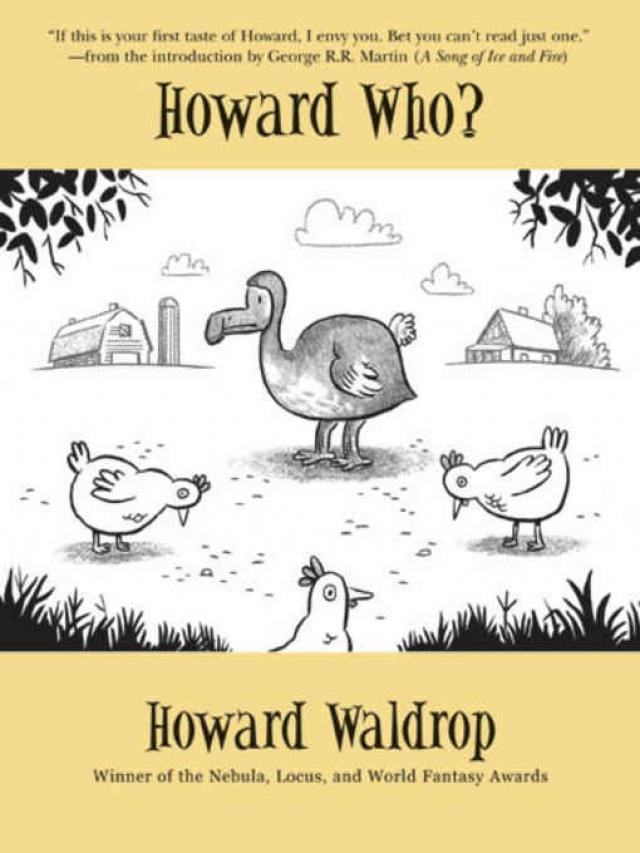
the dance of the dodos
Der Untergang des Abendlandesmenschen
Ike at the Mike
Dr. Hudson's Secret Gorilla
” ... The World, As We Know't."
Green Brother
Mary Margaret Road-Grader
Save a Place in the Lifeboat for Me
Horror, We Got
Man-Mountain Gentian
God's Hooks!
Heirs of the Perisphere
Notes on Stories by Howard Waldrop
The Ugly Chickens
Der Untergang des Abendlandesmenschen
Ike At The Mike
Dr. Hudson's Secret Gorilla
” ... The World, As We Know't."
Green Brother
Mary Margaret Road-grader
Save A Place In The Lifeboat For Me
Horror, We Got
Man-Mountain Gentian
God's Hooks
Heirs of The Perisphere
About the Author
Publication History
Peapod Classics
* * * *
Introduction by George R. R. Martin
Let's begin with some riddles. What do Dwight David Eisenhower and the dodo have in common? How are Japanese sumo wrestlers like Disney cartoon characters? What's the common link between Izaak Walton, Abbott & Costello, and George Armstrong Custer? If you ran into a gorilla in a powdered wig at a tractor pull, what would that remind you of? And while you're pondering all that, just who was that masked man anyway?
The last one is easy. The masked man is Howard Waldrop, a short squinty-eyed fellow with an atrocious accent and a wardrobe like Mork from Ork. He was born in Mississippi, grew up in Texas, and has bounced around the Lone Star State most of his adult life, from Arlington to Grand Prairie to Bryan to Austin, where he now resides. He knows everything there is to know about B movies, he can sing fifties rock and TV theme songs all night long (and often does), he likes to fish, and he just happens to be the most startling, original, and entertaining short story writer in science fiction today.
The word unique is much abused these days, but in Howard's case it applies. We live in a derivative age, and nowhere is that more apparent than in the books we read. Every new horror writer is compared to Stephen King. Our fantasists all seem to write in the tradition of J.R.R. Tolkien, Robert E. Howard, or Stephen R. Donaldson. The hot young talents in SF are routinely proclaimed as the next Robert A. Heinlein, the new Isaac Asimov, the angriest young man since Harlan Ellison, unless they happen to be female, in which case they are dutifully likened to Andre Norton, Ursula K. Le Guin, and Marion Zimmer Bradley. If you listen to the blurb-writers, these days it seems that everybody writes like somebody else.
Howard Waldrop's short fiction is squarely in the tradition of Howard Waldrop. There's never been anyone like him, in or out of science fiction. His voice is his own; singular, distinctive, quirky, and—once you've encountered it—more than a little addictive. I'm tempted to say that the only thing that's like a Howard Waldrop story is another Howard Waldrop story, except that it wouldn't be true. Howard's stories differ as much from each other as from your run-of-the-mill SF and fantasy. The only thing they have in common is that they're all a little bit different.
Howard doesn't like to write the same thing twice. Well-meaning friends keep telling him that the best way to get rich and famous is to write the same thing over and over and over and over again, to keep frying up those robot duneburgers of gor and serving them to a hungry public, but Howard keeps wandering off and getting interested in Groucho Marx, Chinese proletarian novels, and the mound-builder Indians. Suddenly books start piling up in his office, a maniacal gleam lights his tiny little eyes, and he begins to talk incessantly about a strange new story he's going to write. Meanwhile, he consumes those piles of books during breaks in his daily regimen of building bookcases and watching old movies on television. Then, when all of his friends are just about ready to skin him alive, out it comes all in a rush: the latest Waldrop wonderment.
It's an odd way to work, but it's Howard's way, as uniquely his own as the stories it produces. He's been doing it for a long time. People have been paying him for it ever since 1970, but he started long before that, writing stories just for the love of writing. I couldn't tell you just when Howard began to scrawl words on paper, but I suspect that it was about nine seconds after he first learned to hold a Crayola in his stubby little fingers.
I do know that he was born in Mississippi on September 15, 1946 (a date he's immortalized in one of his recent short stories), that later on his family moved to Texas, and that he's been a thorough-going Texan ever since. He was already writing up a storm by the time he first came to my attention.
That was in 1963; we were both in high school, him in Arlington, Texas and me in Bayonne, New Jersey, and both of us were publishing our juvenilia in the comic book fan magazines of the day, tiny publications printed in purple with fast-fading ditto masters and circulated to literally dozens of eager readers, most of them high school kids, like Howard himself. Even then, Howard was unique. Everyone else who wrote for those tiny little fanzines (including, I blush to admit, myself) imitated the professional funny-books and wrote about superheroes. Howard wrote detective stories set in France at the time of the Musketeers. The readers loved him, but didn't quite know what to make of him, and they'd write in puzzlement to the fanzine letter columns to say, “Boy, Howard Waldrop's story was really great, but it was all about Cardinal Richelieu. What powers did he have, anyway?” He's been pleasing and puzzling readers ever since.
Everyone who read him back then knew right off that Howard was too good to stay an amateur for long, and sure enough we were all right. He made his first professional sale in 1970, just before he got drafted. The Army sent him to Georgia, gave him a typewriter, and taught him all the words to “I Want to Be an Airborne Ranger,” but otherwise did him little good. The story had more lasting effects on his life and career. It was a little thing called “Lunchbox,” and the editor who bought it was the legendary John W. Campbell, Jr. During the decades that he had edited Astounding (later Analog), Campbell had discovered and introduced an astonishing number of SF greats, and in fishing Howard Waldrop out of the slush pile, he demonstrated that his eye for talent hadn't deserted him. Campbell's untimely death came before he could actually print Howard's debut story, but in a very real sense it can still be said that Howard Waldrop was Campbell's last great gift to science fiction.
Two years as an army journalist slowed him down a little, but there was no stopping Howard permanently, and once he was discharged he returned to Texas to begin to write and sell all sorts of things. He even wrote a novel, a collaboration with his landlord. It was called The Texas-Israeli War, by Jake Saunders and Howard Waldrop, and it's still in print today.
Those were heady days in Texas, for reasons entirely unconnected with the Dallas Cowboys Cheerleaders. Hot young writers were popping up all over the Lone Star State, and selling stories to every contemporary market, large and small. The brilliant Tom Reamy was just beginning to publish, Lisa Tuttle was turning heads with her early stories, B
It was around then that people finally started noticing Howard Waldrop. He was nominated for two Nebulas in 1977: for “Custer” and again for “Mary Margaret Road-Grader,” Howard's solo tour de force about post-holocaust tractor pulls, which you'll find in this collection. He didn't take home any trophies that year, but it was only a matter of time. Other nominations for other awards followed, and in 1981 his classic story “The Ugly Chickens” (that's also included here) won both the Nebula and the prestigious World Fantasy Award, and came within a dodo feather of copping the Hugo as well, for a rare triple crown.
Nowadays, Howard seems to be just about everywhere. Once, to find the latest Waldrop stories, you had to buy Terry Carr's distinguished hardcover anthology series Universe, or seek out small circulation semi-professional magazines like Shayol, Chacal, and Nickelodeon. These days Howard is publishing in Omni and Playboy ... but you'll still find him in Universe and Shayol as well. He's not the kind who forgets where he came from. His name turns up monotonously on the shortlists for every major award in the field and most of the minor ones, and no wonder. The stories keep getting stranger and stranger, but they're getting better and better too.
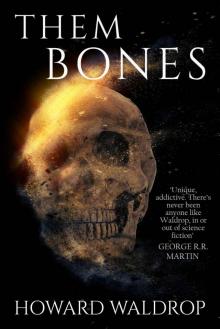
He even had another go at a novel recently, this time without any help from his landlord. The end result was called Them Bones, time travel as only Waldrop would write it, and it was published to loud huzzas as part of Terry Carr's revived Ace Specials line.
As good as it was, however, Them Bones still wasn't a patch on Howard's short stories. Short fiction remains Waldrop's forte, and believe me, nobody does it better. You've got a damned fine sampler of Waldrop in the pages that follow, the famous stories and the obscure ones, plucked from magazines with hundreds or hundreds of thousands of readers. The only thing they all have in common is their quality. If this is your first taste of Howard, I envy you. Bet you can't read just one.
Oh, yes, you'll be wanting the answers to the riddles. Howard Waldrop. Howard Waldrop. Howard Waldrop. And finally, Howard Waldrop. There's only one of him, but—lucky for us—he spreads himself around.
—George R.R. Martin, 1986
To the editors who first bought them—Terry (Bob and Marta sorta for a few minutes), Pat & Arnie, Ellen, Damon, Tom, Alice; Pat (who bought the whole thing); Joe (who sold the whole thing); but mostly for Ruthie, who could have been a contender, instead of a bum, which is what I am.
The Ugly Chickens
My car was broken, and I had a class to teach at eleven. So I took the city bus, something I rarely do.
I spent last summer crawling through The Big Thicket with cameras and tape recorder, photographing and taping two of the last ivory-billed woodpeckers on the earth. You can see the films at your local Audubon Society showroom.
This year I wanted something just as flashy but a little less taxing. Perhaps a population study on the Bermuda cahow, or the New Zealand takahe. A month or so in the warm (not hot) sun would do me a world of good. To say nothing of the advance of science.
I was idly leafing through Greenway's Extinct and Vanishing Birds of the World. The city bus was winding its way through the ritzy neighborhoods of Austin, stopping to let off the chicanas, black women, and Vietnamese who tended the kitchens and gardens of the rich.
"I haven't seen any of those ugly chickens in a long time,” said a voice close by.
A grey-haired lady was leaning across the aisle toward me.
I looked at her, then around. Maybe she was a shopping-bag lady. Maybe she was just talking. I looked straight at her. No doubt about it, she was talking to me. She was waiting for an answer.
"I used to live near some folks who raised them when I was a girl,” she said. She pointed.
I looked down at the page my book was open to.
What I should have said was: “That is quite impossible, madam. This is a drawing of an extinct bird of the island of Mauritius. It is perhaps the most famous dead bird in the world. Maybe you are mistaking this drawing for that of some rare Asiatic turkey, peafowl, or pheasant. I am sorry, but you are mistaken."
I should have said all that.
What she said was, “Oops, this is my stop,” and got up to go.
* * * *
My name is Paul Linberl. I am twenty-six years old, a graduate student in ornithology at the University of Texas, a teaching assistant. My name is not unknown in the field. I have several vices and follies, but I don't think foolishness is one of them.
The stupid thing for me to do would have been to follow her.
She stepped off the bus.
I followed her.
* * * *
I came into the departmental office, trailing scattered papers in the whirlwind behind me. “Martha! Martha!” I yelled.
She was doing something in the supply cabinet.
"Jesus, Paul! What do you want?"
"Where's Courtney?"
"At the conference in Houston. You know that. You missed your class. What's the matter?"
"Petty cash. Let me at it!"
"Payday was only a week ago. If you can't..."
"It's business! It's fame and adventure and the chance of a lifetime! It's a long sea voyage that leaves ... a plane ticket. To either Jackson, Mississippi or Memphis. Make it Jackson, it's closer. I'll get receipts! I'll be famous. Courtney will be famous. You'll even be famous! This university will make even more money! I'll pay you back. Give me some paper. I gotta write Courtney a note. When's the next plane out? Could you get Marie and Chuck to take over my classes Tuesday and Wednesday? I'll try to be back Thursday unless something happens. Courtney'll be back tomorrow, right? I'll call him from, well, wherever. Do you have some coffee?..."
And so on and so forth. Martha looked at me like I was crazy. But she filled out the requisition anyway.
"What do I tell Kemejian when I ask him to sign these?"
"Martha, babe, sweetheart. Tell him I'll get his picture in Scientific American."
"He doesn't read it."
"Nature, then!"
"I'll see what I can do,” she said.
* * * *
The lady I had followed off the bus was named Jolyn (Smith) Jimson. The story she told me was so weird that it had to be true. She knew things only an expert, or someone with firsthand experience, could know. I got names from her, and addresses, and directions, and tidbits of information. Plus a year: 1927.
And a place: northern Mississippi.
I gave her my copy of the Greenway book. I told her I'd call her as soon as I got back into town. I left her standing on the corner near the house of the lady she cleaned for twice a week. Jolyn Jimson was in her sixties.
* * * *
Think of the dodo as a baby harp seal with feathers. I know that's not even close, but it saves time.
In 1507, the Portuguese, on their way to India, found the (then unnamed) Mascarene Islands in the Indian Ocean—three of them a few hundred miles apart, all east and north of Madagascar.
It wasn't until 1598, when that old Dutch sea captain Cornelius van Neck bumped into them, that the islands received their names—names which changed several times through the centuries as the Dutch, French, and English changed them every war or so. They are now know as Rodriguez, R?union, and Mauritius.
The major feature of these islands were large flightless birds, stupid, ugly, bad-tasting birds. Van Neck and his men named them dod-aarsen, stupid ass, or dodars, silly birds, or solitaires.
There were three species—the dodo of Mauritius, the real grey-brown, hooked-beak clumsy thing that weighed twenty kilos or more; the white, somewhat slimmer dodo of R?union; and the solitaires of Rodriguez and R?union, which looked like very fat, very dumb light-colored geese.