

Adventure tales 1, p.1
Adventure Tales #1, page 1


COPYRIGHT INFORMATION
Published by Wildside Press LLC.
www.wildsidepress.com
Copyright ©2005 by Wildside Press
Edited by John Gregory Betancourt
THE BLOTTER, by John Gregory Betancourt
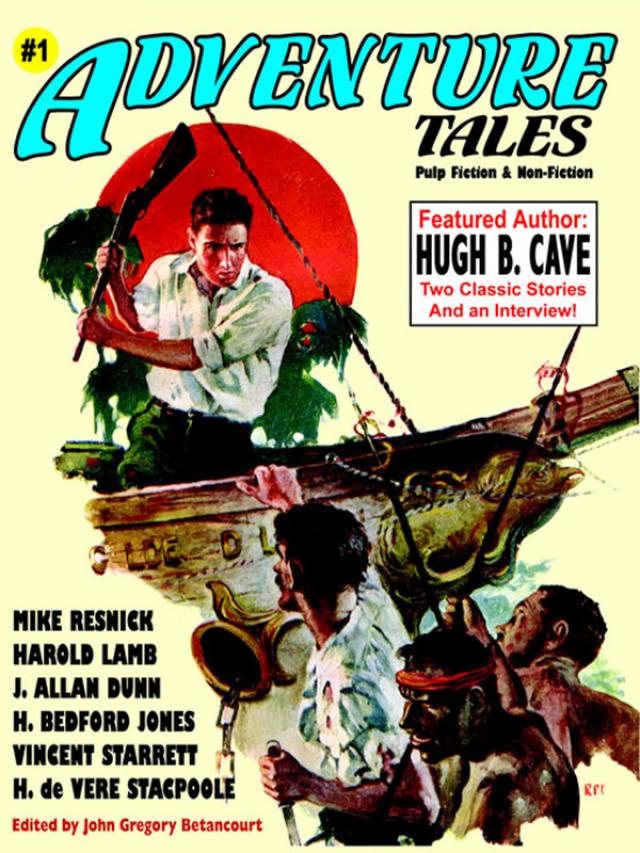
Welcome to the first issue of Adventure Tales. The general idea of AT is to reprint some of the greatest adventure-oriented fiction ever written for pulp magazines (and sometimes the “slick” magazines). We’re not talking about moldering old work by authors nobody has ever heard of, but rare and classic fiction that retains its original excitement and meets current high literary standards. Here you will find everything from fantasy and science fiction to mystery, suspense, and (as the magazine’s name implies) high adventure.
For the premiere issue, we have drawn from Argosy—perhaps the most famous pulp magazine of all time—for two stories by Hugh B. Cave, our Featured Author: “Island Feud” and “The Man Who Couldn’t Die.” Don’t miss the interview with Hugh, too, as he talks about his writing career and pulp magazines.
There are also stories by H. de Vere Stacpoole (best known as the author of The Blue Lagoon, filmed no less than five times, most famously starring Brooke Shields). “Under the Flame Trees” originally appeared in Short Stories magazine.
James C. Young, a well-respected pulp author who is unfairly forgotten these days, contributes “Rats Ashore,” a nautical tale with horrific overtones.
H. Bedford Jones was in many ways the king of the pulp magazine writers, contributing hundreds of stories (under his own byline and more than a dozen pseudonyms) to all of the top adventure and fiction pulp magazines. Here he contributes “Skulls,” a gruesome little revenge story, also from Short Stories.
Noted mystery author Vincent Starrett (1886-1974) contributes “The Evil Eye,” the first entry in his Lavender series, about a Chicago detective. (We will have more Lavender stories in future issues.)
“Watson!” by Captain A. E. Dingle, is an early Sherlock Holmes pastiche. The good Captain was a frequent fixture in pulps in the early 20th century, contributing a long string of nautically-themed stories. Not surprisingly, Holmes and Watson find themselves at sea in this one, too. There is a sly sense of humor to it—and a twist ending that will leave Sherlockians gasping in surprise! It originally appeared in the October 10, 1921 issue of Short Stories.
H. P. Lovecraft, Robert E. Howard, and Clark Ashton Smith, with whom I assume most readers will already be familiar, contribute verse this time around, along with a few lesser-known poets. And the wonderful logos for the contents page, the Blotter, and the Morgue are by the incredibly talented Thomas Floyd.
* * * *
Your editor (me) is John Betancourt. I run Wildside Press, the small publishing company which produces this magazine, and I also write novels now & again in my spare time.
This is actually the fifth magazine I have worked on. My love of magazine editing began when I got a job in college in 1983 working as an assistant editor at Amazing Stories, the classic science fiction magazine. (It used to be a pulp, of course, but had long been a digest when I worked on it.) From there, I went on to help launch the revival of Weird Tales. After I left WT for a book-editing career, I launched a non-fiction news magazine called Horror, which covered (perhaps not surprisingly) the horror field. Horror took too much time, so I turned it over to another small press (which ultimately folded Horror a half dozen or so issues later). Then I wandered back to Weird Tales, becoming the co-publisher (with Warren Lapine of DNA Publications). After that, I started H.P. Lovecraft’s Magazine of Horror, selecting much of the first issue’s content before passing the editorial reins on to Marvin Kaye. I’m still the publisher of HPL’s.
Which brings us to Adventure Tales. I love and collect pulp magazines, and over the years Wildside Press has done quite a few pulp-related projects—from The Best of Weird Tales: 1923 to a line of facsimile reprints of pulp magazines (including issues of Spicy Detective Stories, Spicy Mystery Stories, Ghost Stories, Golden Fleece, Phantom Detective, and more.) Adventure Tales fits squarely in the middle of all the company’s pulp roots (and pulp-revival aspirations).
Assisting me on AT are Wildside Press staffers P. D. Cacek, Sean Wallace, Diane Weinstein, and Darrell Schweitzer, plus Warren Lapine of DNA Publications. Darrell edits Weird Tales magazine with George Scithers and has an encyclopedic knowledge of pulp writers and fiction. Sean Wallace is a book editor with a love for classic pulp fiction. Warren Lapine, who runs DNA Publications, is assisting with circulation management. (All the stuff I don’t want to do, like keeping track of subscribers and mailing out subscription copies.) Diane Weinstein is a terrific proofreader and is always happy to lend her considerable art direction skills. Together, I think we make a great team, and I hope that Adventure Tales becomes your new favorite fiction magazine. If not, it won’t be for lack of trying!
One note for collectors: we are producing two distinct editions of Adventure Tales, one on newsprint for casual readers (it’s much cheaper—only $5.99 per issue) and one on book paper for collectors who want to save it ($15.95 per issue). Because we need a minimum of 108 pages (our printer’s requirement) for the book paper edition, we are going to add a little extra material in to fill it out. With the first book-paper edition, we will feature The Spider Strain, a short novel by Johnston McCulley (best known as the creator of Zorro). With the second issue, we will begin the serialization of a 60,000-word novel, The Golden Dolphin, by J. Allan Dunn. The Golden Dolphin will also be available as a book from Wildside Press if you can’t wait to finish it!
You can subscribe to either version (or both). The newsprint edition is $19.95 for 4 issues; the book paper edition is $29.95 for 2 issues, postage paid in the United States.
Till next time…?
—John Betancourt
IN MEMORIAM: As this issue was about to go to press, we received news of the passing of Hugh B. Cave. He was a great writer and a wonderful person. He will be missed by all who new him. We are all grateful to have been able to work with him to create this special issue of Adventure Tales honoring him and his work.
BRITANNIA VICTURA, by H.P. Lovecraft
When Justice from the vaulted skies
Beheld the fall of Roman might,
She bade a nobler realm arise
To rule the world and guard the right:
She spake—and all the murm’ring main,
Rejoicing, hail’d Britannia’s reign!
The mind of Greece, the law of Rome,
The strength of Northern climes remote,
On one fair Island made their home,
And in one race their virtues wrote:
The blended glories of the past
In England evermore shall last!
Untrodden wilds beyond the sea,
And savage hordes in lands unknown,
At Albion’s touch rose great and free,
And bless’d the sway of England’s throne:
Discordant tribes, with strife o’errun,
Grew Britons, and join’d hands as one!
When Greed and Envy stand array’d,
And Madness threats a peaceful earth,
Britannia’s sons with sacred blade
Defend the soil that gave them birth:
Nor is their cause to that confin’d—
They fight for Justice and Mankind.
Tho’ Fortune frown and trials press;
Tho’ pain and hardship weigh the heart;
the dawn of vict’re soon will bless
Each Briton who sustains his part:
For Heavn’n’s own pow’r is close allay’d
To Virtue’s and Britannia’s side!
EDGAR RICE BURROUGHS: The Man Who Held the Hero’s Horse, by Mike Resnick
There have been a lot of theories advanced as to why Edgar Rice Burroughs remains a popular author more than 90 years after he first broke into print, when dozens of Pulitzer and Nobel winners (and a few Hugo winners as well) can’t be found this side of Bookfinder.com.
A lot of people credit his imagination, and yes, it certainly worked overtime, coming up with Tarzan, Barsoom, Amtor, Pellucidar, Caspak, Poloda, and the rest.
Others point to his break-neck pacing. You follow Tarzan until he’s unarmed and facing a ferocious man-eater at chapter’s end, then cut to Jane until she’s one grope away from a Fate Worse Than Death at the end of the next chapter, then back to Tarzan, and so forth. Works pretty well.
A few point to his remarable facility at creating languages. And truly, what would you call an elephant except Tantor? What could a snake possibly be other than Hista? What better name for an ape-king that half-barks and half-growls his language than Kerchak? Yes, he was damned good at languages.
But there’s another aspect to Burroughs that lends enormous verisimilitude, especially to his younger readers, and it’s an aspect that has been addressed only once before, by the late Burroughs scholar (and Royal Canadian Mountie) John F. Roy—and that is the interesting fact that ERB wrote himself into almost all his greatest adventures.
When I first discovered A Princess of Mars at age 8, I knew the story was true. I mean, hell, Burroughs was writing about his own uncle, the man who had entrusted him with the manuscript of his adventures on that distant and wondrous planet. Wasn’t that proof enough that Barsoom existed?
Well, if you were young and impressionable, it was proof enough—but even if you weren’t, it was a very effective and informal way of getting you into th
And while ERB was not a trained writer, at a gut level he knew it worked. He might not have known what “distancing mechanism” or “stream of consciousness” meant, but he sure as hell knew how to lasso a reader and pull him along, and his favorite and most effective gimmick was to tell you how he himself had been thrust into the company of this book’s hero.
So here he was, the nephew of John Carter, gentleman of Virginia and Warlord of Mars, explaining how he can come upon this remarkable manuscript, how he had watched his uncle standing outside at night reaching out his arms to Mars, how he had followed instructions and buried him in a well-ventilated coffin that could only be opened from the inside, and only now understood the meaning of it all.
And it didn’t stop with the one book. He meets John Carter again and is given the manuscripts to The Gods of Mars and The Warlord of Mars. Some years later he meets Ulysses Paxton (a/k/a Vad Varo) by proxy when John Carter delivers Paxton’s long letter (i.e., The Master Mind of Mars) to him, and he is visited by John Carter at least twice more. It is made clear that ERB is now an old man (as indeed he was), while the Warlord remains the thirtyish fighting man he has always been.
But ERB’s interaction with his characters wasn’t limited to Barsoom.
For example, he knows the man who knows the man who knows Tarzan—or some permutation of that. The very first line in his most famous book, Tarzan of the Apes, is: “I had this story from one who had no business to tell it to me, or to any other.” A Burroughs scholar would probably conclude that the “one” was Paul d’Arnot, but it makes no difference. The point is that here is ERB, inserting himself in the beginning of the story again to lend some degree of authenticity.
Did he ever meet Tarzan? He never says so explicitly, but he did meet Barney Custer, hero of The Eternal Lover, and his sister, and based on the interal evidence of the book, the only place ERB could possibly have met them was on Lord Greystoke’s vast African estate.
It was while vacationing in Greenland that ERB came across the manuscript that became The Land That Time Forgot. (Yes, he was pretty sharp at finding saleable manuscripts.)
Burroughs gets around. At the Earth’s Core finds him in the Sahara, where he stumbles upon David Innes, who in turn had stumbled upon the hidden world of Pellucidar and felt compelled to spend the night telling ERB his story. A reader in Algiers summons him back a few years later, where he is reintroduced to David Innes, who once again pours out his story, which was published as Pellucidar.
After moving to California, who should ERB’s next-door neighbor turn out to be but the brilliant young scientist Jason Gridley, creator of the remarkable Gridley Wave, by means of which Burroughs received still more tales of that mysterious world at the center of the hollow Earth. (And Gridley himself later went to Pellucidar, which means the ERB rubbed shoulders with still another hero.)
Burroughs even wrote his company’s secretary, Ralph Rothmond (who was later fired, more than a decade after ERB’s death, for carelessly allowing a number of copyrights to expire) into one of the books. Rothmond introduces ERB to young, handsome, blond, heroic Carson Napier, the Wrong-Way Corrigan of space, who takes off for Mars and someone winds up on Venus. Napier remains in telepathic contact with Burroughs long enough to dicate Pirates of Venus and three-plus sequels.
There was just something about ERB that made heroes seek him out and tell him their strange stories, always on the condition that he not publish the tale until they were dead, or if he couldn’t wait that long, to at least change their names. The last to find him and unload on him was Julian V, who narrated the tale of The Moon Maid.
ERB never met the author of Beyond the Farthest Star—after all, that would have been quite a voyage—but of all the people in the universe, the author was, perhaps unsurprisingly by this time, drawn to Burroughs, and mystically compelled ERB’s typewriter to produce the story one night in Hawaii while ERB watched in awe.
The interesting thing is that though he associated with Tarzan and John Carter and David Innes and Carson Napier and many others, ERB never once performed an exciting or heroic deed in any of the books, and that lends a little verisimilitude too. These are extraordinary men, these heroes, and neither ERB nor you nor I can begin to match their skills or heroism, so it makes much more sense for him to tell us about it and for us to read and appreciate it. Fighting lions or green men or allosaurs is for heroes; reading about it is for the rest of us mortals.
And maybe that’s why we loved and identified with Edgar Rice Burroughs. He didn’t lop of heads with his longsword, or bellow the victory cry of the bull ape over the corpse of an enemy, or make his way to the center of the Earth. But he seemed to know the remarkable men who did do those things, and, by golly, he got to hold the hero’s horse.
Most of us would have traded places with him in a New York—or Barsoomian—minute. T
ADVENTURE TALES INTERVIEWS HUGH B. CAVE
Hugh B. Cave surely needs little in the way of introduction to any fan of pulp fiction. Under his own name and pseudonyms such as “Justin Case” he wrote more than a thousand stories for magazines, before turning his attention to books. We were pleased when he accepted our invitation to be the Featured Author in the first issue of Adventure Tales, and he consented to this interview.
Adventure Tales: How and when did you enter the pulp field as a writer?
Hugh B. Cave: While still a student at Brookline, Massachusetts High School, I sold poetry and crossword puzzles to Boston newspapers and other publications, stories to Sunday School magazines, and did cartoons for the Boston YMCA News. One such poem, called “Men,” originally published in Sunset Magazine on the West Coast, was set to music by Carlyle Davis, sung by him in Carnegie Hall, and published by the Oliver Ditson Company.
After high school I worked for a Boston publishing company for a year or so. One book of poetry that I had a hand in designing was by W. Adolph Roberts, editor of a pulp magazine called Brief Stories. He suggested I try a short story for Brief Stories, and the suggestion resulted in “Island Ordeal,” my first pulp sale, which was published in July, 1929, when I had just turned 19.
There were more than a hundred pulp magazines being published at that time—so-called because they were printed on rough wood-pulp paper. I eventually sold a total of some 800 to 95 of them, then moved on into the higher-paying slick-paper magazines such as The Saturday Evening Post (to which I sold 46 stories), Good Housekeeping (41), American, Redbook, Ladies Home Journal, Collier’s, Liberty, Esquire, etc. etc. Three hundred fifty stories in all. And my next two books, due out this year, will be Number 49 and Number 50 on my list of books published. Five of these are World War II books written as a correspondent. Two are books on Haiti and Jamaica. Twenty are novels. The others are hardcover collections of my pulp and slick-paper magazine stories. Some of these books and many of my shorter works have been reprinted in foreign countries. About a dozen of my books have been reprinted by John Betancourt’s Wildside Press.
And along the way, two books have been written about me. These are Pulp Man’s Odyssey: The Hugh B. Cave Story by Audrey Parente, published by Starmont House in 1988, and a brand new one, Cave of a Thousand Tales by Milt Thomas, due out this year, 2004, from Arkham House.
AT: Of all those stories, do you have any favorites?
Hugh B. Cave: Two favorites come to mind quickly. The first is a very short story called Two Were Left, which was originally published in American Magazine in June, 1942. It’s about an Eskimo boy and his beloved sled dog who are marooned on a drifting ice floe and, when hungry enough, one of them will have to eat the other to survive. The story has been reprinted more than one hundred times in school books and anthologies.
The other is one of many tales I have written about Haiti after having lived there for five winters. I note there is a question about Haiti coming up in this interview, so I won’t go into my adventures there now, but this story, called The Mission, first appeared in the old Saturday Evening Post of March 14, 1959 and was reprinted in The Best Post Stories of that year, in the first issue of the new Saturday Evening Post, and in seven foreign magazines. Just recently, when Haiti was in turmoil over its president, a group that wanted the world to have a better opinion of that country requeted permission to feature the story on a web-site. It’s about a six-year-old country girl who, after the tragic death of her mother in a landslide, walks miles to Port-au-Prince, the capital, to find her “famous artist” father who actually existed only in her mother’s imagination. After the Post printed it, Doubleday did it as a handsome gift book, calling it “a little classic of the spirit.”


