

When we talk to the dead, p.1
When We Talk to the Dead, page 1


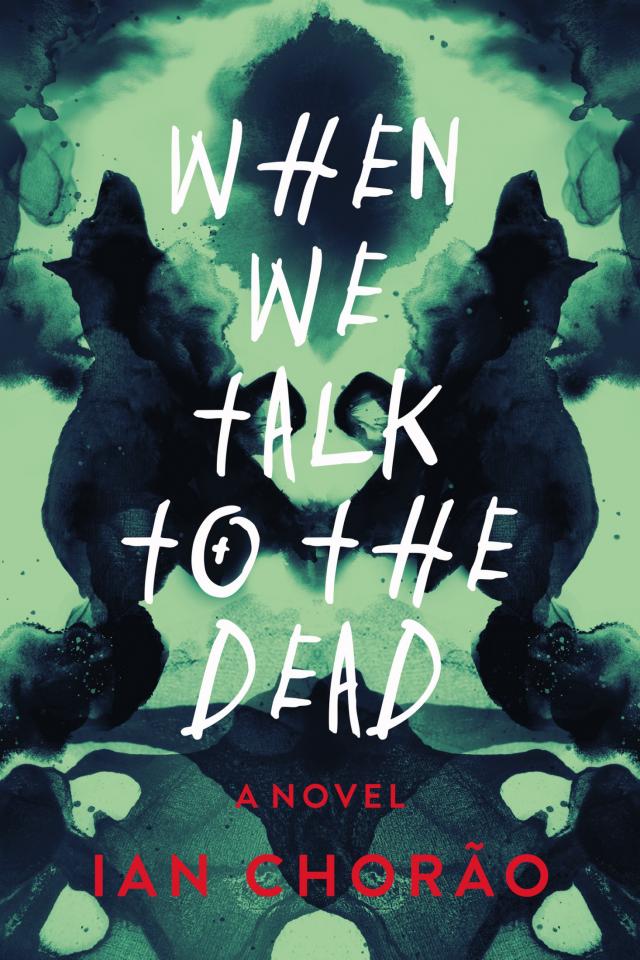
WHEN WE TALK TO THE DEAD
A NOVEL
IAN CHORÃO
For who else but Sylvia And in memory of A.F.S.
The grander the love, the vaster the shadow.
—Emily Dickinson
It was as if that great rush of anger had washed me clean.
—Albert Camus
She muttered, dreamily half asleep, how we perished, each alone.
—Virginia Woolf
Part One: Death
One: Shrink
Two: Buried
Three: Follow
Four: Realize
Five: Facts
Part Two: Transition
Six: Liar
Seven: Onward
Eight: Island
Nine: Home
Ten: Lobster
Eleven: Doll
Twelve: Piss
Thirteen: Chicken
Fourteen: Toad
Fifteen: God
Part Three: Rebirth
Sixteen: Mirror
Seventeen: Together
Eighteen: Sally
PART ONE
Death
deep in the cave, it sleeps in the silence. there is a sound, low. it wakes, it listens. the pitch black is wide, but far down the cavern, a thin shaft of light comes from the ground above where heavy rains recently cut through the soil, making a sliver of an opening into its dark, hidden place.
it moves silently, except for the bones and shells of the small things it eats, little cracks underfoot through the expanse of dark. stopping at the shaft of light, it listens to the sound.
there are right sounds. wind through the thick green forest off the big ocean water. other animals fluttering, scampering, dashing. the rain. the melting snow. its echo in its cave.
there are wrong sounds. hard sharp sounds of machines that come from away. sounds not from here. it listens to the wrong sounds. its hair goes up, its claws dig in the dirt. it listens for the wrong sound to go away. mostly they do. but this wrong sound gets bigger. then bigger.
it wants to stay hidden, but it knows, when they come, to keep safe, it must go.
running from its dark hidden place into the sun, it is blinded, but it knows every step until its eyes meet the light. rushing down the hill to where the green forest meets the sand and the big water, it watches. a boat coming, the wrong sound, its blaring engine biting its ears.
sometimes they come, mostly they go, always it watches, waiting, hoping they go before it must act.
the boat lands, cuts the sand. a man and a woman jump out laughing. how it feels watching them through the leaves, the man and the woman together, different feelings fighting inside it. the man says, “gotta piss like a racehorse.” the man runs up the beach to the edge of the forest, and he sprays his stream. he says, “i christen thee my land.” he says, “let’s explore.” the woman says, “no friggin way i’m going in there.” the woman looks around the deserted place and shivers. the man calls her “scaredy-cat.” he steps from the sand into the green forest. the woman shakes her head for him not to go. he smiles, then steps farther, passes it hidden in the dense leaves. the smell of the man’s stream in its nose burns away its fear. when fear goes away, something much worse comes.
it follows the man walking deeper into the green. “come back now,” the woman calls. “people always say it, but this place really does give me the creeps.” the woman calls, “please, let’s go.” it watches the man smile that the woman is a scaredy-cat; it smells a scent the man gives off from his pleasure in giving the scaredy-cat a good scare.
forgetting itself as it smells the man’s feeling, it shifts. the man stops. it freezes. the man turns, sees it. it wants to be back, deep inside the dark silent cool of its cave. but the burn of the man’s piss stream in its nose tells it to go, and it is at the man’s neck before the man can run. the man drops in a heap. it spits out the man’s chewy hard throat.
it hears the woman coming through the green. she is laughing that the man sucks. it looks at the man. it sees what it has done. behind, the woman’s steps slow. it turns. the woman sees it. the woman sees the man. the woman shakes. it wants to hide, but it rushes.
on top of the woman on her back, the woman does not fight back. she looks up at it. the woman’s face is still. the woman’s face makes it feel quiet inside. looking into another set of eyes, it feels a tiny bit of together. it has forgotten. once, long, long ago, it felt this feeling. the woman’s eyes go wide. the wisp of the together is gone, and before the woman can scream, its teeth sink into her neck.
it moves off the woman. it stands with its back to the woman. It listens until her gurgling stops. it spits out the chewy hard of the woman’s throat next to the man’s. it knows the birds will soon enough eat the fists of flesh.
it curls up in the sun. it listens to the right sounds.
the water and the forest and the wind.
CHAPTER
1
Shrink
“HOLD A MOMENT, Sally,” Stanley says. “Did I miss something?”
Stanley is Sally’s shrink. When she’s home on breaks, she sees him in person, but during the semester he’s an ancient eighty-something-year-old head on her computer screen. “Did you say what this murderous thing in your dream was?”
“Nightmare,” Sally says. “And nope, I didn’t say, Doc.”
Stanley gets a look whenever she calls him Doc, because he once told her, when she asked about the look, he finds her jocular, jokey tone is often a way of “distancing.” Stanley presses: “Is it that you don’t know what this thing in your dream—nightmare—was, or you can’t remember what it was?”
“Why’re you looking at me like that?” Before he can ask what way, Sally says, “Like I’m lying. I know it’s weird I can’t remember the creature when I’m saying how real the nightmare felt. And not just the nightmare—even after I woke up, it felt so real.” Sally touches her face to show how it felt on her skin. “Wide awake, I felt that place, the overgrowth, salt in my nose from the ocean, from the blood. Even the primitive animal thinking of the dream monster: I was wide awake, but my brain felt stuck in it.” A chill oozes up Sally’s spine. She wants to run.
Stanley knows Sally’s a master at freaking herself out. “Feel yourself in your chair.”
Sally knows what he’s doing—they’ve done it before—but still it helps her find calm.
Sally first saw Stanley for a year way back in high school when a dogged self-consciousness appeared and wouldn’t leave. Until then, she’d just been a person living her life, but in tenth grade she found herself constantly fixating on things that before then were invisible nonissues. What to do with her hands while talking, or in the middle of walking, noticing she stepped with a sort of stomp and did people notice and have thoughts on it. Or how the joy of laughing at school turned, when she recalled it later alone in bed at night, into a nauseating certainty that friends thought her embarrassing. Her thoughts were then hijacked by a cascade of worries that people were hiding their real feelings. There was the daily agony of her mind fixating on the grotesque nature of chewing. But Stanley helped her to be less in her head.
Then, four years later, at the beginning of last semester, these bouts of anxiety appeared again, even worse than when she was young—less worries about being likable and more a persistent existential fear. It confused Sally. Had it been her freshman year at college with all the nerves of something big and new, it would’ve made sense, but she was a returning sophomore. She was happy to be heading back, but suddenly this anxiety. Since it made no sense, she initially hoped it would go away.
It didn’t. It got worse.
Brutal bouts that came from nowhere. Like standing with her back to the ocean, she was slammed over and over. So she gave her old shrink a call. It’s been seven months since they started back up.
Stanley directs Sally to feel her body in the here and now, locate objects in the room to ground her, to separate the fear (made up) from the moment (reality).
“I’m good, Stanley,” she says. Exhaling away the chills, she smiles at the screen.
He resumes. “We were talking about what this creature in your dream was.”
Sally’s dorm window looks over a walkway beside a field. A crow pecks at a tray someone’s left balanced atop a garbage can. The tray flips, scattering gnawed chicken bones onto the walkway. As she talks, Sally watches the bird eat the remains of another bird. “You know how dreams are, things that made sense in the dream world, when you’re awake, it’s like, it was this but also that.” Three other crows swoop, fight over the chicken bones. A student with a book bag rides a bike on the walkway, spooking the birds off.
Sally looks back at Stanley’s face on her computer. “The creature was a thing, a malevolent force, or whatever.”
“Recalling dreams is tricky business,” Stanley says. “And it’s true, I don’t know how much stock I put in them.”
“But…?”
“Like you say, what feels so real in the dream is hard to remember when you’re awake, but you just described the nightmare in such vivid detail. The place, the sounds, the scents. The couple, their brutal savaging. Yet the main character, this beastly being, is foggy.”
Sally feels cold over her skin, through her insides. “I don’t know what to tell you.”
Stanley lets it go, nods. “Dreams are peculiar that way. You can’t really make out the monstrous creature, yet at the same time you are watching clear as day this horrible violence.”
â
Stanley waits for her to go on.
“You know in dreams how you can be watching something happening but at the same time you’re also, like, along for the ride—also kind of inside the thing you’re watching?”
Stanley is quiet. Then he says, “In the nightmare you were the creature?”
A moment ago, Sally was cold with fear; now her body flushes hot like she’s been caught.
Stanley leans closer to his camera. “Sally, what is it?”
Sally looks at him, thinking how she might answer his question. She wonders, what kind of person is she to have such a nightmare? But also. Really, it’s this: when Sally woke from the nightmare, she was out of bed. And she was standing. Over Maeve, her roommate, in her bed. It was dark but near dawn, light like murky water. Conscious but still inside the dream, Sally wasn’t fully herself. She stood watching Maeve sleep, filled thick with everything the creature felt. Fear of the intruders, but also another feeling, a sort of yearning in watching them run and laugh that made it feel how alone it was; wanting to hide but knowing it had to act; fright drowned under a wave of territorial rage.
Sally was still, silent, but from inside sleep, Maeve had the instinct of being watched. Her eyes opened. She didn’t move, but Sally could feel Maeve’s insides coiling, felt a little scream frozen in her throat. “Sally?”
When Maeve said her name, Sally snapped out of it. Finally feeling fully awake, Sally was returned to herself, and instantly she was flooded by the horror of what she had witnessed in the nightmare. She wanted it out of her mind, but she didn’t want to share it. Yet there she was, standing over her roommate’s bed, so she had to say something. Sally said she was starving and was getting something to eat and did Maeve want anything. Maeve looked at Sally the way anyone would if they found their best friend standing over their bed at five AM saying she was starving. She laughed.
“You’re lying! How long have you been standing there waiting for me to wake up?” Maeve curled into her bed. “So creepy. Ha! But I didn’t scream,” she said, proud of herself. “Even so, this is one of your better scares,” she said.
Maeve was easily frightened, and often Sally liked to give her a start. Sally was so disturbed at finding herself waking over her roommate’s bed that she stuck to her lie that she was hungry, and did Maeve want anything? In her loving Maeve way, Maeve called Sally a freak, said she was all good, rolling over, back to sleep.
The terror of the nightmare coursed through Sally—it felt as real as if she’d witnessed something horrific in waking life, like once when she watched a family getting off the subway, the littlest member, a girl, maybe six, pausing to look at a little dog a man had in a tote bag in his lap, enough time that the doors shut and the girl, pressing against the closed door’s window, face stricken with terror, screamed, silent behind the glass, beneath the roar of the train and the sound, which still pierces Sally when she recalls it, of the mother’s shrieks as she pointlessly chased after the train that swept her child away.
Sally wanted to crawl under her covers but needed to follow through with the lie that she was starving, so she grabbed her phone and left. Standing in the long, silent hallway of closed dorm doors, she was jittery, spooked that something was lurking, watching. Desperate to not be alone, but all her friends would be asleep. Knowing her dad worked with international clients and was often up early, she video-called him. He picked up quickly enough, but his face was puffy, wrinkled; he’d been asleep. His startled expression at being awakened turned to concern that something must be wrong. It felt nice to Sally, seeing him worry. Recently she’d had this thought: it’s hard to know how to have a dad when you’re nineteen. When you’re a kid, your dad’s just your dad. But now, Sally couldn’t fully shake that he was just sort of a person. Sometimes she wanted him to feel like her dad. To answer his look of concern, Sally told him she was up early to fin— But her dad waved his hand in a quick, reprimanding way to be quiet. Sally could see him looking nervously at Jivani, his wife, her stepmom, asleep in their bed. He looked back at Sally with his finger to his mouth, his concern for her so quickly shifted to concern that his wife not be disturbed. It was one of those tiny moments, but Sally felt how there was an us and a them, and she was the them. Dad slid out of bed, shushing finger still to his mouth, as if Sally needed an ongoing reminder, as he tiptoed out.
Once he’d closed their bedroom door and was safely down the hallway, he asked why Sally called so early, asked what was wrong. She lied that everything was good. She lied that she was up early to finish a paper. She lied that she was calling to say hey, knowing he was sometimes up early for work. His expression relaxed, and it almost broke her heart that he couldn’t tell she was lying. At one end of her dorm’s hallway was a common room with a kitchen, and now Sally was genuinely hungry—starved. Sally told Dad she was going to heat up one of the empanadas he’d sent in a care package. Dad was delighted: what a great idea! He also had some left over. They propped their phones. They each microwaved empanadas made from his mother’s recipe. As they ate, he turned nostalgic. When his mother taught him how to make them, she reminisced about when her mother taught her. Dad shook his head; what a terrible father that so much time had gone by without passing it on to Sally.
“Sally?” Stanley says again.
Sally realizes she’s drifted. A little bit, she forgot she’s here, on a Zoom session with her shrink. He’s shifting his head the way he does when Sally spaces out. He doesn’t call it spacing out. He calls it disassociating. Sally hears a long, wheezing moan. She doesn’t know what it is, where it’s coming from. Then there it is again, louder, more distinct, a low, guttural growling. “What is that?” she asks.
Stanley grimaces, embarrassed. “Can you hear that?”
Seeing his embarrassment, imagining the issues of an old man’s intestines, and, honestly, relieved by the comedy of this possibility, Sally asks, “Is that your stomach?”
Stanley laughs. “No, I’m pet-sitting. My daughter’s family’s dog, Ollie.” Stanley’s screen shakes. He directs the camera to the oldest dog Sally has ever seen. A fat thing, like a small gray walrus, passed out at his feet, snorting and snarling, asleep. Stanley returns his computer square on his face. He glances at the dog, now offscreen. “He’s dreaming.” Stanley looks at Sally. “Maybe he’s trying to get in on your action.”
“How old is he?”
“He’s a real wonder,” Stanley says. “Eighteen and still kicking. Amazing.” Then he says, “Back to you.”
“My mind is completely blank. What would you like to talk about?”
Stanley doesn’t skip a beat. “When your dad got in touch with me—years ago, I mean, when we were first meeting back when you were in high school—”
“Yeah?”
“—he told me your history. The island off the Maine coast. The accident.”
“Uh-huh.”
“Back then, I’d periodically bring it up, but it was clear you had no interest exploring it—still a kid, I thought maybe you weren’t ready. Since we’ve resumed sessions, we’ve discussed your episodes of anxiety, stress about declaring a major. Now that you ask what I’d ‘like’ to discuss, I will admit I wonder why you never talk about it.”
“I don’t remember it. I was six.”
“Back in high school, you did say you had no memory of that time.”
“Yup.”
“Still? No memory?”
Sally gets hot in the face. “Why are you asking this now?”
“The place in the dream. Do you think maybe it’s connected?”
“I don’t remember living there. How am I going to say?”
“In the dream, the way the place looked, the plants, the water, did it feel like New England?” he asks. “You sometimes go up there, so I’m sure you know what I mean.”
“Yes,” she says. “And yes.”
Stanley waits, but Sally doesn’t know what he’s snooping for. “I really like the filmmaking class I’m taking—I’ve been learning cool stuff about editing, special effects, lots of stuff. I was thinking maybe I’ll pursue it more. For my major, I mean.”
“You’ve had an interest in that since you were young—that online channel you have. I imagine it’s mostly an artistic expression, but it seems a real benefit for you, therapeutically.”





