The wilding, p.1
The Wilding, page 1


CONTENTS
Title Page
The Great Bog
1
Day One
2
3
4
5
6
7
8
9
10
11
12
13
14
15
16
17
18
19
20
21
Day Two
22
23
24
25
26
27
28
29
30
31
32
33
34
35
36
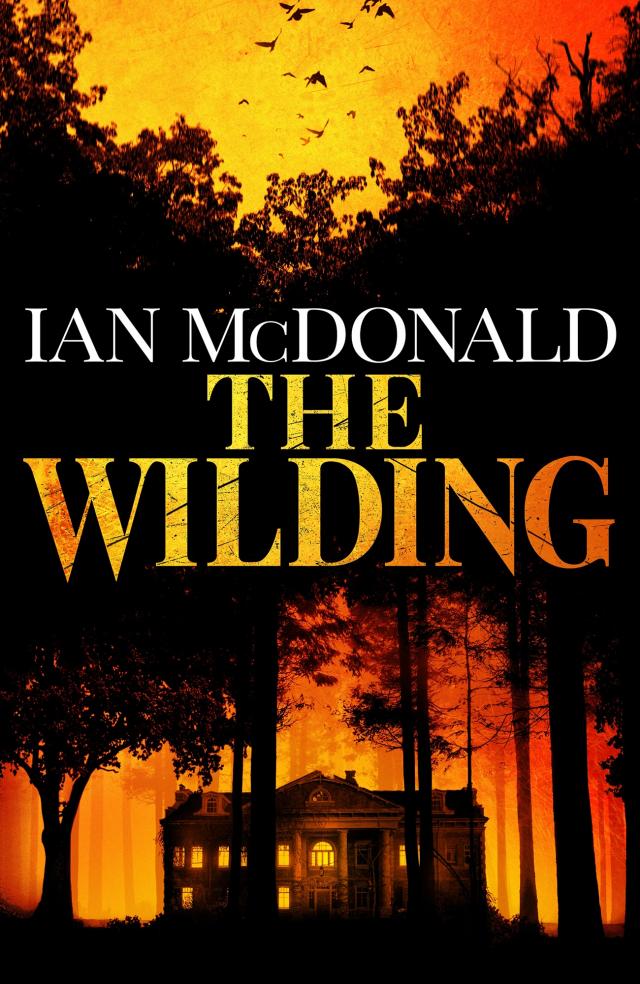
The Wilding
37
38
39
40
41
42
The Great Bog
43
Acknowledgements
Credits
By Ian McDonald
Copyright
The Great Bog
1
Autumn lay on the great bog in silvers and tans, late purples and duns.
The sun rose above the tall ash saplings and feral sycamore. It called the birds into full voice. Stabbing shrills, tumbles of notes, the flutes of dove-call, frantic ticking hisses, song upon song. In hedgerows and copses, among the pale foliage of the birches, in the weave of deep willow and the bramble fastnesses, each bird called and was heard. In this season the peatland held the day’s warmth through the night and on the bright, clear mornings rivers of mist formed, filling the subtle hollow places in the exposed cuttings, the bogs and fields. High sun would dispel it but at this hour half of Lough Carrow lay mist-bound. Each blade of grass hung heavy with dew, the clumps of sedges were already browning, the bracken curling and crisping.
The layers of warm and cold air worked tricks with sound: muting the near, amplifying the far, compressing and stretching time and distance. The sound of a tractor engine was clear and muscular across the great bog: the bull-roar of the John Deere 7R310’s three hundred and forty horses. With it, the steady bass bump of double Kappa subwoofers.
A pair of horns lifted above the willow scrub and out-grown ash hedges of the Wilding. Polished tips caught the low sun and kindled as bright and keen as spears.
Day One
2
The low battery alert beeped. Lisa Donnan jumped from perfect sleep to awake but not aware in an instant. She reached for the phone. It was not in its familiar place. She groped around, struck it a glancing blow. It fell with a thud to the floor. Wood, not carpet.
Lisa Donnan came to sniper-alertness.
She was in her work clothes, in the glamping pod. The multitool in her left pocket had dug a line of agony into her hip. Its bottle-opener had done serious work last night. She had left a drool-stain on the pillow of the double-bed. She could smell her face; she could smell the fresh wood of the pod but most of all she could smell last night’s 420. Glasses on the floor. No hidden bottles, no breakages. No alien bodies.
She spun out of bed and found her phone down the back of the bedside cabinet. 08:27.
‘Shit.’
Team meeting at nine. And the place looked like the aftermath of a drive-by shooting. She hauled a bin bag from under the sink and filled it with bottles, food cartons, smoking paraphernalia. A new glamping pod, out of sight, with an en suite. It seemed so perfect last night. The pod was Baltic. Only Dubs would pay for designer cold.
‘You are a Dub,’ she said to her reflection in the toilet mirror. There was no time for more than a few dabs with a dampened towel. ‘And I am coming back, Anna Livia Pluribelle.’
If she’d stained the pillow, used a towel, nicked a bin bag, she might as well be the complete criminal. Lisa opened the breakfast hamper and hunted for easy eats. Oaty breakfast bars, fruit-in-the-corner yoghurt and a bottle of juice which went part way to rehydrating her sandpaper tongue. She necked the half-pint of semi-skimmed and felt joints release, muscles relax, brain cells spark to life.
Lisa hauled the bin bag out on to the veranda and reset the door code. She flinched at the sharpness of the air. It was even colder than the pod. Overnight, autumn had made a stealth advance. She had learnt the smell-landscapes of Lough Carrow and its weather: leaf mould and an ozonic tang, old water and stagnation; the sky was clear and bright now but a front was coming.
Lisa dumped the bag in the general trash at the wicker-screened recycling hub. A flight of oystercatchers wheeled over her in tight formation, solid black and white birds piping call and response to each other. When she came to Lough Carrow she had refused to believe in such creatures as oystercatchers, then refused to believe that they could exist this far from the sea.
‘They can range up to seventy kilometres from the coast,’ Niamh the bird specialist had told her. ‘Which is most of Ireland. And they don’t eat oysters.’
She watched the birds settle as one on the new wild-flower meadow and stalk and stab for insects.
3
Black Field was the poorest of John O’Dowd’s scattered fields but it was his. His land. While Lough Carrow was still a working bog there had been access roads, railway lines, old cuttings to shorten the way across the peatland. Since the Wilding Zone went up and the former diggings were re-wetted, the drive now took twenty minutes along double-rut lanes, over soft bog tracks and, at the end, down the overgrown boreen, branches lashing and snapping at the tractor’s yellow warning beacon.
His land. His cattle.
John O’Dowd swung the big John Deere into the field entrance. The only way to manage the turn now without becoming hopelessly entangled in the wild growth was with the fork-lift raised. The big black plastic cylinder rested secure against the backstop plate.
He should give up the outfield. It was never good grazing. He had to haul in haylage every day to keep the cows from starvation. Their beef cost him more than it made him. Waterlogged more years than not, filling with sedge and yellow iris. Going back to the bog. But he would not concede to the Wilding, though no one cared about his principles or his stubbornness, or him.
He jumped down from the cab. Morning Mix: Country Swing boomed from the open door. A dog slipped on to his warm seat, black-and-white, prick-eared and oblivious to ‘He Drinks Tequila’. John O’Dowd opened the gate, chased the dog from his seat, drove into Black Field, got down to close the gate. The cattle clung to the further hedge line, already touched by the sun, shin-deep in mist, sweet breath steaming. They backed away from him, heads lowered, eyes wide. Dexters were a carnaptious breed, wily and fearless. These were afraid.
‘Hi lost,’ he ordered the dog, which had climbed back on to his seat again. He switched on the spotlights and they picked out a black shape rising out of the morning mist.
Cow down.
‘Fuck,’ he muttered. He turned off the engine and, as an afterthought, killed the music. It seemed disrespectful. He jumped down to investigate.
‘Come on there,’ he called to the dog but it pressed back as far as the cab allowed, ears down, tail tucked tight.
There had been no rain for an unheard-of forty days but water still squeezed from under his boots. Hopping magpies rose reluctantly from around the carcase.
This was more than a dead cow. This was a cow ravaged, torn apart.
‘Jesus God,’ John O’Dowd whispered.
The animal lay on its side. Its belly was torn open, its soft, mauve, swollen stomachs and guts spilled freely on to the blood-drenched grass. The flesh of the body had been stripped from the smashed ribs. The exposed spine gleamed white, grey, wet yellow. The cow – three hundred and fifty kilogrammes of muscle and obstinacy – had been ripped almost in two. The rear right leg was sheared away and remained attached to the body only by a rag of skin and sinew.
John O’Dowd took out his phone and walked around the cow, photographing it from every angle. He gagged on the stench of blood and shit and raw meat. Every part of the carcase was gashed deep with long, slashing strikes, as if a storm of knives had swept over it. John O’Dowd pulled the neck of his hoodie up over his mouth and nose and stepped in for a closer look.
‘Jesus fucking God.’
The magpies had taken the eyes. He bent to scan the ear tag. The insurance would need it, though he could not explain to them what had happened here.
All at once, the birds rose from their roosts and hedgerows in a torrent of wings.
4
‘Mornin’!’ Lisa Donnan said brightly to a group of glampers sat wadded in quilted jackets on the porch of their deluxe cabin, grimly cooking the contents of their breakfast hamper on the barbecue.
They all wore sports shades. Audi SUVs, Kildare plates. At the same time that she learnt about the unreasonable presence of oystercatchers, she came to live with the incongruity of carbon-crusher SUVs at Ireland’s biggest rewilding and carbon capture project.
Nature Boy saluted the sun by the Ghraonlainn pillar, as he did every dawn.
‘Mornin’!’ Lisa called.
He never acknowledged anyone but Pádraig maintained that he was affronted if he wasn’t saluted. He wore bike shorts and a vest top in all Lough Carrow’s weathers. Lisa admired that. The Ghraonlainn pillar was a recent immigrant, the last marker of the Géanna Eitilte ó Thuaidh alignment set up by some Galway landscape artist.
A recent immigrant like her, she supposed. You need four grandparents in Gortnam ona graveyard before you belong here, they told her when she arrived with the Community Reparations team. All her grandparents living or dead were back in Ballymun.
‘Fuck!’
At her shout, Nature Boy wobbled in his sun salutation.
‘Fuck! Yeats!’
He frowned. She had pierced Nature Boy’s morning zen. Lisa dashed by the Kildare breakfasters, sent the oyster-catchers wheeling up from the wildflower meadow, clattered up the steps to the glamping pod and keyed in the code.
‘Where are you where are you where are you?’
She stood in the middle of the living space, turning, looking, trying to recreate her moves from the previous night. She had brought it with her, of course, because it was her ticket out of Lough Carrow. Show it off. A little. Not seriously. She wouldn’t have left him in here because they would have lifted him, which would have been high humour to rangers. She would have taken him to bed. She could still smell her mouth on the pillowcase. And under the pillow, William Butler.
It was an old, tattered, crack-spined Pan Classics paperback, browning like leaves along the edges, still with the Hodges Figgis sticker over the British price and the book-plate on the frontispiece: From the Library of Eamonn Morrow.
She never saw that book-plate, ornate and rather silly in a cheap mass market edition, without a twitch of guilt.
It’s what he would have wanted, she told herself as she closed the front door again and locked the code panel. Yeats lay next to her thigh, snug in a buttoned-up patch pocket.
Her constant friend, her almanac and talisman. W. B. Yeats. Selected Poetry.
Birds clattered up at sudden blare of a diesel engine. Sound moved strangely, unpredictably on these autumn mornings, shifting focus, drawing near, receding as the sun drove off the early mist.
‘And good mornin’ to you, Farmer John,’ Lisa said to the treeline.
The Dubs had packed up and driven off in their Audis but Nature Boy was still at his practice, as motionless and poised as a heron in Vrikshasana.
‘Thank you,’ she said. He flowed into Virabhadrasana without a flicker of acknowledgement. She greeted the regular dog walkers on the dyke between the new willow wood and Carrowbeg Lough. The Paw Patrol, Pádraig called them. She saluted Deirdre taking a dawn bird-watching walk out on Green Curlew to the Killinure Bay hide and halloed two men on high-end gravel bikes, with Rapha gear and bike-packing backs tucked under their saddles. One to mention at the morning meeting.
The Plucky Dane was checking the charges on the e-bikes in the bike dock.
‘You could have woken me,’ Lisa called.
‘Didn’t want to disturb you,’ Dane answered. He looked brutally hung-over. Lisa drew pleasure from that. His ranger-ribbing of her decision to study poetry had danced close to contempt.
Lough Carrow visitor centre was a two-storey cylinder, the upper floor over-hanging the lower on a ring of wooden posts that referenced Iron Age circle huts. Its official title was An Áirc. The more obvious nickname would have been the Mushroom but the name that stuck, the name everyone who worked at Lough Carrow called it, came from Pádraig: the Tower of Power. The Park Manager had an almost supernatural gift for nicknames. They were always right, always just and always clung.
The Plucky Dane was one of Pádraig’s. No one understood it, everyone used it. Dane hated it.
Lisa nodded to the staff setting down the chairs and laying out the tray-bakes in the Giorria Sléibhe cafe. Bridget, fitting a new till roll, had been at the party. She had the wit to leave early. Eight miles to Portumna drunk was illegal. Eight miles back the next morning still drunk was illegal and horrendous.
Now that the adrenaline of her shock waking, her speed-clean, her emergency rescue of Yeats was dissolving like the mist, her own private horrendous was rising up through Lisa. Coffee and liquid. Coffee and liquid. Then maybe she could face Pádraig and bottomless chirpiness.
5
The morning chorus fell silent. Struck by sudden dread, John O’Dowd walked quickly to the tractor. Buachaill, his short-haired collie, circled in the rear of the cab, fretful.
‘Easy, boy.’
The herd drew back further into their corner of the Black Field.
‘I’ll sort youse when I’m done with this, lads.’
He lowered the lifting gear and rolled the haylage bale into the corner by the water trough. He backed up and dropped the forks until they skimmed the grass. With a dancer’s precision he brought the John Deere in to the carcase and ran the forks under it. In Horan’s he had once won a bet from a group of cross-Ireland cyclists that he could pick up a fifty-cent coin with the digger bucket. He could have run the tines clean through meat and bone; it would have made for an easier lift. He owed the cow the same respect of precision he had shown that coin. He pulled back on the joystick. The cow lifted, sagging, held together only by its spine, guts bulging over the metal forks. He elevated until the dangling leg hung clear. The body slid down to rest against the bail.
‘Fucking God,’ John O’Dowd said as he brought the John Deere around. ‘Fucking God,’ as he did the work with the gate. As he turned the tractor out of Black Field into the boreen: ‘Fucking God.’
The birds were still circling.
His lights were bright, his sound system loud and his engine louder but still the runners and the dog walkers and all those other ones who’d taken over the place always left it until John O’Dowd was on top of them before veering to the verge. All it would take was a dog or a kid or just a fucking eejit taking a last-instant head-stagger and darting for the other side and he’d never be out from under the trouble. Claims and suits and fees and solicitors’ bills.
‘Never hit as much as a magpie,’ he muttered as he bowled down the narrow, high-hedged lanes. The couple in the matching North Face Gore-Tex and beanies with the cockapoo paled at the sight of what hung from the forks as John O’Dowd passed, trailing a banner of diesel smoke.
Country life, fuckers.
No end to the Nordic-walkers, the Connaught Way trail-hikers, the gravel bikers. Back in July he’d spent forty minutes in a stand-off with the driver of a D-reg Audi SUV who couldn’t, but more likely wouldn’t, reverse half a kay up to the gate into Lackan Field to let him past.
This was working land. Still.
And there was Moya Brennan in the camouflage leggings and the purple top and headband and shoes the size of canal barges. Every morning, striding along with the earbuds in. At least she could feel him coming. Some of them were basically deaf. He could ram his forks up their arses before they noticed two and a half tons of John Deere behind them.
Moya Brennan stepped back in to the hedge and raised a hand. John O’Dowd stopped and pulled down the window.
‘John!’
He snapped off the music.
‘How are you, Moya?’
‘Ach, grand, John, grand.’
She was a decent enough creature, for a blow-in. All sorts had washed up in Gortnamona after the project was set up. Hipsters, chancers, greens, eejits, Dubliners. Moya spoke with a northern twang: Monaghan or Armagh, he reckoned.
‘Oh John, that’s a dreadful sight,’ Moya said, nodding at dripping, fetid load lifted high like a chalice on the forklift. ‘The poor beast. What happened?’
In forty-three years in the great bog John O’Dowd had seen all manner of death and rending, skin and bone and hank of leather, but never anything that could work such butchery on a tough, bad-tempered Dexter cow.
‘I’ve a notion,’ he said.
‘Same notion you always have, John?’ Moya said. The tractor growled idly, leaking peat-coloured fumes that hung low in the overgrown lane.
‘They’ll tell you they don’t have them but I reckon they sneaked them out there in the lockdown.’
‘I really don’t think so, John …’
‘Do you want to take a look there and tell me what you think could do that to a healthy Dexter?’
‘Well, I’ve always some mad idea or other. But you’re the expert, John. I’m sorry for the trouble. Well, I’ve things to be about. Oh, one thing: the Hallowe’en Ball.’
‘The disco?’
‘It’s a Ball this year. Fancy dress. Forfeits and spot prizes and all. Can I call on you to do your usual?’
John O’Dowd was King of Country Swing from Ennis to Portumna. No marriage could prosper where the newly-weds did not have the first dance to Nathan Carter, spun on the decks of the King of Swing.