

Death and fromage, p.1
Death and Fromage, page 1


Also by Ian Moore
Death and Croissants
Copyright © 2022, 2024 by Ian Moore
Cover and internal design © 2024 by Sourcebooks
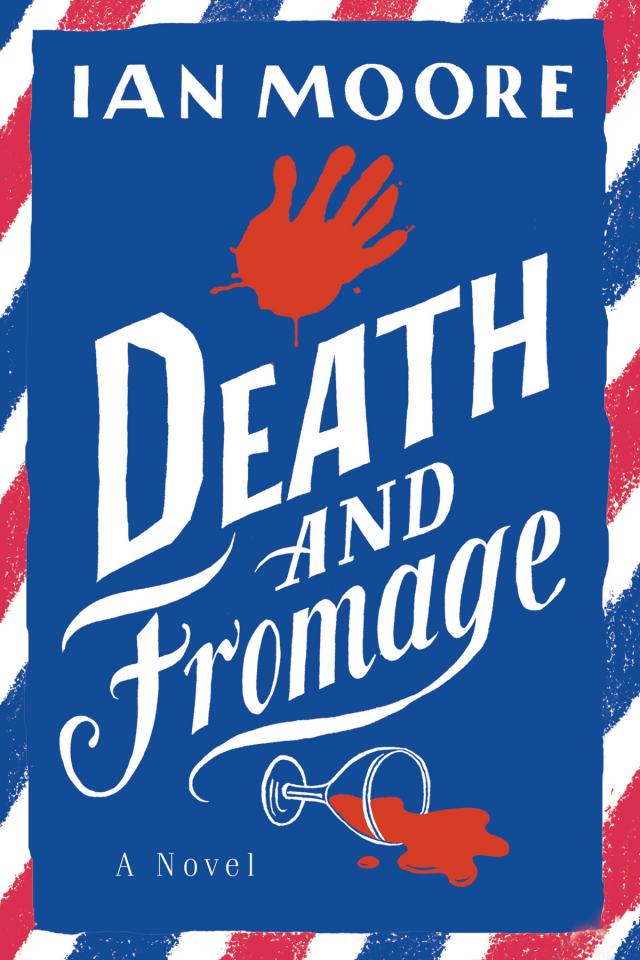
Cover design and illustration by Patrick Knowles
Sourcebooks, Poisoned Pen Press, and the colophon are registered trademarks of Sourcebooks.
All rights reserved. No part of this book may be reproduced in any form or by any electronic or mechanical means including information storage and retrieval systems—except in the case of brief quotations embodied in critical articles or reviews—without permission in writing from its publisher, Sourcebooks.
The characters and events portrayed in this book are fictitious or are used fictitiously. Any similarity to real persons, living or dead, is purely coincidental and not intended by the author.
Published by Poisoned Pen Press, an imprint of Sourcebooks
P.O. Box 4410, Naperville, Illinois 60567-4410
(630) 961-3900
sourcebooks.com
Originally published as Death and Fromage in 2022 in Great Britain by Farrago, an imprint of Duckworth Books Ltd. This edition issued based on the hardcover edition published in 2022 in Great Britain by Farrago, an imprint of Duckworth Books Ltd.
Cataloging-in-Publication Data is on file with the Library of Congress.
Contents
Front Cover
Title Page
Copyright
Chapter 1
Chapter 2
Chapter 3
Chapter 4
Chapter 5
Chapter 6
Chapter 7
Chapter 8
Chapter 9
Chapter 10
Chapter 11
Chapter 12
Chapter 13
Chapter 14
Chapter 15
Chapter 16
Chapter 17
Chapter 18
Chapter 19
Chapter 20
Chapter 21
Chapter 22
Chapter 23
Chapter 24
Chapter 25
Chapter 26
Chapter 27
Chapter 28
Chapter 29
Chapter 30
Chapter 31
Chapter 32
Chapter 33
Chapter 34
Chapter 35
Chapter 36
Chapter 37
Acknowledgments
About the Author
Back Cover
For my dad, who taught me the love of film.
1
Richard Ainsworth was out of his depth and out of his comfort zone. Also, if he carried on drinking this excellent sauvignon blanc at his current rate, he’d likely be out of his box too. A tasting menu soirée to celebrate the opening of Les Gens Qui Mangent restaurant, coinciding with the promised return of Valérie d’Orçay, had seemed too good to be true. And so it had proved. So, now Richard sat conspicuously alone at a table for two, surrounded by every local bigwig within a fifty-kilometer radius in the Follet Valley looking like a man who has had—as Humphrey Bogart put it so eloquently in Casablanca—“his insides kicked out.”
He tried to refrain from taking another sip of wine, avoiding eye contact with the gleaming crystal glass for a moment before giving in to its charms with a “what the hell?” shrug. Immediately a waiter was on him, quicker than a wasp at a picnic, filling his glass while wearing a look on his face that managed to be both obsequious and contemptuous at the same time. A Parisian waiter, thought Richard, trained in the secret art of slick silver service delivered with an impenetrable, almost phosphorous resentment.
“A turp-urp, monsieur?” asked the weaselly little man without looking down. His attempt at English proved the Parisian credentials beyond doubt, the “I’m better than you” one-upmanship the clincher, a pro brought into town for the fancy opening night.
“Oh go on then.” Richard’s joviality was forced. Also he’d wanted to reply in French, just to let the man know he wasn’t to be pushed around, but his instinct was to reply in English, as every damn Parisian-trained waiter knew. How had he even known that he was English? It wasn’t as if Richard went about the place with a bowler hat on his head and a pot of tea at his side. He’d even made a huge effort with the language since he’d moved to France and was just the right side of fluent, knowing that a full-blown multilinguist is never quite trusted, especially an English one, and jokey translating was always a good conversational icebreaker anyway. Sometimes he even pretended to know less than he actually did just to get things started. Maybe it was his suit, not worn for years and the cut of which was, he’d been told, very English. He’d had no idea whether it was meant as a compliment or not, and had preferred not to pursue it. English “style” was very much admired by the French, but he wasn’t sure that a Debenhams off-the-rack counted. Normally his clothes were standard middle-aged fare: smart without being flashy, maybe a snagged pull in a sweater away from the dreaded “He’s let himself go” that the newly single man of a certain age should fear. But tonight, he’d even ditched the string around his neck that held his reading glasses and which stopped him from losing them. Inevitably he now lost them on a boringly regular basis, but it had been at Valérie’s suggestion, so he thought it a small price to pay.
Richard suspected that it wasn’t necessarily his appearance that gave his Englishness away, but a vibe, a sensibility, a very definable quality that made him different from all the French people in the room. It was an awkwardness of the high-end cuisine restaurant environment that betrayed his roots; whereas the French accepted it naturally and behaved as if it were their birthright, Richard felt out of place, unworthy of his surroundings almost, an imposter about to be unmasked. Put bluntly, Richard’s Englishness stood out like a battered sausage on a bed of gratin dauphinois.
That said, he thoroughly enjoyed his life in the wider Loire Valley and his role as an exotic-ish foreigner in its quiet, slow-paced world. One of the locals, the rather giddy Jeanine, who ran the boulangerie in town, said that he looked a bit like the Earl of Grantham from Downton Abbey, which he’d never seen. Since then, however, he’d always tried to affect a stately manner when shopping for his daily baguette, which if he was honest was quite tiring and not his style at all, more used as he was to a kind of endearingly polite befuddlement. He just felt out of sorts this evening, that was all; something was missing. Of course, it was obvious to everyone what that was, as the place opposite him, with its gleaming cutlery and empty plate, screamed, “He’s been stood up.” Dammit! he thought, nearly breaking the stem of his delicate wine glass. When would the pitifully few women in his life, which at the moment amounted to three, including an estranged wife, a demanding daughter, and his missing dining companion…when would they stop taking him at his word and start reading between the bloody lines? He hadn’t been publicly effusive when Valérie had said she was coming to stay, but he’d hardly worn the granite coldness of a statue either. He thought you were supposed to play it cool.
“Another turp-urp, monsieur?”
Richard tensed, ready again with a French comeback for the limpet-like man, then his shoulders slumped and he said a hollow, “Really, already? Well, why not?”
The waiter held the bottle at the base and expertly twisted it as he poured the wine into Richard’s glass. Placing the Pouilly-Fumé back in its ice bucket and wrapping the serving cloth around its long neck, he nodded his head smartly to one side, practically clicked his heels, and with small, delicate steps weaved his way back through the tables in search of someone else to bully. Richard sat looking morosely at the bottle, a Didier Dagueneau no less, which at least cheered him up. There were worse ways to be stood up, and he should be proud that his standing locally was such that he had been invited in the first place. He decided to forsake the Bogart angry snarl at the non-appearance of Ingrid Bergman and switch instead to Cary Grant’s lighter, roll-with-the-punches touch that broke hearts in An Affair to Remember when Deborah Kerr failed to appear at their rendezvous at the Empire State Building. It comforted him briefly: Richard once again, as he had done since his teenage years, finding solace and escape from reality in golden-age Hollywood cinema. He decided that he may as well enjoy himself.
The tasting menu had thus far been pretty good. He’d lost count of the number of courses, possibly eight, maybe more, a dizzying food circus of pan-fried scallops, quail eggs, ginger-infused pois gourmand sorbet served as a starter, kiwi granita as a palate cleanser, raviolis de joue de veau avec soubise à l’oignon as the main course… Richard was no expert; he usually approached fine dining of this caliber with a trepidation bordering on fear, so he had no idea if it was Michelin standard or not. What he did know was that even after eight courses—or was it nine?—he was nowhere near full. In fact, he thought guiltily, trying to suppress his Englishness, he was quite peckish.
“Monsieur?” The waiter was back, his nose so high in the air it risked getting stuck in one of the ceiling air ducts that had been left uncovered, as seemed the modern way with restaurant design, all pipes and tubes. The Pompidou Center had an awful lot to answer for. “We are about to offer ze dessert, would monsieur like ze red wine or to stay wiz ze white?”
Richard knew a trap when he saw one. “I believe the dessert is goat’s cheese based?”
“Monsieur is correct.” His nostril twitched.
“Then I shall stick with this excellent sauvignon blanc, thank you, as nature intended,” he added grandly and in French.
&nb sp; The waiter arched an eyebrow, clicked his fingers for some reason, like a discontented flamenco dancer, and slid off.
The small victory cheered Richard up no end, as small victories always did. He often reasoned that small victories were the very essence of life, the moteur, as the French would say. If life was a war and defeat therefore inevitable, small victories along the way gave at least the impression that it may be a close-run thing. He also, now that the wine had properly kicked in, regarded Valérie’s no-show as a small victory, though he realized that was putting a spin on things that even a seasoned politician would be proud of. He knew that she would have loved the evening, basked in it, and been the center of attention. Her elegance, poise, and beauty would have been the envy of every other woman in the room, while the men would not have taken their eyes off her. Also, thanks to her profession, with one perfectly executed, balletic roundhouse kick she could have broken the waiter’s brass neck. Ah well. He took another sip of the wine, then topped his glass up himself. Another minor triumph.
“Richard?” He looked up guiltily as he placed the bottle back in the wine bucket, suspecting security were on him for breaking some wine code.
“Yes? Ah, Noel.” He relaxed. Noel Mabit was an odd little man, dressed almost like a waiter himself, which was quite un-French, as they prefer informality in a formal setting. Noel leaned over Richard, his hands clasped together. Richard couldn’t put his finger on what he didn’t like about Noel; nobody could, even the long-suffering Madame Mabit, who often referred to him as her appendix, in that she wouldn’t miss him if he were gone. He was just always there. He was on every committee, at every function, like a small-town minister without portfolio, cajoling others to get involved while not seeming to actually do anything himself.
“Richard, I’m so sorry to disturb you.” He made an obvious glance to what should have been Valérie’s chair opposite. “Have you met Monsieur Auguste Tatillon?” He indicated the figure behind him.
Richard had not met Monsieur Auguste Tatillon but he had certainly heard of him. His reputation as one of the more acerbic restaurant critics in France meant that he loomed over the culinary world like a dark cloud, all-powerful and capable of utter destruction. His word meant the difference between success and failure. As one chef not known for his deference to any living being had put it, his pen was sharper than a Japanese kitchen knife. Tatillon hovered behind Noel, looking bored, his lips pursed, his eyes cold.
“We haven’t had the pleasure.” Richard stood and offered his hand to the critic, who was taller than he’d realized and slim, bordering on skinny, looking rather like he could do with a decent meal.
“Delighted,” mewed Tatillon, though he looked anything but.
“Monsieur Tatillon now has business here in Saint-Sauver tomorrow and wishes to stay the night,” Noel gushed. “I suggested your charming bed and breakfast, Richard. I assume you have space…” He couldn’t help waving a hand toward the empty chair. Richard’s B&B, though he preferred the French term chambre d’hôte, was what had given him his standing in the community in the first place, and for that he was grateful, but he didn’t like late bookings, as they represented a change of plan, which he was never quite comfortable with. On the other hand, it was quite clear that Valérie, who had booked the last free room of the three he had, wasn’t coming, and it would be a feather in his cap to have the famous Auguste Tatillon staying at Les Vignes, even if it would put inordinate pressure on the quality of his morning croissants.
“Of course,” he said, “I’d be honored.”
Noel clapped his hands with glee. “Monsieur is most kind,” said Tatillon with a pained expression, making it sound like Richard had just punctured his eardrum with a fish knife. He moved off back to his own table.
“How marvelous!” Noel couldn’t contain himself. “Auguste Tatillon! Staying here in Saint-Sauver! You won’t let us down, will you, Richard?”
Richard ignored the “us.” “Is he more important than Sébastien Grosmallard then, this critic?”
“Who?” Noel’s eyes followed Tatillon as he glided through the tables as if on roller skates.
“Sébastien Grosmallard, Noel. Our celebrated three-starred Michelin chef. Our host.” The lights dimmed. “And here he is now.”
One of the doors to the kitchen opened, spraying light into the dimmed room. From the bright light a shadow emerged; the enormous bulk of the fiery Sébastien Grosmallard, the enfant terrible of French cuisine, now more middle-aged terrible than he’d care to admit, but still the brilliant scourge of the culinary establishment. He stepped forward through the door and the restaurant lights were turned up slightly. He was in his chef’s whites, the cross-buttoned tunic undone at the top and struggling to stay closed further down. He had sweat on his brow, his shoulder-length curly hair was stuck to his forehead, and he looked exhausted. In his right hand was a plate, which he held aloft, and under his left arm was a smaller man, who he was practically carrying.
The room applauded, and so did Richard. It was quite the entrance—very Grosmallard, people would say. The applause died down and Grosmallard nodded his thanks.
“Mesdames et messieurs,” he boomed, his deep, sonorous voice almost echoing off the exposed pipes, “I have come home!” The applause started again and he held his left arm aloft, dropping the smaller man on his feet. He waited for the applause to die down again. “This”—he held the plate aloft—“is the dish that made my name! Parfait de fromage de chèvre de Grosmallard!” He bowed to more applause as the restaurant lights flashed full-beam and suddenly the place was awash with waiters and waitresses who’d maneuvered into position during the gloom, placing the celebrated dish in front of each guest. “Only this time,” shouted Grosmallard over the din, “it is made by my son, Antonin!” He hauled Antonin back under his arm, but most people were staring in wonder at the majesty in front of them. To describe it as a parfait of goat’s cheese was underselling it.
On the white plate was indeed a parfait of goat’s cheese, egg shaped and smooth as marble. Beside it was a small beetroot-and-raspberry tart; nasturtium flowers lay across the tart, as delicate as snowflakes. But the theatricality of the final touch, the central eye-catching drama of the dish, was the red-berry coulis accompanying the two other elements and which lay beneath both. It was on the plate as a perfect handprint, a perfect blood-red handprint. It was magnificent.
Everybody sat down to eat and a silence fell over the room. It was awe, mostly. Richard was no fan per se of food as art, but this was a stunning piece of work, even if it did remind him of the real bloodied handprint on his B&B wall that had first introduced him to Valérie. He didn’t know where to start; it felt a shame to ruin such a tableau, and he could sense others had the same apprehension, before a collective deep breath and “Geronimo!” had everyone diving in. Then he quickly noticed something else: the atmosphere in the room had changed. There were murmurings, discontented murmurings, that came first from Tatillon’s table, and then the chatter, not positive, began to increase in volume.
“He has changed the recipe!” one excited diner yelled.
“It’s sacrilege!” screamed another. Richard even though he saw one woman faint.
Suddenly, anger and pandemonium were everywhere, before being halted by a bloodcurdling scream that came from the kitchen and traveled through the pipes until the noise not only filled the room but surrounded it, a primeval howl.
“You’ve killed me!” went the painful roar. “You. Have. Killed. Me!”
Richard picked up his wine shakily and was just about to take a drink when it was taken from his hand.
“Have I missed anything?” asked Valérie, before taking a gentle sip, the wine and the lights catching the gleam in her eye.
2
The diners drifted slowly out of the now somber restaurant and away into the car park. Their low whispers may have bordered on silence, but spoke volumes. There was a time for gossip and speculation but this wasn’t it; this would shake the town to its core. Richard noticed that Noel Mabit was lingering, presumably to offer his services in the aftermath, but nobody wanted to talk to him. The staff were clearing up, trying not to make too much noise; even Richard’s nemesis waiter looked shocked. He saw Auguste Tatillon waiting for him by the door, a small, elegant leather case in his hand. He’d have resembled an evacuee if it wasn’t for the detached, high-handed air; the cold look on his face was that of a stern teacher let down by a star pupil.


