

K a applegate everworl.., p.1
K. A. Applegate - Everworld 09, page 1


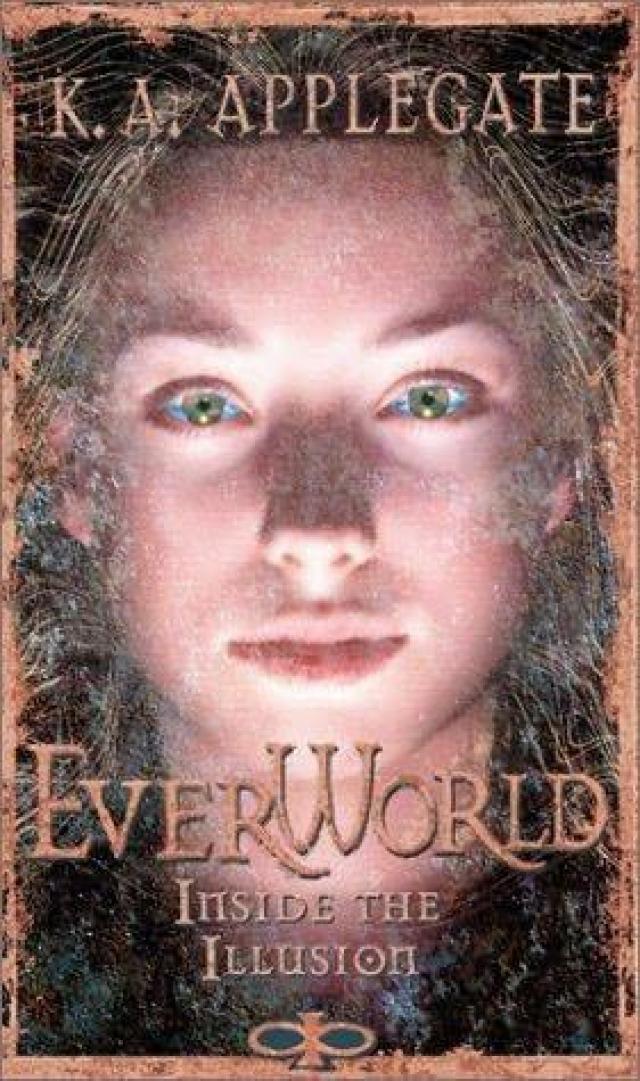
Everworld #9
Inside The Illusion
K.A. Applegate
Chapter
I
I was seven years old when my mother told me she was going away.
I remember the lights on the train were too bright; they made it impossible to see out of the windows. The car jerked and bumped. A man slept, chin down on his chest, wheezing. A nurse had taken off one white shoe and was rubbing her foot.
We sat on hard plastic seats, my mother and I She was nervous, jumpy, I could tel that much. She looked too closely at the other passengers. She whispered to me, putting her lips right against my ear, tickling.
“I know you don’t understand, Senda. You can’t understand, not really, not now. But if I keep you, honey, if we stay together, it wil cause trouble. Bad people might… I don’t want to scare you, sweetie, I don’t want you to worry. You just have to trust your mommy. Someday you’ll know.” She put her hand against my cheek, stroked my cheek and hair. Kissed the side of my head.
“Where are you going?” I asked. I had no idea, of course, I was too little. No idea that this night would be the last I saw of her.
“Mommy has to go far away, to a very different kind of place.
Mommy has to leave. She’s sorry, I’m so sorry, I never should have…
but someday maybe you’ll leave, too, Senda. Maybe, I hope not, I really do, I hope you’ll find a way to be okay, to be normal. Oh, sweetie.”
She talked on and on, a loop, repetitive, meandering, fil ing time and space with words that meant nothing to me.
I watched the other people on the train. None of them glowed. None of them shone with the pale light that I saw around my mother. None of them was like us. No one ever was.
There was only us, I knew that, had known it forever, it seemed.
Only we were like us. A minority of two.
That night I met my father for the first time. I had my little suitcase and a Barbie backpack. I had my few toys, my clothes, my books. We emerged from the CTA station and stepped into a canyon of overpoweringly tall buildings. I knew what this place was called, it was “downtown.”
It was late, dark. The streets weren’t deserted — Chicago streets are never entirely deserted — but there was an empty, depopulated feeling.
Yellow cabs glided past, their “available” lights glowing.
Limousines splashed through puddles of recent rain. An occasional bus would gasp and struggle by, leaving an oily smell in its wake.
Pedestrians were few. They walked fast and kept their faces buried in collars and scarves. It was cold, wet cold. Across the street an Italian restaurant with a gaudy red, green, and white marquee. A Kinko’s, wide-awake and bright white, but empty aside from a long-haired guy standing over a massive copier, eyes glazed, head bobbing to music I didn’t hear.
I looked up. The buildings rose forever, up into a sky of orange-tinted darkness. The stars were washed away by the lights, the moon invisible.
“Come on,” she said, and we crossed at the light. She held my hand, she carried my little suitcase, and I carried my Barbie pack. I didn’t like it, I didn’t like Barbie, but it was mine, and having it with me helped.
We pushed our way through a heavy glass door into a half-lit mausoleum of a lobby, al granite brushed aluminum and recessed lights. A guard looked up, surprised to see the likes of us. “We’re here to see Tom O’Brien,” my mother said.
The guard made a phone call. Then we got on the elevator and rode it up and up, neither of us speaking. Music was playing. The elevator dinged as we passed each floor.
We rode all the way alone. We stopped and found ourselves in another lobby, more carpet and walnut. The lights were low here, too. I heard someone typing on a keyboard.
Saw a man in a white shirt down one hallway. He was talking to someone inside an office. He looked excited.
From the other direction came a tall man. He seemed so old to me. He had gray hair on the sides of his head, a worried look, lines in his forehead. But his eyes were soft as he looked at me.
“Anica, what are you doing?” he asked my mother.
“I have no choice, Tom. She’s your daughter. I can’t keep her.
If I do, we’ll both be in danger. You have no concept… no idea.”
He drew her away, looked back over his shoulder, and said,
“Stay right there. Don’t go anywhere.”
He ushered her into an office and closed the door. I went and listened. Crouched and pressed my ear to the fine, satin-finished walnut.
“… crazy? You can’t just come waltzing in here and drop off a little girl. I have a family. I have a wife and a daughter of my own.”
“You had a wife when you were having me,” she said sharply:
“Yes, and it was wrong, and if I’d known you had a baby I’d have helped with support. But you took of . You never told me.
You —”
“There’s no time for all this,” my mother interrupted wearily.
“Come. Take my hand.”
Even through the door I could feel it, the glow. That’s what I called it, the glow, that’s what my mother taught me to call it. A light that shines from nowhere, a light that people can’t see. I felt her take the glow within her, focus it, direct it, use it. It all passed through me, that glow; we were one and inseparable, my mother and I, united by the glow.
There was a pause. Then my mother’s voice again, softer, soothing. “Now it’s all better, isn’t it? You’re a good man, Tom.
You want to do what’s right. You want to live up to your responsibilities.”
No answer at first. Then a vague, troubled voice. “Yes. Of course.”
“You still love me.”
“Yes.” Not a ringing affirmation, more of a reluctant confession.
“You’ll take her. For me.”
“My will is your will, Tom. My needs, your needs. Your worries will come to nothing. All will be well. All is well. You will take the girl, you will raise her, protect her, keep her as safe as it is within your power to do.”
“Yes,” the man said. A sleepwalker mumbling.
“Good. Remember.” Then, in a different, more businesslike tone, she said, “Don’t worry, Tom, you won’t have her for long.
The powers will find her or she will find them.”
“Anica, I don’t understand”
“No. But she will. Someday. She’s listening now. She’s outside the door, I can feel her there.”
I jerked away from the door, face burning. But then I decided to listen again. What harm would there be? My mother was leaving me. What could she do that was worse than that?
And then she was speaking to me, right through the door, as if she could see me, as if she had heard my bitter, unvoiced question.
“You are great and dangerous, Senda. I named you
‘pathway’ but may you never become one. If we stay together, the two of us together in one place… too dangerous, and I am too weak, Senda, my innocent little girl. But the day may come, forbid! But if the day comes, look for me with Mother Isis.”
“What did you say her name was?” my father asked.
“Senda. My lovely daughter, Senda, the Pathway.”
“Senna?” he repeated, losing the soft Spanish “d” sound in his flat Midwestern pronunciation.
And from that day, I was Senna. I was his daughter. And I knew that I was different.
My mother never came out of the office. I heard my father gasp. I felt a terrific rush of power, the glow, unfiltered. And a few moments later my father emerged, white as a ghost, shaking.
I looked inside. My mother was gone.
Chapter
II
“Hey, witchy woman,” Christopher said, pitching his voice to be overheard by everyone. “Hey, hey, witchy woman? Are you sure you can’t make a six-pack of Heinies appear? I mean, you can move a whole freaking river and you can’t work up a six-pack? It’s okay if it’s cans. I’m not saying it has to be bottles.”
I ignored him. As a rule I ignore all of them. They hate me.
They blame me. They’re afraid of me. All of which means very little to me. What matters to me is the question of whether they do as I need them to do. Humans aren’t chess pieces, they do after all have free will — to some degree — but a good player can still use them.
In fact, playing humans is harder. Or maybe I should say it simply requires different skills. A chess grandmaster has to be able to see his own and his opponent’s moves, six or seven plays into the future. That’s impossible with humans, of course.
Humans are pawns or bishops or rooks who may on occasion move in impossible ways.
Chess pieces don’t do that. The knight does not simply decide to move two spaces forward and three back.
To play humans you need less of an ability to see many moves ahead, more of an ability to adapt swiftly, to keep your eye on one or more goals simultaneously, and to be prepared to add human free will into your own equation.
“Heineken?” April said, just to make conversation and annoy me. “I would never have thought of you as an imported-beer kind of guy, Christopher.”
“Well, I’m not saying I would turn down a humble Budweiser. I just thought, hey, if the Wicked Witch of the North Shore can do it, why not go upmarket?”
Thus far in Everworld I had managed to escape Loki, escape Merlin, and weaken Huitzilopoctli, which in turn weakened Ka Anor. Of course there had been failures, t oo. I had failed to use Hel for my own ends. That was overreaching on my part. Hel is just a mad beast; I should have realized that.
Worse yet, I had lost control of David. Not all control — he would always want me, always love me, always have to fight the urge to think first of my needs and demands. But that bitch Athena…
“Guinness,” April said. “That’s beer. Or stout, I guess they cal it.”
Well, live and learn. Live and learn and grow stronger. I could feel it. Every day I was stronger. Every day the force that ran through Everworld like electricity through a live wire was easier for me to reach, to touch, to manipulate. I could see lines of power everywhere, sense them, draw their power into me. Use them.
And more than use them, feed on them. Normal people would never know the pleasure. They would never know how empty their lives were without the glow. Even I had only seen a part of it in the old days, the days of my long exile in the real world.
There the glow is a mere trickle coming through the rift between universes. There the glow touched me and I touched it, but it was a weak, paltry light that only kept my soul from freezing but never made me warm.
Here, ah, this was the source. I had been Neptune, Pluto, out in the cosmic darkness squinting to see a far-distant star. Here I stood in the full tropical glare of that sun. The light was every where. The light was within me. No longer a glow, but a furnace.
Could I make a six-pack of beer appear? No. Make what did not exist suddenly exist? Of course not, even most gods can’t do that. And I am no god, but a mere mortal with unusual abilities.
Still, I had tapped into the deep powers and moved a river.
The memory filled me up, rushed through me, the sensation of power more erotic than any fantasy, more exciting. My skin crawled and tingled with it. I could scream from the pleasure of all that magic, all that light flowing into me, through me.
“Look,” David said. “See something shining up there? Is that a river?”
“God, I hope so,” Christopher said. “I am running out of sweat.”
We paused atop a scruffy knoll and they all shaded their eyes and blinked in the blinding sun, trying to see clearly. I closed my eyes and saw more clearly than any of them. Oh yes, it was a river. A river that vibrated with energy. The river.
“Looks like a river, those are clearly trees, some kind of a val ey,”
Jalil said. “Although with this heat the water could be an illusion, a mirage.”
“Can’t you tell for sure, Spock?” Christopher mocked. “Spock, we count on you.”
My hook was still in him. But it was his core character that I relied on. He hated himself, David did. Hated himself for failing as a child to resist molestation. He would never let himself up off the floor for that. He would demand ever-greater evidence that he was a man, a man, a capital M man. He would never, ever find satisfaction.
And he would never truly turn against me, never really abandon me, he couldn’t. He had to be the hero or die trying.
My half sister, April, began to sing. A perky little melody from some no-doubt popular singer. April likes to sing. She’s a showy, superficial person. She wants to be an actress and may well accomplish that minor goal — and no more.
She was the daughter in my father’s house, the one and only, the adored, cute, perky, sweet-faced, red-haired, Talbot-Kids-wearing girl, the beloved one, when I moved in with my Barbie backpack and nouveau-bohemian clothes.
It was contempt at first sight. I’ve never liked her. On her good days she amused me. On her bad days I found her self-righteous religiosity, her smug normalcy intolerable.
Christopher began to babble under the reviving influence of the oranges, an oversized kid on a sugar rush. “Hey, maybe this isn’t Egypt. Maybe it’s Florida. Keep a sharp eye out for old people.
Anyone spots a golf course where all the players are ninety years old, we’ve gone right past Egypt and ended up in Lauderdale.”
Originally I had chosen Christopher because of his weaknesses.
He would keep David of -guard, he would be an irritant, never let the group truly coalesce. A lightweight bigot, an alcoholic, a selfish coward. But Christopher was maturing and causing less dissension than I had hoped.
Pity. I would have to see what I could do about making beer.
Maybe I could drown the reborn, new-and-improved Christopher in alcohol.
For now, though, there actually seemed to be a friendship growing between Christopher and Jalil. Evidence of the unpredictability of human chess pieces.
Jalil had been a major disappointment, greater even than Christopher. I thought I had him. But my hold over Jalil was a bluf now, and he knew it.
Jalil is a very intelligent young man with a twisted brain.
Obsessive-compulsive, a hand washer, a counter, a person ruled by uncontrol able, irrational impulses that are the distorted mirror of his own cold rationalism. He will stand at a sink washing and washing till his skin cracks and bleeds and he cries, sobs, unable to resist.
But for some reason I didn’t understand, the compulsions were absent from the Everworld Jalil.
That weakened my hold. That and the fact that Jalil suf ers from the vice of stubbornness. He is not easily bluf ed or intimidated. I misjudged him. Underestimated him. He was a hard piece to play.
I had chosen David to play the soldier, Christopher to play the clown, April to play the peacemaker. And I had chosen Jalil to be the scientist. Because I could never rule safely till I had my hands on the software, as Jalil called it.
I loved the glow, needed it. I was fil ed with it. But I was never a mystic like my mother. I was never content to let it be, let it flow. I was a child of the twenty-first century, not some fugitive from the Dark Ages like her. I didn’t want mumbo jumbo and Wiccan spirituality, I wanted control.
I needed to understand the software. I needed the codes, and to be able to rewrite them. And Jalil would die trying to find those codes. He can’t help himself any more than David can.
That should have been enough, but now Jalil was becoming dangerous. He’d shown that in our passage through Africa. He had tried to use me, had used me, and had even forced David to help him.
I suppressed a shudder, clenched my jaw tight to keep from screaming. The smug bastard had used me!
No, no, just embarrassing or manipulating Jalil was no longer nearly enough. Jalil had used me. I would hear his screams for that. I would watch his agony and laugh.
Not that I would enjoy it. I was not a sadist. But I had a destiny.
Nothing could be allowed to get in the way of that, surely that was obvious. It should have been obvious to Jalil.
Did he think I resisted Loki’s attempt to use me. Merlin’s at empt to use me, everyone’s attempt to turn me into their own personal little turnstile, making me an object, depriving me of control, of power? Did he really think I would let him use me and not make him suffer, not make him plead for mercy, not make him scream til his filthy throat was raw?
I could do it right now. I had moved a river. I could do it right now, couldn’t I?
I watched him, stared at the back of his neck, he was ahead of me, watched his scrawny form move in dappled sunlight, watched him gnaw at a split orange, and thought. Shall I kill you now, Jalil? I felt anticipation within me. Felt the stirring of the carnal lust that filled me with every use of the great power.
No. No, what if I tried and failed? What if I failed?
Why didn’t he wash his hands? Where had his weakness gone? Was it a by-product of the cross-universe shift? Or was he protected?
Ah, that was the question. That is what stayed my hand. Had someone, some power, some god, seen my scheme and made just the subtle changes needed to weaken me?
Was I someone else’s chess piece?
Chapter
III
We reached the river without incident. An accomplishment in Everworld, where no innocent walk is ever free of mortal danger.
The river was broad, slow, almost sluggish. Too wide, too slow.
Of course I saw a different river than the others did. They saw indifferent, opaque, silt-choked water. I saw the bright glow of enchantment, the sense of a thing vibrating, like a plucked violin string.
And yet, up close it felt wrong. I sensed frustration of purpose. A certain strangeness, resentment, energy penned and controlled, energy that wanted release.


