

When i sing mountains da.., p.1
When I Sing, Mountains Dance, page 1


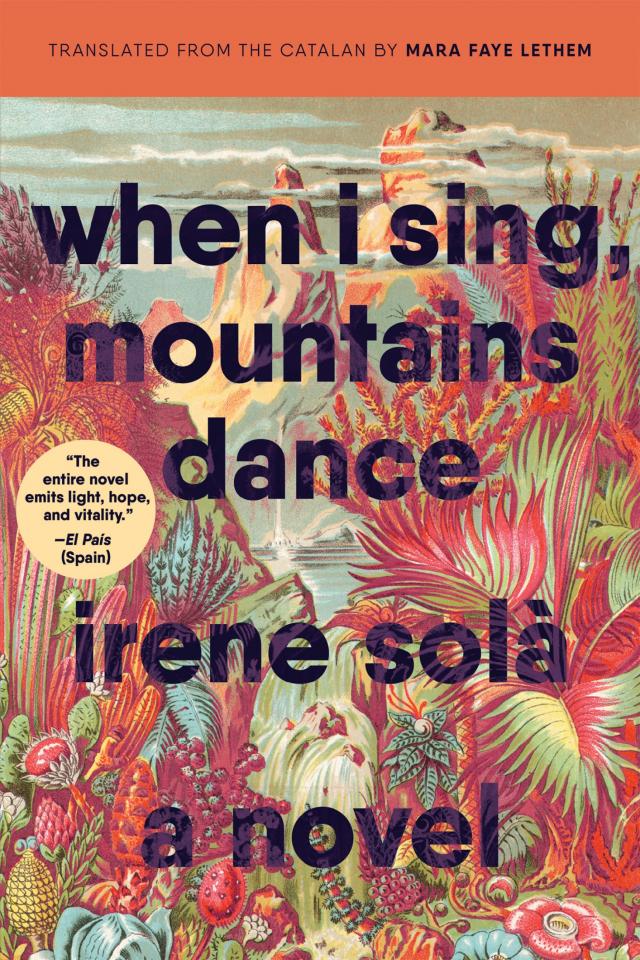
when i sing,
mountains
dance
when i sing,
mountains
dance
A Novel
Irene Solà
Translated from the Catalan by Mara Faye Lethem
Graywolf Press
Copyright © 2019 by Irene Solà
English translation copyright © 2022 by Mara Faye Lethem
Originally published in 2019 as Canto jo i la muntanya balla by Editorial Anagrama
Excerpt from Sjálfstœtt folk by Halldór Laxness, copyright 1934 by Halldór Laxness. Used by permission of Forlagid Bókabú. All rights reserved. Excerpt from Independent People by Halldór Laxness, English translation copyright 1946 by Halldór Laxness. Used by permission of Vintage Books, an imprint of the Knopf Doubleday Publishing Group, a division of Penguin Random House LLC. All rights reserved.
The author and Graywolf Press have provided this e-book to you for your personal use only. You may not make this e-book publicly available in any way. Copyright infringement is against the law. If you believe the copy of this e-book you are reading infringes on the author’s copyright, please notify Graywolf Press at: us.macmillanusa.com/piracy.
This publication is made possible, in part, by the voters of Minnesota through a Minnesota State Arts Board Operating Support grant, thanks to a legislative appropriation from the arts and cultural heritage fund. Significant support has also been provided by Target Foundation, the McKnight Foundation, the Lannan Foundation, the Amazon Literary Partnership, and other generous contributions from foundations, corporations, and individuals. To these organizations and individuals we offer our heartfelt thanks.
This book was translated with the help of a grant from the Institut Ramon Llull.
Published by Graywolf Press
250 Third Avenue North, Suite 600
Minneapolis, Minnesota 55401
All rights reserved.
www.graywolfpress.org
Published in the United States of America
ISBN 978-1-64445-080-2
Ebook ISBN 978-1-64445-170-0
2 4 6 8 9 7 5 3 1
First Graywolf Printing, 2022
Library of Congress Control Number: 2021940574
Cover design: Carlos Esparza
Cover art: Private collection. © Look and Learn / Bridgeman Images
To Oscar
Og þegar vorvindarnir blása um dalinn; þegar vorsólin skín á hvíta sinuna á árbakkanum; og á vatni; og á tvo hvíta svani vatnsins; og laar vornálina frammúr keldum og veitum, – hver skyldi þá trúa því a þessi grösugi frisæli dalur búi yfir sögu vorrar fyrri ævi; og yfir forynjum hennar? Menn ría mefram ánni, þar sem hestar liinna tía hafa gert sér götur hli vi hli á breiu svæi öld frammaf öld, – og ferskur vorblærinn stendur gegnum dalinn í sólskininu. Á slíkum dögum er sólin sterkari en fortíin.
Sjálfstæt fólk
HALLDÓR LAXNESS
And when the spring breezes blow up the valley; when the spring sun shines on last year’s withered grass on the river banks; and on the lake; and on the lake’s two white swans; and coaxes the new grass out of the spongy soil in the marshes—who could believe on such a day that this peaceful, grassy valley brooded over the story of our past; and over its spectres? People ride along the river, along the banks where side by side lie many paths, cut one by one, century after century, by the horses of the past—and the fresh spring breeze blows through the valley in the sunshine. On such a day the sun is stronger than the past.
Independent People
HALLDÓR LAXNESS
Translated from the Icelandic by J. A. Thompson
CONTENTS
I
Lightning
The Names of the Women
The White Tablecloth
The Black Chanterelles
II
The Bailiff
The First Roe-Buck
The Setting
Poetry
Everybody’s Brother
III
Crunch
Birthing Babies
The Snow
Fear
Lluna
IV
The Bear
Cristina
The Dance of the Oat Harvest
The Ghost
Author’s Note
Acknowledgments
when i sing,
mountains
dance
I
LIGHTNING
We arrived with full bellies. Painfully full. Black bellies, burdened with cold, dark water, lightning bolts, and thunderclaps. We came from the sea and from other mountains, and from unthinkable places, and we’d seen unthinkable things. We scratched at the rock atop the peaks, as if we bore salt, to ensure not even weeds would sprout there. We chose the color of the hills and the fields, and the gleams in rivers, and the glints in upward-glancing eyes. When the wild beasts caught sight of us, they cowered deep in their caves and crimped their necks, lifting their snouts to catch the scent of damp earth approaching. We covered them all like a blanket. The oak and the boxwood and the birch and the fir. Shhhhhhh. And they all went silent, because we were a stern roof and it was up to us to decide who would have the tranquility and joy of a dry soul.
After our arrival all was stillness and pressure, and we forced the thin air down to bedrock, then let loose the first thunderclap. Bang! A reprieve. And the coiled snails shuddered in their secluded homes, godless and without a prayer, knowing that if they didn’t drown, they would emerge redeemed to breathe the dampness in. And then we poured water out in colossal drops like coins onto the earth and the grass and the stones, and the mighty thunderclap resounded inside the chest cavity of every beast. And that was when the man said damn and blast. He said it aloud, because when a man is alone there’s no need to think in silence. Damn and blast, you had to get yourself stuck in a storm. And we laughed, huh, huh, huh, huh, as we dampened his head, and our water slunk into his collar, and slid down his shoulder and the small of his back. Our droplets were cold and made him cross.
The man came from a house not far off, halfway up to the crest, by a river that must have been cold because it hid beneath the trees. There he’d left behind two cows, a bunch of pigs and hens, a dog and two roving cats, an old man, and a wife and two kids. Domènec was the man’s name. And he had a lush midmountain garden patch and some poorly plowed fields beside the river. The patch was tended by the old man—his father, whose back was flat as a board—and Domènec plowed the fields. Domènec had come to reel off his verses over on this side of the mountain. To see what flavor and what sound they had, because when a man is alone there’s no need to whisper. That evening when he checked on the herd he found a fistful of early black chanterelles, and he carried the mushrooms wrapped in the belly of his shirt. The baby cried when he left the house, and his wife said “Domènec” as if protesting, as if pleading, and Domènec went out anyway. It’s hard to come up with verses and contemplate the virtue hidden inside all things when the kids are crying with the shrillness of a flayed piglet, making your heart race despite your best efforts to keep calm. And he wanted to go out and look at the cows. He had to go out and look at the cows. What did Sió know about cows? Nothing. The calf went maaaaaaaaaaa, maaaaaaaaaaaaaa. Desperately. Sió knew nothing about cows. And again he cried out, damn and blast!, because we’d snuck up quickly, hell yes, capricious and stealthy, and we’d trapped him. Damn and blast!, because the calf’s tail was stuck in a jumble of wires. The wires had gotten lodged between two trees, and what with all its straining the calf’s legs were shredded and gleamed bloody, ragged and dirty. It went maaaaaaaaaaa, maaaaaaaaaaa, trapped by its tail between the two trees, and its mother guarded it restlessly. Through the downpour Domènec climbed over to the animal. His legs were good and strong from barreling up the mountain to get some air when the kids were yelling too much, or when they weighed too heavy on him, and the plowing weighed too heavy on him, and the old man’s silence, and all the words, one after the other, from his wife, who was called Sió, and who was from Camprodon, and who’d gotten herself into a fine fix, agreeing to go up there to that mountaintop with a man who slipped away and an old man who never spoke. And of course, sometimes Domènec loved her, loved her fiercely, still. But what a weight, for the everlasting love of God and Satan, how heavy that house could be! Folks should have more time to get to know each other before they marry. More time to live before making children. Sometimes he grabbed her by the waist and spun her around, round and round, like when they were courting, because Sió, oh Sió, lord have mercy, what a pair of legs! He dropped the chanterelles. The calf lowed. Domènec approached the animal, leading with his hands. Slowly, step by step. Saying things in a deep, quieting voice. Ssssh, ssshh, he said. Its mother watched him warily. Domènec’s hair was streaming wet. When he got home he’d have Sió heat up some water to wash off the cold and the rain. He looked at the wire that cut into the calf’s legs every time it moved. He grabbed its tail firmly, pulled out his knife, and deftly cut the knot. And then we let loose the second bolt. Quick as a snake. Angry. Wide like a spiderweb. Lightning goes where it wants to, like water and landslides and little insects and magpies, transfixed by all things pretty and shiny. The knife was out of Domènec’s pocket and it gleamed like a treasure, like a precious stone, like a fistful of coins. The metal blade, polished mirror, reflected us back. Like open arms, luring us closer. Lightning goes where it will, and the second bolt went into Domènec’s he
The four women who’d witnessed it approached him. By degrees. Because they weren’t used to taking any interest in how people die. Or in attractive men. Or in ugly men, for that matter. But the scene had been captivating. The light so bright and so dazzling that it sated all need for seeing. The knife had called to the lightning, the lightning had hit the man’s head, bull’s-eye, it had parted his hair right down the middle, and the cows had fled in a frenzy, like in some slapstick comedy. Someone should write a song about the man’s hair and the lightning comb. Putting pearls in his hair, in the song, white like the gleam off the knife. And include something about his body, and his open lips, and his light eyes like cups filling up with rain. About his face, so lovely on the outside and so burned on the inside. And about the torrential water that fell onto his chest and rushed beneath his back, as if it wanted to carry him off. And about his hands, the song would tell, stumpy and thick and calloused, one open like a flower expecting a bee, the other gripping the knife like tree roots swallowing a rock.
One of the women, the one named Margarida, touched his hand, partly to find out if the man was burning with the lightning bolt inside him, and partly just for the caress. Then the women left him be and gathered up the soaking wet black chanterelles he’d dropped, and abandoned the scene, because they had many other things to do, and many other things to think about. Then, as if their satisfaction were contagious, we stopped raining. Sated. Dispersed. And when it was clear we were done, the birds hopped out onto the branches and sang the song of the survivors, their little stomachs filled with mosquitoes, yet bristling and furious with us. They had little to complain about, as we hadn’t even hailed, we’d rained just enough to kill a man and a handful of snails. We’d barely knocked down any nests and hadn’t flooded a single field.
We retreated. Dog-tired. And we looked upon our work. Leaves and branches dripped, and we headed off, vacant and slack, for elsewhere.
One time we rained frogs and another time we rained fish. But best of all is hail. Precious stones pummel towns and skulls and tomatoes. Round and frozen. Covering terraced walls and paths with icy treasure. The frogs fell like a plague. The men and women ran, and the frogs, who were teensy-weensy, hid. Alas. The fish fell like a blessing on the men and women’s heads, like slaps, and the people laughed and lifted the fish up in the air as if they wanted to give them back to us, but they didn’t want to and we wouldn’t have wanted them back anyway. The frogs croaked inside our bellies. The fish stopped moving but didn’t die. But whatever. Best of all are the hailstorms.
THE NAMES OF THE WOMEN
Eulàlia did tell them how the Great He-Goat’s anus was so soft, tender as a newborn’s from how we coddled and kissed it, and how his shaft was cold as an icicle, and I laughed and laughed and laughed, and all that laughing ’twere what got me hanged. ’Twas that laughter, like a heady venom inside me, like the witch milk from a spurge, ’tis why I remember all the things. Because the laughter was white and contagious like tickles there inside my blood and if you broke my arm, white milk would come out instead of red blood. And the laughter left me emptied. They could’ve saved themselves the trouble of the tortures and the rooms that stank of piss, could’ve saved those ropes that stretched out so long, and the wool rags full of ash, and their waiting for me to stop laughing and confess. Confess what? Laughing was a good thing, ’twas a cushion, ’twas like eating a pear, like sticking your feet into a waterfall on a summer’s day. I ne’er would’ve stopped laughing for all the gold in the world, not for all the hurt in the world. The laughter unhitched me from the arms and legs and hands what’d been my loyal companions till then, and from the skin I’d covered and uncovered so many times, and it washed away the pain and grief over things that men can do to you. It done emptied me out like a dunderhead, all that heeheeheehee and hahahaha, and my noggin went clong-clong with the whistling air that entered me and came out my nose and ears. The laughing left my little head clean as a walnut shell, fit to hold all the stories and all the things what we said we done, and all the things they said we done against God and Jesus and all the saints and the Virgin. What Virgin? A god like each of their fathers, evil, evil, evil, and a torturer like them, and frightened by all the lies they’d repeated so many times they done come to believe them. For there be not a single one left on these mountains, nary a one of those who did point at us, who locked us up, who searched for the devil’s mark upon us, who knotted the nooses and tightened the ropes. Because staying or not staying had nary a thing to do with the fires of hell, nor with divine punishment, nor with any faith, nor with any sorts of virtue. No. Being able to get up every morn to gather penny buns and golden chanterelles and to make piss and tell stories ’tis to do with the thunderclaps what befall that tree and that man. ’Tis to do with the infants born whole and the infants what aren’t, and the infants born whole but with their innards not in the right places. Has to do with being the bird what the buzzard hunted or the hare the dog hunted, or not. And the Virgin and child and the demon ’twere all fashioned of the selfsame folly.
Of us all, ’tis Joana the eldest. She did come from a house nigh mine, Joana did, and everyone did know she would make cures in a cauldron, and one day she bade me join her if I so desired to learn, and if I desired to go along with her at night. And to have her teach me how to cure fevers, and inflict the evil eye and goiters, and nursling maladies and wounds and cattle diseases. And to find lost and stolen objects and cast glances. Oh, such innocence. For ere our biggest sin against God ’twas getting up every morn after they hanged us, and gathering flowers and eating blackberries.
They all left Joana be and they all did call for her when they went into labor or suffered goiters. Until that time when the hail fell heavy. Joana kept a field of wheat, and when the hail razed all the other fields, nary a hailstone fell on hers. They did say ’twas Joana had made the storm with some of her powders. Sorceress! they did yell. And then the son of her neighbor, who was called Little Joan, a five-year-old lad who was just about the first to call her sorceress, fell ill and his feet did swell purple and black, and he did expire four days later, and everyone did point at Joana, and did exclaim that she had empoisoned his victuals. Get her, get that old strumpet, that sorceress! And they did. And soon after that, little, little tiny frogs did rain down, and Joana sayeth unto them that if she so desired she could bring on the hail, or bring down a rain of frogs, or make all their livestock die, and then they did take me also and Joana said nothing more ever again. But I was fine, for I learned to laugh.
And then Eulàlia did appear, from Tregurà de Dalt, and she did tell them how she had once gone to Andorra to unearth a dead baby and extract its lungs and liver, to make of it an unguent to kill people and livestock. And then she did tell of how she bound men so they could not lie with other women but only with their wives. Since she made six knots on the strings of their undergarments and then with every knot she did say, I bind you on behalf of God, Saint Peter and Saint Paul, and the whole heavenly court, and on behalf of Beelzebub and Tió and Cuxol, so that you cannot join carnally with any woman who be not your wife. And once, she bound a man and a woman, who were neighbors of hers and who were cruel and threw rocks at her. She did bind them with hairs from their heads, so they couldn’t copulate. And when the husband wasn’t there, the woman couldn’t live without him, and when he was there and wanted to come close to her, her entire body itched such as she thought she might die, and she couldn’t stand to be near him. And that way four years passed. Four years! Hahaha heehee. And then one day, their son who took care of their goats brought the animals past Eulàlia’s land, and Eulàlia did say oh may bad wolves devour your goats. And right then and there, a wolf pounced into his herd and killed a goat. Then they took Eulàlia, too, and when they had her, she dared tell them that one night the four of us had snatched a nursling from his mother’s side, and taken him to a field, and we had played with him as if he were a ball.





