The seven minutes, p.1
The Seven Minutes, page 1


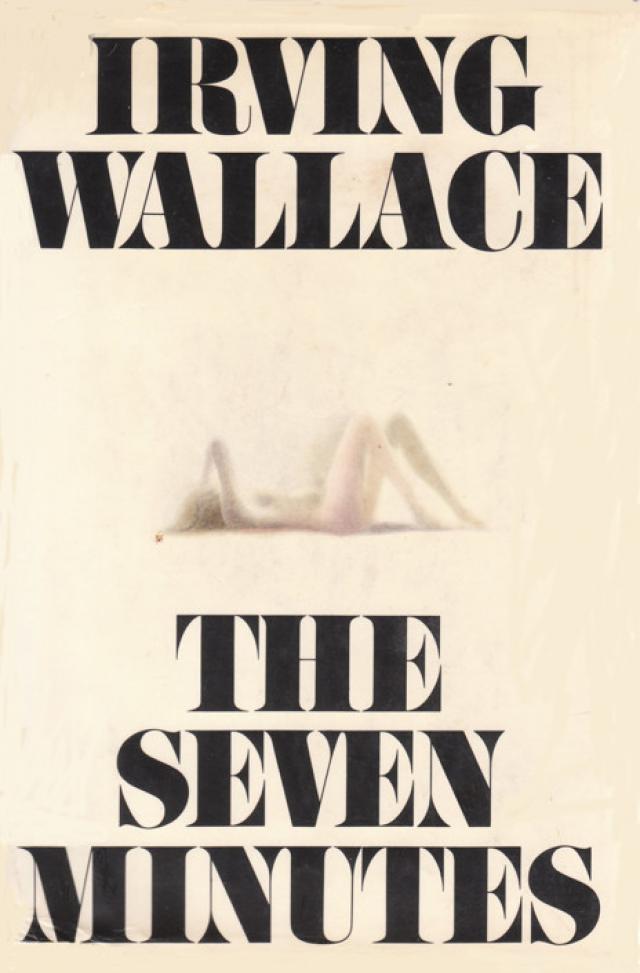
THE
SEVEN
MINUTES
____
a novel by
IRVING WALLACE
First published by
Simon & Schuster
September 1969
THE SEVEN MINUTES
The book that couldn’t be advertised in nine big cities from Boston to Dallas. The choice of two major book clubs with more than a half million readers. Published in twenty foreign editions from Yugoslavia to Japan. Soon to be a multimillion-dollar motion picture.
“Impossible to put down…To watch Mr. Wallace and his young lawyer hack their way through the thicket of political careerism, technocratic self-interest, the sexual and literary undergrounds, obscenity laws and the subterfuges of the past is to be mesmerized.”
—The New York Times
“The best Wallace to date. The subject is more topical, more relevant, better explored than any in his earlier books. The idea of a book being tried for inciting to crime may sound legalistic, but as fought out in these pages, it becomes a real cliffhanger with a good deal of relevance for our times. Moreover, a trial novel based not on a routine rape or murder but on the suppression of a book is a welcome novelty…The denouement is startling, and the outcome of the trial satisfactory or unsatisfactory depending on how you feel about the treatment of sex in fiction. In either event, you’ll find the story exciting and enlightening.
—Saturday Review Syndicate
“Irving Wallace demonstrates again his storytelling talent. Aficionados of fictional trials will relish in Wallace’s courtroom the genuine flavor of Anatomy of a Murder.”
—Book World
“Irving Wallace had done it again…The suspense is built in…you find yourself near the end on the edge of your chair…”
—Milwaukee Journal
“In his newest book, Wallace has again rung the bell…few who begin this book will pause, for Wallace’s gift of storytelling will carry them on to the very surprising end of the trial—something that Ernest Hemingway used to describe as a ‘wow’.”
—Cincinnati Enquirer
Summary from inside the front and back covers:
THE SEVEN MINUTES is Irving Wallace’s most controversial and explosive novel to date, certain to stir up national debate from the moment of its publication. It opens with the arrest of a bookstore owner for selling a copy of “the most obscene piece of pornography written since Gutenberg invented moveable type.” This notorious, long-banned work (which tells the thoughts inside a woman’s head during the seven minutes she is engaged in sexual intercourse) is condemned under the California Criminal Code for obscenity—and is also charged with having driven a respectable college boy to commit a brutal rape and murder.
Overnight, as the battle lines are drawn, the defenders of free speech rallying against the legions of censorship, the Los Angeles obscenity trial erupts into an international cause célèbre. In the center of the storm is Michael Barrett, a young lawyer who unwillingly takes the case for the defense and pits himself against an honest but ambitious district attorney, who is backed by relentless and powerful political forces.
Behind the scenes, at risk of his life, Barrett seeks the crucial truth about the mysterious and long dead expatriate author of the book on trial—a book that has become a rallying point in the fight for literacy and sexual liberation as well as the symbol of Barrett’s own maturity as a man. In his dangerous quest to save the book, the trial, his own future, Barrett crosses the paths of a galaxy of unforgettable characters—including the leering producer of filthy stag films, a sexually permissive society girl, a drunken Greenwich Village poet, the prelate representing the Vatican’s Index of Prohibited Books, a ruthless electronics tycoon, a French publisher of underground erotica, a bitter and bearded college student, a beautiful secretary with loyalties in both camps, the infallible head of a public opinion poll… As conflict and suspense mount, and surprise follows surprise, The Seven Minutes builds to a shattering and unexpected climax.
Anticipating censorship headlines yet to come, The Seven Minutes brings the reader directly into the center of today’s battle over sexual freedom, perversion, nudity, coarse language, human rights. With a frankness and deep insight unrivaled since his earlier books, Irving Wallace dramatizes the hidden motivations and activities of censors and anti-censors, the problems of permissiveness and restraint, and the moral dilemmas facing all of us today.
To
Fanny, Constance, Molly
who made it possible
&
To
Sylvia, David, Amy
who approved
Mrs. Digby told me that when she lived in London with her sister, Mrs. Brooke, they were every now and then honoured by the visits of Dr. Johnson. He called on them one day soon after the publication of his immortal dictionary. The two ladies paid him due compliments on the occasion. Amongst other topics of praise, they very much commended the omission of all naughty words. “What, my dears! then you have been looking for them?” said the moralist.
—H. D. Best, Personal and Literary Memorials
(London, 1829)
THE
SEVEN
MINUTES
I
BY ELEVEN O’CLOCK in the morning, the sun had come out, and now the women of Oakwood, most of them housewives in summer attire and most of them at the wheels of their own cars, were converging on the business district to do their shopping.
In the suddenly thickening traffic, the green two-door Ford coupe with a nasty dent in its front fender was at last forced to slow down.
Slumped in the seat beside the driver, Otto Kellog grunted his displeasure, then sat up impatiently to get his bearings. He resented delays at a time like this, when he was anxious about what he must soon do. He wanted to get it over with as quickly as possible.
There was a jarring screech as Iverson, who was driving the car, slammed on the brake, muttering, “Goddam women drivers.”
“Yeah,” said Kellog. “Wish they’d get moving.”
In the rear, the third occupant of the coupe, Eubank, older, more tolerant, less often exposed to the outside world than his companions, seemed to be enjoying the interval. He had brought himself forward from the back seat to peer over Iverson’s shoulder through the windshield. “So this is Oakwood,” he said. “Attractive. I don’t know how many times I’ve been out this way, but I guess I never paid much attention before.”
“Nothing so different,” said Iverson, easing his foot off the brake. “It’s still Los Angeles County.”
“Well, it just looks more prosperous and settled down,” said Eubank.
“Maybe not for long,” said Iverson. “We’re going to shake them up a little today.” He glanced at Kellog, and grinned. “What do you say, Otto? Ready for action?”
“Yeah,” said Kellog, “providing we ever get there.” He squinted through his sunglasses. “Third Street’s the next corner. You turn right the next corner.”
“I know,” said Iverson.
The traffic was moving again, loosening, and the green coupe moved with it along Center Boulevard, and then swung sharply onto Third Street.
The vehicle and foot traffic was thinner here on the side street. The man at the wheel showed relief. “There it is, middle of the block,” he said. “You can see the sign just after the Acme Jewelers. See it? Fremont’s Book Emporium. How do you like that for a name? Emporium.”
“Looks like there’s plenty of parking,” said Eubank. “I was worried there might not be any parking close by.”
“There’s always enough room once you get off Center Boulevard,” said Iverson. He spun the wheels of the car toward the curb, and expertly brought it to a halt before the jewelry shop. As he reached to turn off the ignition, he spotted a young blonde, in tight sweater and shorts, stepping out in front of the car, preparing to cross the street. Iverson emitted a low whistle. “Hey now, lookit those tits.” He watched the blonde as she hurried to the other side. “Not bad all over, I’d say, but me, I’m strictly a tit man. I like them big and bouncing.” He sought agreement from his front-seat partner. “What do you say, Otto?”
At the moment, Kellog had no interest in his friend’s preoccupation with women. He had a one-track mind, and the track was already occupied. His right hand fidgeted inside his plaid sport jacket, working beneath his left armpit. At last, satisfied, he looked up, his long face serious and tight. “Am I all right?” he asked Iverson as he secured the middle button of his jacket and fixed the collar of his open sport shirt. “Does it show?”
“Nothing shows,” said Iverson. “You look like a regular anyone-for-tennis type. Naw, I’m kidding. You look okay, Otto—like an insurance salesman or accountant who’s taken the morning off to shop for his wife.”
“I hope so.”
“Don’t worry.”
“What time is it?”
“It’s eleven—eleven-fourteen.”
“I’d better get going.” He twisted around in his seat. “You set back there, Tony?”
Eubank patted the open lid of the suitcase on the rear seat. “All systems in go position.”
Kellog returned his attention to the driver. “You’ll stay right here?”
“I’m not moving an inch till you need me.”
“Okay,” said Kellog. “I won’t be more than ten minutes.”
He opened the door on his side, lifted himself out of the car stiffly, closed the door, and stood a moment on the sidewalk straightening his jacket. Then, casually, he wa lked past the jewelry shop, approached the bookstore, moved past its recessed entrance and planted himself before the main display window. On the lower right-hand corner of the window was a painted representation of Pegasus and beneath it, in Spencerian lettering, “Ben Fremont’s Book Emporium, Established 1947.” In the other corner of the main window, Scotch-taped inside and at eye level, was a full-page newspaper advertisement for a new novel.
Kellog edged toward the advertisement. He studied the boldfaced heading:
A WEEK FROM TOMORROW
PUBLISHING HISTORY
WILL BE MADE!
Kellog’s eyes ran swiftly down the rest of the advertisement.
After 35 Years of Suppression, the Most Reviled and
Praised Novel in History—Written by an Expatriate
American—Will Be Available to the Public at Last
You must read—
“The most widely and completely banned book of all time.”
Osservatore Romano, Rome
You must read—
“The most obscene piece of pornography written since Gutenberg invented movable type… Brilliant as a private revelation, but unforgivable as a public confession.”
Le Figaro, Paris
You must read—
“One of the most honest, sensitive, and distinguished works of art created in modern Western literature.”
Sir Esmond Ingram, London Times
WITH GENUINE PRIDE,
SANFORD HOUSE, PUBLISHERS,
OFFERS AMERICA AND THE WORLD
THE UNEXPURGATED ORIGINAL VERSION
OF THE UNDERGROUND MODERN CLASSIC
THE SEVEN MINUTES
BY
J J JADWAY
There was more, Kellog could see, but he did not bother to read it. He had read it all in last Sunday’s newspaper.
Briefly, Kellog’s gaze shifted to the contents of the display window. The window contained many books, three soaring pyramids of books, but all the volumes were one book, bearing one and the same title. Each copy featured a white dust jacket, and on the front cover was delicately etched the faint outline of a nude young woman lying on her back with her bent legs up high and wide apart. Imprinted over this, in artistically simulated longhand, color red, was the title The Seven Minutes, and below it “by J J Jadway.”
J, no period, J, no period, Jadway.
Yeah.
Kellog slipped his right hand inside his sport jacket, groped beneath his armpit, touched the cold metal, and then he was ready.
Quickly, he entered the store. It was a bright, cheerful, cluttered store. Down the middle of the floor area were rectangular tables piled high with recent publications. Standing by the nearest table, which was stacked with copies of The Seven Minutes, Kellog searched the interior. In the rear, there were two people, apparently customers, one an elderly gentleman poking about the shelves beneath the placard reading PAPERBACKS, the other a small woman, probably somebody’s mother, browsing near the sign reading JUVENILES. A short distance from the customers, an overweight lady wearing a smock was removing books from a carton and setting them on a table.
Then Kellog became aware of one more person on the premises. To his left, fifteen feet from him, bookcases jutted out from the wall to form an alcove. This was barricaded on the open side by a counter on which rested a cash register and another column of copies of The Seven Minutes, and propped on a stool behind the counter, leafing through invoices, was a slightly built man of perhaps forty years. Offsetting the sparse hair on top of his head were thick brown sideburns. He also wore heavy-lensed, metal-rimmed spectacles, and they distorted his eyes. He had a hook of a nose, an undershot jaw, and a pallid pink complexion. His brown sweater was erratically buttoned down the front.
Kellog had never seen the man before, but Iverson had, and Iverson had described him.
Kellog held his breath, went woodenly to the cash register, and exhaled. “Hi,” he said, the insurance salesman taking the morning off to shop for his wife.
The wispy, myopic man looked up, immediately offered a customer-tailored smile, and said courteously, “Good morning, sir.” He slid off his stool, putting aside the invoices. “Anything I can do for you this morning, or would you prefer just to browse about?”
“Is Mr. Fremont, Ben Fremont—is he here?”
“I’m Ben Fremont.”
“Oh, good to meet you. I’m trying to remember if I’ve ever been in here before. Very nice. I should make more time for books, but I guess I’m too busy, what with being on the road half the time. It’s my wife who’s the reader in the family. She’s one of your customers. I mean, from time to time she comes in.”
“That’s fine,” said Ben Fremont. “I’m sure I’d recognize her name—”
“No. She just drops in from time to time. Yeah. And I won’t let her have no charge. You know women.”
“Sure, sure.”
“Anyway, I’m here as a proxy. Seems like she got herself a kidney-stone attack. It’s out now, she’s doing okay, but she’s still over at Saint John’s Hospital and she wants some reading. You can get awfully tired of television.”
“More people are reading books than ever, thanks to television,” agreed Fremont seriously. “There is nothing like the experience of a good book, as your wife obviously knows.”
“A good book,” repeated Kellog. “Yeah, that’s what I want to get her.”
“Well, now, we’ve got something to satisfy every taste. If you could give me an idea …”
Kellog stepped closer to the bookstore proprietor. “The old girl reads everything. Even history. But mostly, I guess it’s fiction, novels. Anyway, for the hospital, I don’t think it should be anything too deep or sad-like. Maybe something kind of fast and easy to read through, something with a little snap to it. And new, it should be real new, so’s I won’t be getting anything she’s already got from her friends. I asked her to give me some help last night—what does she want?—but she just said, ‘Otto, you go and surprise me. And if you get real stuck, you go over to Ben Fremont’s and ask what he suggests.’ So here I am.”
“Well, now, I’m sure we can find—”
“Of course,” Kellog interrupted, leaning over the counter, lowering his voice, “I don’t think she’d mind if the book had a little realistic life to it. You know, something with a bit of—well…”
“Oh, sure, sure, I understand.”
“Don’t get me wrong. She goes for the heavy intellectual stuff too, but she sure got a kick out of that Lady Chatterley. Now, that was a kick, a real kick, if you know what I mean. Still, it was a classic, but at least it wasn’t boring. Well, there she is in the hospital, and if you’ve got anything half as good and brand new …”
“Half as good?” Fremont had come to life. “The minute you described your wife, I was going to suggest something. Listen, I’ve got a brand-new book in, spanking new, not even officially published yet, and this book, it’s ten times as good as Chatterley or any similar classic, maybe a hundred times better. I’m telling that to every woman who comes in the shop, and I don’t recommend everything. In a couple weeks, I’ll bet you, the eyes of every woman reader in Oakwood, in all of Los Angeles, will be glued to this book.” Fremont snatched a volume from the pile beside the cash register. “Here it is. She’s in the hospital? Here’s just what the doctor ordered.”
Kellog began to lift his sunglasses. “What’s that cover say?”
Fremont’s forefinger pointed at the title on the front jacket. “The Seven Minutes, by J J Jadway. This is something no woman’ll ever forget. Your wife, it’ll excite her, absolutely excite her—and yet it’s literature.”
“Oh, it’s literature. Well. I’m not sure, maybe that’s not exactly—”
“Forgive me. I misled you with that word. I just meant it’s nothing to be ashamed to read if you are a reader, a sophisticated reader like your wife. Most people, not being sophisticated, being clods or puritans, they might take offense at the whole thing. But if you know what life’s all about, you can appreciate the frankness of a novel like this. As far as I’m concerned, you can take them all, the books by Cleland, D. H. Lawrence, Frank Harris, Henry Miller, and they’re like reading the Bobbsey Twins compared to reading Jadway. They don’t know a thing about sex, and nobody ever did, until Jadway came along. He invented it. He invented it for The Seven Minutes, except his is real, realer than anything I ever read.”