

Aphrodite, p.1
Aphrodite, page 1


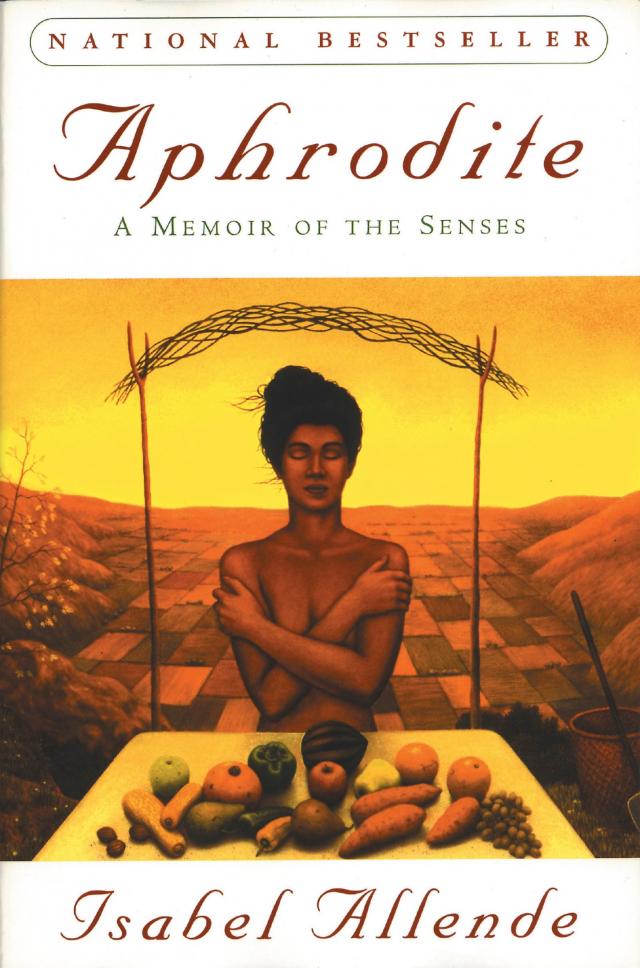
Photograph, Lori Barra.
Credits
Creative Director: Lori Barra, TonBo designs
Designer: Nathalie Valette
Production: Jan & Eric Martí, Command Z
Imaging: Shane Iseminger
Photo Research: Carousel Research, NY
Fay Torres-yap, Elizabeth Meryman, Leslie Mangold, Laurie Platt Winfrey
Dedication
I dedicate these erotic
meanderings to playful lovers
and, why not?
also to frightened men and
melancholy women
Epigraph
Her breath is like honey spiced with cloves,
Her mouth delicious as a ripened mango.
To press kisses on her skin is to taste the lotus,
The deep cave of her navel hides a store of spices
What pleasure lies beyond, the tongue knows,
But cannot speak of it.
Srngarakarika, Kumaradadatta, twelfth century
Contents
Cover
Title Page
Credits
Dedication
Epigraph
Introduction
Mea Culpa of the Culpable
Aphrodisiacs
The Spice Is in Variety
The Good Table
Cooking in the Nude
The Spell of Aromas
“Death by Perfume”
At First Sight
Etiquette
With the Tip of the Tongue
Herbs and Spices
Forbidden Herbs
The Orgy
Aunt Burgel’s Aphrodisiac Stew
Panchita’s Curanto En Olla
Soup for Orgies
About Tastes
Alligators and Piranhas
Aphrodisiac Cruelties
About Eroticism
Large Birds and Small Birds
Carrier Pigeons of Love
Whispers
A Night in Egypt
Sins of the Flesh
Unclassifiables
The Gigolo
Aphrodisiac Soup of Acupuncture Master
Bread, God’s Grace
Creatures of the Sea
Bouillabaisse
“Ode to Conger Chowder”
More Creatures from the Sea
The Harem
Eggs
Supreme Stimulus for Lechery
The Empress’s Omelet
Forbidden Fruits
Other Delicious Aphrodisiacs
Nouvelle Cuisine
Cheese
Si Non è Vero . . .
Reconciliation Soup
The Spirit of Wine
Liquors
Love Philters
The Language of Flowers
From the Earth with Love
Shekter’s Vegetarian Aphrodisiac
Subjective List of Aphrodisiac Vegetables
Colomba in Nature
“Eating the World”
Finally . . .
Panchita’s Aphrodisiac Recipes
Sauces
Cold Sauces and Dressings
Homemade Mayonnaise
Tartar Sauce
French Dressing
Pebre
Guacamole
Light Dressing
Turkish Sauce
Mediterranean Sauce
Salsa Picante
Huancaina Sauce
Walnut Sauce
Ravigote
Sweet-and-Sour Sauce
Orange Whirl
Costa Brava
Three-Minute Marinade
Salsa Verde
Erotic Dressing
Sauces Served Hot
Béchamel Sauce
Sherry Sauce
Roquefort Sauce
Aromatic Sauce
Amaranta Pesto
Coralina Sauce
Mykonos Sauce
Marinara Sauce
Wine Sauce (White or Red)
Salome Sauce
Mango Chutney
Quick Curry
Hors d’Oeuvres: First Tickles and Nibbles
Seafood in Cocktail Sauce
Adam’s Nuts
Widower’s Figs
Cheese Logs
Shrimp Pica Pica
Frivolous Prunes
Salmon Temptation
Celery Roquefort
Festive Mushrooms
Soups: Heating Up
Four Basic Stocks
Beef Stock
Chicken Stock (And All Other Fowl)
Fish Stock
Vegetable Stock
Consommé
Consommé Bacchus
Rise and Walk Soup
New Life
Consommé El Dorado
Consommé Neapolitan
Sherry Consommé
Spirit Lifter
Royal Consommé
Hot Soups
Cream of Artichoke
Clam Chowder
Alicante Cream
Onion Soup
It’s-A-Feast! Soup
Quick Crab Bisque
Fish Soup
Carrot Soup
Cold Soups
Margarita Island
Gazpacho
Apple Holiday
Vichyssoise
Cucumber Breeze
Appetizers: Amorous Games, Leaf by Leaf, Kiss by Kiss
Havana-Style Prawns
Crab and Avocado Mousse
Artichoke Whisper
Shrimp Cocktail
Seviche
Odalisques’ Salad
Sierra Potatoes
Greek Islands Salad
Bariloche
Pears Roquefort
Spinach California
Creole
Spring Shower
Chilean Salad
Celery Salad
Main Courses: Kama-Sutra . . . Well, More or Less!
Fruits of the Sea
Conger Eel De La Caleta
Seafood Newburg
Corbina à La Crème
Hake Diana
Curried Sea Bass
Stuffed Trout
Salmon Neptune
Park Avenue Lobster
Squid Lucullus
Saffron Shrimp
Pseudo Paella
Fowl
Duck à La Pêche
Mexican Chicken Mole
Chicken Alegre
Harem Turkey
Romantic Chicken
Chicken Breast Valentino
Coq Au Vin
Jellied Partridge
Meat
Lamb With Spinach and Apricots
Filet Mignon Belle Epoque
Champagne Tenderloin
Fillet Orientale
Spicy Rabbit
Rabbit Hamburgers
Rosemary Venison
Kidneys Montmartre
Brains Italian Style
Alpine Osso Buco
Vegetarian Dishes
Asparagus and Caviar Pasta
Noodles With Artichoke
Curried Zucchini
Eggplant to a Sheik’s Taste
Punjab Kebabs
Risotto Lori
Desserts: The Happy Ending
Sweet Sauces and Creams
English Custard
Sabayon
Chocolate Sauce
Mocha Cream
Raspberry Syrup
Jazzy Applesauce
Honey Sauce
Banana Mousse
Red Wine Sauce
Apricot Sauce
Rum Sauce
Desserts
Peach Delight
Soused Pears
Tropi-Cup
Taj Mahal
Spellbinding Apples
Novice’s Nipples
Moorish Bavarois
Catalan Cream
Venus Mousse
Caribbean Bomb
Madame Bovary
Mousse Au Chocolat
Charlotte for Lovers
Crêpes
Crêpes Suzette
Crêpes Noël
Sybarite
Zucoff Surprise
Apricot Soufflé
Arroz Con Leche, or Spiritual Solace
Also by Isabel Allende
Copyright
About the Publisher
Introduction
AND RONDO CAPRICCIOSO
The fiftieth year of our life is like
the last hour of dusk,
when the sun has set and one turns
naturally toward reflection.
In my case, however, dusk incites me to sin,
and perhaps for that reason,
in my fiftieth year I find myself reflecting
on my relationship
with food and eroticism; the weaknesses
of the flesh that most tempt
me are not, alas,
those I have practiced most.
I repent of my diets, the delicious dishes rejected out of vanity, as much as I lament the opportunities for making love that I let go by because of pressing tasks or puritanical virtue. Walking through the gardens of memory, I discover that my recollections are associated with the senses.
My Aunt Teresa, she who was slowly turning into an angel and died with buds of embryonic wings upon her shoulder blades, is linked forever with the scent of violet pastilles. When that enchanting lady came to visit, her gray dress discreetly highlighted by a lace collar and her snow-crowned head, we children would run to meet her and she, with ritual precision, would open a pocketbook worn slick with age—always the same one—and take out a small painted tin box from which she chose a mauve candy to hand to each of us. Ever since then, when the unmistakable scent of violets floats upon the air, the image of that sainted aunt, who stole flowers from others’ gardens to take to dying inmates of the poorhouse, floods back into my heart, intact. Forty years later, I learned that the scent of violet was the cachet of Josephine Bonaparte, who trusted blindly in the aphrodisiac power of that evanescent aroma, a scent that suddenly assaults the senses with a nearly nauseating intensity only to disappear without a trace, then return with renewed ardor. Before their amorous encounters, the courtesans of ancient Greece used violet to perfume their breath and erogenous zones, because when blended with the natural odors of perspiration and feminine secretions, violet alleviates the melancholia of the eldest men and torments the young beyond endurance. In the Tantra, the mystical and spiritual philosophy that exalts the union of opposites at all levels, from the cosmic to the infinitesimal, and in which man and woman are mirrors of divine energies, violet is the color of female sexuality, which is why it has been adopted by some feminist movements.
For me, the penetrating odor of iodine stirs images not of wounds or surgeries, but of sea urchins, those strange creatures of the deep inevitably related to my initiation into the mystery of the senses. I was eight when the rough hand of a fisherman placed the tongue of a sea urchin in my mouth. When I visit Chile, I seek the opportunity to go to the coast and taste freshly caught sea urchins once more, and every time I am flooded by the same mixture of terror and fascination I felt during that first intimate encounter with a man. Those ocean creatures are inseparable in my mind from that fisherman, with his dark sack of shellfish streaming seawater, and my awakening sensuality. That is how I remember all the men who have passed through my life—I don’t want to boast, there aren’t that many—some by the texture of their skin, others by the flavor of their kisses, the smell of their clothing, or the sound of their murmuring voice, and almost all of them are associated with some special food. The most intense carnal pleasure, enjoyed at leisure in a clandestine, rumpled bed, a perfect combination of caresses, laughter, and intellectual games, has the taste of a baguette, prosciutto, French cheese, and Rhine wine. With any of these treasures of cuisine, a particular man materializes before me, a long-ago lover who returns, persistent as a beloved ghost, to ignite a certain roguish fire in my mature years. That bread with ham and cheese brings back the essence of our embraces, and that German wine, the taste of his lips. I cannot separate eroticism from food and see no reason to do so. On the contrary, I want to go on enjoying both as long as strength and good humor last. Thence the idea for this book, which is a mapless journey through the regions of sensual memory, in which the boundaries between love and appetite are so diffuse that at times they evaporate completely.
To justify yet one more collection of recipes or erotic instructions is not easy. Every year thousands are published, and frankly, I don’t know who buys them, because I have never known anyone who cooks or makes love from a manual. People who work hard to earn a living and who pray in secret, like you and me, improvise in casseroles and bedroom romps as best we can, using what we have at hand, without brooding over it or making too much fuss, grateful for our remaining teeth and our enormous good fortune in having someone to embrace. All right, then, so why this book? Because the idea of poking about a bit in aphrodisiacs seems amusing to me and I hope it will be to you as well. In these pages I intend to approximate the truth, but that will not always be possible. What, for example, can one say about parsley? Some things scream for a little creativity . . .
Since time immemorial, in order to stimulate amorous desire and fertility, humanity has called upon substances, tricks, magic acts, and games that serious and virtuous people hasten to classify as perversions. Fertility will not interest us here—everyone else, you will have noticed, already has too many children—we’re going to concentrate on pleasure. In a book on magic and love philters stacked among many similar tomes on my desk are formulas from medieval and even earlier times, some of which are practiced to this day, such as sticking pins in an unfortunate, still living toad and then burying it amid muttered incantations on a given Friday night. Friday, it seems, is woman’s day. The other six fall to men.
I found, too, a spell for trapping an elusive lover still practiced in certain rural areas of Great Britain. The woman kneads flour, water, and lard, sprinkles the dough with her saliva, then places it between her legs to endow it with the form and savor of her secret parts. She bakes this bread and offers the loaf to the object of her desire.
Long ago, philters of blood—often elixir rubeus or menstrual blood—and other bodily fluids were fermented in the hollow of a skull by the light of the moon. If the skull belonged to a criminal who had died on the gallows, so much the better. There are a surprising number of aphrodisiacs of this nature, but we are going to concentrate on those that could be dreamed up in normal minds and kitchens. In these times, there are very few women who have time to muck about kneading dough or have access to a human head.
The ultimate purpose of aphrodisiacs is to incite carnal love, but if we waste all our time and energy in preparing them we won’t have much left for luxuriating in their effects. That is why you won’t find any long-winded recipes here, except in a few unavoidable cases such as our orgiastic dishes. We have also consciously omitted recipes that necessitate cruelty. Can anyone who spends the day concocting a stew made of canary tongues actually concentrate on erotic games later? Spending my savings on a dozen of those delicate little birds, then mercilessly tearing out their tongues, would kill my libido forever. Robert Shekter, the creator of the satyrs and nymphs slipping through the pages of this book, was a pilot in the Second World War. His worst nightmares are not of bombings and corpses, however; no, rather of a distracted duck he brought down with his shotgun. When he went over to it, he saw it was still flapping its wings, and he had to wring its neck to prevent further suffering. He’s been a vegetarian ever since. It seems that when the duck was shot it fell into a vegetable garden, flattening a head of lettuce, so he won’t touch lettuce either. It is extremely difficult to prepare an erotic meal for a man with such limitations. Robert would never have collaborated with me on a project that included tortured canaries.
You will not find shark fins, baboon testicles, and other like ingredients here, because they don’t turn up in neighborhood supermarkets. If you need to go to such extremes to pique your libido or fire your desire to make love, we suggest you consult a psychiatrist—or find a new partner. Our sole focus will be on the sensual art of food and its effects on amorous performance, and the recipes we offer contain products that can be ingested without peril of death—at least in the short term—and are delicious besides. Broccoli, therefore, is not included. We limit ourselves to simple aphrodisiacs, like oysters passed from your lover’s mouth to yours, following an infallible recipe of Casanova, who used this method to seduce a pair of naughty novitiates, or the smooth paste of honey and ground almonds that Cleopatra’s lucky lovers licked from her intimate parts, in the process going out of their minds, along with modern recipes that contain fewer calories and cholesterol. We do not offer any supernatural potions, for this is a practical book and we know how difficult it is to find paws of koala, eye of salamander, and urine of a virgin—three species on the endangered list.
The road of gluttony leads straight to lust and, if traveled a little farther, to the loss of one’s soul. This is why Lutherans, Calvinists, and other aspirants to Christian perfection eat so poorly. Catholics, on the other hand, who are born resigned to the concept of original sin and human frailty and who are purified by confession, free to go and sin again, are much more flexible in regard to the groaning board, so much so that the expression “a cardinal’s tidbit” was coined to define something delicious. Lucky for me that I was brought up among the latter group and can devour as many treats as I wish with no thought of hell, only of my hips, although it has not been equally easy to shake off taboos relating to eroticism. I belong to the generation of women who married the first person with whom they “went all the way,” because once their virginity was history, they were used goods on the matrimonial market, even though usually their partners were as inexperienced as they and seldom qualified to distinguish between virginity and prudery. If it weren’t for the Pill, hippies, and women’s lib, many of us would still be captives of obsessive monogamy.
Morning Grace, painting by Martin Maddox, 1991.
In the Judeo-Christian culture, which divides the individual into body and soul, and love into profane and divine, anything having to do with sexuality, other than its reproductive function, is abominated. That demarcation was carried to the extreme when virtuous couples made love through an opening in the woman’s nightgown embroidered in the form of a cross. Only the Vatican could imagine something that pornographic! In the rest of the world, sexuality is a component of good health; it inspires creation and is part of the pathway of the soul. It is not associated with guilt or secretiveness because sacred and profane love issue from the same source and it is supposed that the gods celebrate human pleasure. Unfortunately, it took me some thirty years to discover this. In Sanskrit the word that defines the joy of the creative principle is similar to the word for sensual bliss. In Tibet copulation is practiced as a spiritual exercise, and in Tantrism it is a form of meditation. The woman straddles the man, who is seated in the lotus position; they erase all thoughts from their mind, count their breaths, and lift their souls toward the divine, as their bodies join with tranquil elegance. Now, that makes you want to meditate.


