

The whens of wittenoom, p.1
The Whens of Wittenoom, page 1


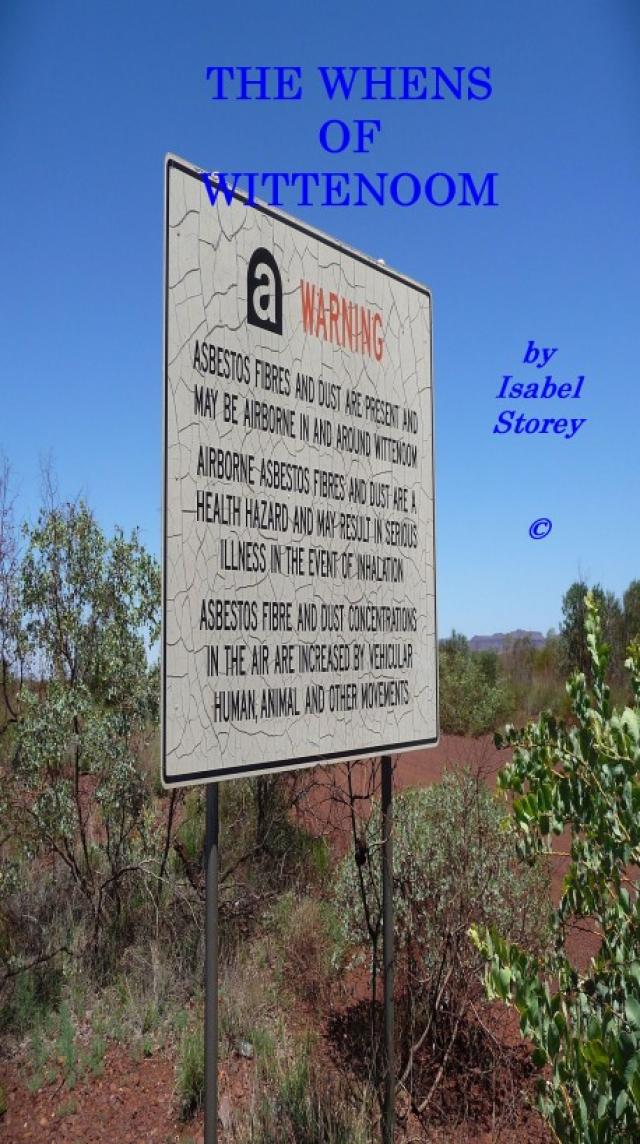
THE WHENS OF WITTENOOM
Blue Asbestos Through the Ages :Chronology of a Slow Death
by
Isabel D Storey
PUBLISHED BY:
Isabel D Storey on Smashwords
The Whens of Wittenoom
Copyright © 1994 by Isabel D Storey
Smashwords Edition License Notes
This ebook is licensed for your personal enjoyment only. This ebook may not be resold or given away to other people. If you would like to share this book with another person, please purchase an additional copy for each person you share it with. If you are reading this book and did not purchase it, or it was not purchased for your use only, then you should return to Smashwords.com and purchase your own copy. Thank you for respecting the author’s work.
NOTE TO THE READER
Some entries within the Chronology are included to provide some context of the times. Mining of any form has always been dangerous. Accidents happen that are not connected to mining. Disasters are always more dramatic the closer we are to the event. That does not diminish the reality but says much about our capacity to cope.
*****
CONTENTS
Diseases Related to Mining in General
Asbestos Related Diseases
Mesothelioma
Fibres and Cancer
Airborne Fibres
The Chronology
BC
AD -> 1870
1898
1901
1910
1920
1930
1940
1950
1960
1972
The Fibre Counting Begins
1980
1990
BIBLIOGRAPHY
Reports
State Archives
Journals
Books
Official Records (mostly Shire of Ashburton Council Minutes)
*****
The Whens of Wittenoom
A town is born. A town dies. Not uncommon.
That the cause of the town's being is also the cause of its ceasing to be is less common unless it is a mining town. But this is a town in which people own their own homes. They choose to live there despite the fact the mine closed nearly thirty years ago. Or perhaps because of it in that there were many houses sold for less than people would pay for a old second-hand car.
The town of Wittenoom was created to house workers at the nearby mine and processing plant. Had the material mined been almost any other substance it would have had few problems.
It was an asbestos mining town; mining and milling blue asbestos fibres. The dust created in this process at that time resulted in the full spectrum of asbestos-related diseases and conditions caused by inhaling dust: pleural plaques, asbestosis and lung cancer which affected those employed in the mine and the mill.
The fibres released at that time contributed to Western Australia having the highest rate of deaths from mesothelioma (cancer of the lining of the lung) in the world.
As the name of this particular disease is one found often in the following pages it might be helpful to be able to wrap one's tongue around the word early on
Mee soh thie (as in thief) lee oh mah.
Known in Wittenoom as the Big M.
In compiling the following account many sources have been used.
All information contained in the Chronology has been accessed from other sources. When my opinion intrudes, this is identified by being placed in parentheses. Wherever possible I have gone back to original documents. Where this was not possible and accounts differed, I chose the one seeming more reliable based on accuracy on other points.
All the information contained within the Chronology has been sourced from documents within the Bibliography.
Where I felt that some readers may instantly react against a piece of information, I have included the source with the item.
DISEASES RELATED TO MINING IN GENERAL_
Pneumoconiosis : results from inhaling and retaining excessive dust in the lungs. Anything foreign breathed into the lungs over a long period eventually causes tissue changes. Inorganic dusts that cause the least severe medical problems include :
carbon among coal-workers (anthracosis)
iron among welders, hematite & magnetite miners (siderosis)
These dusts can accumulate to the amounts of about 20 grams (0.7) ounce with only minimal tissue changes.
Inhalation of silica dust (silicosis) is far more serious and is found in mining, sand-blasting and pottery workers. It takes only 5 to 6 grams of dust retained in the lungs to cause symptoms.
Experience in Western Australia has been that workers in asbestos mines are ten times more likely to contract asbestosis than gold miners are to contract silicosis.
The inhalation of aluminium, talc or beryllium (berylliosis) also produces forms of pneumoconiosis.
(Back to top)
ASBESTOS RELATED DISEASES_
Pneumoconiosis : as listed above, of which asbestosis is one form. Can be produced by all types of asbestos.
Pleural plaques : may appear as a thickening on the lining of the chest wall, may never be diagnosed in life and may not affect general health in any way. Can be produced by all types of asbestos.
Lung Cancer : Lung cancer has been produced in smoking asbestos workers by all types of asbestos. Non-smokers exposed to asbestos dust for a long period evidence a slightly higher rate of lung cancer than the general non-smoking population. Can be produced by all types of asbestos.
All of the above industrial diseases are known to occur following continued exposure to levels of all forms of asbestos dust which far exceeds that within environments outside mines and factories.
However :
(back to top)
MESOTHELIOMA is different.
It is caused, not by dust, but by microscopic fibres. Fibre counts are measured in the number of fibres per millilitre or cubic centimetre. That is, the number of fibres found in a thimbleful of air.
Waste material (tailings) containing 5% of asbestos were used as aggregate in cement construction throughout the town, streets were covered with tailings, they were used to keep down the pervasive red dust in household yards, spread across the school playground and used in the construction of the airport.
Fibres remain in Wittenoom. They remain in the remnants of tailings about the town. They are made air-borne every time a surface on which they rest is disturbed by activities such as walking and driving.
The fibres are invisible.
The air in the town is many, many times more clear than when the mine was open. It LOOKS just like anywhere else in a remote region unpolluted by modern industry.
Residents of Wittenoom want to know why they cannot be treated as members of any other small town in Western Australia.
Because mesothelioma, a rare cancer, is now less rare. Within Western Australia the death rate from mesothelioma among men is 42, among women 4.5 deaths per million. This is the highest recorded rate in the world. Mesothelioma affects the lining of the lung (the pleura) and, less frequently, the lining of the abdominal wall (peritoneum). The lining of the pleura is normally about as thick as a cigarette paper. When mesothelioma occurs it becomes markedly thickened and may eventually totally enclose the lung with a malignant growth sometimes several centimetres thick. The tumour is highly malignant and is often accompanied by a chest pain greater than with other lung tumours. Life expectancy after diagnosis is often as little as nine months. The most chilling factor is the length of time it takes to develop. Ranging from fifteen to fifty years, it takes, on average thirty-five years from first exposure to this known carcinogen to death.
It is thought to occur spontaneously in one in a million deaths. This is termed the "background" rate.
There is no argument that exposure to the mineral fibres of blue asbestos (crocidolite) contributes to the death rates from mesothelioma world-wide. That Western Australia is one of two places in the world where these mineral fibres have been commercially mined, milled and despatched can account for some of the high level of occurrence.
There is some question as to the proportion of deaths that can be attributed to exposure to blue asbestos fibres. It is estimated by some that 30%-50% of cases of mesothelioma have no known exposure to blue asbestos fibres. The counterclaim is that it is extremely difficult for anyone in an industrial society not to have been exposed to products containing blue or other forms of asbestos.
The person first to have publicly made the connection between mesothelioma and blue asbestos was Dr. Wagner of South Africa. His more recent studies show that blue asbestos is not the only mineral fibre capable of inducing mesothelioma. He claims the group of minerals to which the blue asbestos fibres belong amphiboles- are also carcinogenic and productive of mesothelioma.
(back to top)
Two things which have been on this Earth since before the advent of Humankind are :
(1) air-borne mineral fibres shed through weathering and (2)the fossils of dinosaurs who also experienced cancers.
Cancer is found among all vertebrate beings. The cancer that is known as mesothelioma is common among cattle with the tumour being found among calves at slaughter.
(Incidentally, tuberculosis was rare in Man compared with its common occurrence in cattle. The incidence of tuberculosis was falling/had fallen when the incidence of mesothelioma started to rise. The first autopsy within which the definite relationship between blue asbestos and mesothelioma was est
It is known that there exist families who are particularly prone to developing cancer and families within which cancer is a complete stranger. Most people are likely to fall somewhere between these two extremes. To the present, protecting people from being exposed to carcinogens through legal or social sanctions means that in protecting the susceptible, the resistant are given protection they do not need and may not welcome. Where no legal or social sanction exists, the susceptible exercise their freedom to go to or do that which is only safe for the resistant and for this they may pay the highest price.
Employing people on the basis of their genetic background is something for the not too distant future. It certainly had no place in the selection of employees and families who went to Wittenoom to mine a carcinogenic fibre.
Some in Wittenoom can say "But we have been here for forty years! If it is so bad, how come we are not affected?" They simply chose the right parents, grandparents, great and great great grand-parents. If all were so lucky, Wittenoom would be a thriving city.
Instead it is almost a ghost town.
Those earning an income within Wittenoom, do so from the tourist trade. The account of the number of tourists varies greatly, but it is certainly many thousands every year. If all the tourists were certainly made fully aware of the slight risk there is in visiting Wittenoom and entered the town at their own risk they should be allowed to do so. The risk is slightly higher than that of being murdered in Western Australia.
What is unacceptable (to me, at any rate) is that tourists are not properly informed before arriving at the town and having arrived, any warning, if given, comes too late for any change of mind.
Compensation and damages payable to those who suffer mesothelioma where contact with blue asbestos fibres can be demonstrated or claimed is now a well established process through the Courts.
This is a cost that all West Australians will bear until no-one is ever able to say that they were ever in Wittenoom. The only way that can be guaranteed is when forty or fifty years have passed since there was a place called Wittenoom.
It is not the fear of mesothelioma that is the prime mover behind the closing down of Wittenoom. It is the fear of future litigation based on claims of breathing its air that will guarantee its eventual closure.
Providing the State Government maintains the stand it has taken, during Easter of 1995 most of the remaining buildings will be cast into and covered within a pit in the centre of the race-course.
Before the history of Wittenoom was the history of the use of asbestos. The town of Wittenoom is isolated even within the vastness of Western Australia. But the history of Wittenoom cannot be isolated from other events. Some of these events had no impact on the town; others had a strong impact. Then there are those events which should have had an effect. There are some things, that had they happened as they are thought should have, then Wittenoom may never have come into being.
The mining of asbestos at Wittenoom compressed the time scale within which mineral fibres have been released into the air long before there were lungs to breathe them. Asbestos fibres would have already been in the air before the mine was developed, but at a level so low their impact may never have been realised were it not for the mining of blue asbestos in South Africa and Western Australia.
This could explain the existence of the "background" rate of mesothelioma cases where no known contact with asbestos fibres can be identified.
(back to top)
AIR-BORNE FIBRES_
Three groups of mineral fibres have featured in research on the relationship between mesothelioma and contact with such fibres.
Not all members of these groups appear in fibrous form. Only those members described as often or frequently appearing in fibrous form are mentioned here. It is not necessary that rocks be in the form of asbestos for mineral fibres to be released into the atmosphere.
These are : Amphiboles, Kaolin-Serpentines and Zeolites.
Few of the members of these groups appear in sufficient quantity or quality to be commercially attractive.
(The names listed below have been garnered from the Encyclopaedia of Minerals.2nd Edition. WL Roberts, TJ Campbell, GR Rapp jr. van Nostrand, Reinhold NY, 1990)
The only way to prospect for these mineral fibres is to see them. They are not buried out of sight. It stands to reason if they can be seen by the human eye they are also exposed to the effects of weathering over time. As most of the area within which they occur within Western Australia predates fossils, that is a lot of weather and a lot of time.
AMPHIBOLE GROUP : Fibrous to asbestiform
Actinolite, Anthophyllite, Crossite, Cummingtonite, Dannemorite, Edenite, Ferro-Actinolite, Ferro-Anthophyllite, Ferro-Gedrite, Ferro-Glaucophane, Ferro-Hornblende, Gedrite, Glaucophane, Grunerite (also known as Amosite - brown asbestos), Holmquisite, Kaersutite, Kozulite, Magnesio-Anthophyllite, Magnesio-Cummingtonite, Magnesio-Riebeckite, Riebeckite- also known as crocidolite or blue asbestos, Tremolite, Winchite.
Crocidolite (blue asbestos) is found (not necessarily mined) in Canada, Greenland, Scotland, Portugal, France, Austria, USSR (as was), Corsica, Nigeria, South Africa, Zambia, Korea, Madagascar, South Australia (Robertstown) and Western Australia.
The Hamersley Range deposit was noted as containing large deposits of crocidolite which is distributed throughout the length of the Hamersley Ranges. Believed to extend from Willi Wolli Springs north-west to Millstream Station. The three most important deposits noted were Wittenoom, Yampire and Dale Gorges. At Wittenoom it occurred in cliff faces 150-200 feet above the bottom of the gorge. At Yampire Gorge it was noted as occurring below riebeckite rock. The seams at Dales Gorge had been worked prior to 1929.
Actinolite and Tremolite
(From "Asbestos Mineralogy", FD Pooley, Chapter 1 of book "Asbestos-Related Malignancy" Eds. K.Antman & J Aisner 1987, Grune & Stratton.)
"Although tremolite, actinolite and anthophyllite are not mined commercially as forms of asbestos, it is not because they are rare minerals. They are the most common of amphibole asbestos minerals and found in a wide range of geological environments. Being so widely distributed and thus having formed in a variety of ways ranging from a very fine fibrous texture to what are mineralogically termed massive with no apparent fibrous appearance.
Not being mined commercially they are given virtually no consideration when the epidemiology and aetiology of asbestos related diseases are considered."
Commercial production of tremolite and actinolite in Australia is from the Orange and Gundagai districts of New South Wales.
In the 1948 publication "Minerals of Western Australia" published by the Department of Mines, it is stated that actinolite and tremolite are very similar and at times it is difficult to distinguish between the two. tremolite is used as an industrial talc. Over time, in some places, these fibres have been incorporated into the soil.
The first confirmed contamination in agriculture was in Bulgaria. Pleural plaques were found in people working tobacco fields. The soil in these fields contained tremolite and anthophyllite. Further contaminations have been found to cause pleural plaques among agricultural workers in Turkey, Greece, Yugoslavia, Czechoslovakia and Austria.(Wagner,1986)
[According to the Graham Report (p.27) "communities built around natural sources of tremolite have also experienced incidence of the disease (mesothelioma) through non-occupational exposure."]
Although few of the amphibole group are found in commercial quantities, they are found in some mining areas in association with the search for and mining of other minerals. Such an example is winchite which has been found in a manganese mine in India. Examples in Western Australia of finding amphiboles while mining some other mineral are :
Crocidolite at Yandi, Paraburdoo and Tom Price (iron ore mines); actinolite at Yandi (iron), Jandakot and Munglinup (vermiculite), Kambalda (nickel), Paddington and Marvel Loch (gold); tremolite at Leinster and Windarra (nickel), Marvel Loch (gold).
KAOLIN-SERPENTINE GROUP - fibrous members_ Antigorite, clinochrysotile, fraipontite, kaolinite, orthochrysotile, parachrysotile, pecoraite.
A map issued by the Department of Minerals and Energy, Western Australia in its booklet "Asbestos Management in Mining" shows the geographic distribution and the probability of encountering asbestos materials.


