

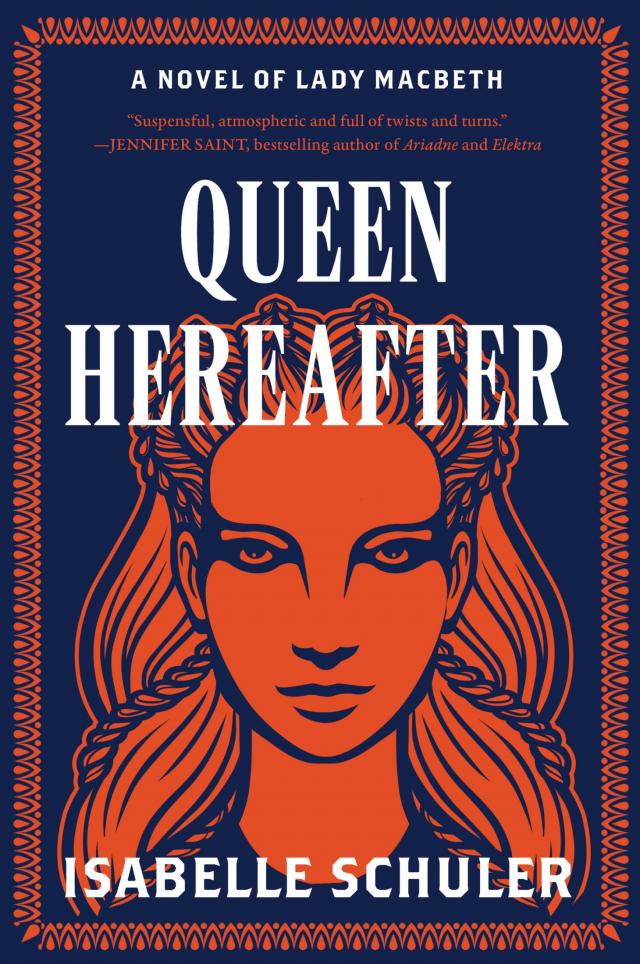
Queen hereafter, p.1
Queen Hereafter, page 1


Dedication
To Charlotte Blacklock
Contents
Cover
Title Page
Dedication
Chapter 1
Chapter 2
Chapter 3
Chapter 4
Chapter 5
Chapter 6
Chapter 7
Chapter 8
Chapter 9
Chapter 10
Chapter 11
Chapter 12
Chapter 13
Chapter 14
Chapter 15
Chapter 16
Chapter 17
Chapter 18
Chapter 19
Chapter 20
Chapter 21
Chapter 22
Chapter 23
Chapter 24
Chapter 25
Chapter 26
Chapter 27
Chapter 28
Chapter 29
Historical Note
Acknowledgments
A Note on the Author
Copyright
About the Publisher
Chapter 1
Picti means painted one, my grandmother once told me. My ancestors decorated their skin in hues of blue and red and green. The whirling patterns shone so vibrantly that my people were believed to be otherworldly. Only when their blood was spilled did their humanity betray them.
My grandmother remembered it all; she was part of that dying breed—a daughter of druids who had once served kings and princes in the Kingdom of the Picts, before Alba was born and that way of life was buried. She felt the defeat bitterly. Even more so when she and my mother, Ailith, were brought to Scone, to live in the court of the great Alban prince Boedhe, my father. As a young girl, Ailith had visited the court of my grandfather, King Coinneach, and a betrothal had been agreed upon. Though a believer in the new religion, Coinneach sought to unite those Albans who had not taken to the Christian god—it was an act of considerable goodwill to place a pagan on the throne beside his son.
My grandfather’s cousin, Malcolm, put an end to these aspirations when he killed King Coinneach and took his crown. Many remained loyal to Grandfather even after his death, and so King Malcolm made my father Mormaer of Fife, to pacify those who might otherwise join him in a revolt.
Much as he hated King Malcolm, Father’s fear of losing what little he had left ran deeper still. And so when in the name of the new religion a ban was placed on all druidic practices, he made Ailith renounce her ways. Grandmother was harder to silence.
So Father destroyed every amulet and charm she had brought with her. In silent determination, he extinguished every sacred fire he caught her burning. With set jaw, he sent guards to root out every secret store of herbs, his timing always impeccable, leading Grandmother to suspect he spied on her.
Only when she insisted on giving me a Picti name did Father give voice to his outrage. Later, Grandmother would tell me the story with all the fervor of a martyr.
“Boedhe, she must be named Groa! Look at her eyes! They are large pools of wisdom, like the great Norse seeress herself,” she had insisted to him.
“She is two days old! To what wisdom are you referring?”
“Her name is Groa,” Grandmother replied, ignoring the question.
“It is bad enough King Malcolm suspects I have a druid for a wife,” Father continued. “I will not bring further scrutiny by choosing a heathen name for my child.”
“Perhaps if you spent less time licking your wounds, and more time plotting to get the throne back from Malcolm, you would not have to resort to such cowardice,” my mother shot back, fanning the flames of his fury.
“Listen to Ailith,” my grandmother said. “Name her Groa to prove that you are beholden to no one.”
“Enough!” Father bellowed. “That kind of talk will get us killed. The war is over. We have lost. She will be named Gruoch.” His word was final.
Grandmother called me Groa anyway.
Her banishment was immediate. She was sent to live on an island in the middle of a lake at the furthest reaches of my father’s lands, with only a handful of servants to look after her. The locals soon flocked to her for secret remedies to heal their ailments and blessings to protect their homes, and she was never short of company or food.
Mother and I were allowed to visit her once a year; our pagan pilgrimage, we called it. I loved visiting my grandmother and hearing stories about my Picti ancestors. We would celebrate the Festival of Imbolg with the locals. Then Grandmother would teach my mother new incantations, and together they would chant in whispers over the ground, drawing power up from the earth to cast charms of protection and good fortune. Best of all was the final night of our visit, when Grandmother would bring out the beautiful tapestry she had woven over the past year. Her walls were adorned with them, each one telling a glorious tale from the time of druids and Picti gods.
I sat between my mother and grandmother, munching soft rosemary bread lathered in butter as the fire crackled in the great hearth, the tapestry spread over our legs. My mother’s auburn hair pooled on the fabric as she bent to inspect Grandmother’s work, and it took all my self-control not to bury my tiny hands in her soft mane. Mother’s delicate fingers traced the intricate maze of threads; the golden bracelet she always wore sparkled in the firelight, enchanting me.
Grandmother’s voice, low and deep, filled the room with stories of battles fought and won, and quests for beauty, love, and truth. The woven pictures shimmered before my eyes, and as she sang the ancient song of parting, I could feel the echo of generations past thrumming in my chest.
Cuin choinnicheas sinn a-rith’st nar triùir?
An tàirneanaich, an dealanaich no ’m bùrn?
Nuair bhios an ùirle-thruis na tàmh,
Nuair bhuannaichear ’s a chaillear blàr.
Though I didn’t understand their meaning, her words filled me with warmth and magic and freedom. That one week with my grandmother would be just enough to sustain me through another year of living in the shadow King Malcolm cast over Fife, over my father.
He may have resented living so far from Scone and the throne that should have been his, but I found Fife more beautiful with every passing season. Situated between a deep valley and the sea, our fortress was made of wood and brick. In its grounds were a modest stable block and a barracks that was usually unoccupied. Although the rank of mormaer was second only to the king, Father was not allowed to keep more than a handful of guards. These were to be used for personal protection only, and technically reported to King Malcolm’s man, the Bishop of St. Andrews. The barracks were often used to house guests instead. Our real defense was the large wooden wall that wrapped around the entire compound, but usually its perimeter was patrolled by only a single watchman.
I had not seen much of the world, and so thought in my naivety that our house was the most majestic structure ever to have been erected. Mother and I would make a great game of hiding the charms Grandmother prepared for us in every corner of our home, venturing even into the small settlement beyond. Protecting our people and land from danger by practicing our ancient ways filled me with a sense of great purpose.
All of that changed one summer afternoon when I was five years old.
I had begged Mother to play Selkies with me, and we had spent the warmest hours of the day leaping through the waves, pretending to be Selkies—the mythical women who could transform themselves into seals and live on both land and sea. The cold water took our breath away, but when we collapsed on the sand, the sun warmed us once more.
As part of our Selkie play, my mother had taken out the blue and green dyes that she kept hidden in her rooms and painted our arms and stomachs with the swirling symbols that paid homage to the great sea god Lir. We glistened like magical beings, and Mother looked every inch a sea goddess. Her wild hair streamed out behind her, amber eyes glinted in the sunlight, painted skin reflected the gleam of the sea.
I had expected we would wash off the dye before returning to the fortress, but Mother was in a bold mood. We gathered up our clothes around our waists and sauntered home, bare-chested and proud. Father walked from the fortress to greet us, the sun glancing off the gold torc he wore around his neck—the mark of a mormaer. It felt like something from one of Grandmother’s stories—here was an Alban prince come to greet his sea-goddess wife.
But when he saw the way in which we carried ourselves, he quickened his pace. Mother opened her arms wide in a loving gesture, the bounce of her bare breasts and the sway in her hips deepening. Only once we were close enough to make out the steel in his eyes did she hesitate.
He closed the distance between us and hit her harder than I had ever seen a man hit a woman.
I screamed as she stumbled to the ground.
Our men were always striking our women. I saw the thanes who came to visit the fortress do it to their wives. I saw the servants do it. Even the young kitchen boys would do it to their sisters, repeating curses they’d inherited from their fathers. At that age, the girls swung right back.
But I had never before seen my father do it.
He gripped Mother’s arm as she tried to stand, jerking her close to shield her from the watchful eyes of the guards standing at the entrance to the keep. I clawed at his arm, but he fended me off effortlessly.
“What are you doing?” he hissed, turning back to my mother. “Do you want us thrown out of Alba? Do you want what little we have left to be stripped away?”
Mother just stared at him, her expression inscr
Glancing up, I noticed a few inquisitive faces poking out of windows high above the wooden wall, staring down at us. I pulled my dress up over my chest and around my shoulders, trying to shield myself from our disgrace, but the shameful dye soaked through the thin cloth, staining my linen shift. My cheeks burned red, as if I too had been struck. I wanted to reach out to my mother, but she held my father transfixed with such a fearsome glare that I dared not intervene.
I had expected her to scream or shout at him, but she only began muttering under her breath in a language I recognized as that of our ancestors. Father’s anger evaporated as he shrank from her, though his grip tightened.
“Take back your curses, woman, they have no hold over me,” he growled. He meant to sound menacing but his voice shook. Mother heard it too.
She continued speaking in that old language, voice mounting in pitch. When it was loud enough to be heard from the walls of the fortress, Father let go of her arm. Only then did Mother’s chanting cease.
I was amazed by her composure. The fingerprints around her arm were already reddening, stark against her pale skin, but as my father cowered, it was clear to me who had won.
Mother let her victory hang in the stillness, the air heavy and thick until I nearly spoke just to be rid of its oppression. Then she pulled the rest of her shift up over her chest and walked away without looking back. Father turned to me and I was shocked to see tears in his eyes. In that moment, my father had crumbled before my mother and I was awed.
* * *
Father never struck her again, but as winter drew in the sound of my parents arguing could be heard from every corner of the fortress. One day as I wandered past Mother’s rooms, I heard them fighting over Grandmother.
“I send you back to her for one reason!” my father shouted.
“You send me because you know our power is real,” Mother said.
“Where is this great power you speak of? It has been five years since Gruoch was born. A stronger man would bury his love, admit you are cursed, and have done with a barren wife.”
“Perhaps you are the one cursed, for rejecting the ways of our people!”
“Where is my heir? Where is my son!” Father bellowed.
Before Mother could reply, he crashed out of the room. I stumbled back but he barely noticed me, so caught up was he in his turmoil.
“There are other ways,” Father muttered to himself as he stormed down the hall. Curiosity overcame me then and I tiptoed through the open door. Mother was grabbing fistfuls of charms from her trunk and hurling them into the fire, angry tears coursing down her face. The smell of lavender filled the room as the herbs burned—a calm, peaceful aroma so at odds with her frenzied movements.
I gasped as she yanked the pouch of elderflowers from her neck—a charm she always wore to protect her from illness—and added it to the pyre of amulets.
The noise drew her attention.
“Out,” she said.
I froze, torn between wanting to wrap my arms around her and offer comfort or shy away from that broken, hollow voice.
She lunged towards me and I flew out of the room.
Shortly after that fight, a rumor that her husband had taken a lover pushed my mother into abandoning the old ways, finally and completely—his inattention far worse than his anger. After that she directed all her energy to playing the role of loyal and obedient wife. Father was relieved and, wilfully or not, blind to the lack of ease with which she carried out this duty. She promised him an heir over and over until he believed her once more.
Either from guilt or genuine affection, his demeanor towards her changed. He was kind and soft, and even bought her jewellery from a merchant who came up from St. Andrews to try his luck at the fortress.
I began to long for Grandmother and the freedom of her island. I was afraid that Mother no longer wished to make the journey there, but when the next spring came around, she made preparations to go. More surprising still was that she did so with Father’s approval.
“I promise,” Mother murmured to him as I was lifted onto my horse. “This time, I promise.”
Father kissed her deeply in response.
* * *
As the distance between us and our home lengthened, I decided to try my luck, hopeful that on the journey my mother might return to the playful companion she had once been.
“Will you teach me spells like Grandmother taught you?” I ventured.
“No,” she said, and her mouth hardened slightly. “Your grandmother draws her power from the land, but its divinity is all dried up. It belongs to men now.”
“It belongs to Father?”
“Some, but not as much as when we were first betrothed.” She pouted as she answered me, and despite her words it made me happy to see her customary petulance returning.
“Will it ever belong to me?”
She turned to look at me as we rode side by side. The guard who rode with us stiffened slightly.
“No, it will belong to my son.”
“But you don’t have a son,” I shot back, irked.
“I will,” she said. “I will give your father many sons.” She toyed with the reins absent-mindedly.
“But what about me?” I whined. As her firstborn, I thought I deserved something.
“We will get you a mormaer,” Mother acquiesced. She hated it when I complained.
“Like Father?”
“A better one. One with more authority,” she said decisively.
I considered this.
“But what if he dies? Or takes a whore? Will the land still be mine?”
Mother sighed and waved her hand in the air as if swatting away an insect.
“That is why you must have male heirs. To secure your place in the land. Your power resides in men; your husband, your sons. If you rule them, you rule the land. If you cannot rule them, you are useless and may as well die young.”
I folded my arms over my chest and knitted my brows together. Mother made to chastise me for sulking, but clearly decided against it and we continued riding in uncomfortable silence.
I had no desire to secure myself a husband or a son. I preferred to imitate Grandmother, murmuring over herbs and stones. They were infinitely more amusing than men. But I could not deny the sway my mother now possessed over my father.
Grandmother would know what to do.
* * *
As our boats reached the island, my grandmother was waiting with open arms, but Mother greeted her mutely before going into the house. Grandmother pulled me aside and demanded to know what had happened. Though an entire year had passed and there were a great many things she could have been enquiring after, I knew what she wanted to hear.
When I told her what my father had done and how Mother had destroyed every sign of our pagan ways and now only spent time with Father and his various guests, something like the protective rage of a she-wolf flared in her eyes.
“When will your father learn that turning his back on our ways will not win him the return of all his people and land?”
“And Mother? Is she wrong, too?”
Grandmother’s eyes filled with sadness.
“She is lost. She thinks her influence over him is everlasting, but men are more changeable than the sea.”
Grandmother pointed to the sky, which was growing dim in the evening light.
“Do you see how the clouds shift, chasing each other across the great expanse?”
I nodded.
“She sees the ever-shifting patterns of nature and believes its power to be inconsistent, but she has forgotten where to look.”
My grandmother knelt as if in prayer, burying her face in the cool grass. She breathed in deeply.
“There,” she said, motioning for me to join her.
I knelt beside her, burying my face as she did.
“Do you feel the hum of power, Groa? A power that runs deeper than any wielded by men.”
I listened and tried to reach out as my grandmother instructed, but all I felt was the evening dew licking at my cheeks and the smell of grass filling my nostrils.
“No,” I admitted sheepishly.
“You will in time. Brighde desires you to—”
“What are you doing?” My mother’s voice cut through the evening stillness.
Grandmother straightened. Though I was desperate to know what Brighde desired of me, I did not want to ask for further elaboration in front of my mother.





