

Invisible, p.1
(In)visible, page 1


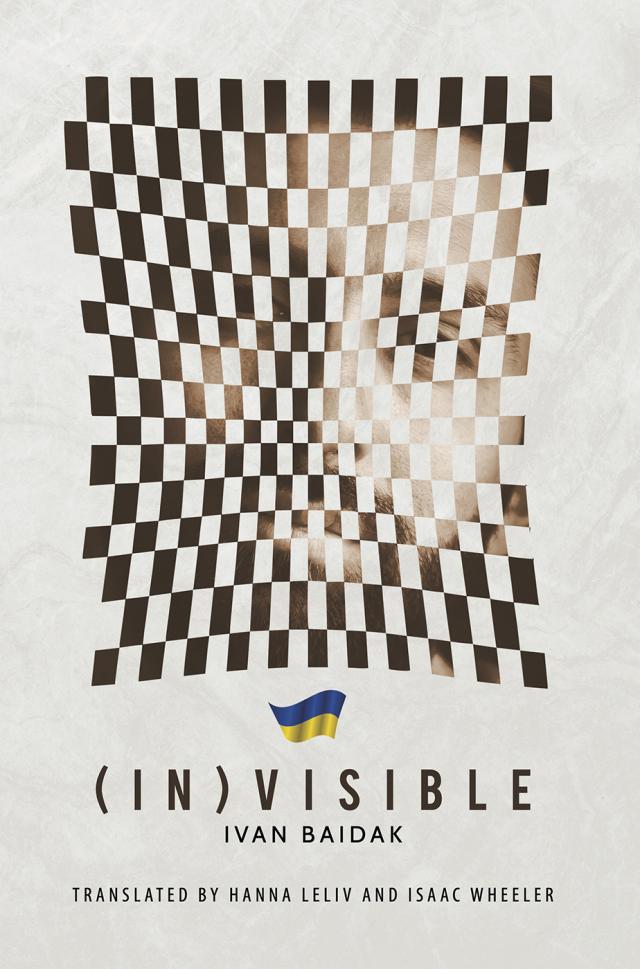
Original title: (Не)помітні (2020)
Ukrainian copyright © 2020, Vivat Publishing
Translation copyright © 2022, Hanna Leliv, Isaac Wheeler
and Guernica Editions Inc.
All rights reserved. The use of any part of this publication,
reproduced, transmitted in any form or by any means, electronic,
mechanical, photocopying, recording or otherwise stored
in a retrieval system, without the prior consent of the publisher
is an infringement of the copyright law.
Guernica Editions Founder: Antonio D’Alfonso
Michael Mirolla, general editor
Anna van Valkenburg, editor
Interior design: Jill Ronsley, suneditwrite.com
Cover design: Allen Jomoc Jr.
Cover image: Lesya Yasnitska
Ebook: Rafael Alt
Guernica Editions Inc.
287 Templemead Drive, Hamilton (ON), Canada L8W 2W4
2250 Military Road, Tonawanda, N.Y. 14150-6000 U.S.A.
www.guernicaeditions.com
Distributors:
Independent Publishers Group (IPG)
600 North Pulaski Road, Chicago IL 60624
University of Toronto Press Distribution (UTP)
5201 Dufferin Street, Toronto (ON), Canada M3H 5T8
Gazelle Book Services, White Cross Mills
High Town, Lancaster LA1 4XS U.K.
First edition.
Printed in Canada.
Legal Deposit—Third Quarter
Library of Congress Catalog Card Number: 2022940815
Library and Archives Canada Cataloguing in Publication
Title: (In)visible / Ivan Baidak ; translated from the Ukrainian by Hanna Leliv and Isaac Wheeler.
Names: Baidak, Ivan, author. Leliv, Hanna, translator. Wheeler, Isaac Stackhouse, translator.
Series: Guernica world editions ; 71.
Description: Series statement: Guernica world editions ; 71
Identifiers: Canadiana (print) 20220265291 Canadiana (ebook) 2022027102X ISBN 9781771838528
(softcover) ISBN 9781771838535 (EPUB)
Classification: LCC PG3950.12.A534 H3713 2022 DDC 891.7/934—dc23
To my sister
who knows me better than I do.
Table of Contents
Cover
Titlepage
Copyright
Adam
Eva
Adam
Marta
Adam
Anna
Adam
Anna
Adam
Eva
Adam
Ivan
Acknowledgements
About the Author
About the Translators
Landmarks
Cover
Half Title Page
Title Page
Copyright Page
Dedication
Table of Contents
Preamble
Acknowledgments
Our family always had dinner in silence. My father would return home irritable after an exhausting shift at the factory, and he couldn’t bear our chatter. Mama knew his habits all too well, and she could tell whenever he wanted a second helping, a pinch of salt, or another beer. I was expected to finish my meal as quickly as possible and make myself scarce. I liked it better when my father had night shifts. Then Mama and I could joke and laugh a lot. It’s not that I didn’t love my father—I just felt more comfortable having dinner when I wasn’t worrying that I might drop a knife on the floor or stain the tablecloth.
That night, Father came home wiped. He drank more than usual and vented to Mama about his boss, and then he started grilling me about things at school and the sports club. Once he’d heard what he wanted, he reached for another beer.
“Stop blinking!” Father burst out, glaring at me.
I froze. Then I grew agitated and started blinking even harder.
“Didn’t you two go to the doctor last month?” he asked Mama.
“Yes, but he said that tics aren’t easily cured.”
“Then find another doctor who can sort him out! Last thing I need is people thinking that my son is dumb.”
Mama was angry, but she kept quiet. I couldn’t hold back my tics.
“It’s been years now,” Father said. “Can’t they give you pills or something? I’m working my ass off to support this family, and what do I get for it? A damn disgrace! What are you going to do with him anyway? He’ll need to get a job one day.”
Father glared at me.
“Stop that at once!” he yelled, but I just couldn’t stop twitching. “Can’t you hear?”
“Enough!” Mama said. “He can’t help it, as you well know.”
Father stopped yelling, and muttered:
“Then he’ll have to learn to control it.”
A
It’s been a while, but I still remember that episode. I honestly couldn’t understand what Father was demanding of me that night, but I didn’t want to wind him up even more, so I tried to make my body listen to me. Later, my whole life would be centered around controlling my tics so that people wouldn’t see me as “different,” and I wouldn’t have to explain “what was wrong with me” all the time. I heard these two phrases more often than any others. At some point, I caught myself thinking that my tics were taking over my entire life—I had to secure their approval for all my actions and plans. It sometimes felt like friendship. How ironic. It was nothing but madness.
I’m tired of it. I came here to break free.
“Hello. I’m Adam. I’m a graphic designer. Freelance. I love watching TV series, and I hate shopping. I’m 26. I have Tourette’s syndrome.”
A
Hello. I’m Ivan. I am a writer. I love helping people, and I hate discrimination. I started writing this novel when I was 29. I have Tourette’s syndrome.
I first realized that I was “different” when a university professor asked me to leave the room because my sniffing made it hard for her to read her lecture. All my life, I’ve been struggling with the side effects of Tourette’s syndrome. I was fired from jobs; my girlfriends broke up with me; passers-by mimicked my movements just for fun. Had I written this book a few years ago, it would have been full of memories like that, negative emotions, and reflections about the unfairness of the world—which is a confirmed fact, by the way. It’s just that each of us has their personal reason for saying that. This book, though, is not about negative things. Neither is it a bold coming-out. It is a silent coming to terms with my own lived experience. It is a call to not give up on yourself. It is a plea for acceptance of others.
A disclaimer. Adam’s story is not the story of my own life, and there’s no point in looking for similarities. Even so, let me assure you: there’s a lot of truth in it.
Adam
“H ello, Adam,” said a short middle-aged man.
“Hello, Adam,” repeated everyone else in unison.
It was a social support group for people with challenges. My therapist recommended that I join it. Sitting in a circle, people took turns to tell their stories, share their feelings, and listen to the words of understanding and support from others like them. It took me a whole month to work up the courage to tell my story. Until then, I’d been only listening to others as if I’d wanted to make sure that it was safe. On the one hand, that therapy method offered some comfort, but on the other, human stories were usually too emotional, and that’s what made them destructive—you could relate to any of them, and it ripped open your old wounds. My tic was noticeable, to be sure, but they ignored it just like they ignored the challenges of other group members.
At my first meeting, I couldn’t handle more than fifteen minutes. Memories came flooding back, and I jumped to my feet and dashed for the door, interrupting someone’s story.
“You’re leaving already?” a girl asked, stopping me halfway. She had a big lump that looked like a ball of skin on her cheek.
“Yeah … I live on the other side of town. Don’t want to miss the last bus.”
“So, you live across the bridge?” she asked.
I nodded.
“I can give you a lift. It’s on my way.”
I said thank you and took my seat again, but I tried to tune out everything that was happening around me. I should’ve thanked her and turned her offer down, of course. She could obviously see that I had no trouble getting back home. But it turned out for the better that I stayed.
A
That was how I met my first friend with challenges. Actually, Anna became my first ever friend. I kept people at a distance unless circumstances forced them to talk to me. Sooner or later, any new connection reached the point when I had to explain why I was having the tics, which wasn’t my favourite thing to do. Just imagine that you have to explain—to justify—why you’re 5’11” tall, or why you have black hair, brown eyes, and a mole near your left eye.
I had to do that for my Tourette’s syndrome all the time, and it damaged my relationships irreparably—no matter the sincere sympathy, get-well wishes, or even doctors’ recommendations.
I didn’t have to explain anything to Anna. But I wanted to because she could hear me out. She could really understand me.
Anna had a hemangioma—a benign tumor on her cheek. She couldn’t have it removed because a carotid artery ran right through it.
“I get emails from
“And how are you doing, in general, these days?” I asked, trying to change the subject. I had enough stories at the support group meeting that night.
“How am I doing? Great. I spend most of my days working. Making clothes. My co-workers are nice, and I like my job. I could do more, to be sure, and one day things will change. It’s just that some people are assholes, and they don’t see me as I am … you know why …”
I nodded.
“I even got myself a car to avoid public transport. Whenever I took a subway, someone would always kill my mood with their stares.”
“I know,” I said, unable to squeeze out more than two words.
“But it’s okay. You know it, right? It’s just a matter of choice of how you decide to feel about it: angry, hurt, hateful, ironic … I go for this last one. Sometimes, I can even make fun of myself. I often say that I’m going to remodel my face just like I remodel clothes. Not the best joke, I know.”
“I live around the corner from here,” I said. The joke was not funny at all.
“Well, this is quite far out, buddy.”
“I’m trying to save up money to move out of my parents’ house,” I said.
“Move in with me, if you like,” she said.
I merely smiled.
“No! I’m serious. Girls and I are renting a three-bedroom apartment. One of my flatmates has just moved out. So, one room for me, one for Marta—I met her at a support group meeting, too. And there’s another spare room. Pack up and give it a go if you want to. Just let me know by next Thursday.”
Smiling again, I got out of the car.
A
By the way, my father apologized for that dinner incident, and I promised I’d try not to twitch, as if that was something I enjoyed. Tics are sudden uncontrollable movements of muscles in different parts of the body. Suppose you want to raise your hand—your brain sends a nerve impulse to your hand, telling it to do it. With tics, these impulses are not controlled. That’s a very brief explanation of Tourette’s syndrome. I make no claims to medical accuracy, to be sure, but that’s how I made sense of my illness after many attempts to treat it.
I’m still trying not to bother people around me. I go shopping when there aren’t too many customers at the store, and I prefer supermarkets and self-service stations to avoid too much attention. I told the cashier at a neighbourhood grocery about my illness, so she never asks unwelcome questions. To tell the truth, I feel relieved when I tell others about my condition, even though I don’t like talking about it.
I hide in my hoodie on public transport, skip all kinds of exciting meetings and events, and don’t let myself go to the movies or other public places so as not to bother other people. I even avoid sitting by a café window during lunch, just in case my tics scare the potential customers away. When tourists ask me for help, I usually say no to avoid contact or uncomfortable situations, although I do have some qualms about it.
I’ve thought up excuses for all kinds of questions:
“I caught a cold,” I say when I’m struggling with sniffing;
“I have a stiff neck,” I say when my head suddenly jerks.
In some situations, these explanations help.
I never went to college. After I finished school, my father got me a job at the nail factory where he was working. I held out for only two weeks. I got a deep gash to my hand when the tics defeated me, so I had to look for another, safer job. I spent some time sorting mail at the post office, but I wanted to work with people, so I decided to become a sales rep. Over a year, I had fifty job interviews with wine merchants, sweet shops, and bakeries, travel agencies, language schools, and internet providers. None of them turned me down—they just kept silent. Only at one interview did I hear what was probably the truth at least half the time.
“You’ll have to work with other people, you know. Your movements … they create certain distrust. This job involves a lot of communication. The person doing it will be the company’s public face. Our clients might have a mixed reaction, I’m afraid.”
My job search ended right there. Or wait—there was another story. I somehow managed to control my tics during an interview, only to be fired on my third day at work.
“Unconvincing sales strategies,” they said.
My prospects were unconvincing, too, but I moved on to become a graphic designer.
I ran into my art teacher in the street. She’d always been incredibly kind to me—because of my tics, perhaps, or simply because I liked painting. She told me about her son who worked as a designer and recommended that I give it a try.
I did. And things went well. After an online course in graphic design, after thousands of minutes of videos and as many hours of practice, I signed up on a freelance website and found my first client. He then recommended me to his friend who owned an advertising agency. That’s how I landed a full-time job.
Now I’m a designer with three years’ experience. I work from home, never meet my clients in person, and sometimes Skype with my workmates. With my camera off. Twice a week, I go grocery shopping. In the evenings, I watch TV series. I don’t talk to my neighbours; I don’t use social media; I don’t have friends. That’s what my life is like. I work as a designer, and I try not to bother other people. And I’m fine with it. I’ve created a routine that I enjoy. Some time ago, Mama started to worry about my mental health. A therapist visited me for a while. That’s when I joined the social support group.
My parents. I’m still living with them. But our relationship broke down a long time ago. Mama often seems to be eager to leave me be. But in fact, I’m pushing her away by feeling indifferent to my own life. My father … I don’t think that he’s ever wanted to fix his relationship with me. After that incident at the nail factory, he made another attempt—he tried to teach me to drive. But during the very first tic attack, I lost control and ran into another car in front of me. That was it for my driving lessons. And not only for them.
The next week, I moved to Anna’s place.
A
I feel that otherness is inside us—in what we think about, in what we consider important, in how we treat people around us. It has always surprised me how different we can be; how different people are interested in different things, from drama to machine-building; how they have different tastes in music and food; how they root for different sports teams. Our appearance can be part of what others like about us, but can it become an object of ridicule, mockery, or discrimination?
Our society has learned to accept people with disabilities even though it can’t always provide the conditions they need. Scared of the words “cancer” and “AIDS,” we’ve developed an empathetic form of response to them. Low-income groups get all kinds of help. We’ve been fighting hard against gender and racial inequality. Yet, people with disfigurements are left outside this system of acceptance.
One day, on my way back home, I met a man with Tourette’s syndrome on the tram. I remember him taking a back seat—to avoid unwanted attention, most probably. His head jerked. He made some random sounds, and I saw he was trying to control himself. When passengers started to make disapproving noises, his body tensed up, and his tic worsened, so I went closer and, stopping in front of him so he could see my blinking, I tried to make him understand: he was not alone. He took the hint and smiled. His tic attack calmed.
How to respond is always a delicate question. It’s never clear what is the right way to react: to look away—or to let your eyes linger. Either reaction might hurt the person. There was another situation: I saw a girl with Tourette’s syndrome on the bus, but when she noticed my tics, she burst out screaming and crying, and then she hurled insults at me. At the next stop, the girl got off in a fit of tears, and I followed her, trying to excuse myself and explain that I was just like her.
“I’m just like you,” I said, trying to calm her down. “I have tics, too. I didn’t do that on purpose.”
She slapped me. All I remember is her flushed, tear-stained face.





