

The bridge on the drina.., p.1
The Bridge on the Drina - PDFDrive.com, page 1


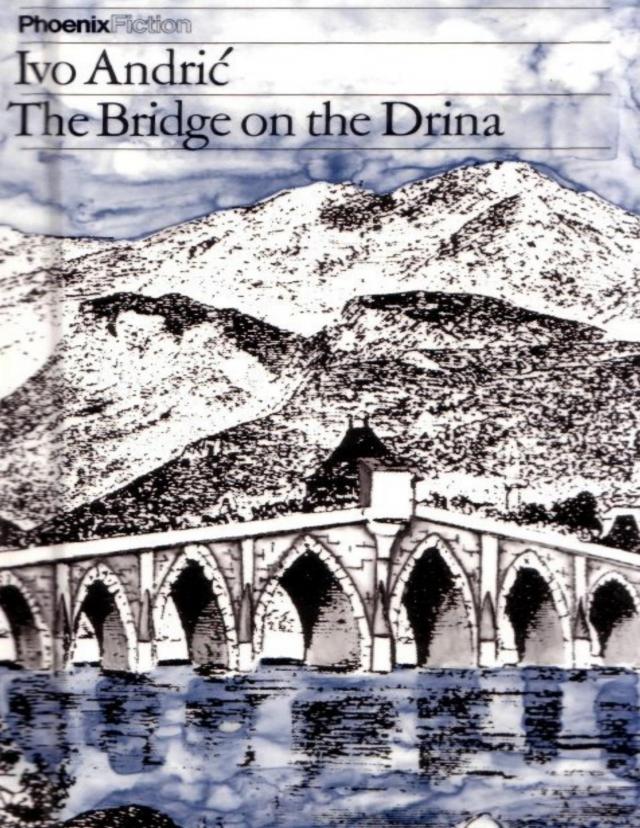
IVO ANDRIĆ
THE BRIDGE
ON THE DRINA
Translated from the Serbo-Croat by
LOVETT F. EDWARDS
With an Introduction by
WILLIAM H. MCNEILL
Originally published in 1945
Translation © George Allen and Unwin Ltd., 1959
Phoenix Edition /977
ISBN: 0-226-02045-2
Prepared and formatted by nepalifiction, TPB, 2014
INTRODUCTION
TRANSLATOR'S FOREWORD
I
II
III
IV
V
VI
VII
VIII
IX
X
XI
XII
XIII
XIV
XV
XVI
XVII
XVIII
XIX
XX
XXI
XXII
XXIII
XXIV
INTRODUCTION
William H. McNeill
The committee that awarded the Nobel prize for literature to Ivo Andric in 1961 cited the epic force of The Bridge on the Drina, first published in Serbo-Croat in 1945, as justification for its award. The award was indeed justified if, as I believe, The Bridge on the Drina is one of the most perceptive, resonant, and well-wrought works of fiction written in the twentieth century. But the epic comparison seems strained. At any rate, if the work is epic, it remains an epic without a hero. The bridge, both in its inception and at its destruction, is central to the book, but can scarcely be called a hero. It is, rather, a symbol of the establishment and the overthrow of a civilization that came forcibly to the Balkans in the fourteenth to sixteenth centuries and was no less forcibly overthrown in the nineteenth and twentieth centuries. That civilization was Ottoman—radically alien to, and a conscious rival of, both Orthodox Russia and the civilization of western Europe. It was predominantly Turkish and Moslem, but also embraced Christian and Jewish communities, along with such outlaw elements as Gypsies. All find a place in Andric's book; and with an economy of means that is all but magical, he presents the reader with a thoroughly credible portrait of the birth and death of Ottoman civilization as experienced in his native land of Bosnia.
No better introduction to the study of Balkan and Ottoman history exists, nor do I know of any work of fiction that more persuasively introduces the reader to a civilization other than our own. It is an intellectual and emotional adventure to encounter the Ottoman world through Andric's pages in its grandoise beginning and at its tottering finale. Every episode rings true, from the role of terror in fastening the Turkish power firmly on the land to the role of an Austrian army whorehouse in corrupting the old ways. No anthropologist has ever reported the processes of cultural change so sensitively,- no historian has entered so effectively into the minds of the persons with whom he sought to deal. It is, in short, a marvelous work, a masterpiece, and very much sui generis.
Perhaps a few remarks about Bosnia and its history may be helpful for readers who approach this work without prior acquaintance with the Balkan scene. Bosnia is a mountainous region in the central part of Yugoslavia. Today it is one of the constituent republics of that federal state. In medieval times it broke away from the Kingdom of Serbia in a.d. 960 and thereafter became more or less independent, though perpetually subject to rival jurisdictional claims because of its borderland position between Orthodox and Latin Christendom. In the twelfth century, the ruler of Bosnia sought to assert a fuller independence by becoming a Bogomil. This was a religion, related to Manichaeism, that spread also to western Europe where it was known as Albigensianism. Many Bosnians followed their ruler's example, remaining heretics in the eyes of their Christian neighbors until after the Turkish conquest, when nearly all of the Bogomils became Moslem.
As a result, about one-third of the population of Bosnia is Moslem today, even though they speak a Slavic language, Serbo-Croat, as their ancestors had done back to Bogomil days.
The Turks conquered Bosnia between 1386 and 1463. Conversion to Islam proceeded rather rapidly, especially among the landowning families of Bosnia; and with religious conversion went a cultural transformation that made Bosnia an outpost of Ottoman civilization. From the fifteenth century onwards, Bosnian military manpower reinforced Ottoman armies. Year after year, Moslem warriors answered the summonses of local governors to go raiding into Christian lands to the north and west. Simultaneously, at irregular intervals agents from Constantinople chose Christian peasant conscripts to replenish the ranks of the sultan's personal household. These recruits were officially classed as slaves, and in addition to military service in the Janissary corps many performed menial services in and around the court. Some, however, after appropriate training, emerged as the topmost military administrators and commanders of the Ottoman armies. A select few rose to the supreme administrative post of grand vizier.
Andric's story of how the bridge was built is completely historical. A Bosnian peasant's son, Muhammad Sôkôllu (né Sokolović) became grand vizier in 1565, and as such governed the empire until his death in 1579. Having been recruited into the sultan's service as a youth, he remembered well his Bosnian birth, and among other acts acknowledging his origins, he chose his own blood brother to become patriarch of the Serbian church. The construction of the bridge across the Drina was another, similar act emanating from the grand vizier's desire to be remembered in the place of his birth.
Ever since the Turkish conquest, Bosnian society had comprised a complex intermingling of Moslems, Roman Catholics and Orthodox Christians. As long as Turkish power remained secure, local Moslem dominance was assured, both by the prowess of Moslem landowners and by the sporadic force Ottoman armies could bring to bear against any outside challenge. As Ottoman power diminished, however, and the might of adjacent Christian empires correspondingly increased, the religious divisions of Bosnian society became potentially explosive. Revolt by an oppressed Christian peasantry could expect to win sympathy abroad, either in Russia (for the Orthodox) or in Austria (for Roman Catholics). Simultaneously, mounting population pressure made it harder and harder for the peasantry to maintain traditional standards of living.
On top of this, early in the nineteenth century, a handful of intellectuals, educated in Germany, picked up the idea that nationhood and language belonged together and could only attain full perfection within the borders of a sovereign, independent state. Since existing literary languages did not define clear boundaries between the Slavic dialects spoken in Balkan villages, the ideal of linguistic nationalism intensified confusion in the older religiously structured (and divided) society by offering individuals alternative loyalties and principles of public identity.
These circumstances provided the background for the "Eastern question" that so bedeviled nineteenth-century European diplomats. Bosnia played a conspicuous role. First it was Moslems who revolted against Constantinople (1821, 1828, 1831, 1838-50) in a vain effort to defend their accustomed privileges. Soon after their reactionary ideals had met final defeat (1850), through military conquest by reformed (i.e., partially westernized) Ottoman armies, Christian peasants of Bosnia, objecting to an intensified tax burden brought on by a modernized administration, took up the standard of revolt (1862, 1875-78). This, in turn, provoked intervention by the Christian powers of Europe, with the result that at the Congress of Berlin (1878), Bosnia and the adjacent province of Herzegovina were placed under an Austrian protectorate. A generation later, in 1908, the Austrians announced the annexation of these two provinces to the Hapsburg crown. This precipitated a diplomatic crisis that was part of the prologue to World War I; and, of course, that war was itself occasioned by the murder of the Archduke Ferdinand in Sarajevo, the Bosnian capital, by Bosnian revolutionaries who wanted their land to become part of Serbia. After 1918, they had their way, for Bosnia was incorporated into the new south Slav kingdom of Serbs, Croats, and Slovenes. During World War II, Bosnia, because of its mountainous character, became Tito's principal stronghold, and after 1945 it was made one of the six constituent republics of the new federal Yugoslav state.
Ivo Andric was born in Travnik, Bosnia, in 1892, but he spent his first two years in Sarajevo, where his father worked as a silversmith. This was a traditional art, preserving artisan skills dating back to Ottoman times; but taste had changed and the market for the sort of silverwork Ivo's father produced was severely depressed. The family therefore lived poorly; and when the future writer was still an infant, his father died, leaving his penniless young widow to look after an only child. They went to live with her parents in Visegrad on the banks of the Drina, where the young Ivo grew up in an artisan family (his grandfather was a carpenter) playing on the bridge he was later to make so famous, and listening to tales about its origin and history which he used so skillfully to define the character of the early Ottoman presence in that remote Bosnian town. The family was Orthodox Christian, i.e., Serb; but in his boyhood and youth Andric was thrown into intimate contact with the entire spectrum of religious communities that coexisted precariously in the Bosnia of his day; and his family shared the puzzling encounter with a strange new Austrian world that he portrays so sensitively in The Bridge on the Drina.
The young Andric returned to Sarajevo to attend secondary school, and there became a nationalist revolutionary. This did not prevent
him from attending Hapsburg universities, at Zagreb, Cracow, Vienna, and Graz; but with the outbreak of World War I his political activity caused the Austrian police to arrest him. Andric therefore spent the first three years of World War I in an internment camp, where he wrote his first successful book, published in 1918. On release (1917) he took an active part in conducting a literary review that advocated the political union of all south Slav peoples, and he had a minor part in the political transactions that brought Croatia into the new Kingdom of Serbs, Croats, and Slovenes that emerged in December, 1918.
Thereafter, Andric returned to academic pursuits, working towards a doctor's degree at the University of Graz, achieved in 1924. His thesis was entitled "The Development of the Spiritual Life of Bosnia under the Influence of Turkish Sovereignty." The solid and precise historical information that underlies The Bridge on the Drina was thus systematically built up through academic study; but instead of continuing as a historian Andric opted for a diplomatic career. Between 1924 and 1941 he was stationed at various European capitals. In his spare time he wrote short stories and planned his later, larger works.
World War II presented him with the enforced leisure necessary for realization of those ambitions. With the collapse in 1941 of the government he had served, Andric, who had been Yugoslav ambassador at Berlin, returned to private life in Belgrade. During the ensuing years of harsh occupation and mounting resistance, he wrote no less than three novels, including The Bridge on the Drina. They were published in rapid succession in 1945, and at once established his reputation in Yugoslavia as a major writer. Translated into English in 1959, The Bridge on the Drina became the principal basis for his Nobel Prize for literature, which, in turn, made him a literary figure of world renown. Under Tito, Andric held a number of honorific offices, but even after the Nobel Prize he maintained a discipline of work that permitted continued literary creation, and kept a zone of privacy around himself that few could penetrate. He died in Belgrade in 1975.
What seems truly remarkable about Andric's literary achievement in The Bridge on the Drina is the way he entered into the minds of the Moslems of Bosnia. No doubt, in his youth he had ample opportunity to observe the fractured world in which the Bosnian Moslems found themselves. Very early in life he found the Orthodox Christian world view he himself had inherited to be inadequate. Revolutionary linguistic nationalism, to which he lent support in his student days, recognized no distinction between speakers of Serbo-Croat on the basis of their religion. Yet older habits of thought and feeling lingered on in Bosnia, so that Orthodox Serbs and Roman Catholic Croats stubbornly distrusted one another, while both Christian communities remembered the former Moslem domination with dread.
Clearly, Andric grew up in a world where rival and mutually incompatible world views found themselves in acute conflict. This in itself is liable to provoke intellectual detachment, at least among sufficiently intelligent, sensitive, and experienced individuals. Andric's mature years pushed him further in that direction, for his youthful reliance on linguistic nationalism as a means of bridging gaps between Serb, Croat, and Moslem soon proved vain. During World War II he saw Tito lead yet another revolutionary ideal to power. But his age and temperament did not allow him to lend that movement active support. Instead, he turned his mind backward to the deeper past, probing for the roots of the conflicts that so distracted his Bosnian homeland.
In youth he had repudiated the Orthodox outlook. In middle age he was compelled to abandon the expectation of his youth that linguistic nationalism would somehow resolve social conflict in Bosnia. Just what he thought of the Communist recipe for solving ethnic and social conflicts is unclear. He definitely preferred the inclusive south Slav sympathies of Tito's movement to the narrow nationalisms of rival Serb and Croat leaders who disputed power with the Communists during the occupation years. This made him acceptable to the postwar Communist government. Yet anyone reading The Bridge on the Drina will find it hard to believe that its author thought Marxism or any other new faith could be expected to resolve long-standing national and religious conflicts.
In spite of the many honors paid him by Tito's regime, it seems plausible to suggest that Andric by the 1940s had become a thoroughgoing conservative. He clearly implies that the sort of cultural transformation required to transcend Bosnia's religious and social divisions will cost a great deal, requiring the surrender of
precious local peculiarities and identities. Moreover, to judge by how such changes came in the past, as Andric understands that past, the requisite cultural changes are most likely to come about, if at all, not through intelligence and good will but through force and brutal interference from without—as happened both when the Ottoman identity was implanted on the province from distant, mysterious Constantinople, and when western patterns were imposed by a no less distant and incomprehensible Vienna.
Such a message cannot appeal to the youthful enthusiast who wants to make all things new and to brush away past errors. But for a person who has lived long enough to experience the persistent gap between human achievement and expectation, Andric's sensitive portrait of social change in distant Bosnia has revelatory force. That is the way it was. Here is human reality, stubborn, irregular, awkward, heartfelt, and ever-changing in spite of everything people can do to maintain, or to overthrow, inherited patterns of life.
TRANSLATOR'S FOREWORD
The customs and the minds of men alter less rapidly than the vagaries of political
and ideological change. The visitor to Yugoslavia can still see the bridge on the
Drina, whose fate is described in this book, though once again modernized and
repaired. But he will find Višegrad itself less changed than he may expect and
will not find it hard to identify the types of Andrić's novel even under a national
state and a communist administration. The Bosnian peasant faces the hazards of
an
egalitarian
administration
with
the
same
incomprehension
and
imperturbability as he faced the novelties of the Austro-Hungarian occupation;
he experienced the greater brutalities of the last war with the same courage and
resignation as he faced those of World War I, and his relations with state
controlled purchasing agencies differ mainly in degree from those of his fathers
with the banks and merchants of the Višegrad market. The last war, in Bosnia
especially, showed examples of horror and torment at least equal to those of
Turkish times, while the idealism and fanaticism of youth, so well described in
the conversations on the kapia, have only changed slightly in direction, while retaining their essential mixture of practical politics and imaginative
romanticism.
Dr Ivo Andrić is himself a Serb and a Bosnian. These provincial and religious
subtleties are still as important in present-day Yugoslavia as they were in earlier
times. But in the case of Dr Andrić they have had an effect different from that on other Yugoslav writers and politicians.
Instead of intensifying the local and religious conflicts that still bedevil
Yugoslavia — as was only too tragically shown during the last war—they have


