

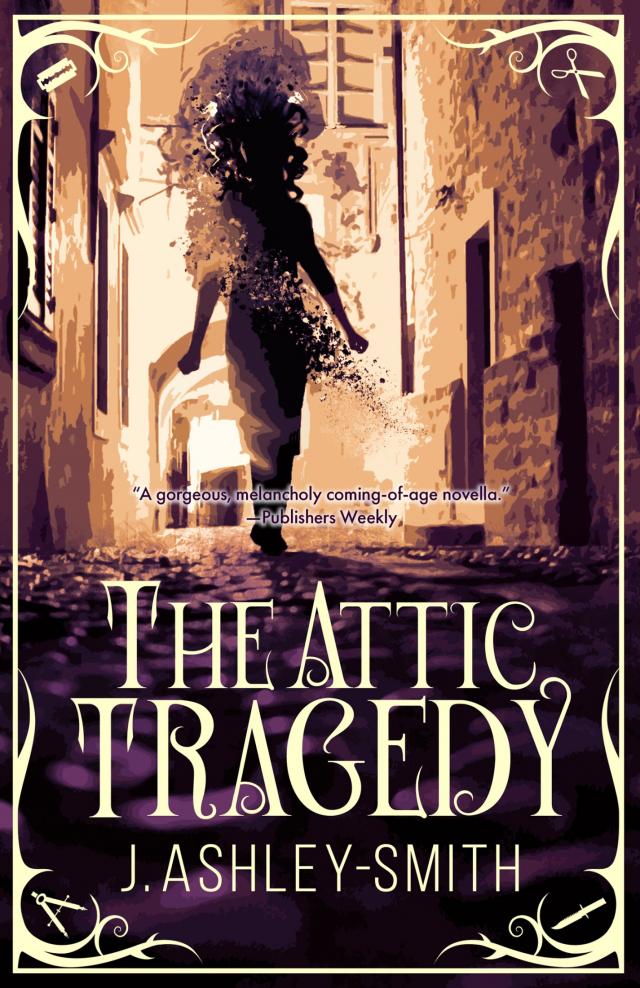
The attic tragedy, p.1
The Attic Tragedy, page 1


Praise for The Attic Tragedy
“Ashley-Smith debuts with a gorgeous, melancholy coming-of-age novella about girlhood and ghosts. . . . This eerie, ethereal tale marks Ashley-Smith as a writer to watch.”
—Publishers Weekly
“A beautifully written book about desire, pain, and loss, haunted by glimmerings of the supernatural. The Attic Tragedy manages to do more by intimation and suggestion with its fifty-three pages than most novels manage to accomplish over their several hundred.”
—Brian Evenson, author of Song for the Unraveling of the World
“J.Ashley-Smith doesn't put a foot wrong in this chilling, devastating story. The Attic Tragedy is hard to read in the best possible way.”
—Kaaron Warren, award-winning author of Into Bones Like Oil and Tide of Stone
“J. Ashley-Smith's stunning The Attic Tragedy follows the friendship between two young outcasts, Sylvie and George, as they navigate the treacherous years of high school and after. With piercing, clear-eyed sympathy, Ashley-Smith depicts a relationship centered on the secrets of the living and the dead. Sylvie knows and voices the histories of the spirits attached to the objects in her father's antique shop; George wrestles with the emotions raging within her and which find their outlet on her skin. Acutely observed, frequently surprising, this is fiction of the highest order.”
—John Langan, author of Children of the Fang and Other Genealogies
“Lyrical and melancholy, The Attic Tragedy is a dark and poignant study of what it means to love and to be loved, to lose and to be lost. Ashley-Smith conjures a compelling, haunting tale that will stay with you like a ghost long after the last page is read.”
—Alan Baxter, award-winning author of Devouring Dark and Served Cold
“The Attic Tragedy is full of heart and darkness, both endearing and terrifying. These pages open like a raw wound. You don’t read this story. It bleeds into you, and it leaves a scar on the way in.”
—Sarah Read, Bram Stoker Award© winning author of The Bone Weaver’s Orchard and Out of Water
“The Attic Tragedy is beautifully engrossing, elegant, and lavish in the traditions of ornate architecture: J. Ashley-Smith’s exquisite words are its sculpted stone blocks; his layers of resonant emotions their subtle coloring treatments; his backdrop of ghosts those detailed flourishes that drive all expressive design to be admired for impression and refinement.”
—Eric J. Guignard, award-winning author and editor, including That Which Grows Wild and Doorways to the Deadeye
“Softly shrouded in smoke and shadow, Ashley-Smith’s The Attic Tragedy cuts close to the bone. Startling, pointed, and powerful.”
—Lee Murray, three-time Bram Stoker Award© nominee and author of Into the Ashes
“With The Attic Tragedy, J. Ashley-Smith proves himself an elemental writer of great talent. Emotions are bushfires. Foggy mountains shadow streets where violence festers. Dust, the microbes of otherness, settle over empty rooms that are never as empty as you think they are. This attic is a place of patchwork-detail where characters are forced to question their legacies, and I was held captive by their frightening revelations. A moody, melancholic read that I can’t recommend highly enough.”
—Aaron Dries, author of House of Sighs and A Place for Sinners
“J. Ashley-Smith’s short novella, The Attic Tragedy, is a sharp and delicate jewel that both shines beautifully and cuts deeply. Focusing on the friendship of two girls, it slowly unveils a deep sense of strangeness and dread, both puzzling and fascinating. Masterly crafted, it will please all lovers of Shirley Jackson, who will be thrilled to find again this mix of humanity, beauty and cruelty.”
—Seb Doubinsky, author of Missing Signal and The Invisible
THE ATTIC TRAGEDY. Copyright © 2020 by J. Ashley-Smith.
All rights reserved. No part of this publication may be used, reproduced, distributed, or transmitted in any form or by any means without prior written permission from the publisher, except in the case of brief quotations embodied in critical reviews and certain other noncommercial uses permitted by copyright law. For information, contact Meerkat Press at info@meerkatpress.com.
One line from The Oresteia by Aeschylus, translated by Robert Fagles
Copyright © Robert Fagles 1966, 1967, 1975, 1977
ISBN-13: 978-1-946154-48-4 (Paperback)
ISBN-13 978-1-946154-49-1 (eBook)
Library of Congress Control Number: 2020938666
This is a work of fiction. Names, characters, businesses, places, events and incidents are either the products of the author’s imagination or used in a fictitious manner. Any resemblance to actual persons, living or dead, or actual events is purely coincidental.
Book cover and interior design by Tricia Reeks
Printed in the United States of America on acid-free paper
Published in the United States of America by
Meerkat Press, LLC, Atlanta, Georgia
www.meerkatpress.com
To K, for the enduring love of stories locked in strange old things.
Dear gods, set me free from all the pain.
—Aeschylus
Prologos
Sylvie never called them ghosts, but that’s what they were.
The day we became friends, she walked me through the darkened rooms of her father’s antique shop, trailing her fingers over the objects. All of them were lovingly cleaned, none with even a trace of dust. There were old books and reliquaries, trinket jars and model ships, barometers, credenzas, compendiums and lamps. There were music boxes and what I now know was a Minton hand-painted jardinière. Sylvie brushed them with her long pale fingers, her eyes aflutter, her voice so soft it was almost lost to the tinkle of the overhead chandeliers, the tick tick tick of the many hidden clocks.
“The woman who wore this lost her husband to madness.” Sylvie fingered an ornate ring, curlicued silver bordered with diamonds. “He disappeared when she fell pregnant and everyone thought him dead. He’d been gone three years when she read about him in the paper. He was living rough in Centennial Park, running naked and wild, biting the heads off geese.” She slipped the ring back into its padded velvet tray. “Her mother always said he’d come to no good.”
“Or this,” she said, and her fingers moved to the stem of a burnished brass telescope. “A lover’s memento. The woman who owned this took a keepsake from every man she fell for. Not one of them ever knew of her love. And none loved her in return. She died of loneliness and an overdose of laudanum, lifted from the Gladstone of a doctor she’d set her heart on.”
Sylvie swam between display cases with fluid movements, her touch as delicate as a butterfly. I hardly dared move, afraid my bulk would knock over some priceless curio, topple some fragile ancient thing.
“How do you know?” I asked and followed, squeezing between a bookcase and a mahogany sideboard. A blue glass vase wobbled on its shelf and I reached out to steady it. “D’you find all that on the Internet or something?”
“No, silly,” said Sylvie, eyes laughing. “They tell me.”
I thought she was teasing, so turned away, pretended I was examining the collectables. Beside us was a heavy leather-top desk, the surface inlaid with gold leaf that glittered faintly in the half-light. There was an old-fashioned cash register and a marble bust and, beside them, a black-and-white photo in a silver art deco frame. It was a portrait of a dark-haired woman with round faraway eyes and a haunting smile; just as Sylvie would look in ten years, twenty years—beautiful and tired and sad. But there was a spark in her eyes, as though she were smiling through the sadness, like a single beam of sunlight glimpsed through brooding clouds.
“And this one?” I said and reached to pick it up, but felt through my sweater a delicate touch. Sylvie’s hand on my arm.
I felt hot all over and prayed I wasn’t blushing. Every one of my scars was tingling. “What do you mean they tell you? Like you can . . . hear them?”
Sylvie looked up at me and frowned, her eyebrows furrowed and serious.
“Of course,” she said. “You mean you can’t?”
Parados
Sylvie joined our school in the year before final exams. Graceful and etheric, dressed in a pale, simple frock, white cotton gloves and clutching an old-fashioned leather satchel, she looked like a creature from another time. She was quiet in class, didn’t play sport, kept herself to herself.
She was hardly the first out-of-place teenager at Blackworth High School. There’d always been a steady turnover of tree-changer offspring, dragged to the mountains by parents fleeing the bustle of city life. These kids knew they were different from us, knew they stood out. They went out of their way to ingratiate themselves—coarsened their accents, roughened their polished city edges, fell too quickly in line with the will of the schoolyard leaders. But not Sylvie. She made no effort to connect, spoke always in the same soft, cultivated tone, was forever daydreaming, always preoccupied. Her lack of deference did not go unnoticed.
Tansy Rimer and her gang of pretties sniffed around for a week or two but gave up in disgust, told everyone Sylvie was a stuck-up bitch with tickets on herself. The quiet boys watched and pined, too afraid to approach the sweet new girl with her distant warmth and faraway eyes. Tommy Payne and his thugs jostled and joshed whenever she passed, made mucky remarks and filthy gestures, their laughter echoing down the corridors.
I saw her, sometimes, beneath the stands of conife
I didn’t go in for sport much either, spending break and afternoon games in the library. There’s only so many times you can endure the indignity of being picked last, the look of revulsion on Tansy’s face or the faces of her lieutenant bitches, the nauseated groans when they lost the lottery and had to have me on their team. They used to yell at me as I lumbered around the field, tripped me if I ever came near the ball. They sang “Georgie Porgie” and changed the words, tried to make me cry.
The library was my escape. I didn’t read all that much, but I liked to handle the books, liked the smell of them, the quiet. Miss Terry, the librarian, was always kind to me, always called me George. Never my hated name. I helped her with the catalog, stuck new labels on the inside pages, wheeled the trolley of returns up and down the fluorescent-lit aisles. I liked sorting the books into piles, into subjects, into alphabetical order, then slipping them back onto the shelves, always in just the right spot. Each one of them had a home, a place where it and no other belonged. It gave me a good feeling to know that, in at least this one corner of the world, I brought some semblance of order to what would otherwise be chaos. Here, at least, there was something I could control.
I watched Sylvie from the library window, watched her float round the edges of the courtyard. Perhaps I saw something in her that reminded me of myself; on the surface we couldn’t have been more unalike, but in our isolation, in our status as outsiders, we were very much the same. I’d watch her drift out beyond the thresholds of the playing field, as though pulled by some invisible thread, guided by inaudible voices.
•
At the farthest corner of the oval, out where the monkey puzzle trees met the train tracks, there was a derelict maintenance shed. It had been abandoned since the school got its extension and was all but empty, with the only reminders to its intended purpose rolls of chain-link fence and a heap of star pickets. It was hidden from most of the school buildings, tucked round to the side. The only place you could see it from inside was the window in the library storeroom.
Everyone knew Tommy took girls back there to do things. More than once I’d been loading the trolley with returns, had seen from the window one or another Year Ten girl come out from behind that old shed with her hair in a tangle, tugging at her undies or wiping at her skirt. Sometimes there were tears. Always there’d be a plume of bluish smoke that rose from behind the shed, before Tommy Payne—sometimes Darren and Boz too—would come swaggering out and back to school.
I never understood why they went there, those girls, whether stripping naked for Tommy in the lee of that old shed was a choice they made themselves, or one that was made for them. No matter how much of a shit we all knew Tommy to be, he never wanted for admirers. There was always some half-broken waif from the year below who’d fall into a trance when Tommy strode down the corridor. Often it was those same girls coming out from behind the shed, making that walk of shame. Sometimes there were photos. The boys would load them to the Internet, or everybody’s phones would beep and there’d be sniggers and jeers. One time, after, a girl killed herself and we—all of us—pretended not to know the reason.
It made me boil to think of it, what Tommy and his boys got away with, knowing what was happening and having no power to do anything. I often pictured it—wheeling the trolley from aisle to aisle, or making space on the shelves for the new editions—pictured what I’d do to them. But that only made me boil all the more, made my scars sing, knowing pictures were all they’d ever be and that nobody would make those boys stop. Me, least of all.
•
It was November when it happened, the first hot days after a long, cold spring. For weeks before, the mountain had been pressed under a blanket of fog and drizzle, breaking only to erupt into storms of wild rain, black clouds that roiled and tumbled in from the valley and thunder that shook every weatherboard along the ridge. That morning, though, the rain cleared and by first break the sun had burned away the last of the milky fog. By lunch, it was like the past weeks had never been. There was no moisture in the air; the heat was oppressive. Just walking between classes had me sweating so bad that my school shirt was sodden and I had to pull on my morning sweater to cover the stains spreading around my armpits. The heat was unbearable beneath that scratchy wool, but better to be hot than seen. It was an enormous relief to get into the library, out of the sunlight, away from the taunts, to be slowly cooled by occasional gusts from the air conditioner.
I pushed the book trolley over to my favorite spot by the window. From there I could shuffle the books around, lay them out in order before wheeling them to their stacks. I could keep one eye on the world outside, maybe catch a glimpse of Sylvie. I’d got used to seeing her pass beneath the covered walkway outside the library windows, past the Principal’s office and the portable classrooms, out to the edge of the oval and the chain-link fence and the train tracks beyond. I’d come to look forward to the moment when she’d drift past, buoyant, as though afloat in some sublime ether only she could perceive. Those moments for me felt eternal, frozen in time. The light was perfect as a dream. My heart would blaze and my scars sing, and my true body would tingle and vibrate with an aliveness so intense it made me dizzy, made me almost believe I could burst free from this prison of flesh.
That day, when Sylvie passed, I pretended to be engrossed in the trolley, in slipping the unread copy of Ulysses in beside the dog-eared Nancy Drews. When I looked up, there she was, crossing the oval, her head in the clouds. She was so lost in herself that she didn’t notice Tommy Payne and his boys sneaking behind her, following her out to the edge of the grounds, out toward the derelict maintenance shed.
Then they passed beyond the corner of the school and I lost sight of them.
I stuffed the books I’d been sorting onto the shelves at random, pushed the still-full trolley out to the back of the library, into the storeroom and over to the window. There was the shed, and there was Sylvie, drifting, oblivious. Tommy Payne was closing the gap, Darren and Boz behind, clowning, making dirty gestures, laughing silently. I lurched away from the trolley, caught it with my thigh as I turned and the books went flying, James Joyce and Carolyn Keene and all the rest of them.
“George?” said Miss Terry. But I didn’t answer, didn’t have the breath.
Out of the doors, across the courtyard and onto the oval. I couldn’t see Sylvie or Tommy or any of them anywhere. I felt sick to my guts, suddenly desperate for the loo. I lumbered over the grass, a stitch burning in my chest, sweat pouring off me so thick it was in my eyes, my ears. I heard voices from behind the shed, cruel laughter, and jeering. As I passed the heaps of coiled fencing, I snatched up a star picket, hefting it like a club. With no idea what I was doing or why I was doing it, I stepped round the side of the shed to face them.
“Leave her alone,” I said, trying to make my voice as deep and threatening as a boy’s.
“Fuck me,” said Tommy. “It’s the Hulk.”
Darren and Boz turned and both of them laughed. Tommy had Sylvie against the wall of the shed, gripping her bare arm. She recoiled from the touch, her face crumpled. I saw she was missing a glove.
“I said leave her alone.” I took a step toward them, tried to lift the picket but I was so scared my arms were like jelly.


