

Edge of oblivion np 2, p.1
Edge of Oblivion np-2, page 1
part #2 of Night Prowler Series


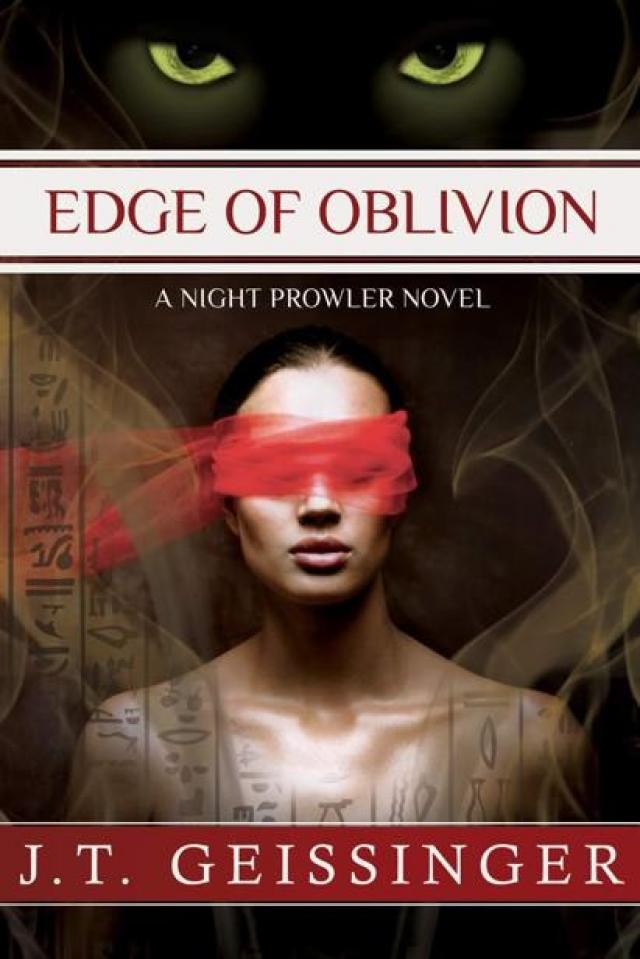
Edge of Oblivion
( Night Prowler - 2 )
J. T. Geissinger
There exists a world beyond our own. It is a world of ancient magic and well-guarded secrets, a world of strict laws and harsh punishments for those who betray them, a world inhabited by the Ikati, a race of gifted people who are so much more than they first appear. Brought together by fate in this world of danger and beauty, two people with dark pasts will meet.
Morgan is beautiful, smart, sexy…and about to die. Convicted of treason against her shape-shifting kin, she is given one last chance at redemption; discover the hidden lair of the enemy intent on destroying every one of her kind, or forfeit her life.
Xander is ruthless, heartless, cold-blooded…and assigned to kill her if she fails in her task. Expecting to feel nothing but contempt for the traitor under his watch, the assassin accompanies Morgan on her search, but as the two race through the heart of Italy while the clock winds down to zero hour, he finds himself drawn into a dangerous web of desire as powerful as it is forbidden. Their passion will test everything they believe in, and endanger the future of the tribe itself.
Sensual, edgy, and action-packed, Edge of Oblivion is a must-read for lovers of dark paranormal romance.
Edge of Oblivion
Night Prowler - 2
by
J T Geissinger
To Jay, my husband, boyfriend, business partner, and best friend. The best part of every day is opening my eyes in the morning and seeing
you there
To Jay, my husband, boyfriend, business partner, and best friend. The best part of every day is opening
my eyes in the morning and seeing you there.
What judgment pronounce you upon him who though honest in the flesh is a thief in spirit?
What penalty lay you upon him who slays in the flesh yet is himself slain in the spirit?
And how prosecute you him who in action is a deceiver and an oppressor,
Yet who also is aggrieved and outraged?
And how shall you punish those whose remorse is already greater than their misdeeds?
KHALIL GIBRAN
Prologue
Once, we were gods.
Ages ago, idyllic, uncounted centuries before man or his sly, sprawling civilizations had even been dreamed, we ruled sovereign over all other creatures in the deepest, virgin heart of equatorial Africa. Divine and resplendent, reveling in the bounty and glory of our many Gifts, we took the name Ikati—Zulu for “cat warrior”—because it most closely described our stealthy perfection, our feline, sinuous grace, our cunning and lethal prowess.
We lived and loved and raised our children there, beside the pristine, glimmering waters of the Congo, beneath the nourishing sun and the endless blue sky and the lush, dappled shade of the baobab trees. We wore crowns of gold and garnet and tanzanite; we walked naked among nature and one another and knew no shame. We honored our dead and hunted our food and slept in the fat, crooked arms of acacias and marulas; we passed the stories of our illustrious history to the next generation. We celebrated our Mother Earth and her great magic, and all was well. All was perfect.
But Time is a merciless thief, even for creatures so blessed as we, and slowly things began to change.
Invaders came. Clumsy, ugly, two-legged beasts with spears to stab hearts and arrows to pierce flesh and fire to burn homes. They stole through our forests and poached in our grasslands; they poisoned our rivers and captured our children, our old and weak. We fought our enemies back; we had no choice. Year after year we fought, decades of struggle, war, blood, death. Battles were won, only to begin anew with the next generation. There were so many of our enemy, and so few of us. In time, our numbers dwindled. In time, our enemies gained the advantage.
So, like all creatures must, we adapted to survive.
We learned the human ways. We spoke the human tongue. We wore human clothing and raised human crops and built homes of mud and grass, then wood, then brick, as they did. We learned to hide our true nature. And in this way, we began once more to thrive.
In secrecy. In silence. With seething hatred in our hearts.
Then one day came a different sort of man, a man with no spear or sword, a man with open arms and a gentle voice who claimed to be our friend. He offered a truce and the return of what was already rightfully ours, the rivers and the mountains and the verdant, untouched forests. Trust me, the man said, and, tired of so much war and bloodshed, we did.
For a long, long while, the arrangement suited us both and we prospered. Our children grew up together. Our clans lived side by side. Because we were so beautiful and Gifted, unfixed as they were in a single aspect of flesh and bone but mutable, pliable, evanescent, the two-legged invaders began to worship us as the gods we truly were. Offerings were made, statues of gold and ebony and oiled stone were carved, temples were built—the Sphinx, most famously—all in our name. We even mated with our former enemies, bearing half-Blood children, offspring that might one day be as Gifted and blessed as the pure-Blooded were.
Or might not.
A Queen arose from one of these unions. Cleopatra, she was called, meaning “the glory of her father,” because he was Ikati, one of our own Blood. More beautiful and cunning and sensual than us all, she ruled empires and seduced hearts and convinced a human man to turn against his king. And with that, she sealed all our fates.
The coup failed. The Queen and her lover died. And the Ikati were hunted once again. We were hated. We were driven out of our homeland, nearly extinct.
The few that remained remembered how they had survived before the human pestilence came, before clever deceptions blinded their eyes and stole their glory, and made a pact to return to the old ways of pretending and lying, of keeping to themselves. They fled their beloved Africa and found other places in the world to call their own, small, wooded places, cloaked in silence, far away from prying eyes.
Untold eons have passed, and still we live in secrecy and silence, bound together by honor and betrayal and a tradition of ironclad rules to protect us from the greatest threat of all: forgetting.
Our kingdom of peace and perfection was stolen from us by you, covetous, ambitious, treacherous Man. And though we have learned to live alongside you, though we have learned to survive, though we may smile and nod as we pass you in the street, we are always, always ready to eat out your hearts.
Beware.
Certification of Assembly Resolution No. 218.4.9 Dated this 12th day of July, 20—
Concerning the legal disposition of Morgan Marlena Montgomery, senior Assembly member, Sommerley colony, Hampshire, UK, accused of high treason, criminal accessory, et al.
RESOLUTION AUTHORIZING EXECUTION WHEREAS, the above-named Assembly member has been accused of and pleaded guilty to the following:
1. High treason
2. Criminal accessory
3. Assault with intent
4. Hate crimes
5. Mayhem
6. Terrorism WHEREAS, the punishment for each of these crimes individually or in plurali according to the Law and common practice is death, WHEREAS, we, the undersigned Assembly members, in a unanimous vote do find the defendant guilty of all charges, THEREFORE, be it resolved the accused shall be executed. Punishment will be carried out immediately upon recording of this document.
IN WITNESS WHEREOF, I have ascribed my name and affixed the seal of this Assembly on 12/7/20
—
Edward, Viscount Weymouth KEEPER OF THE BLOODLINES
1
Nathaniel quickly descended the narrow, twisting wood stairs to the underground holding cells, a large flashlight gripped in one hand, an electric cattle prod in the other.
It was cold and dank, the pitch black unbroken except for the narrow wedge of his flashlight’s yellow beam. The stairs had been built long ago—nearly two dozen generations of the Alpha’s ancestors had inhabited the manor since—and they creaked in loud protest underfoot. His steps disturbed a choking cloud of dust and small, unseen creatures that went scurrying away to disappear into cracks in the rough stone walls, slick with moss and moisture. A cobweb drifted by, ghostly pale strands that lifted to brush his face. Somewhere far off—below?—he heard the muffled sound of flowing water.
He almost lost his footing on an uneven step, then regained his balance and, scowling, nervously pushed an errant lock of brown hair from his eyes. He didn’t want this errand, was loath to do it, if truth be told, but he’d only today been voted in to fill the empty Assembly seat and was not in a position to say no. He’d just have to get it over with as quickly as possible and put the whole nasty business out of his mind once it was done.
He hated executions. The blood. The screams. The cold, unsmiling faces gathered to watch it all. A necessary evil, but he wished they’d been able to make an exception for her.
Not that he’d question. Not that he’d ever dare.
At the bottom of the steps he paused, grimacing. It smelled down here, like rust and rot and something sour and profoundly unpleasant, something he didn’t want to take too much time trying to identify. His flashlight illuminated a long, primitive room with a dirt floor, a rough-hewn ceiling above, a row of windowless wooden doors lining either side, heavily locked.
His heart began to pound. The criminals and outlaws and deserters of the clan had always been kept here, deep in the bowels of the earth, so far below the manor their screams could not be heard.
Shivering, he imagined the dying whispers of those screams still ec hoed off the walls.
He hurried to the third door on the right, paused beside it with one ear trained for any sound within. But all was silent. With a quick glance back to the stairs, he transferred the flashlight to his mouth, held it between his teeth as he fumbled at his belt for the ring of rusted, old-fashioned keys, frowning at each in the semidark until he found the correct one. He fit it into the lock, turned his wrist, and cringed at the harsh screech of metal against metal as it gave.
He had a fleeting thought that this might not have been such a good idea, coming down here alone. It was a test, he knew, and he wanted to prove himself worthy, but this place made his skin crawl with prickling dread, and he had no idea what was about to greet him on the other side. She might even be dead, for all they knew.
Or worse: angry.
The door swung slowly open with a long, eerie groan of rusty hinges. He tensed, awaiting any movement or noise, but there was nothing. He took the flashlight in hand and, with the cattle prod held out like a crucifix warding off evil spirits, eased into the cell.
The corpse of a rat lay disemboweled near a pile of rotten straw against the stone wall, its mouth frozen open, fur stiff with dried blood. There was a bucket of brackish water, an untouched plate of food on the floor near the door, a dirty wool blanket atop an empty pallet of hay. The air was grave-still and so cold he saw his exhalation in a cloud of frosted white. Did he have the right cell?
He set the tip of the cattle prod against the back of the door and gave a little push. The door swung farther open, and suddenly there came a sound that stood all the tiny hairs on the back of his neck straight on end.
A low, rumbling growl, from a back corner of the cell, a corner so black he couldn’t fathom it.
Rich and spine-chilling, with an unmistakable tone of warning, it was a sound he’d recognize anywhere. Then out of the blackness, a glow appeared, two almond-shaped points of hot, burning green.
A pair of eyes, beautiful and predatory, fixed on him.
He had the right cell after all.
“Miss Morgan,” he whispered, holding his ground though he really, really wanted to turn and run. He cleared his throat, stood a little straighter. “Miss Morgan,” he said again, his voice a bit stronger this time, though still threaded with hesitation, “it’s time.”
The growl deepened, electrifying and primal. The eyes did not blink.
Nathaniel felt his own predatory animal blink wide awake inside him, hackles raised, claws unsheathed. He took a deep breath to calm it. That wouldn’t resolve anything, and he’d probably end up dead. She was the stronger of the two, the more experienced, by far the more lethal. He kept a hard grip on the cattle prod and, with his thumb, flicked on a tiny switch. The flashlight he kept angled toward the floor. It draped the walls and ceiling in gold and umber shadows.
“I’m sorry,” he added, keeping his tone even with a surprisingly difficult exertion of will. “You know this is not my doing. You know this is the Law.”
A hitch in that deep, snarling rumble, a telling note of something like agreement. It made him breathe easier, just the tiniest bit. Leaving the door open, he inched back over the uneven dirt floor, slowly, making no sudden movements, giving her more room. The cattle prod, however, he hadn’t lowered. He didn’t need to glance away from those glowing emerald eyes to know how hard his hand shook.
“I’m just going to wait here, Miss Morgan, right out here where you can see me, and you come out whenever you’re ready.” Please, please don’t make me come in there and get you. I only just got engaged last month, I’m only twenty-one—“Whenever you’re ready, I’ll just be waiting right here.”
He snapped his jaw shut so he wouldn’t say anything stupid and continued slowly backing up until he was a safer distance away near the stairs. After a moment, the growling subsided to a disgruntled chirrup, then a final, huffing snort.
He waited by the stairs for what felt like a thousand years, nerves screaming, ears aching for the slightest hint of movement, sincerely hoping Leander and the rest of the Assembly had thought better of their decision to send him down alone and were on their way to assist. Then all of a sudden the frigid, dark underground prison hummed with a pleasant snap of electricity that sent a wash of honeyed warmth over his skin in wave after perfumed wave.
God, she was powerful. Feeling her Shift was like standing a few feet away from a lightning strike, just as electrifying, just as lethal. And she smelled of something warm and luscious, like maple syrup or brown sugar, only darker, finer, completely unlike his fiancée, who was scented of lilac and rosewater, girlishly sweet—
“Nathaniel,” a voice purred, feminine and smooth, as dark and delicious as her scent. It sent a rash of goose bumps crawling over his skin. He saw movement beyond the open cell door. A figure glided forward through shadows without noise, maneuvering with unstudied grace and sleek elegance.
A hand on the doorframe, then a face that seemed to manifest from thin air, arched brows and huge almond eyes and lovely full lips curved into a small smile that might have been sadness or disdain.
She stepped forward past the door and into his puddle of weak yellow light, and Nathaniel could not stop the gasp that parted his lips.
She was naked. Incredibly, perfectly, naked.
His mind wiped blank. The cattle prod lowered to his side. Random words formed in his mind then vanished, swallowed by pleasure and astonishment: lovely; full; curve; satin; slender; sweet; soft; want; yes, want—
“Nathaniel,” she said again, amused at his slack-jawed admiration. “The Williams boy. I remember you.” Her gaze flickered over him, uncomfortably keen, then she smiled. “You’re all grown up.”
His tongue would not work. He could not form a coherent thought.
“I’m unfortunately without clothes,” Morgan continued, turning her wrist in a slow, graceful motion to indicate her spectacular nudity. He tried to sputter out a reply, but she went on, ignoring him. “Would you be a dear and find me something nice to wear to my execution?”
The great hall of Sommerley Manor was noisy, crowded, and hot. The tall, lead-paned windows that lined the west wall were thrown open in their casements, letting in the heather-scented glory of an English country afternoon. A desultory breeze ruffled the ivory silk curtains but did nothing to cool the sea of bodies pressed shoulder to shoulder in the grand, gilded room.
Though the entire tribe had wanted to attend the proceedings, only so many would fit, so the Assembly had held a lottery. Feeling immensely pleased with themselves for both the turnout and the demonstration of faux democracy that so gratified the crowd, the group of fifteen men now sat pompous and preening on an elevated dais at the front of the room behind a long oak table draped in somber gray linen, nodding to the crowd and murmuring smug congratulations to one another.
Erected in the center of the crowded, cavernous room was a tall, evil-looking device atop a scaffold. A clever assembly of blood-darkened wood and shining metal and sharp, angled blades, the machine had been rolled in on a wheeled platform from its storage place in a well-avoided shed near the back of the property, once the gamekeeper’s storage shack. Now it housed a collection of macabre items such as this, racks and crushers and saws and garrotes, used not infrequently. Beside the machine stood a hooded executioner, hulking and silent.
Though well entrenched in the twenty-first century, the soul of the tribe had not changed in millennia. Neither had its Law, nor the punishment for those who broke it.
And colluding with the enemy exacted the direst punishment of all.
Beside the dais on their own platform were two elaborately carved mahogany chairs, cushioned and large. In one sat a man, handsome and leonine, wolf-eyed and silent, black-haired like the rest of his kin. His posture was relaxed except for the tanned forefinger of his right hand, which kept a steady beat against the polished arm of his throne, belying his inner turmoil. The throne beside him, toward which he sent a swift, occasional glance, sat empty.
His wife had refused to attend.
They’d been close, everyone knew, the new Queen and the traitor the excited crowd awaited.


