Draculas, p.43
Galactic Empires 2, page 43


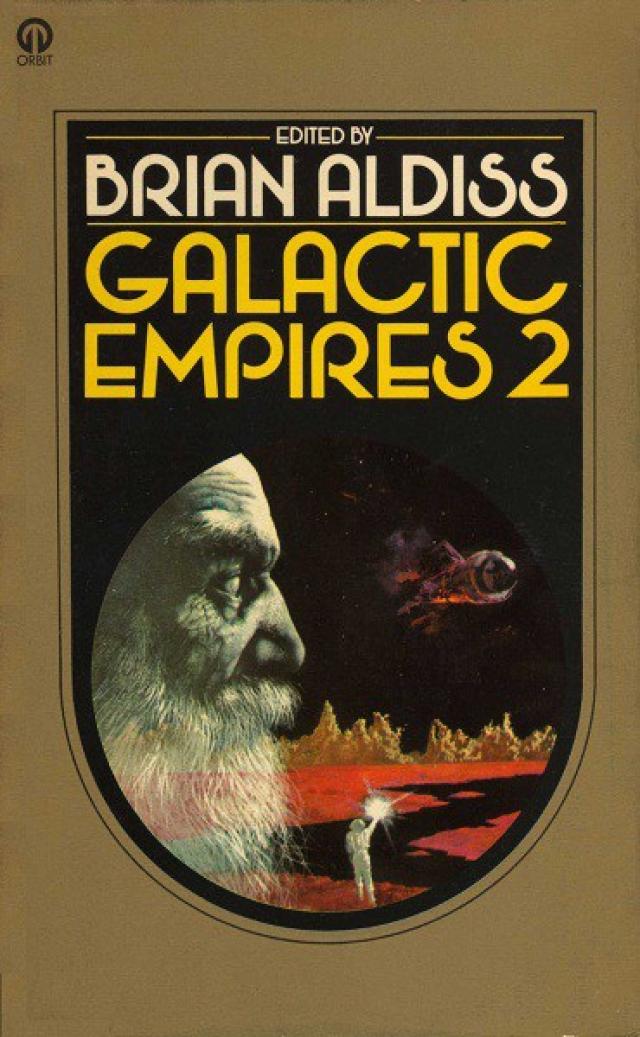
GALACTIC
EMPIRES 2
VOLUME II
Edited by
BRIAN W. ALDISS
Futura Publications
An Orbit Book
First published in Great Britain in 1976
By Futura Publications Limited
Introduction and original material
Copyright © 1976 by Brian W. Aldiss
ISBN 0 8600 7909 0
Printed in Great Britain by
Hazell Watson & Viney Ltd
Aylesbury, Bucks
ACKNOWLEDGEMENTS
ESCAPE TO CHAOS by John D. Macdonald
Copyright © 1951 by Fictioneers, Inc.
CONCEALMENT by A. E. van Vogt
Copyright © 1943 by Street & Smith Publications
copyright renewed, 1970 by A. E. van Vogt
TO CIVILIZE by Algis Budrys
Copyright © Columbia Publications Inc.
reprinted by permission of the author and the author’s agent
Candida Conadio and Associates Inc.
BEEP by James Blish
Copyright © 1954 by James Blish
DOWN THE RIVER by Mack Reynolds
Copyright © Startling Stories 1950, Better Publications Inc.
THE BOUNTY HUNTER by Avram Davidson
Copyright © 1958 by King-Size Publications Inc.
Reprinted by permission of the author and E. J. Carnell Library
Agency
NOT YET THE END by Frederic Brown
Copyright © 1941 by Captain Future
TONIGHT THE STARS REVOLT by Gardner F. Fox
Copyright © 1952 by Gardner F. Fox
FINAL ENCOUNTER by Harry Harrison
Copyright © 1964 by Galaxy Publishing Corporation
reprinted by permission of the author and his agent
A. P. Watt & Son
LORD OF A THOUSAND SUNS by Poul Anderson
Copyright © 1951 by Love Romances Publishing Co. Inc.
BIG ANCESTOR by F. L. Wallace
Copyright © 1955 by F. L. Wallace
THE INTERLOPERS by Roger Dee
Copyright © 1954 by Roger Dee Aycock
INTRODUCTION
There is no point in pretending to distinguish the galactic empire story as a genre. Generally speaking, such stories form part of what is known as ‘space opera’—to which the first two anthologies in this series were devoted. The galactic empire is a sort of crystallisation of space opera; there are others, of which Sword-and-Sorcery is one.
Some stories use the imperial background to make a moral point; didacticism is perenially popular in science fiction and Mack Reynolds provides a good example in this volume. But it is the playful aspect of the galactic empire which mainly strikes a reader.
This aspect led many readers, including a lot of sf fans, to despise space opera and the galactic scene. Now, there are good literary reasons why a wide canvas, such as these stories demand, will defeat all but the Michelangelos of sf—and we have too few of them—thus more thoughtful writers (and perhaps the ones we might call the better artists) eschewed the galactic manner. But to dismiss it just because it is playful is not good enough.
The two editors who have wielded most power since sf magazines came into being are undoubtedly Hugo Gernsback, founder of Amazing Stories and thus of magazine sf, and John W Campbell, who edited Astounding Science Fiction (later Analog) for more than thirty years. Both these influential men took a certain attitude to mankind and mankind’s activities. Their philosophy was utilitarian. Campbell’s was the more formidable intellect, but he believed, no less than Gernsback, that greater human units made for a greater humanity, rather than for less humanity.
Both editors tolerated, nay, fostered space opera in their pages, but it was space opera strongly oriented towards the machine. Campbell saw man as a tool-making animal; he loved to talk about the thumb as the opposed digit which distinguished man from the other primates and gave him a better grasp of weapons, thus setting him on the path to the stars. And his influence was strong on the writers who wrote for him, writers such as Arthur C Clarke. That great imaginative moment in the Kubrick-Clarke film, 2001: A Space Odyssey, when a bone used by the early man as a killing weapon is hurled triumphantly into the air, to be transformed into a space station, is a Campbell image, the image of homo faber.
This Campbellian view of man naturally predisposed him to advocate larger and larger doses of technology. Or perhaps it was the other way round, and his belief in the dosages made him see man as primarily a worker. Whichever way it was, Astounding rarely admitted stories which showed mankind growing away from technology. Technology, after all, may merely be a manifestation of racial puberty, rather like motor bikes—to be abandoned for all the rest of our species, lifespan. Other races may ascend to a high and creative level of civilization without carrying technics much further than the potter’s wheel. But such speculation would have been heresy in Astounding. The unorthodox are particularly hot on their own orthodoxies.
Campbell was brilliantly clever. Yet he preferred—and the preference brought his eventual decline as an editor—to ignore the fact that the contents of his beautiful magazine were play, mind games, and, in Campbell’s heyday, the best mind games in the business. His writers, too, following his example, liked to justify sf in terms of how accurately its predictions were fulfilled, or how well it served as propaganda for the space race, or how strongly it influenced American kids to become physicists when they grew up. This was sf as function, sf as just another tool.
The writers who wrote for other magazines often felt otherwise. They believed that sf should be a game, if a serious one, that its merits were integral, not applied. They understood homo ludens; and so their products were denigratingjy referred to as escapism by the faber brigade.
Some philosophers have argued that homo ludens has played a supreme role in history, a role that the upstart homo faber has tended to editor out. The most distinguished contribution to this theory is J Huizinga’s Homo Ludens, which has recently received massive support from Lewis Mumford in The Myth of the Machine. In general sf has been approached and evaluated from the utilitarian standpoint, and conscripted willy-nilly under the faber banner. The result has been undue encouragement of an sf grounded in a little grey philosophy of man churning away into futurity as a unit of an amorphous technocracy. At least, such has been more or less the official view—in New York as in Moscow—and one which probably played a part in hastening the notorious sf revolt, the New Wave, of the mid-sixties, with its emphasis on doing one’s own thing, however obnoxiously. But it is noticeable that when a madman enters the sf field, just plainly enjoying himself, he generates an immediate and enthusiastic following. The early A E van Vogt, Alfred Bester, Michael Moorcock, and R A Lafferty, are examples of this, while public speaking up and down the country has convinced me that probably the most popular of all short story writers is not Ray Bradbury, as commonly supposed, but Robert Sheckley, an imaginative joker whose ramshackle worlds and leaky spaceships have immediate appeal.
A galactic empire, in short, is not intended as a blueprint for a future Utopia. That might not be much fun, though no doubt a few trendy sociologists would recommend it to their class. A galactic empire is ramshackle and anachronistic, full of miscegenous worlds, leaky spaceships, and naked slaves working by torchlight in uranium mines. A galactic empire owes more to Cecil B de Mille than to Einstein: it is the Spectacular of sf.
This unashamed escapism is not incompatible with profundity of thought. Here we may recall the question J R R Tolkein asked C S Lewis, ‘What class of men would you expect to be most preoccupied with, and most hostile to, the idea of escape?’ He answered his own question: ‘Jailers.’
I quoted Tolkein’s remark in the introduction to the first volume of this anthology. This introduction has been an attempt to restate what I said there in different terms.
There’s more than one way of killing a cat, or of sneaking up on a galactic empire.
SECTION 2 (continued): MATURITY OR BUST
I ‘You Can’t Impose Civilization by Force’
John D MacDonald: ESCAPE TO CHAOS
A E van Vogt: CONCEALMENT
Algis Budrys: TO CIVILIZE
James Blish: BEEP
* * *
The issue of this appalling struggle in the minds of these former imperialists depended on the extent to which specilization for empire had affected them. In a few young worlds, in which specialization had not gone deep, a period of chaos was followed by a period of reorientation and world-planning, and in due season by sane Utopia. But in most of these worlds no escape was possible. Either chaos persisted till racial decline set in, and the world sank to the human, the sub-human, the merely animal states; or else, in a few cases only, the discrepancy between the ideal and the actual was so distressing that the whole race committed suicide.
Olaf Stapledon: Star Maker
* * *
One thing is certain. Men unify only to achieve strength, whether the strength of religion, knowledge, or power. And unification leads to various ills; once you have joined, you are apt to stay joined, whether or not you want out Unification also leads to complexity, and in this section mature empires reflect that complexity. Our four distinguished authors, van Vogt, John D MacDonald, Algis Budrys, and James Blish, were writing for the amusement of their readers in generally despised popular magazines, yet they touch on a weird sort of truth. A friendly reviewer of the first book in this series said, ‘Space Opera is
all good, unpretentious, and proud fun, yet one can’t help but suspect that these tales touch some of the mythopoeic archetypal well-springs deep in every id.’ Large words, but I agree—though it may all depend on the circuit diagrams in one’s id. These stories seem to me to have the quality described.
Talking of the circuit diagrams of the id, no science fiction writer could boast more elaborate circuits than the late James Blish. All learning was his province. He was a great man for making connections. His splendid Cities in Flight saga explores one of the seminal connections of the modern age, the sibling relationship between space and time; while his formidable life of Roger Bacon, Doctor Mirabilis, examines the multitudinous relationships between science and religion—a theme developed in fictional counterpoint in Blish’s most famous novel, A Case of Conscience, and later in Black Easter and The Day After Judgement. These threads can also be traced through ‘Beep’, the slice of galactic history we present here.
One of Blish’s preoccupations was with the problem of sin, which he appeared to deal with sometimes as if it were merely an intellectual question. With hindsight, we can observe that sin in ‘Beep’ is conspicuous by its absence, to deploy that phrase precisely. The story can be interpreted as being about a machine which abolishes sin, root and branch—sin in fact, sin as concept
‘Beep’ is a think-piece, and it forms a central think-piece to this volume. It is a story I greatly admire. When I first read it in Galaxy I was less impressed by its intellectual qualities than by a haunting image, which embodies much of the glamour of sf, the image contained in these lines:
‘I’ve heard the commander of a worldline cruiser, travelling from 8873 to 8704 along the world-line of the planet Hathshepa, which circles a star on the rim of NGC 4725, calling for help across eleven, million light years—but what kind of help he was calling for, or will be calling for, is beyond my comprehension.’
This passage was picked up by Emsh, who illustrated it on its first appearance. He contributed a design showing a whirlpool of space-time, with the cruiser trapped along its spiral.
One of the ingenuities of ‘Beep’ lies within its title, and in the correspondence of that title to the effect of the story, which unpacks a world of implications from a meaningless seed of noise. ‘Beep’ tackles headlong one of the central problems of galactic empires: the problem of how to deal with, and if possible overcome, immensely long lines of communication. The Dirac transmitter proves a remarkably effective answer; and Blish shows us what paradoxically good side-effects it generates, including having one of the main characters almost forcibly married to a transvestite lady of mixed ancestry—which marriage he enjoys.
When writing the story, Blish perhaps felt that with free will removed from human affairs there would be no more sin. His assumptions about predestination are interesting and uncomfortable (a lot of Jim’s lines of thought were interesting and uncomfortable). He depicts human consciousness as ‘just along for the ride’; elsewhere, it is described as ‘helpless’. Events rule. I once wrote a story (‘Not for an Age’) in which I depicted a human consciousness as carried along helpless to interfere with events. It was, and remains, my idea of hell. Yet Blish manages to make it sound almost Utopian. The world he portrays in ‘Beep’ is an extremely happy one, happier than any other world-view in the anthology; as one of the characters says, ‘The news is always good’.
To make the connection between instant communication and redemption (freedom from sin) is a remarkable jump. Blish embodies it symbolically by the tender care taken to see that lovers meet as planned. All this is even more remarkable when we consider that most sf writers use the posit of instant communication to further aims of conquest and aggression. In ‘Beep’, it brings peace. Was Blish trying to equate instant with perfect communication. How else explain why his all-powerful Service is incorruptible?
Science fiction stories often leave strange vapour trails in the skies of our minds. I find myself wondering at the way in which Blish has planted two people in disguise, one in the inner, one in the outer, story; though they assume the disguises for devious purposes, neither meets disapproval or anything stronger when discovered. Perhaps that is how it should be in a Utopia. If you remove reasons for aggression, would aggression disappear? But one cannot ask such questions in this construct of Blish’s, since cause and effect are proven inoperative by the Dirac transmitter.
If you grant that ‘Beep’ is Utopian in disposition, then you have to grant that it is a very rare sort of story indeed. Although Utopias and dystopias are traditionally associated with science fiction, no galactic empire to my knowledge could be remotely regarded as Utopian. ‘Beep’ is the one exception. In his wisdom, James Blish did a lot of strange things.
Algis Budrys’ early short stories showed wisdom. Then he stopped writing. He has recently reappeared on the science fiction scene disguised as a reviewer; perhaps that experience will tempt him back to fiction, to show us all how it should be done. Meanwhile, I advise readers to seek out his novel, Who? (recently filmed) and, especially, Rogue Moon. One line in ‘To Civilize’ remains in my memory: ‘You can’t impose civilization by force.’ It is something that people, and not only sf writers, tend to forget.’
These stories are garnered from obscure magazines, some of which were never published in Britain: Super Science Stories did appear over here in an emaciated edition. Above cover scenes showing such delights as New York in flames ran their proud legend, ‘Read It Today—Live It Tomorrow.’
It is unlikely that the world of Escape to Chaos will ever see actuality, but that is hardly to the point. John D MacDonald—famous for his polished thrillers—posits an amazingly complex civilization, hemmed cheek-by-jowl by other galaxies of similar probability. Among them moves the splendid City of Transition. Van Vogt himself might envy such a grand design.
Not that the Old Master has anything to fear. His Imperial Battleship Star Cluster moves through a galaxy inhabited by many races with many different abilities. Will the future see such things? The question remains open. But it should be remembered that space travel itself was once a similar mad dream; science fiction readers were among the scattered few who believed in its possibility. Van Vogt, at this stage of his career, always carried belief, even when his subject matter seemed frankly incredible. Over thirty years later, the magic remains, even if we are less easy to impress.
In this story and ones linked with it, van Vogt captured a sensuous interpretation of space which connects not only with the future but with man’s early experience of the cosmos. Van Vogt’s great storms in space, his light-year wide streams of particles—so ‘modern’ when they first appeared—draw us back to ages when our everyday lives were less sundered from the elements and the night skies more omni-present. Technology has weaned us from Mother Nature; electricity and the water closet blacked the mind’s eye. Now we have space travel, and we no longer believe in it, except as a quasi-military exercise.
But once it was believed in, before we built water-tight bulwarks against sky and moor and forest and sea. Long before science fiction was thought of, great voyages were cosmic in scope, and responsive minds leapt up to embrace the wanderer and his tale. Homer, first voice of the Western psyche, takes us to the margins of the known, where gods and goddesses form part of the traffic of Man, extending the dimensions of his experience. The ancient Epic of Gilgamesh celebrates the belief that if you navigate your ship to the edge of the oceans you may be able to join the great stream of stars and sail upwards into the heavens, where the secret of Creation is. The familiar names of the constellations tell us of an ancient and intimate relationship between man on Earth and the far stars.
One of the impulses behind modern science fiction—particularly the adventure-impulse behind such stories as Poul Anderson’s and Gardner Fox’s—is extremely ancient. And, we hope, inextinguishable.
At bay against his dissolving skies he fought—the last champion of a star-spanning dynasty which never existed save to die!