Aunt effies ark, p.1
Aunt Effie's Ark, page 1


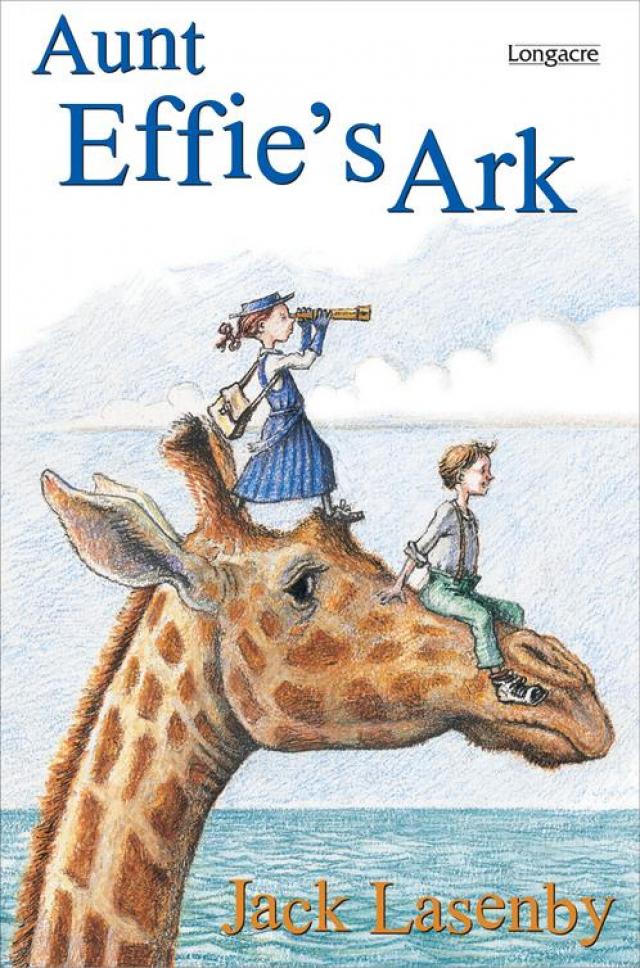
Here is the second book in the hilarious and outrageous ‘Aunt Effie’ series. In this story, Aunt Effie, dressed in her green canvas invalid’s pyjamas, hibernates all winter, leaving her 26 resourceful nieces and nephews to deal with snowstorm and flood, ravening monsters, a barnful of hungry animals and a wild ark-ride over the Vast Untrodden Ureweras. Among the comic cast of cousins are Daisy, whose primness puckers the mouth, Alwyn, who echoes and ‘backwardises’ the most emphatic statements, and Jack, a junior version of Jack-the-deer-culler Lasenby. There’s a horse who acts as a dubiously qualified doctor, a gander who causes the ark to roll, and cows with insomnia - snoring in tune. With his trademark embellishments and wonderful blend of humour, excitement and wacky fun, Jack Lasenby has written another story of mayhem and delight.
Contents
Title page
Dedication
Introduction
I Small and Alone at Night
II The Day School Opened
III “Open the Door, Euphemia!”
IV The Battle with the Tattooed Wolf
V Why Skeletons Don’t Go to the Dunny
VI Finding a Doctor for Daisy
VII “I’ve Got a Big Bag of Chews for You!”
VIII What Happened to the Stuffed Heads
IX Mr Bulawayo’s Stuffed Head
X Keeping Our Fingers Crossed
XI Rigging Aunt Effie’s Ark
XII The Vast Untroddens
XIII Netting Harry Wakatipu
XIV The Return of the Tattooed Wolf
XV Pua Wananga
Daisy’s Glossary
The Lying Old Author
Also by Jack Lasenby
Copyright
To the memory of all the kids and teachers of the Waharoa Primary School who disappeared while swimming in the Great Waharoa Swamp.
Also, to the memory of the enormous eels.
Aunt Effie’s Ark is a work of fiction. The characters, places, and incidents in this book are all figments of my imagination. None is intended to bear any resemblance to any person, place, or incident, living or dead. Only the names of the Ark, Mr Bulawayo, and the Stuffed Heads are real.
Introduction
Aunt Effie could never remember which of us was which, so she called us all by all our names. “Daisy-Mabel-Johnny-Flossie-Lynda-Stan-Howard-Marge-Stuart-Peter-Marie-Colleen-Alwyn-Bryce-Jack! Ann-Jazz-Beck-Jane-Isaac-David-Victor-Casey-Lizzie-Jared-Jess!” she’d shout, and we’d all come running. When she said she might paint our names on us to make it easier, we cried. We liked being called by all our names.
We knew Aunt Effie didn’t like her real name. She told us about some of her old husbands including Captain Flash with the pointed head, Rangi the Maori chief, and Samuel the drunken missionary. They all made the mistake of calling Aunt Effie by her real name. We called it “The Name We Dare Not Say” and knew we must never say it out loud.
Aunt Effie showed us how to fell a kauri tree, how to build a dam and drive the logs, and how to build a scow, the Margery Daw. We sailed a load of kauri logs across the Hauraki Gulf, had a battle with a tattooed pirate, got stuck in the Doldrums, and crossed the Equator. We saw Rangitoto born from under the sea, unloaded our logs, put the Margery Daw into a mud berth, and ate a barrow-load of fish and chips. When we could stand up, we went home to get the farm ready for winter.
As the weather got colder, we put the stock and poultry into the barn behind the house, and moved the haystacks, crops, and firewood inside as well. One Friday night, Aunt Effie warned us to keep an eye out for gluttonous wolves, grizzled bears, and man-eating rhinoceroses coming down from the Vast Untrodden Ureweras. She went upstairs, put on her green canvas invalid’s pyjamas, and hibernated. Her six enormous dogs – Caligula, Nero, Brutus, Kaiser, Genghis, and Boris – went to sleep, too. We all burst into tears, because we thought we’d lost Aunt Effie for ever.
Then we heard our names being called. “Daisy-Mabel-Johnny-Flossie-Lynda-Stan-Howard-Marge-Stuart-Peter-Marie-Colleen-Alwyn-Bryce-Jack-Ann-Jazz-Beck-Jane-Isaac-David-Victor-Casey-Lizzie-Jared-Jess!” It was the Prime Minister shouting at us over the wireless in her mannish voice.
She told us to keep ourselves warm, to look after the stock in the barn, to go to school and learn to read, and to do our homework. She told us to watch out for gluttonous wolves, grizzled bears, and man-eating rhinoceroses coming down from the Vast Untrodden Ureweras. “Above all,” she said, “make sure you put a good breakfast by Aunt Euphemia’s bed before she wakes in the springtime.” We looked at each other. The Prime Minister had called Aunt Effie The Name We Dared Not Say. “Behave yourselves!” she commanded. The wireless shook, there was a long silence, and we heard somebody snoring.
Alwyn – who could never resist teasing grown-ups and animals – grunted and snored back at the wireless.
“What if she hears you!” said Daisy, our oldest cousin, who was both proper and self-righteous. But the rest of us giggled. The Prime Minister was hibernating, too.
Chapter One
Small and Alone at Night
The same Friday night Aunt Effie hibernated, our foolish sheep got itself eaten. It would keep getting out of the barn, and we’d warned it often enough. Even so, we were still upset when we heard it baaing, and the chewing and swallowing noises of the wild beast.
We were even more upset when the wild beast finished eating the foolish sheep and looked at us through the keyhole. In fact, we were so upset we couldn’t eat a thing ourselves – even though Peter and Marie had made a tasty mutton stew – and we went to bed hungry.
Our bunks were like cupboards built into the walls either side of the fireplace in one end of Aunt Effie’s kitchen. We pulled across the little sliding doors but could still hear the wild beast growling and cracking the foolish sheep’s bones. Every now and then it swallowed noisily, smacked its lips, looked through the keyhole, and howled, “Ooowhooooo!” For once, Alwyn didn’t howl back.
In the middle of the night, Daisy, our self-righteous cousin, woke up and had hysterics when she dreamt the wild beast wouldn’t let us out of the house. She was looking forward to the opening day of school and getting lots of homework.
We woke hungry next morning and thought Aunt Effie must have come out of hibernation because we heard our names called. “Mabel-John-Florence-Lynda-Stanley-Howard-Marjorie-Stuart-Peter-Marie-Colleen-Alwyn-Bryce-Jack-Ann-Jeremy-Rebecca-Jane-Isaac-David-Victor-Casey-Elizabeth-Jared-Jessica!” But it was Daisy wearing her school uniform. Navy-blue gym frock, tie, panama hat with the enamel school badge, gloves, thick black stockings, and polished black shoes with the bowknots on the laces doubled so they wouldn’t come undone. Daisy was the only one who wore shoes to school.
“Mabel-John-Florence-Lynda-Stan-Howard-Marge-Stuart! Peter-Marie-Colleen-Alwyn-Bryce-Jack! Ann-Jeremy-Rebecca-Jane-Isaac-David-Victor! Casey-Elizabeth-Jared-Jessica! I won’t call you again!”
“I’m Johnny, not John,” said Johnny.
“John sounds more refined,” said Daisy.
“I’m Flossie, not Florence.”
“Florence is nicer,” said Daisy.
“I’m Stan, not Stanley.”
“Stan sounds so common!”
“I’m Marge, not Marjorie.”
“Girls’ names should never be shortened.”
“I’m Jazz, not Jeremy.”
“I’m Beck, not Rebecca.”
“I’m Lizzie, not Elizabeth.”
“I’m Jessie, not Jessica.”
“And you’re not Aunt Effie!” we all told Daisy, but we jumped out of bed and threw some apple tree prunings against the huge maire backlog in the fireplace. They flamed and filled the room with the sweet scent of apples as we got dressed in front of the fire.
“Today’s only Saturday,” Peter reminded Daisy. “School doesn’t open till Monday. We’ve got a lot to do, and you don’t want to get your school uniform dirty.”
Since we’d been too upset to eat any tea the night before, we squatted around the camp oven and ate the mutton stew cold. And to keep us going till breakfast, Marie and Peter made some corned beef and pickled onion sandwiches that we gobbled as we went to muck out the barn. Halfway there, we stood in a circle and looked at the torn-up dirt, the bloodstained bits of wool, and four sad little feet – all that was left of the foolish sheep.
“It’s enough to put you off your sandwiches,” said Jazz. He swallowed the last of his and offered to help finish Jessie’s.
In the barn, the bulls threatened to hook us with their horns, but were just pretending. They stood on their hind legs while we swept and shovelled out the muck-caked straw and threw down clean stuff, and we knew they were really grateful. The clever horses stood on one front foot, talking knowledgeably about the weather while we cleaned their loose boxes. The sheep were silent as we swept out their skillions.
“Poo!” we said and hosed out the turkeys’ enclosure. “Stinkers!” we told the geese as we shovelled out their pen. We milked the cows and turned the handle until the Alfa-Laval separator hummed and then whined. Skim dick ran out of the big spout into the pigs’ trough. We tried to beat the pigs to it, but they were too fast for us, guzzling and shoving us out of the way.
Cream ran out the little spout on top and into the dairy to be made into butter. We collected the eggs and took a billy of milk and a bucket of cream over to the house for our proper breakfast. Casey, Lizzie, Jared, and Jessie carried the little bantam eggs they liked.
We had porridge, poached and scrambled and boiled eggs, fried bacon and eggs, steak, bla ck pudding, kidneys, lambs’ fry, toast and marmalade, plum, strawberry, and raspberry jam, and thick black flax and tea-tree honey from our own hives. We had stewed tree-tomatoes, stewed apples, stewed pears, and stewed Chinese gooseberries. It took us hours to wash and dry the dishes, scrub the camp ovens clean, and leave the porridge pot to soak. And we’d no sooner finished cleaning up than it was time for morning tea.
We cooked scones and buggers afloat in the camp ovens, and pikelets on the lids set upside-down on the embers. They were corker with cocky’s joy. We had tea and coffee for the bigger ones, and cocoa with warm milk for the little ones.
“Come on,” said Peter. “We’ve got work to do,” and he looked outside through the keyhole to make sure the wild beast wasn’t waiting to eat us.
We screwed steel shutters over the doors and the downstairs windows of the house and barn. We caulked the weatherboards with oakum, painted them with tar, and tacked tarred felt over the top. By lunchtime, the house and barn looked like a gigantic bear, sticky, black, and hairy.
“It’s like building the Margery Daw,” said Casey.
Peter nodded. “Aunt Effie said to be sure and do it before winter comes. I suppose it’s to keep out the snow.”
“And the wolves and bears and rhinoceroses that come down from the Vast Untrodden Ureweras,” said Lizzie and jumped when Alwyn went, “Ooowhooooo!”
We had a light lunch of mushroom and pumpkin soup, pork snarlers that had been cooking slowly in the camp oven all morning, cheese and date scones, and cold beef and mutton and Vegemite and cheese and lettuce and tomato sandwiches, and apples and pears and oranges, and glasses of golden cider.
In the afternoon we mixed barrels of schenam – whale oil and shell lime – and spread it like thick cream over the tarred felting.
“Remember Aunt Effie said it should keep out the worm?” said Peter. “When we were building the Margery Daw.”
We thought of building our beautiful scow and cried at summer memories of sailing her across the Hauraki Gulf. It was as if we all looked through the big end of the telescope and saw – tiny and far away – a white ship on blue waves under a yellow sun.
“Get on with it!” said Peter’s voice. We blinked and were back by the barn, hands dripping whale oil, staring at the black and lumpy sky bulging its muscles just above the snow on Mount Te Aroha and the Kaimais.
Afternoon smoke-oh was the same as morning tea, but we also had Louise cake, almond biscuits, gingernuts, afghans, sardine and pickled onion sandwiches, and rainbow cake with hundreds and thousands for the little ones.
That evening a red-faced, pompous turkey gobbler complained the inside of the barn stunk of tar and whale oil. But his red comb and wattles turned white when Daisy told him, “Just be grateful we don’t put you outside for the wild beast!”
We milked the cows, fed and watered the animals, bedded them down for the night, had a good heavy dinner because we’d worked hard all day, and climbed into our bunks.
On Sunday, the day before winter began and school opened, we sawed and passed up the totara planks while Peter and Marie climbed ladders and nailed and sheathed the whole outside of the house and barn.
“It’s just like building another ship,” said Lizzie, and Peter and Marie nailed even faster while the rest of us looked at the bullying sky. From up on the ladder, Peter said he could see snow coming across the farms. “The tops of the kikes in Mr Hawe’s bush are all white, and it’s covering the cabbage trees, too.”
We gave the steel doors a couple of extra coats of tar. “Now it’s falling on Mr Murdoch’s back paddock,” called Peter.
The sky swelled blue-black like the head on a boil and even angrier. We caulked the totara planks, and had just finished tarring them black when white flakes spun and stuck to our faces like plum petals blowing in spring. Casey, Lizzie, Jared, and Jessie caught and ate them. The snowflakes dotted white the black hulk of the house.
Ann laughed. “It looks like a ship!”
“Aunt Effie told me, just before she hibernated, the bottom of the house and barn is caulked and tarred and felted and schenammed and sheathed in totara, too,” said Peter.
“Why?” we asked.
“‘Just in case.’ That’s all she’d say. It’s getting dark – time to milk and feed the stock and get them bedded down.”
Inside the barn, the geese had got into the turkeys’ pen and pooped all over their floor again. Daisy told them off in her carrying voice. “You know very well you do your number twos in your own pen!” We grinned at each other. Daisy was the only one who insisted on calling it “number two”, but she was also the only one the geese would listen to. Even the big gander dropped his wings and stopped hissing when Daisy caught him doing a poop and shouted, “I’ll wring your neck!”
We counted and fed the sheep. We made sure the cows and horses and donkeys and bulls and pigs all had plenty of hay and oats and chaff and water and chopped-up turnips and swedes for their tea. We tucked the chooks’ heads under their wings so they could sleep. “Goodnight!” we whispered, and blew out the lanterns.
“Please, would you mind leaving one lantern burning?” said a small pig. “I wake up sometimes, and it’s such a comfort to see a light when you’ve very small and alone at night.”
“You’ll just have to learn to sleep without a light like everybody else!” Daisy snapped, but Peter nodded.
“I used to be scared of the dark when I was little. I’ll leave this lantern burning, but I’ll turn it down so it doesn’t keep the others awake.”
“Thank you!” the small pig grunted gratefully. He closed his sandy eyelashes, rested his head on his front trotters, and slept. We tiptoed out, swung the steel-sheathed door to, barred it, and caulked it with oakum and tar. Swinging storm lanterns, shouting at the top of our voices, we ran through the dark as snow settled cold along the tops of our ears.
We’d just got inside, swung our own steel-sheathed door to, turned the great key, pushed the bars across from side to side, lit the candles, got the fire going, and washed the stink of whale oil, tar, and goose poop off our hands, when we heard a hungry cry. “Ooowhooooo!”
Marie shook her fist at Alwyn before he could howl back. Alwyn could never resist giving cheek to grown-ups and animals.
We shovelled the ashes off the camp ovens that had stood buried in embers all afternoon. While we set the table, Peter and Marie lifted off the camp oven lids with the billy hooks, and took out the roasted haunches of venison, barons of beef, and saddles of mutton. We stood, warming our plates in front of the fire and dribbling at the smell of roast meat, as Peter and Marie rang the carving knives up and down their sharpening steels and cut thick, juicy, hot slices.
Peter always saved the sweetest bones and crispy bits for the little ones. He heaped their plates and said, “If you’re going to work hard, you’ve got to eat hard!”
He and Marie dished out roast potatoes, kumaras, onions, carrots, and pumpkin done to a turn in the camp oven. And when we were glutted, gasping, and staggering, Marie served us plum duff covered in clotted cream off scalded milk. It was some time before we could stand.
Daisy washed the dishes while we dried.
“Tomorrow’s Monday,” said Peter, “the first day of winter. I think everything’s ready.”
“And school opens at nine o’clock.” Daisy had ironed and laid out her gym frock. Now she sprinkled her starched blouse and ironed it. “Remember we’ve got to get there before Mr Jones stops ringing the bell,” she said. We weren’t supposed to wear lace on our uniforms, but Daisy had sewn a piece around the collar of her blouse, and she was crimping and fluting it with the goffering iron.
We set the porridge to soak overnight, climbed into our bunks, and slid the doors across. Just before we went to sleep, we heard knocking. We sat up, slid back our doors, and saw Jessie in her nighty and bare feet tapping at Peter’s door. He stuck out his head.
“What do you want?” He sounded gruff, like the Bugaboo who lived under Aunt Effie’s enormous bed and tried to grab us by the ankle.
“Please, would you mind leaving one lamp burning?” said Jessie. “I wake up sometimes, and it’s such a comfort to see a light when you’ve very small and alone at night.”