

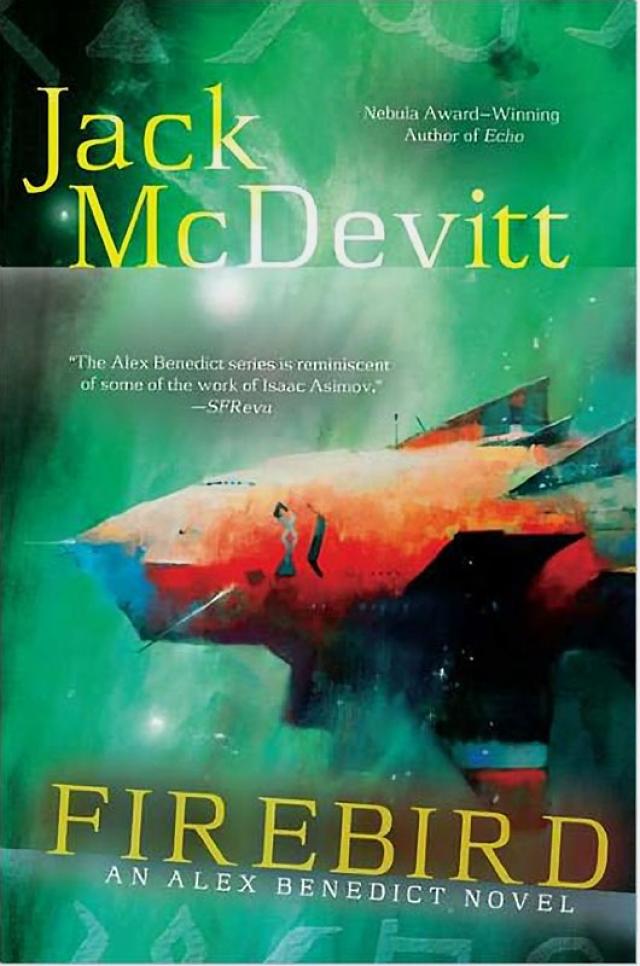
Firebird ab 6, p.21
Firebird ab-6, page 21
part #6 of Alex Benedict Series


Harley Evans was a counselor at the Westbrook Universal Church. He'd invited me in several times as a speaker at luncheons for the Rangers, the church's youth group. And on one occasion I'd passed out awards for him at a student-achievement event. Harley had been leading the charge for years in his church to recognize AIs as sentient beings and to admit them to the congregation. Alex knew him, and reacted to our conversation with Bittinger by inviting him over for dinner at the country house. We rarely made our own food, and that night was no exception. After we determined that Harley liked pizza, we arranged to have some delivered by Poppa Louie's.
While we waited for it to arrive, we shared some white wine, and Harley got a tour of the artifacts in the reception room. Like the bronze lamp that had once belonged to Omar Gorman. “Was this really his?” he asked.
“It provided his light,” I said, “while he was writing Lost Cause.”
And over here was a coffee cup, made in South America in the twenty-fifth century, that had been aboard the Valiant in its historic voyage.
And this was the bound copy of Their Finest Hour, which had given us back the second volume of Winston Churchill's classic history of World War II.
“Pity,” Harley said, “that the rest of it's lost.”
Alex touched the crystal case that held the book. “This volume's nine hundred years old. So we had it in relatively recent times. Maybe, one day, we'll find the rest. Meanwhile, at least we have the flavor of it.”
Harley was in his middle years. He was a small man, not quite my size, with blond hair and deep-set dark eyes that seemed always to be looking for something.
The pizza showed up in due time, and we sat down in the dining area in back. Alex uncorked a fresh bottle and Harley offered a toast. “To those who keep history alive.”
We divided the pizza and talked about the weather and how things were going at the parish, and the latest episode of Starburst, an HV adventure series that had drawn the interest of members of the congregation. Aliens, the Torabi, were gradually undermining the Confederacy while the good guys tried to convince politicians and whoever else might listen that they were really there.
When we'd finished, Alex brought out a chocolate cake. And it was while we were dividing the cake that Harley paused and thanked us for having him in. “Guys,” he said, “I know there's a reason I'm here, but before we get to it, I want you to know that we'd be delighted to have you stop by the church sometime, so we can return the favor.”
“Sounds good,” said Alex. “Count on us.”
“And now may I ask if there's something I can do for you?”
Alex nodded. “In fact, Harley,” he said, “we do need your help.”
“Ah. You want to join the fold. Excellent.” He smiled, letting us know he was kidding. “In fact, though, you'd both enjoy the social activities.”
“I have no doubt we would, Harley.” Alex took a bite of the cake, commented on how delicious it was, and sat back. “Chase has told me about your efforts to get the church to recognize AIs as sentient creatures.”
“Ah, yes. That's not exactly how we phrased the issue, but it's true. Yes.”
“How did you phrase it?”
“We've tried to make the point that they may have souls. And that even if we can't be certain, we should assume that they do. An error in this matter should be made on the side of caution.”
“You're concerned,” he asked, “that they may be punished in an afterlife because they weren't admitted to churches?”
“No. I'm concerned that we may be judged negligent for the way in which we've treated them.”
I lifted my glass to him. “I suspect we're not far apart, Harley.”
Alex took another bite. “How has the campaign been going?”
“Not well.” Harley's native optimism was fueled by a conviction that there truly was an ongoing divine plan. But something drained out of him at that moment. “'Black boxes have no future,'“ he said. “That's what they all say. The bishops. The prime donors. Pretty much anybody with influence. Black boxes have no need for salvation because they are no more God's children than the furniture. It's a rather large leap to try to convince people otherwise. This despite the fact that they will take offense at anyone who insults the house AI. And I must confess that I'm not sure they're wrong. But I think the correct course of action is, as I said, the cautious one. Assume a kind of basic”-he struggled for the right term-”humanity?”
“I think that works, Harley,” I said.
“But people aren't going to change, Chase. The sense is that a machine, no matter how human it seems, cannot qualify for Heaven. Alex, we have several dozen Mutes who are now members of our congregation. Not here, of course. On Toxicon. Where maybe people are a little more open-minded.” He paused. “We accept them, but not an AI.” He heaved a sigh. “Why is this an issue for you?”
Alex said, “We're just back from Villanueva.”
“Oh.” His expression changed to one of disapproval and, almost, horror. “I'm glad to see you got through it okay. From what I hear, it's pretty dangerous out there. Chase, you went, too?”
“Yes, Harley.”
“And something happened.”
Alex nodded. “I want you to hear something.” He raised his voice slightly: “Charlie-?”
Charlie apparently needed a moment to gather himself. Then the twenty-year-old boy appeared: “Good afternoon, Reverend.”
Harley smiled. “I take it you are not the house AI?”
“No, sir. I'm not.”
He told his story. How it had felt knowing that everyone was fleeing the world. How he'd watched first the school, then the town, emptying. The long silence that had followed, broken only by occasional thunder and rain, by the wind in the trees, and the rumble of trucks when the repair bots came to restore the building. Or restore him.
And there had been Harbach, a Beta who'd taken over most of the systems that Charlie had access to. “Harbach is a maniac. I watched him break down gradually, over the centuries. And finally he lost all touch with reality. He had no compunction about killing his own, if provoked. Had Chase and Alex left me, I'd be dead now.”
When Charlie was finished, Harley looked exhausted. “Alex, have you spoken to anyone yet?”
“One of the senate's science people.”
“Bittinger?”
“Yes.”
“What did he say?”
“Told us not to worry about it. Don't get excited about boxes. It's exactly what Charlie predicted would happen.”
“What would you like to see him do? I mean, it would be hard to sell a rescue mission. The public wouldn't support it. Chances are a few people would get killed. That would be political suicide.”
“I know,” Alex said. “I don't have a solution.”
“What would you like to see him do?”
“I'm not sure. But I promised Charlie I'd help.”
“That will not be an easy promise to keep.”
“We talked about it on the way home,” said Alex. “It shouldn't be that difficult to arrange something. The AIs are probably connected. We already have Charlie. He can help us pull out a couple more. Then we can get them to help us locate others. We'd have to send in some teams, some well-trained people. Maybe shut down the power temporarily. Wait for them to exhaust their reserves. Then we could go in with minimal risk.”
“By 'we,' you mean-?”
“StarCorps.”
“It won't happen.” Harley patted his mouth with his napkin. Tried the wine again. “I'm not sure what to say.”
“Harley, the question we have for you-”
“Yes?”
“-I think you've answered. What would be the chances of putting together a political movement? People who'd demand something be done about Villanueva?”
“I'd say nil, Alex.” He looked unhappy. “It's a sad commentary on human nature. Most people get connected to their own AIs. They literally become part of the family. But everybody else's is just a data system with a voice.” He stared down at his plate. “I wish I could be more encouraging. But I'd recommend you stay away from it.”
Senator Caipha Delmar told us much the same thing the following morning. “Nobody would touch it,” she said, speaking from her office. “It would be a political disaster, Alex. A rescue effort for obsolete computer systems? That's bad enough. But we'd be putting people's lives at risk. And where's the upside? When we arrived at Skydeck with a cruiser full of electronics, who'd be there to wave the flag?”
That evening, as I was getting ready to close up shop, I noticed Alex wandering around outside, hands in pockets, looking lost.
I joined him. It had rained earlier in the day, and the grass was still wet. But the weather had cleared, and a full moon floated in the eastern sky. I don't think he even noticed I'd come up behind him until I asked if he was okay.
“I'm fine,” he said, with a quiet smile.
“You still thinking about Charlie?”
“Him, too.”
“What else?”
“The Firebird,” he said.
“What about it?”
“Think Uriel.”
“Angels again?”
“No. A point of reference.”
“Explain.”
“Remember what Robin said to Todd Cunningham?”
“Well, I remember that's where Uriel came up.”
“'Maybe after Uriel,' Robin might offer some explanations.”
“I don't-”
“If they were going to try to lose the Firebird, submerge it into this phantom zone or whatever, they'd want to find it when it reappeared, wouldn't they? Otherwise, they'd have no way of knowing the experiment succeeded.”
“Sure.”
“So they have to put it on a given course. How would you do that?”
“Oh.”
“Right. Pick a star and aim the thing at it.”
TWENTY-FIVE
We are much given to debating our place in the grand scheme of things. Some | years ago, I was aboard the Constellation, headed for somewhere, I don't; recall where, when they had a problem with the drive and had to retreat back out into what they call “normal space,” which is that part of the universe where I've lived contentedly for the last eighty years or so. Suddenly, the stars, which had been missing for several hours, were all around us. But there was no visible sun, by which I mean no large fiery body. There was no world, no moon, no comet, just the sense that everything was very far away. So what is our place? I would say, to stand in jaw-dropping wonder at the grand design. And laugh at the notion that we ever could have thought we were at the center of things. And maybe also to enjoy the music.
— Leona Brachtberg, Travels with Max, 1403
We wandered back toward the deck and eased into the lounge chairs. “Chase,” he said, “if Robin had figured out a way to send the Firebird forward, however we want to phrase that, he'd want to go back to it at the conclusion of the experiment, if for no other reason than to check the onboard clocks. So they could see how much time had passed on the yacht.”
“I'd think so, yes.”
“Okay so far. Let's assume for a minute that Robin could set the Firebird to submerge the way these other ships did. Accept that he'd figured out how to plot a course. And could control where it would show up again. If you could do that, and you wanted to test the system, how long a jump would you want?”
“Maybe two meters.”
“Of course. When would you want it to reappear?”
“Five minutes later?”
“Good. So we keep everything as short as possible. Maybe two meters and five minutes is a bit too short. They couldn't manage that or they wouldn't have had to go back two weeks later. So that gives us the time span. Roughly.”
“Okay, Alex. But where were they when they began the initial launch?”
“They'd want to get far enough out that Skydeck wouldn't be able to track them.”
“Cermak mentioned, what, two hundred billion kilometers to his brother.” Alex nodded. “Well, that's certainly well out of sight. A lot farther than they'd need to go. But okay. Let's say two hundred billion klicks. Which way?”
“I'd say in the direction of the target.”
“Uriel.”
“Yes.”
I had to stop and think. “All right, Alex. And that would be from where we were forty-one years ago. The sun's moved a considerable distance since then.”
“We are now almost,” said Jacob, sounding amused, “three hundred billion kilometers from that location.”
“Thanks, Jacob.”
“You are most certainly welcome, Chase.”
“Alex, is the Firebird going to continue to emerge, go back under, and emerge again every two weeks, indefinitely?”
“If not,” he said, “we've no chance to find it.”
“Okay. But I still don't see how we can manage this. Every two weeks for forty-one years. How can we begin to figure out where it would be now? We don't even know how far it will go in a jump.”
“We can make a decent guess.”
“Based on what?”
“If you were selecting a length for each jump, would you pick 946 kilometers? Or a thousand?”
“A thousand, of course.”
“Okay.”
“So we're going to assume a thousand kilometers.”
“Yes.”
“Alex, that's pure guesswork.”
“It's a beautiful night.”
I knew that smug tone. “What aren't you telling me?”
“Remember the Carmichael Club? How far do you walk to prove your point?”
Ah, yes. “A thousand kilometers.”
“Bingo.”
“Okay, it sounds reasonable.”
“We'll go out to the launch site, or to what we hope is the launch site, just to make sure it isn't traveling a couple of meters with each jump. Then we'll assume a thousand kilometers. We'll send Belle out to look. Give it two weeks. Then we'll move on.”
“I'm trying to do the math.”
“Forty-one years times twenty-six times whatever we settle on for a routine jump.”
“Twenty-nine times,” said Jacob. “It hasn't been forty-one years to the day.”
“Using a thousand klicks to start, Jacob, how much would that be?”
“Approximately 1,066,000 kilometers.”
“Okay. That's where we look for the Firebird. If that doesn't work, we try two thousand kilometers-”
“Which would put us at about two million one-”
“Yes.”
“Sounds ridiculous.”
“Let's not lose sight of the fact that the Breakwater had to find them, too. That should mean we may hear a radio signal when the ship surfaces.”
I looked out across the grounds. A kara was standing at the edge of the trees, munching something, watching us. “Something bothers me, though, Alex,” I said.
“The two hundred billion kilometers?”
“Yes.”
“I know.”
“If they only want to get beyond Skydeck's ability to observe what they're doing, that's way over the mark.”
“Well,” Alex said, “maybe they were just playing it safe.”
“You don't believe that.”
“I think we're still missing something. But maybe we'll get lucky.”
Alex had questions for Shara, but when we called, her AI answered. “Dr. Michaels is on a field trip,” it said. “May I be of assistance?”
Alex grumbled something. “Can you contact her?”
“She is off-world at the moment, but should be home within two weeks, Mr. Benedict. Do you wish to leave a message?”
“Just ask her to call me, please.”
I didn't really have to go up to Skydeck to program Belle. But I decided I would. It was the first time we'd be sending her out on her own, and it would have seemed a bit cold to just call her and tell her good-bye.
Alex looked at the time and remembered he had an appointment. He hurried off, and I was getting ready to leave for the day when Charlie asked if I was busy. He was speaking over the house system, of course. “Hi, Charlie,” I said, “what can I do for you?”
“I hope you'll forgive me, Chase, but I was listening in when you and Alex were planning the Uriel flight.”
“Yes?”
“I was wondering if I could go along?”
“We're not really going to Uriel, Charlie. It's just-”
“I understand that. But I'd like to go with you.”
“You don't like being inside.”
“I love to travel.”
I pulled on my jacket while I thought about it. “Okay,” I said. “I don't see a problem with it.
“Thank you, Chase.”
I don't think Alex ever really understood how deep my affection for his uncle had been. I met my current boss shortly after the Capella went missing. And we've never talked much about it. You'd think that, with the two of us working together, we'd have laid everything on the table. But we both kept it pretty much bottled up.
I loved Gabe. In the widest possible sense. He enjoyed life and was always telling stories on himself. He never hesitated to give credit to his colleagues, and to me, when he could. He shared Alex's passion for the past although it had taken him in a different direction.
He was constantly offering to fix me up with one of the younger guys at the dig sites, although, he'd say with a wink, I'd have to be a bit tolerant. “You know how these archeological types are.”
He'd never mentioned Alex to me. So it came as something of a shock when, the first time I saw him, I found myself looking at a guy who might have been Gabe's (much) younger twin.
Alex was haunted by the knowledge that his uncle had been disappointed in him. That had Gabe been around, he would probably have been one of the guys on the talk shows disparaging what Alex had done with his life.
But he was, after all, the real reason Alex and I were together. And I fully grasped the implications: that if we were right about Chris Robin, he might have held the key to retrieving thousands of people stranded in lost ships, and, possibly, to heading off future incidents. Gabe had been lost years after Robin disappeared, so it was possible- Well, best to let it go.
While we waited for it to arrive, we shared some white wine, and Harley got a tour of the artifacts in the reception room. Like the bronze lamp that had once belonged to Omar Gorman. “Was this really his?” he asked.
“It provided his light,” I said, “while he was writing Lost Cause.”
And over here was a coffee cup, made in South America in the twenty-fifth century, that had been aboard the Valiant in its historic voyage.
And this was the bound copy of Their Finest Hour, which had given us back the second volume of Winston Churchill's classic history of World War II.
“Pity,” Harley said, “that the rest of it's lost.”
Alex touched the crystal case that held the book. “This volume's nine hundred years old. So we had it in relatively recent times. Maybe, one day, we'll find the rest. Meanwhile, at least we have the flavor of it.”
Harley was in his middle years. He was a small man, not quite my size, with blond hair and deep-set dark eyes that seemed always to be looking for something.
The pizza showed up in due time, and we sat down in the dining area in back. Alex uncorked a fresh bottle and Harley offered a toast. “To those who keep history alive.”
We divided the pizza and talked about the weather and how things were going at the parish, and the latest episode of Starburst, an HV adventure series that had drawn the interest of members of the congregation. Aliens, the Torabi, were gradually undermining the Confederacy while the good guys tried to convince politicians and whoever else might listen that they were really there.
When we'd finished, Alex brought out a chocolate cake. And it was while we were dividing the cake that Harley paused and thanked us for having him in. “Guys,” he said, “I know there's a reason I'm here, but before we get to it, I want you to know that we'd be delighted to have you stop by the church sometime, so we can return the favor.”
“Sounds good,” said Alex. “Count on us.”
“And now may I ask if there's something I can do for you?”
Alex nodded. “In fact, Harley,” he said, “we do need your help.”
“Ah. You want to join the fold. Excellent.” He smiled, letting us know he was kidding. “In fact, though, you'd both enjoy the social activities.”
“I have no doubt we would, Harley.” Alex took a bite of the cake, commented on how delicious it was, and sat back. “Chase has told me about your efforts to get the church to recognize AIs as sentient creatures.”
“Ah, yes. That's not exactly how we phrased the issue, but it's true. Yes.”
“How did you phrase it?”
“We've tried to make the point that they may have souls. And that even if we can't be certain, we should assume that they do. An error in this matter should be made on the side of caution.”
“You're concerned,” he asked, “that they may be punished in an afterlife because they weren't admitted to churches?”
“No. I'm concerned that we may be judged negligent for the way in which we've treated them.”
I lifted my glass to him. “I suspect we're not far apart, Harley.”
Alex took another bite. “How has the campaign been going?”
“Not well.” Harley's native optimism was fueled by a conviction that there truly was an ongoing divine plan. But something drained out of him at that moment. “'Black boxes have no future,'“ he said. “That's what they all say. The bishops. The prime donors. Pretty much anybody with influence. Black boxes have no need for salvation because they are no more God's children than the furniture. It's a rather large leap to try to convince people otherwise. This despite the fact that they will take offense at anyone who insults the house AI. And I must confess that I'm not sure they're wrong. But I think the correct course of action is, as I said, the cautious one. Assume a kind of basic”-he struggled for the right term-”humanity?”
“I think that works, Harley,” I said.
“But people aren't going to change, Chase. The sense is that a machine, no matter how human it seems, cannot qualify for Heaven. Alex, we have several dozen Mutes who are now members of our congregation. Not here, of course. On Toxicon. Where maybe people are a little more open-minded.” He paused. “We accept them, but not an AI.” He heaved a sigh. “Why is this an issue for you?”
Alex said, “We're just back from Villanueva.”
“Oh.” His expression changed to one of disapproval and, almost, horror. “I'm glad to see you got through it okay. From what I hear, it's pretty dangerous out there. Chase, you went, too?”
“Yes, Harley.”
“And something happened.”
Alex nodded. “I want you to hear something.” He raised his voice slightly: “Charlie-?”
Charlie apparently needed a moment to gather himself. Then the twenty-year-old boy appeared: “Good afternoon, Reverend.”
Harley smiled. “I take it you are not the house AI?”
“No, sir. I'm not.”
He told his story. How it had felt knowing that everyone was fleeing the world. How he'd watched first the school, then the town, emptying. The long silence that had followed, broken only by occasional thunder and rain, by the wind in the trees, and the rumble of trucks when the repair bots came to restore the building. Or restore him.
And there had been Harbach, a Beta who'd taken over most of the systems that Charlie had access to. “Harbach is a maniac. I watched him break down gradually, over the centuries. And finally he lost all touch with reality. He had no compunction about killing his own, if provoked. Had Chase and Alex left me, I'd be dead now.”
When Charlie was finished, Harley looked exhausted. “Alex, have you spoken to anyone yet?”
“One of the senate's science people.”
“Bittinger?”
“Yes.”
“What did he say?”
“Told us not to worry about it. Don't get excited about boxes. It's exactly what Charlie predicted would happen.”
“What would you like to see him do? I mean, it would be hard to sell a rescue mission. The public wouldn't support it. Chances are a few people would get killed. That would be political suicide.”
“I know,” Alex said. “I don't have a solution.”
“What would you like to see him do?”
“I'm not sure. But I promised Charlie I'd help.”
“That will not be an easy promise to keep.”
“We talked about it on the way home,” said Alex. “It shouldn't be that difficult to arrange something. The AIs are probably connected. We already have Charlie. He can help us pull out a couple more. Then we can get them to help us locate others. We'd have to send in some teams, some well-trained people. Maybe shut down the power temporarily. Wait for them to exhaust their reserves. Then we could go in with minimal risk.”
“By 'we,' you mean-?”
“StarCorps.”
“It won't happen.” Harley patted his mouth with his napkin. Tried the wine again. “I'm not sure what to say.”
“Harley, the question we have for you-”
“Yes?”
“-I think you've answered. What would be the chances of putting together a political movement? People who'd demand something be done about Villanueva?”
“I'd say nil, Alex.” He looked unhappy. “It's a sad commentary on human nature. Most people get connected to their own AIs. They literally become part of the family. But everybody else's is just a data system with a voice.” He stared down at his plate. “I wish I could be more encouraging. But I'd recommend you stay away from it.”
Senator Caipha Delmar told us much the same thing the following morning. “Nobody would touch it,” she said, speaking from her office. “It would be a political disaster, Alex. A rescue effort for obsolete computer systems? That's bad enough. But we'd be putting people's lives at risk. And where's the upside? When we arrived at Skydeck with a cruiser full of electronics, who'd be there to wave the flag?”
That evening, as I was getting ready to close up shop, I noticed Alex wandering around outside, hands in pockets, looking lost.
I joined him. It had rained earlier in the day, and the grass was still wet. But the weather had cleared, and a full moon floated in the eastern sky. I don't think he even noticed I'd come up behind him until I asked if he was okay.
“I'm fine,” he said, with a quiet smile.
“You still thinking about Charlie?”
“Him, too.”
“What else?”
“The Firebird,” he said.
“What about it?”
“Think Uriel.”
“Angels again?”
“No. A point of reference.”
“Explain.”
“Remember what Robin said to Todd Cunningham?”
“Well, I remember that's where Uriel came up.”
“'Maybe after Uriel,' Robin might offer some explanations.”
“I don't-”
“If they were going to try to lose the Firebird, submerge it into this phantom zone or whatever, they'd want to find it when it reappeared, wouldn't they? Otherwise, they'd have no way of knowing the experiment succeeded.”
“Sure.”
“So they have to put it on a given course. How would you do that?”
“Oh.”
“Right. Pick a star and aim the thing at it.”
TWENTY-FIVE
We are much given to debating our place in the grand scheme of things. Some | years ago, I was aboard the Constellation, headed for somewhere, I don't; recall where, when they had a problem with the drive and had to retreat back out into what they call “normal space,” which is that part of the universe where I've lived contentedly for the last eighty years or so. Suddenly, the stars, which had been missing for several hours, were all around us. But there was no visible sun, by which I mean no large fiery body. There was no world, no moon, no comet, just the sense that everything was very far away. So what is our place? I would say, to stand in jaw-dropping wonder at the grand design. And laugh at the notion that we ever could have thought we were at the center of things. And maybe also to enjoy the music.
— Leona Brachtberg, Travels with Max, 1403
We wandered back toward the deck and eased into the lounge chairs. “Chase,” he said, “if Robin had figured out a way to send the Firebird forward, however we want to phrase that, he'd want to go back to it at the conclusion of the experiment, if for no other reason than to check the onboard clocks. So they could see how much time had passed on the yacht.”
“I'd think so, yes.”
“Okay so far. Let's assume for a minute that Robin could set the Firebird to submerge the way these other ships did. Accept that he'd figured out how to plot a course. And could control where it would show up again. If you could do that, and you wanted to test the system, how long a jump would you want?”
“Maybe two meters.”
“Of course. When would you want it to reappear?”
“Five minutes later?”
“Good. So we keep everything as short as possible. Maybe two meters and five minutes is a bit too short. They couldn't manage that or they wouldn't have had to go back two weeks later. So that gives us the time span. Roughly.”
“Okay, Alex. But where were they when they began the initial launch?”
“They'd want to get far enough out that Skydeck wouldn't be able to track them.”
“Cermak mentioned, what, two hundred billion kilometers to his brother.” Alex nodded. “Well, that's certainly well out of sight. A lot farther than they'd need to go. But okay. Let's say two hundred billion klicks. Which way?”
“I'd say in the direction of the target.”
“Uriel.”
“Yes.”
I had to stop and think. “All right, Alex. And that would be from where we were forty-one years ago. The sun's moved a considerable distance since then.”
“We are now almost,” said Jacob, sounding amused, “three hundred billion kilometers from that location.”
“Thanks, Jacob.”
“You are most certainly welcome, Chase.”
“Alex, is the Firebird going to continue to emerge, go back under, and emerge again every two weeks, indefinitely?”
“If not,” he said, “we've no chance to find it.”
“Okay. But I still don't see how we can manage this. Every two weeks for forty-one years. How can we begin to figure out where it would be now? We don't even know how far it will go in a jump.”
“We can make a decent guess.”
“Based on what?”
“If you were selecting a length for each jump, would you pick 946 kilometers? Or a thousand?”
“A thousand, of course.”
“Okay.”
“So we're going to assume a thousand kilometers.”
“Yes.”
“Alex, that's pure guesswork.”
“It's a beautiful night.”
I knew that smug tone. “What aren't you telling me?”
“Remember the Carmichael Club? How far do you walk to prove your point?”
Ah, yes. “A thousand kilometers.”
“Bingo.”
“Okay, it sounds reasonable.”
“We'll go out to the launch site, or to what we hope is the launch site, just to make sure it isn't traveling a couple of meters with each jump. Then we'll assume a thousand kilometers. We'll send Belle out to look. Give it two weeks. Then we'll move on.”
“I'm trying to do the math.”
“Forty-one years times twenty-six times whatever we settle on for a routine jump.”
“Twenty-nine times,” said Jacob. “It hasn't been forty-one years to the day.”
“Using a thousand klicks to start, Jacob, how much would that be?”
“Approximately 1,066,000 kilometers.”
“Okay. That's where we look for the Firebird. If that doesn't work, we try two thousand kilometers-”
“Which would put us at about two million one-”
“Yes.”
“Sounds ridiculous.”
“Let's not lose sight of the fact that the Breakwater had to find them, too. That should mean we may hear a radio signal when the ship surfaces.”
I looked out across the grounds. A kara was standing at the edge of the trees, munching something, watching us. “Something bothers me, though, Alex,” I said.
“The two hundred billion kilometers?”
“Yes.”
“I know.”
“If they only want to get beyond Skydeck's ability to observe what they're doing, that's way over the mark.”
“Well,” Alex said, “maybe they were just playing it safe.”
“You don't believe that.”
“I think we're still missing something. But maybe we'll get lucky.”
Alex had questions for Shara, but when we called, her AI answered. “Dr. Michaels is on a field trip,” it said. “May I be of assistance?”
Alex grumbled something. “Can you contact her?”
“She is off-world at the moment, but should be home within two weeks, Mr. Benedict. Do you wish to leave a message?”
“Just ask her to call me, please.”
I didn't really have to go up to Skydeck to program Belle. But I decided I would. It was the first time we'd be sending her out on her own, and it would have seemed a bit cold to just call her and tell her good-bye.
Alex looked at the time and remembered he had an appointment. He hurried off, and I was getting ready to leave for the day when Charlie asked if I was busy. He was speaking over the house system, of course. “Hi, Charlie,” I said, “what can I do for you?”
“I hope you'll forgive me, Chase, but I was listening in when you and Alex were planning the Uriel flight.”
“Yes?”
“I was wondering if I could go along?”
“We're not really going to Uriel, Charlie. It's just-”
“I understand that. But I'd like to go with you.”
“You don't like being inside.”
“I love to travel.”
I pulled on my jacket while I thought about it. “Okay,” I said. “I don't see a problem with it.
“Thank you, Chase.”
I don't think Alex ever really understood how deep my affection for his uncle had been. I met my current boss shortly after the Capella went missing. And we've never talked much about it. You'd think that, with the two of us working together, we'd have laid everything on the table. But we both kept it pretty much bottled up.
I loved Gabe. In the widest possible sense. He enjoyed life and was always telling stories on himself. He never hesitated to give credit to his colleagues, and to me, when he could. He shared Alex's passion for the past although it had taken him in a different direction.
He was constantly offering to fix me up with one of the younger guys at the dig sites, although, he'd say with a wink, I'd have to be a bit tolerant. “You know how these archeological types are.”
He'd never mentioned Alex to me. So it came as something of a shock when, the first time I saw him, I found myself looking at a guy who might have been Gabe's (much) younger twin.
Alex was haunted by the knowledge that his uncle had been disappointed in him. That had Gabe been around, he would probably have been one of the guys on the talk shows disparaging what Alex had done with his life.
But he was, after all, the real reason Alex and I were together. And I fully grasped the implications: that if we were right about Chris Robin, he might have held the key to retrieving thousands of people stranded in lost ships, and, possibly, to heading off future incidents. Gabe had been lost years after Robin disappeared, so it was possible- Well, best to let it go.


