Company of cowards, p.1
Company of Cowards, page 1


COMPANY OF COWARDS
Also by Jack Schaefer
The Big Range
The Canyon
First Blood and Other Stories
Heroes without Glory
The Kean Land and Other Stories
Mavericks
Monte Walsh
Old Ramon
The Pioneers
Shane
Stubby Pringle’s Christmas
COMPANY OF COWARDS
JACK SCHAEFER
© 1957 by Jack Schaefer, renewed 1985 by Jack Schaefer
All rights reserved. University of New Mexico Press edition
published 2017 by arrangement with the Jack Schaefer Trust
Printed in the United States of America
22 21 20 19 18 17 1 2 3 4 5 6
Library of Congress Cataloging-in-Publication Data
Names: Schaefer, Jack, 1907–1991, author.
Title: Company of Cowards / Jack Schaefer.
Description: University of New Mexico Press edition. |
Albuquerque : University of New Mexico Press, 2017.
Identifiers: LCCN 2017004058| ISBN 9780826358639 (softcover : acid-free paper) | ISBN 9780826358646 (e-book)
Subjects: LCSH: United States—History—Civil War, 1861-1865—Fiction. |
GSAFD: Historical fiction.
Classification: LCC PS3537.C223 C66 2017 | DDC 813/.54—dc23 LC record available at https://lccn.loc.gov/2017004058
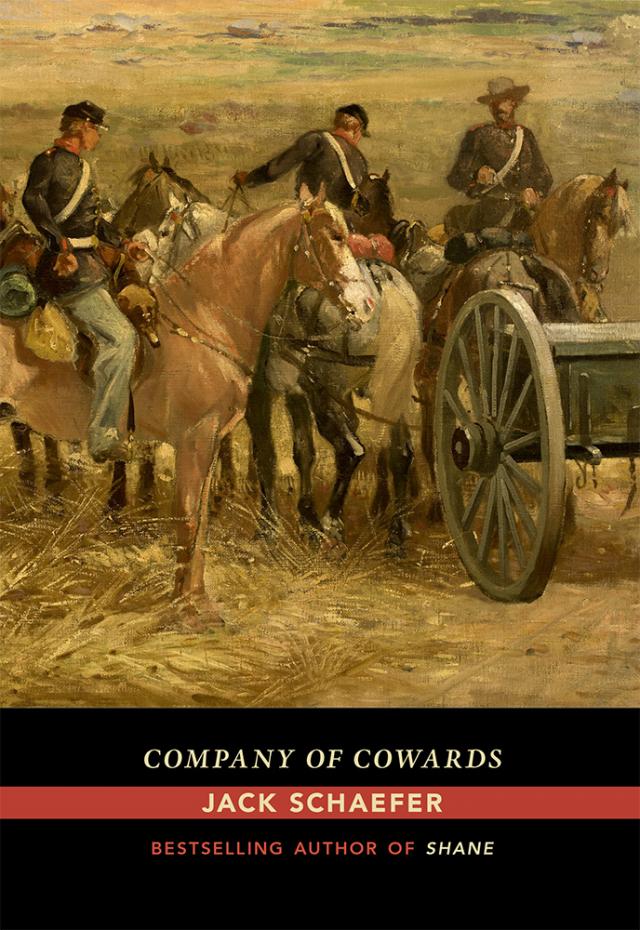
Cover art: Civil War Scene,
by Paul Philippoteaux (1846–1923), oil on canvas, 32 ¼ x 58 in.
Courtesy of Godel & Co., Inc., NYC
Designed by Catherine Leonardo
This one for Hank
May, 1864. In the dark, tangled woodland south of the Rapidan, where second-growth pine and matted vines and underbrush clogged movement and clouded vision, the Army of the Potomac and the Army of Northern Virginia were locked in the deadly, unearthly embrace of the Battle of the Wilderness. This was the brutal beginning of the long, last, grinding ordeal that would lead to Appomattox Court House. That was not known then. The past hung heavy over the immediate present. Again and again the Army of the Potomac had started on the road to Richmond only to have its driving power blunted and broken against Confederate courage and the daring shining integrity of Robert E. Lee. The list of commanders failing and being replaced had lengthened: Scott and McClellan and Pope and Burnside and Hooker and Meade. The best that could be said was that Meade had held firm at Gettysburg.
Now the Army of the Potomac was moving again under a stubby, stubborn little man from out of the west named Grant who would fight and fight and fight again until the brute weight of superior numbers and resources would grind out a final victory. He had swung left of Lee’s long fortified line and crossed the Rapidan and headed south through that strange, murky woodland, hoping to strike on through and draw Lee down to the open ground beyond before coming to battle-grip—and Lee had driven slashing in from the side to grapple with him there in the Wilderness.
All that is nailed down in history, described and redescribed and argued and analyzed in volumes enough to fill a large library. Why worry it again and in words that can never recapture the harsh, stinging reality of the bitterest, bloodiest fighting ever to torment American soil?
Because this is not a story of the Civil War. It is the story of a man who followed his own peculiar trail out of that war and on to his own peculiar victory. And of the queer, crippled, unrecorded company that went with him.
His name was Jared Heath. It stands, in firm slanting script, on the first line of the first page of a small, leather-laced account book in which he kept an intermittent journal of events. Jared Heath, 12th Massachusetts Volunteers. And beneath it the first entry: 1861, May 11. Answered the call to the colors.
The date there indicates that the call he was answering was Lincoln’s appeal issued a few days earlier for 42,000 men to serve for three years or the duration of the war. No matter that no one thought then the war would last more than a few months. His enlistment made him one of the regulars, the hard core of duration men who held the Union forces together and served on while the three-month and the six-month and the one-year men came and went and the draft was born of necessity and was corrupted by the bounty and substitute evils that accompanied it. He was a regular, a three-year man, and it was natural he should be. He was the third Jared Heath in direct line to wear an American uniform.
His grandfather, who brought the name to this country, had served under Washington himself, one of the ragged continentals who marched and endured and fought through the weary years to Yorktown and saw the United States come into being. The old man, still living when this Jared Heath was a boy, stern of bearded face, erect as a ramrod to the last, wore again his old revolutionary uniform and shouldered again his old revolutionary musket to lead the local Fourth of July parades. He had little to say, probably because he had done much. His deeds, part of a heroic history, acquiring the mystic glow of an accomplished glory, spoke for him and gave the family a distinction in the local community that had pleasant, social overtones and was good for the family business.
The father, second of the name, with the same sternness of face, the same and perhaps somewhat self-conscious erectness of bearing, had much to say, perhaps too much, perhaps too frequent and labored a harping. He must have felt overshadowed by the presence and later the memory of the old man. His own war had, in effect, cheated him. Massachusetts and the rest of New England had no relish for the War of 1812, did not want it, even refused to supply troops when Congress voted the declaration and called for militia. Indignant, he tried to organize rallies and made speeches and at last tramped over to New York State and enlisted there.
He was with the army dispatched to take the British posts across the Niagara River in Canada. When part of the army had crossed, the New York troops refused to leave New York soil. No doubt indignant again, held there in the immobile ranks, he saw those who had crossed beaten by the British and driven back to the river’s edge and ingloriously captured. Then the war was over and not once had he marched into actual battle. But he had been ready to march. In time, in his talk—he married late and had it well worked out by then—he could cast a glow of glory over what he had done. In the words worn by repetition and echoed in his son’s journal, he had answered the call to the colors.
So this Jared Heath, third of the name, unhesitating, with the weight of two older generations on his square-set shoulders and gallantly unaware of that weight, answered Lincoln’s call, among the first in his county, setting an example as such a man should. His mother, frail, never fully recovered from a lingering childbed sickness, bore up well and set to work sewing extra linen for him. His brother, still in knee pants, regarded him with increased envy and admiration. His father talked more than ever, working through familiar tales of two wars. It was all as it should be. He was no raw youngster bowled over by band-playing and flag-waving and the thought of parading in uniform. He was a man answering the call to the colors. Twenty-four at the time, already a partner in the family foundry, solid and compact and competent in mind and body, a staunch Unionist, he knew what he was doing and why. His father’s patriotic references to following the old flag and upholding the family tradition may have seemed to him excessive but certainly not off-key. He was, as the recruiting officer remarked and as his father repeated in later letters, excellent soldier material, the kind of man the country needed to whip the rebels into swift submission.
There were others like him scattered through those first hurriedly assembled regiments and it was fortunate there were when the Union forces all but collapsed under the initial impact of rebel strength and determination. What set him apart, if anything could be said to set him apart at the time, was a slight, rarely noticed, exaggeration of another aspect of his New England heritage, the proverbial Yankee stubbornness of mind.
The record of the next three years is all there in his journal, the facts at least, simple and direct, with occasional flashes suggesting thoughts behind them. Those were the days, in the first stage of the war, when newly recruited regiments elected their own line officers. He had his lieutenant’s bar within the week. As a lieutenant he marched out to First Bull Run. The entry on that is brief, blunt: Unable to rally the men. Forced to retreat. And one of the rare flashes: Like Grandpa at Brandywine.
That was his baptism in battle, not really a battle, a retreat becoming a rout, but one in which panic did not push him as it did so many others, a test he took well, in the tradition—like Grandpa at Brandywine.
Thereafter, for a long stretch, he was in a sense out of the war, out of the fighting, stranded in garrison duty close to Washington. Lincoln and the Cabinet, shaken by the defeat, pressured too by Congress, insisted that a strong screen of troops be maintained around the city. That was pleasant duty, in snug quarters, with regular meals and a round of parties to attend and the actual fighting relatively far away. But it was not for that a Jared Heath had answered the call to the colors. Perhaps he felt that his war too was cheating him. There is an entry made after a party at some unnamed colonel’s quarters, where battles were won in words over a good dinner and future victory toasted in wine: This is no way to win a war. And there are a few shrewd comments on the generals in the field. When the peninsular campaign, striking toward Richmond up the land neck between the James and York Rivers, fizzled out in weary withdrawal and the reports trickled into Washington, he hit it in a single short sentence: McClellan is not the man.
Then Antietam finished McClellan and Fredericksburg finished Burnside and Hooker took over and dreamed his personal dream of crushing Lee and some of the garrison troops were pulled away from Washington to augment his field force. Lieutenant Jared Heath was back in the war, marching toward Chancellorsville. But not into battle. Close enough to hear it, to smell it, to see some of it. He was with the brigades held back by Hooker, unused out of some strange caution or indecision in the man even when his whole right wing was crumpled by Stonewall Jackson’s flank assault and Lee was battering him back in defeat. The entry on that is one of the briefest: Kept out of it. Then another of the flashes: Almost like Father up in New York. Followed by another, right again as rain: Hooker is through. Fights like a man with one hand tied.
Nothing remarkable, nothing unusual in all that. The conviction had long been spreading through the Army of the Potomac, through the men in the ranks and the line officers, that politics and suspicion and confusion and downright stupidity in the high places, reaching perhaps even to the presidency and certainly to the Cabinet, were depriving them of the leadership they deserved or at least needed. The letters and diaries of other men in that army, men who like this Jared Heath were alert and used their minds some, run much the same. It was part of the prolonged, shaking-down process, the shift from expectation of a swift, gallant, flag-waving suppression of the rebellion to some understanding of the ordeal ahead, some realization that this war would be won only by a bitter struggle of endurance.
Then Meade was in command and Lee was smashing north into Pennsylvania and Lieutenant Jared Heath was marching toward Gettysburg. He won his captaincy there, breveted on the field after holding his platoon firm in the face of repeated assaults. The entry simply states the facts. And adds: Wrote Father about it. Back home in Massachusetts his father must have been busy polishing another battle account for his stock of family tales.
Yes, it is all there, the record of the three years following his enlistment, the pertinent facts fitting the third Jared Heath into his place in his war, right up to the start of the last long campaign southward under Grant, the entry on that hurriedly written, probably during a brief rest halt: Crossed the Rapidan at Germanna Ford. Moving toward Wilderness Tavern. It is the record of a good soldier, steady and intelligent, alert to what he was doing and why, stiffening like those of his breed around him to the long hard task as its measure began to unfold, consciously and perhaps proudly upholding a family tradition—a man, you would say, who would see it through as his grandfather had done before him.
But he did not see it through.
Something is missing, or hidden, or never committed to paper. The record revealed by that journal was heading toward a moment that would repudiate it. Was there a slow change in the man of which he himself was unaware? Was it Gettysburg, on whose haunted battlefield the high-bannered pageantry and gallantry of old-style, time-honored warfare rose to its final moment and died away forever in the crumpled crushed glory of Pickett’s charge, that started a corrosive unconscious change in him? Or was there no change at all but a sudden revealing of essential character, of his own individual unique segment of mortality laid raw and bare at last?
The man who wrote the first entry, echoing the family phrase, was in all seeming circumstance young, confident, quite certain he was stepping out on the glory road that would lead to a quick colorful quenching of the rebellion. The man who wrote the final entry, three years later almost to the day, had aged in more than time and the normal rigors of war, most of it in the last few days. He had forsaken the glory road. The quenching of the rebellion no longer touched him. He was looking down another and far different road and all that counted was the far lonely question of his own individual integrity.
It is all over—Why?
And again, in strokes tearing the page: Why?
If a full answer were ever found, only Jared Heath himself could have been certain and he never spoke of it, not even in the later years, long after the war, when settlement spread out toward his small homestead ranch in northern New Mexico and he mingled more with neighbors and the garrulousness of age crept on him. He would talk readily enough, in those last years, when prompted to it, of the distant days in the Wilderness and after, speaking of himself and events with a strange and strangely impressive detachment, a remoteness, almost an indifference, as if all that too no longer touched him and he had pushed beyond into another existence. But he never spoke of what those events had meant to him, what meaning he had wrung out of them. That was his alone. All that can be done is to tell what happened there in the Wilderness and what followed.
One
It was midmorning when they forded the river. Back in the night a cavalry regiment had slipped across and cleared away the few rebel pickets. In the first morning hours a division of cavalry had crossed as advance guard and gone up the curving road to disappear into the dim woodland beyond. Now the infantry, broken out of camps and assembled in marching order, were moving, the 12th Massachusetts among them, splashing through the ford and regrouping on the other side and heading up and on into the Wilderness. Eastward, down the river a few miles at Ely’s Ford, Hooker’s old crossing, more of the army was in motion, marching southward in almost parallel line along the battle-scarred road to Chancellorsville. And in the reaches behind both fords the men of the artillery brigades and of the great lumbering canvas-topped supply trains were harnessing and wheeling into formation to follow.
There was a brightness that spring day in the valley they were leaving, a golden mist of sunlight shimmering on the dogwood and the early flowers almost hidden in the fresh growing grasses. There was joking among the men and comments ran along the marching column, but subdued, lacking the lightness of the start of other campaigns under jauntier more flamboyant commanders. This was a bigger, grimmer, tougher army, taking its tone from the stubby stubborn little man who would use it, not as a sword, with skill, flashing in supple action, but as a hammer pounding out victory over lesser forces at whatever cost. Despite the myriad sounds of masses of men and battle equipment in movement, a muffled hush hung over the long lines. They moved out of the brightness, looking back and then facing forward, into the dark woodland.
All that day and all went well. They moved southward down the Germanna Road, the tangled murky growth thickening on either side, and went into bivouac in the heart of the Wilderness, the infantry near the old abandoned stage station called Wilderness Tavern at the crossroads where the Orange Turnpike came in from the west, the cavalry on ahead near the old landmark known as Tapp Farm where the Orange Plank Road also came in from the west. Not a sound, not a sight of rebel activity along the way. Nothing to mar the evening relaxation of rest and campaign rations after a dreary plodding through an almost deserted land where only a few weedy clearings and tumbledown shacks stood against the encroaching matted growth. Yet an uneasy apprehension clung to the men around their small shared campfires. They knew that off to the west where those two side roads, the only passable routes, ran silent and somehow ominous in their silence into the last light of the dying sun, were Robert E. Lee and the Army of Northern Virginia. Perhaps this new general Grant was stealing a march on old Marse Bob at last. But many had tried and no one yet had stolen a march on that great legendary man in gray.
The first darkness of night held thick over the sprawling infantry encampment. No neat orderly arrangement here, not in this forbidden resistant wilderness cut by hidden ravines and clogged with its tangled growth. The various units lay as the land itself let them, roughly along the road but off it to keep it clear. A fire, flaring in brief flame as fresh fuel was applied, might be invisible only a few yards away or simply glimpsed fitfully through the underbrush. A dark ghostly glimmering hung under the low branches of the stunted pines, fading as fires died and soldiers crept under their slanted dog tents to clutch at uneasy sleep.
Colonel Goddard’s V-topped tent, seeming unnaturally large in its recently cleared small space under the trees, gave off a weird spotty faint glow through its worn old canvas from the lit candles within. The tent flaps parted and Major Moody appeared, followed by Captains Heath and Clemmons, pausing in respectful silence as the colonel himself stepped out behind them. Tall, wide-mustached, military correctness in every detail, Colonel Goddard peered at the others in the outer darkness. “That’s it, gentlemen,” he said. “Goodnight and get some rest.” The tent flaps fell softly into place as he returned inside.