

Sundance 29, p.1
Sundance 29, page 1
part #29 of Sundance Series


The Home of Great
Western Fiction
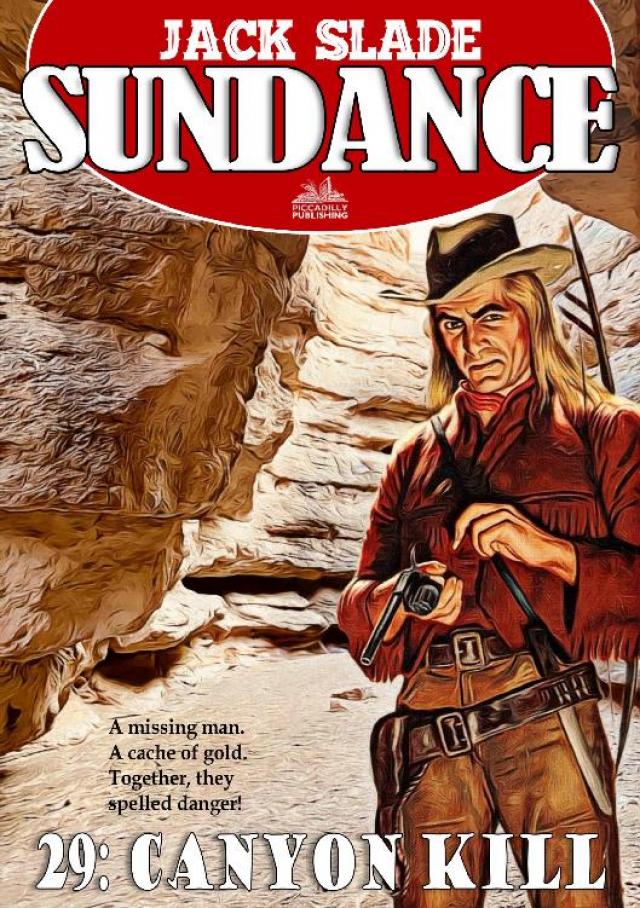
A herd of cattle had been stolen, the cowboys who tended them massacred. A story was going around that Comanches were responsible—three dead braves found in the vicinity of the massacre were said to be part of the war party.
But Jim Sundance knew better.
Half-Indian himself, he set out to prove that his brothers had been framed—by a white man.
The vengeance trail led straight to Hale Erskine, former major in the Confederate Army, and now the biggest cattle rancher in the brasada.
If Sundance had anything to do with it, Erskine wouldn’t live to see another day!
SUNDANCE 29: CANYON KILL
By Jack Slade
First published by Norden Publications in 1978
Copyright © 1978, 2023 by Jack Slade
This electronic edition published April 2023
Names, characters and incidents in this book are fictional, and any resemblance to actual events, locales, organizations, or persons living or dead is purely coincidental.
You may not copy, store, distribute, transmit, reproduce or otherwise make available this publication (or any part of it) in any form, or by means (electronic, digital, optical, photocopying, recording or otherwise), without the prior written permission of the publisher. Any person who does any unauthorized act in relation to this publication may be liable to criminal prosecution and civil claims for damages.
This is a Piccadilly Publishing Book
Text © Piccadilly Publishing
Editor: Ben Bridges
Published by Arrangement with the Golden West Literary Agency.
Visit www.piccadillypublishing.org to read more about our books.
Table of Contents
Chapter One
Chapter Two
Chapter Three
Chapter Four
Chapter Five
Chapter Six
Chapter Seven
Chapter Eight
Chapter Nine
Chapter Ten
Chapter Eleven
Chapter Twelve
Chapter Thirteen
Chapter Fourteen
Chapter Fifteen
Chapter Sixteen
About the Author
Chapter One
ABOVE THE HIGH-PITCHED whine of wheel flange on steel, Jim Sundance heard a man’s faint scream for help. Instinctively he jerked Eagle, the big appaloosa stallion, away from the railroad tracks he had been about to cross. Only moments before as he stared at those ribbons of steel, Sundance was recalling bitterly how his Cheyenne brothers had tried to keep the railroad from building here; the lives sacrificed on both sides. Better had his brothers tried to stop the wind with bare hands. And as that spun through his mind he heard the chilling sounds of potential disaster; a runaway on what was known as Saylor’s Grade. A banshee wail in the lonely mountains that sent a tremor through Eagle.
Far up the tracks a handcar swept into view from shadowed pines and into a beam of sunlight, its speed increasing on the steeper downgrade. Clinging to the car was a man. Sundance tensed, eyes riveted on the hurtling car; he had seen a handcar in operation before, usually propelled by one man or two, pushing their weight on the pair of crossbars. At such speed as this one had attained the handles should have been pumping wildly on their own even without a hand laid on them. A brief flash of sparks, blue-green, beneath the onrushing car caught his eye; something dragging had struck a rock or piece of metal. Some vital part that had broken loose?
Lying flat on the wooden platform of the careening handcar was a man in work clothes. Graying hair blew into his face. Evidently he had lost his balance when, for one reason or another, the handcar had gotten away from him, and had thrown himself to the platform. He clutched it frantically with both hands, feet dangling over the edge.
“Help!” he cried, the sound receding swiftly, for the handcar had already flashed past Sundance and was screaming toward a sharp curve at the bottom of the incline. Although his first instinct was to set the great Nez Percé war horse into a dead run to try and overtake the handcar, Sundance realized it already was too late.
At the curve the handcar flipped off the rails, shooting its passenger into a dust cloud. Almost gracefully the car sailed through the air for twenty feet or so, then struck the ground to hurtle end-over-end into a stand of pine. One of the wheels, torn loose, gouged tree trunks with the force of a howitzer shell. When dust began to clear in those few seconds, Sundance looked for the man. There was no sign of him. Undoubtedly dead; another victim of the railroad due to someone’s carelessness.
In the sudden, eerie silence, Sundance urged Eagle over the crossties. A spring sun warmed the back of his neck. He had traveled many miles, all the way from the high plains where the request from General William Tecumseh Sherman had finally reached him. He had gone to the camp named by the general only to find that its location had been changed suddenly to these mountains. He was weary and anxious to reach his destination nearby. Much as he wanted food and drink he could not ride away without first making sure of the fate of the handcar passenger. He thought he heard a distant chuff-chuff of a locomotive, but couldn’t be sure.
Sunlight and shadow touched his tall figure through the trees, his battered sombrero, red neckerchief, buckskin shirt, fringed and with bead work across the chest and down the arms. His pants were brown denim. Instead of boots he wore moccasins. As he neared the wreckage of the handcar, instinct for trouble caused his right hand to hover over the ivory butt of a Colt revolver. Brass cartridges gleamed in the belt around his narrow waist, shells not only for the holstered revolver but for a Henry rifle in a saddle scabbard under his knee. As in the past, his survival had often depended on a sixth sense; something was wrong here but he couldn’t tell what it was.
His black eyes scanned the craggy heights, the trees. He sat his saddle like an Indian, horse and rider as one.
As he neared the curve where the handcar had left the track he was surprised to see its occupant not a corpse but sitting up on the ground. The man stared vacantly, arms limp at his sides. Then Sundance saw what had undoubtedly lessened the impact of his body hurtling from the car. A great hill of gravel left by railroaders was beside the tracks. When flung off the runaway car the man had skated across the gravel pile, nearly leveling it, then tumbled to a mat of pine needles.
Sundance crossed the tracks and swung down in some trees, allowing Eagle’s reins to fall to the ground. He hurried to the man, who was probably in his mid-forties; clothing shabby and typical of railroad workers Sundance had seen. A trickle of blood from a cut on the forehead ran down the side of his face. A deep scar from some previous accident angled from the right temple into his hair.
“Better not move,” Sundance counseled, kneeling down. “I’ll see if you’ve got any broken bones.”
The man blinked, then stared vacantly out of eyes reddened no doubt from wind in the wild ride down the mountain. “Last thing I remember,” he said, a trace of South in his voice, “was somebody yelling ‘Comanches!’ And then ...” He broke off, squeezing gray eyes tightly shut. “Comanches,” he breathed. “And then they hit us ...”
“You just imagined it,” Sundance said. “No Comanches around here. I’ll bet on it.”
The man’s mouth dropped open and for the first time his eyes seemed to focus on Sundance. He was already pale as a result of the terrifying brush with death, but now he lost even more color. Sundance wasn’t surprised at the reaction; it was common for anyone at first meeting to mistake him for a full-blood; his coppery skin, hawklike features. But in contrast to a face typically Cheyenne was hair the color of new wheat that tumbled to the shoulders of the buckskin shirt.
“Don’t be afraid of me,” Sundance said as the man began to tremble. Sundance probed expertly for broken bones. But the only injury seemed to be the cut on the forehead. Sundance’s black eyes studied the gaunt face with its fringe of gray beard. He said, “How’d the handcar get away from you?”
The man stared blankly and absently brushed pine needles from his shirt sleeves. “Handcar?” he said in disbelief. “What handcar you talking about, mister?”
Sundance frowned, then related how the car had roared down the tracks out of control and left the rails at the curve.
Gray eyes were suddenly worried. “Where are the others? What happened? And my brother ... what happened to him?” The man started to get up, but Sundance pushed him back. A locomotive hooted far up the track.
“Just set still. A train’s coming. I’ll flag it down ...”
“And the cattle. What happened to the cattle? We had a herd ... three, four thousand head ...” The voice began to shake. “Comanches ...”
“I didn’t see anybody but you. Just you and the handcar. And this isn’t cattle country ...”
“Comanches ... they’re going to kill ...” The man’s voice was agonized. “I don’t understand,” he went on, looking around. “What am I doing here in the mountains? Last thing I remember I was in Canon del Muerte, Canyon of Death as the Mexicans call it. And it was death ... Oh, gawd!”
“I know that canyon. Miles south of here. Many miles.”
“You say I was on a handcar?”
Sundance pointed at the wreckage some yards away. “That lick on the head likely wiped out your memory. It’ll come back in no time at all. I’ve seen it happen to others.” Sundance tried to be cheerful but he was dubious. “Listen, you must work for the railroad or you wouldn’t have b een on one of their handcars. Or did you steal it?”
“Steal? Sir, I was a captain in the Confederate Army in the War Between the States ...”
“That war’s long been over and done with.”
“Yes,” the man said softly and stared at the ground as if to seek answers from gravel and clumps of pine needles. “Wait a minute, more of it is starting to come back.” He clenched his teeth. Blood still seeped from the forehead gash.
A locomotive whistled, this time nearer. Black smoke smudged treetops and clear sky beyond the top of the grade. Sundance hurried over to where he had left Eagle in the trees as the chuff-chuff of the locomotive became louder. He caught the horse by its headstall. Out here in the wilderness Eagle might forget his training and be spooked at sight and sound of the iron monster that both he and Sundance would have to learn to live with. There was no turning back now; whites were pouring into the west, streaming across Indian lands.
Sound of the approaching locomotive and sight of the steel rails epitomized the treachery of the white man. At times like this the Cheyenne in his blood prevailed over the white.
Far up the tracks a locomotive and a single flatcar backed downgrade. He felt Eagle tremble. It quieted at Sundance’s low-voiced command in Cheyenne; but he did not leave the horse. He couldn’t risk its possible injury on the steep embankment on the far side of the tracks should it panic.
Eagle’s head suddenly came sharply up, swinging to one side, the ears slanting forward. And Sundance knew this reaction had nothing to do with the locomotive now slowing on the grade, belching steam and smoke. Sundance put a hand to his gun, feeling the cool ivory grips against his palm. He wheeled to face whatever had alerted the horse. Two riders had appeared in the trees, hooves of their mounts silenced by the mat of pine needles. They had not seen him but were staring at the man on the ground, a dozen yards or so from where Sundance stood with Eagle. They drew rein. One of the riders was huge, in tight-fitting brown suit and bowler hat. There was something vaguely familiar about him.
The man pointed at the one who had been flung from the handcar. “He’s alive, Mr. Jared,” Sundance heard him say to his companion, a shorter man in kepi and English hunting jacket.
“Talk about a cat with nine lives,” the man called Jared said with a shake of his head. “I tell you one thing, Killian, I didn’t believe it when Erskine wrote me to come up here and see if there was any truth to the story about this one still being alive.”
“He looks harmless to me, Mr. Jared,” Killian grunted.
“Depends on whose neck is in the noose. We’d better get him out of sight before that train ...” Jared turned to look up track at the approaching locomotive and flatcar. He saw Sundance for the first time. “I say, we surely thought we’d find him dead,” Jared said with an English accent that Sundance, from experience, sensed was acquired. He considered himself somewhat of an expert on the subject because of his late father. Jared continued, seeming nervous under Sundance’s cold scrutiny. “We saw the runaway handcar. Did he tell you how it happened to get away from him? Did he tell you anything at all?” The man, smooth-faced and in his thirties, was pressing; Sundance felt not only irritation but faint anger, a prickling along the nape as the larger man studied him closely.
Sundance jerked his head at the one on the ground. “I think he’s lost his memory. Got jolted out of him in the crash.”
Jared seemed relieved. “Then he still can’t remember anything.”
Sundance narrowed his eyes. “You talk as if he’s had no memory for a long time.”
Jared suddenly lost patience. “Why don’t you clear out, Indian? We’ll take care of our friend there,” indicating the man on the ground. But Sundance heard a whimper of protest from the gray-bearded one. Sundance did not look away from the horsemen.
“I’ll flag down that locomotive,” Sundance said. “He belongs with the railroad, not on the back of a horse. He may have hurts I can’t even see.”
“I guess you didn’t hear what I said!” Jared’s face began to redden; a man obviously used to being obeyed. “We’ll take him with us ...”
Again the injured man whimpered and Sundance heard him say, “No ... don’t let me go with them.”
The locomotive was slowing to a crawl, still fifty yards up the track, so Sundance knew he wouldn’t have to flag it down.
“That Indian better buy himself an ear horn,” the big man, Killian, in the bowler hat, said angrily. He started to jerk free a rifle from a saddle boot. Before the move was even half completed, Sundance’s Colt was leveled, the hammer back.
“Not so fast, friend,” he warned through his teeth. “I don’t know what the hell this is all about, but you’re not going to pull a rifle on me.”
Both men seemed surprised by the speed with which Sundance had drawn his gun. Killian glowered, his companion, Jared, obviously wary.
“All right, Killian,” he said, forgetting his English accent. “Enough for now.”
Whether they didn’t know how many railroad men might be in the engine cab or whether they just had no wish for trouble in front of witnesses Sundance didn’t know. Wheeling their horses, they galloped back into the trees just as the locomotive and flatcar slid to a halt with a squeal of brakes. Eagle still trembled but stood steady under Sundance’s low-voiced command. He holstered his gun.
A fireman with soot-streaked face and clothing leaped from the engine cab and rushed to the man on the ground. “Hey, Bob, you all right?” he asked anxiously. “Jeezus, lucky we was on the siding when you came roarin’ past. If we’d been on the main line you’d have splattered yourself all over us sure as hell.”
Bob gave the newcomer a blank look.
Sundance said, “He remembers nothing about what happened.”
The fireman straightened up, putting his full attention on Sundance for the first time. He paled and started to back away.
“Let me help you get him on that flatcar,” Sundance said. “Is there a doctor in these mountains?”
The fireman, still in awe of Sundance, nodded. He said the railroad doctor happened to be in Reddington. “Just up the line a ways. Whew, you sure give me a scare at first, mister. Thought you was a Cheyenne. There was plenty of ’em around when we was pushin’ track through here.”
“I know,” Sundance said dryly. An engineer peered down at them from the cab. Jets of steam spurted from the locomotive. Sundance indicated the man, Bob. “Who is he?”
“Bob Talbert. Does odd jobs for the railroad.” Sundance frowned at that; the man seemed too intelligent, too well-educated, if his speech was any indication, for such menial work. The fireman said, “He come here last year, late fall I reckon it was. Had no memory at all. Doc Sturges figures he was one of them got hurt in the war an’ don’t remember who he is. Anyhow, they put him to work.” The fireman looked at the wreckage. “There’ll be hell to pay when the track foreman hears about the handcar Bob wrecked.”
“Got a hunch it wasn’t his fault.” Sundance started to mention the fact that handles on the runaway car had not been pumping but unmoving instead. It made him feel that the car had been tampered with; possibly a pin removed so that the connecting rod to the gears would work loose. He recalled something dragging under the car, producing a burst of sparks at one point in the wild descent. He decided not to talk about it just yet.
The fireman looked at him quizzically. “What you mean, it wasn’t Bob’s fault?”
Sundance shrugged. “Main thing now is to get him to the doc. I don’t think anything’s broken but you can’t be sure. Let’s handle him easy.” They deposited Bob Talbert on the flatcar. Apparently Talbert’s loss of memory was nothing new, according to the fireman. And even the man Jared had mentioned it. Jared seemed to know Talbert, who was obviously afraid of him. Sundance recalled Talbert’s whimper of fear: “... don’t let me go with them.”
Sundance asked the fireman if he knew of Jared and Killian. The fireman shook his head, explaining that he’d been working temporarily in another division until today.
Sundance learned that his destination, Reddington, was four miles upgrade.
“Wish we could give you a lift,” the fireman said, “but don’t know how we’d carry that hoss of yours. Sure a big one, ain’t he?”


