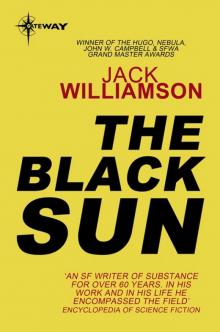
Collected short fiction, p.1
Collected Short Fiction, page 1


Jerry eBooks
No copyright 2024 by Jerry eBooks
No rights reserved. All parts of this book may be reproduced in any form and by any means for any purpose without any prior written consent of anyone.
Collected Short Fiction
Jack Williamson
(custom book cover)
Jerry eBooks
Title Page
About Jack Williamson
Pseudonyms
“As Williamson Sees Himself”
“Meet the Author” (November 1939)
“Meet the Author” (July 1941)
“Author, Author”
“The People Who Write Science Stories”
“BIOLOG”
Bibliography: Novels
Bibliography: Magazine-published Novels
Bibliography: Serials
Bibliography: Anthologies
Bibliography: Chapbooks
Bibliography: Collections
Bibliography: Omnibus
Bibliography: Nonfiction
Short Fiction Bibliography: chronological
Short Fiction Bibliography: alphabetical
Fiction Series
Epigraph
1928
The Metal Man
1929
The Girl from Mars
The Alien Intelligence (Part One)
The Alien Intelligence (Conclusion)
The Second Shell
1930
The Green Girl (Part One)
The Green Girl (Conclusion)
The Cosmic Express
1931
The Birth of a New Republic
The Prince of Space
The Meteor Girl
The Lake of Light
Through the Purple Cloud
The Doom from Planet 4
Twelve Hours to Live
The Stone from the Green Star (Part One)
The Stone from the Green Star (Conclusion)
1932
Wolves of Darkness
The Moon Era
The Pygmy Planet
Red Slag of Mars
The Lady of Light
The Electron Flame
The Wand of Doom
1933
In the Scarlet Star
Salvage in Space
Golden Blood (Part One)
Golden Blood (Part Two)
Golden Blood (Part Three)
Golden Blood (Part Four)
Golden Blood (Part Five)
Golden Blood (Conclusion)
“We Ain’t Beggars”
The Plutonian Terror
Dead Star Station
Terror Out of Time
1934
The Flame from Mars
Invaders of the Iceworld
Born of the Sun
Xandulu (Part One)
The Legion of Space (Part One)
Xandulu (Part Two)
The Legion of Space (Part Two)
Xandulu (Conclusion)
The Legion of Space (Part Three)
Wizard’s Isle
The Legion of Space (Part Four)
The Legion of Space (Part Five)
The Legion of Space (Conclusion)
1935
The Galactic Circle
Islands of the Sun (Part One)
Islands of the Sun (Conclusion)
Grey Arms of Death
1936
The Ruler of Fate (Part One)
The Ruler of Fate (Part Two)
The Ruler of Fate (Conclusion)
The Cometeers (Part One)
The Cometeers (Part Two)
The Cometeers (Part Three)
The Cometeers (Conclusion)
The Great Illusion
1937
The Blue Spot (Part One)
The Blue Spot (Conclusion)
The Ice Entity
The Mark of the Monster
The Devil in Steel
Released Entropy (Part One)
Released Entropy (Conclusion)
1938
Dreadful Sleep (Part One)
Dreadful Sleep (Part Two)
The Infinite Enemy
Dreadful Sleep (Conclusion)
The Legion of Time (Part One)
The Legion of Time (Part Two)
The Legion of Time (Conclusion)
The Dead Spot
1939
Nonstop to Mars
After World’s End
The Crucible of Power
One Against the Legion (Part One)
One Against the Legion (Part Two)
One Against the Legion (Conclusion)
Passage to Saturn
Star Bright
The Fortress of Utopia
The Angel from Hell
1940
As in the Beginning
The Reign of Wizardry (Part One)
The Reign of Wizardry (Part Two)
Hindsight
Mistress of Machine-Age Madness
The Reign of Wizardry (Conclusion)
The Sun Maker
Crystal of Death
The Girl in the Bottle
Racketeers in the Sky
Ashes of Iron
Darker Than You Think
1941
The Star of Dreams
The Iron God
Gateway to Paradise
Backlash
1942
Breakdown
The Alien Intelligence (First Installment)
The Alien Intelligence (Second Installment)
Collision Orbit
The Alien Intelligence (Concluding Installment)
Minus Sign
1943
Opposites—React! (Part One)
Opposites—React! (Conclusion)
Conscience, Ltd
1947
The Equalizer
With Folded Hands . . .
1948
. . . And Searching Mind (Part One)
. . . And Searching Mind (Part Two)
. . . And Searching Mind (Conclusion)
1949
Seetee Shock (Part One)
Seetee Shock (Part Two)
Seetee Shock (Conclusion)
1950
The Moon and Mr. Wick
1951
The Man From Outisde
The Peddler’s Nose
The Greatest Invention
1952
Man Down
The Humanoids
Dragon’s Island
1953
The Cold Green Eye
Hocus-Pocus Universe
Operation: Gravity
The Happiest Creature
1954
Guinevere for Everybody
The Hitch-Hiker’s Package
1958
Beans
1959
Second Man to the Moon
1962
A Planet for Plundering
1963
The Reefs of Space (Part One)
The Reefs of Space (Part Two)
The Reefs of Space (Conclusion)
The Masked World
1965
Starchild (Part One)
Starchild (Part Two)
Starchild (Conclusion)
1967
Nowhere Near
1968
Rogue Star (Part One)
Rogue Star (Part Two)
Rogue Star (Conclusion)
1969
Jamboree
1971
The Moon Children (Part One)
The Moon Children (Part Two)
The Moon Children (Conclusion)
1973
Doom Ship
The Power of Blackness
1974
The Org’s Egg (Part One)
The Org’s Egg (Part Two)
The Org’s Egg (Conclusion)
1975
The Eternity Engine
Counterkill
1976
The Dark Destroyer
The Highest Dive
The Machines That Ate Too Much
1977
Stepson to Creation
Slave to Chaos
1978
Kinsman to Lizards
Brother to Demons
Farside Station
Brother to Gods
1980
The Humanoid Universe
1981
. . . All Ye Who Enter Here
1982
A Break for Dinosaurs
Seedship
1985
At the Human Limit
1988
The Mental Man
1992
The Birds’ Turn
Venus is Hell
1993
The Litlins
1994
The Ice Gods
1995
Dark Star
1996
The Death of a Star
1997
The Firefly Tree
The Hole in the World
1998
The Purchase of Earth
The Story Roger Never Told
Terraforming Terra
The Pet Rocks Mystery
1999
Miss Million
Engines of Creation
2000
Agents of the Moon
A Question of Time
Eden Star
The Ultimate Earth
2001
The Nth Step
Nitrogen Plus
2002
Afterlife
The Planet of Youth
The Luck of the Legion
2003
The Man from Somewhere
2004
Black Hole Station
Devil’s Star
2005
The Stonehenge Gate (Part One)
The Half Men
The Stonehenge Gate (Part Two)
The Stonehenge Gate (Conclusion)
2006
The Mists of Time
John Stewart Williamson was born April 29, 1908 in Bisbee, Arizona Territory, and spent his early childhood in western Texas. In search of better pastures, his family migrated to rural New Mexico in a horse-drawn covered wagon in 1915. The farming was difficult there and the family turned to ranching, which they continue to this day. He served in the U.S. Army Air Corps in World War II as a weather forecaster.
As a child Williamson enjoyed storytelling to his brother and two sisters. As a young man, he discovered the magazine Amazing Stories, established in 1926 by Hugo Gernsback after answering an ad for one free issue. He strove to write his own fiction and sold his first story to Gernsback at age 20: “The Metal Man” was published in the December 1928 issue of Amazing Stories. Early in his career he sometimes used the pseudonyms Will Stewart and Nils O. Sonderlund, but predominantly wrote as Jack Williamson.
Early on, Williamson became impressed by the works of Miles J. Breuer and struck up a correspondence with him. A doctor who wrote science fiction in his spare time, Breuer had a strong talent and turned Williamson away from dreamlike fantasies towards more rigorous plotting and stronger narrative. Under Breuer’s tutelage, Williamson would send outlines and drafts for review. Their first work together was the novel Birth of a New Republic in which Moon colonies were undergoing something like the American Revolution—a theme later taken up by many other SF writers, particularly in Robert A. Heinlein’s The Moon is a Harsh Mistress.
Wracked by emotional storms and believing many of his physical ailments to be psychosomatic, Williamson underwent psychiatric evaluation in 1933 at the Menninger Clinic in Topeka, Kansas, in which he began to learn to resolve the conflict between his reason and his emotions. From this period, his stories take on a grittier, more realistic tone.
By the 1930s he was an established genre author, and the teenaged Isaac Asimov was thrilled to receive a postcard from Williamson, whom he had idolized, which congratulated him on his first published story and offered “welcome to the ranks”. Williamson remained a regular contributor to the pulp magazines but did not achieve financial success as a writer until many years later.
An unfavorable review of one of his books, which compared his writing to that of a comic strip, brought Williamson to the attention of The New York Sunday News, which needed a science fiction writer for a new comic strip. Williamson wrote the strip Beyond Mars (1952-55), loosely based on his novel Seetee Ship, until the paper dropped all comics.
Beginning 1954 and continuing into the 1990s, Williamson and Frederick Pohl wrote more than a dozen science fiction novels together, including the series Jim Eden, Starchild, and Cuckoo. Williamson continued to write as a nonagenarian and won both the Hugo and Nebula Awards during the last decade of his life, by far the oldest writer to win those awards.
Williamson received his Bachelor of Arts and Master of Arts degrees in English in the 1950s from Eastern New Mexico University (ENMU) in Portales (near the Texas panhandle), joining the faculty of that university in 1960. He remained affiliated with the school for the rest of his life. In the late 1990s, he established a permanent trust to fund the publication of El Portal ENMU’s journal of literature and art. In the 1980s, he made a sizable donation of books and original manuscripts to ENMU’s library, which resulted in the formation of a Special Collections department; the library now is home to the Jack Williamson Science Fiction Library, which ENMU’s website describes as “one of the top science fiction collections in the world”. In addition, Williamson hosted the Jack Williamson Lectureship Series, an annual lectureship where Guests of Honor and other noted authors give lectures, read from their works, and participate in lively panel discussions on a variety of topics. The lectureship is still celebrated at ENMU each year. The Jack Williamson Liberal Arts building houses the Languages & Literature, Mathematical Sciences, History Religion & Social Sciences, and Psychology & Political Science Departments of the university, as well as the College of Liberal Arts and Sciences Dean’s Office.
Williamson completed his Ph.D. in English literature at the University of Colorado in Boulder, focused on H.G. Wells’ earlier works, demonstrating that Wells was not the naive optimist that many believed him to be. In the field of science, Jack Williamson coined the word terraforming in a science-fiction story published in 1942 in Astounding Science Fiction.
The Science Fiction Writers of America named Williamson its second Grand Master of Science Fiction after Robert Heinlein, presented 1976.
After retiring from teaching full-time in 1977, Williamson spent some time concentrating on his writing, but after being named Professor Emeritus by ENMU, he was coaxed back to co-teach two evening classes, “Creative Writing” and “Fantasy and Science Fiction” (he pioneered the latter at ENMU during his full-time professorship days). Williamson continued to co-teach these two classes into the 21st century. After he made a large donation of original manuscripts and rare books from his personal collection to the ENMU library} a special collections area was created to house these and it was named the “Jack Williamson Special Collection”.
In 1994 Williamson received a World Fantasy Award for Lifetime Achievement.
The Science Fiction and Fantasy Hall of Fame inducted Williamson in 1996, its inaugural class of two deceased and two living persons.
The Horror Writers Association conferred its Bram Stoker Award for Lifetime Achievement in 1998 and the World Horror Convention elected him Grand Master in 2004.
Despite his age, he had made an appearance at the Spring 2006 Jack Williamson Lectureship and published a 320-page novel, The Stonehenge Gate, in 2005.
On November 10, 2006, Williamson died at his home in Portales, New Mexico at age 98.
PSEUDONYMS
Hector Parl
Nils O. Sonderlund
Will Stewart
Džek Vilijemson
John S. Williamson
J. Williamson
As Williamson Sees Himself
Born, 1908, at a mining camp in Arizona Territory. Carried mule-back, aged six weeks, to Rancho La Loba, deep in Sonora’s Sierra Madre. A wheel-less land, of Scorpions, mountain lions, and renegade Apaches—but it took revolution to send my parents back to the States.
Arrived in New Mexico by covered wagon. When drouth of ’18 struck the Llano Estacado, drove chuck wagon for father’s trail herd. Now I write in a shack on the ranch, still find relaxation in the saddle.
Science fiction is the answer to why don’t I write westerns. For nothing else has quite equalled the thrill of Merritt’s Moon Pool. Ambition to write dates from age five, when informed that Mark Twain got a dollar a word—even, astonishingly, for easy words like if and is. (Family’s skepticism not yet wholly overcome.)
Like travel; have knocked about a bit, mostly with Edmond Hamilton. But chief interest remains science fiction. Now working on second million words—and hope to make them better than the first.
For I believe that science fiction will come to fill a very important niche in a scientific age, that the possibilities in depicting the dramatic impacts of science and human beings have hardly been explored.
Originally appeared in Thrilling Wonder Stories, June 1939
MEET THE AUTHOR
l
A NEW WORLD
JACK WILLIAMSON
Author of “The Fortress of Utopia,” this Month’s Book-Length Novel
IT is thirteen years since a rather lonely, dreamy farm boy stumbled across his first stray copy of a science fiction magazine—which had a glorious cover by Paul—and was instantly gripped by the breath-taking wonder of this new world of science and imagination.
At once I knew that I wanted to write science fiction, and soon forgot a planned career in chemistry to do it. The first story appeared within two years, and more than a million words have been printed since. But still I find that every science fiction story is a new and thrilling adventure.
The writing of FORTRESS OF UTOPIA—a long with the science-fictional spectacles at the World’s Fair and the recent Science Fiction Convention —was one of the high points of a three-month stay, this spring, in New York City.
The novel—if the editors will allow a behind-the-scenes glimpse—was evolved in a series of conferences with the staff of STARTLING STORIES.
A good deal is said, these days, about Utopias. Nearly every orator, in fact, on every soap-box, has his own utopian scheme to cure the ills of the world. And your alert editors propounded this question:
What would happen if a band of earnest scientists, equipped with a certain instrumentality, set out to transform our muddling modem world into a planned Utopia?