

Flames of silver, p.1
Flames of Silver, page 1
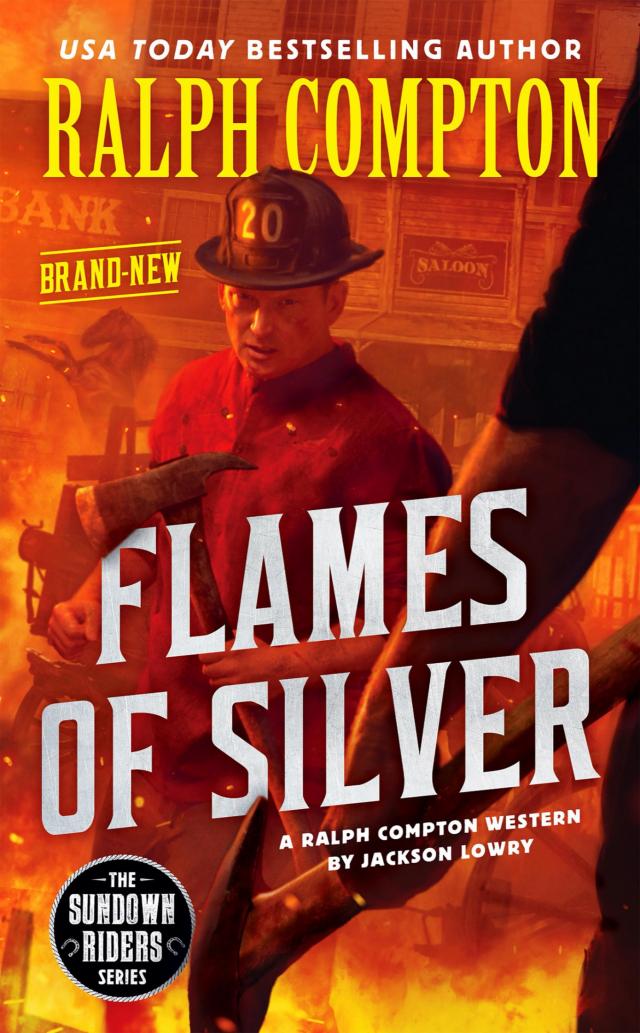


INTO THE FIRE
Morgan Mason swung his axe in a wide arc and knocked away a burning chair as he plunged into the inferno. Squinting, coughing, he advanced one step at a time in the face of intense heat. Never in his life had he reacted without thinking, but another man’s life depended on what he did now.
“Can you get out? Come toward my voice!” He waited to see if the miner responded. Nothing. Mason swung back and forth to hack a path through the debris.
He quickly saw why there hadn’t been an answer. The miner lay stretched out on the floor by the filing cabinet. A falling roof support had struck him on the top of the head. Mason chopped his way forward and reached the man’s side. He poked him with the butt of the axe handle.
He then reached out and put his hand on the other man’s shoulder. The smoke billowing about obscured all vision. Then came a sound unlike anything he had ever heard before. It was a creaking and snapping and a moan that was eerily human. A sudden upward gust cleared the smoke for a brief instant, showing the bright blue Nevada sky.
Then the roof collapsed. Mason recoiled and tried to drag the miner with him. A heavy beam crashed smack-dab onto the man. Mason felt him jerk away as he fell to the floor. Before he could move to pull the burning beam away, another, larger one fell amid a shower of sparks. Mason stepped back instinctively, caught his heel and sat heavily. He smashed into a desk.
A quick jerk to the side carried him into the knee well of the desk. The rain of fire and wood from above no longer fell on his head, but he saw his companion stretched out with two large beams pinning his legs down.
Then the rest of the roof gave up the ghost and came thundering down.
BERKLEY
An imprint of Penguin Random House LLC
penguinrandomhouse.com
Copyright © 2021 by The Estate of Ralph Compton
Penguin Random House supports copyright. Copyright fuels creativity, encourages diverse voices, promotes free speech, and creates a vibrant culture. Thank you for buying an authorized edition of this book and for complying with copyright laws by not reproducing, scanning, or distributing any part of it in any form without permission. You are supporting writers and allowing Penguin Random House to continue to publish books for every reader.
BERKLEY and the BERKLEY & B colophon are registered trademarks of Penguin Random House LLC.
Ebook ISBN: 9780593333822
Cover art by Chris McGrath
Cover design by Steve Meditz
Book design by George Towne, adapted for ebook by Kelly Brennan
This is a work of fiction. Names, characters, places, and incidents either are the product of the author’s imagination or are used fictitiously, and any resemblance to actual persons, living or dead, business establishments, events, or locales is entirely coincidental.
pid_prh_5.7.0_c0_r0
Contents
Cover
Title Page
Copyright
The Immortal Cowboy
Chapter One
Chapter Two
Chapter Three
Chapter Four
Chapter Five
Chapter Six
Chapter Seven
Chapter Eight
Chapter Nine
Chapter Ten
Chapter Eleven
Chapter Twelve
Chapter Thirteen
Chapter Fourteen
Chapter Fifteen
Chapter Sixteen
Chapter Seventeen
Chapter Eighteen
Chapter Nineteen
Chapter Twenty
Chapter Twenty-One
Chapter Twenty-Two
Chapter Twenty-Three
Chapter Twenty-Four
Chapter Twenty-Five
Chapter Twenty-Six
About the Authors
THE IMMORTAL COWBOY
This is respectfully dedicated to the “American Cowboy.” His was the saga sparked by the turmoil that followed the Civil War, and the passing of more than a century has by no means diminished the flame.
True, the old days and the old ways are but treasured memories, and the old trails have grown dim with the ravages of time, but the spirit of the cowboy lives on.
In my travels—to Texas, Oklahoma, Kansas, Nebraska, Colorado, Wyoming, New Mexico, and Arizona—I always find something that reminds me of the Old West. While I am walking these plains and mountains for the first time, there is this feeling that a part of me is eternal, that I have known these old trails before. I believe it is the undying spirit of the frontier calling me, through the mind’s eye, to step back into time. What is the appeal of the Old West of the American frontier?
It has been epitomized by some as the dark and bloody period in American history. Its heroes—Crockett, Bowie, Hickok, Earp—have been reviled and criticized. Yet the Old West lives on, larger than life.
It has become a symbol of freedom, when there was always another mountain to climb and another river to cross; when a dispute between two men was settled not with expensive lawyers, but with fists, knives, or guns. Barbaric? Maybe. But some things never change. When the cowboy rode into the pages of American history, he left behind a legacy that lives within the hearts of us all.
—Ralph Compton
CHAPTER ONE
The bullet tore a fist-sized hole in the wood beside Morgan Mason’s head. He jerked back and collided with the whiskey salesman crowded close behind him in the stagecoach, anxiously waiting to exit. A strong hand shoved him forward. Mason stumbled and landed on one knee in the dust. He looked around frantically for whoever had taken the shot at him. The Virginia City street was crowded with men and women going about their noontime business. No one paid him any heed.
No one seemed to notice the gunfire. He brushed off his trousers and settled his coat. His vest had ridden up a bit over his paunch. Trying not to be too obvious, he pulled it down and fastened the bottom buttons that had popped open.
“Here. You left this in the stage.” The whiskey peddler tossed him his bowler, then lithely jumped to the ground and took a deep breath. “There’s that aroma in the air. Isn’t it grand?”
Mason sucked in a breath and almost gagged. This was nothing like the sea air blowing off the Pacific Ocean or the Bay in his hometown of San Francisco. Acrid smoke mingled with horse dung and more than a little whiff of alcohol blowing from the three saloons lined up side by side across from the Wells Fargo depot.
“It’s awful,” he gasped out.
“It’s wonderful,” the peddler insisted. “That’s the smell of thirsty miners wanting just one more shot of my fine whiskey before they return to work.” The peddler laughed in delight, hefted his case and left. Mason heard the contents of the leather suitcase gurgle. The salesman carried his wares inside. Without so much as a look back, the whiskey peddler went into the nearest saloon.
“You all right, Mister?” The shotgun guard dropped from the driver’s box. “You’re looking a mite peaked, but then you got a pale complexion just like most of them miners. Only they don’t look fair of skin because they’re Irish. They look that way because they spend their lives underground. You thinking on becoming a miner?” The guard looked skeptically at Mason, his bulging waistline, his mussed fiery red hair and then into eyes so blue they rivaled the sky.
“You think I look like a miner?”
“Well, now, ain’t my place to say.” The guard pushed back the canvas flap on the boot and dragged out Mason’s bag. He dumped it to the ground.
Mason cried out and tried to keep it from crashing into the dirt. He failed. The peddler’s wares were liquid and alcoholic. His were more specialized and far deadlier. The pints of acids and bases he had in that bag matched anything on the shelves around Virginia City. He had wasted a considerable part of his fortune sending telegrams to inquire about assayers and land agents and then purchasing the chemicals in San Francisco, where there was an abundance of supply off the ships rounding the Horn.
“Don’t get so worked up. Whatever you got in there’s already survived getting bounced all over on the road coming up the mountain.”
“Yeah, there’s that,” Mason said dubiously. He stood back and waited to see if any of the chemicals leaked out. If they mixed, the least that would happen would be a toxic puddle. The most might be an explosion, followed by a cloud of noxious gas capable of killing a horse. Not seeing any obvious damage, he hefted the case. Then he took out a small bag with his clothing and personal items.
He stood stock-still for a moment and looked around.
“You lose something? You got the look of a man who’s not sure of himself.” The guard fastened the canvas flap back down and rested his scattergun in the crook of his left arm.
“I was shot at when I got off the stage.”
“No, you wasn’t.”
“There. Look there.” Outraged that the man called him a liar, Mason pointed out the huge hole blasted through the dried wood. He shoved his finger through, into the compartment, and wiggled it. “See?”
“I heard the shot. Nobody much cares what happens to these old coaches.”
“Somebody shot at me!”
“Ain’t you the prima donna, thinking anybody cared about a stranger getting off the stage. There’s lead flying around all the time. Nobody’s aiming at you or likely anyone else. T
hey’re just letting off steam.”
The driver called to the guard.
“You settle down and you’ll find Virginia City a whole lot more welcoming.” The guard walked to the front of the team, grabbed a harness on the lead and led the team away, the driver gently snapping the reins to get the other horses pulling.
In seconds Morgan Mason stood all by himself in the middle of Virginia City’s main street. He looked around and wondered where to go. The town was built on the side of a steep hill, with three or four levels below him. The streets were extreme enough that ladder-like sidewalks had been installed. Going downhill required a reckless abandon, but climbing up meant a considerable exertion. He had lived most of his life at sea level. Up here in the mountains, breathing was something of a chore for him. Mason rested his hand on his belly. Altitude and being out of shape cut his wind in a hurry.
He chose not to descend but to remain on the street, at least for the time being, until he regained his breath. As far as he could tell, one level was like another, though he thought he saw a tree-shrouded cemetery just off the lowest level.
Warily looking around, not certain the stagecoach guard told the truth about the bullet that had greeted him as he stepped down, Mason walked along the street, taking in the sights. Every other building housed a saloon and did a thriving business. He was almost sorry he had brought hydrochloric acid and sodium hydroxide and all the other chemicals instead of whiskey. The peddler had a distinct edge on him and was likely to do a land office business.
At that thought, he stopped and stared. The city surveyor shared a building with an assayer. The surveyor had a closed sign on the door, but the assay office was still open. Mason hitched up his trousers and smoothed wrinkles in his coat and vest. His starched collar and tie were a complete loss after the long trip here. From the dishabille of most Virginia City citizens around him, he doubted anyone would think him out of place. Stride sure and confident, he crossed the street, adjusted his bowler and tucked a shock of red hair under the brim, then entered the office.
“Leave your sample on the counter. Fill out your name on the form. I’ll get it done by the end of next week.” The clerk hunched over his desk, his face only inches from a newspaper.
“I’m not here to have an ore sample analyzed,” Mason said.
“Ain’t got money to give to a beggar.”
“It’s not that.”
“I don’t buy into mining claims or grubstake prospectors.” The clerk looked up, pushed his glasses back with an acid-stained finger and peered hard at Mason. “You don’t look like any of those. Whatever you’re selling, I’m not buying.”
Such a negative attitude irritated Mason. He drew himself up to his full five-foot-eight height and tried to sound as authoritative as possible.
“I am a chemist and have my own laboratory equipment to aid you in your work.” He looked around the room. The chemical odors were whisked away by a strong breeze gusting through two open windows at the rear of the room. Tattered linen curtains stood out, caught in the wind blowing up the slope from Virginia City’s lower levels.
“Not hiring any assistants. Not hiring anyone. I’m the town’s only assayer, and I intend to keep it that way.”
“That sounds a mite threatening,” Mason said.
“Good. That means there’s nothing wrong with your ears.” The clerk looked back at the newspaper in obvious dismissal.
“How much do you pay to restock your reagents?”
The assayer looked up, adjusted his glasses, then said in measured tones, “You got some to sell?”
Mason patted his pockets. He had spent virtually every penny he had buying the ticket for the Wells Fargo coach. Rumor had it that Virginia City streets were paved with silver and they weren’t able to find enough workers for the mines. That meant to him that considerable talent was required to support the assay and smelting. He had experience as a chemist as well as geologist. Two such skills must be in demand if Virginia City was the boomtown everyone in San Francisco claimed.
“I’m thinking another assayer might offer more.”
The clerk laughed harshly. He pushed back in his chair and hiked his feet to the desktop. One sole had a hole in it. A piece of cardboard in the shoe did little to patch the damage.
“I’m the only one in town.”
“Perhaps it’s time for competition to move in,” Mason said. The clerk’s expression warned that something about this fine ambition was flawed.
“You got to pay the license fees. You got a thousand dollars? The mayor’s talking about increasing business fees to a hundred a week, in addition.” The assayer laced his fingers behind his head. His smile was pure evil. “Me and the town clerk’re cousins. Even if you had the money, getting a business license might take . . . months. You willing to wait around?”
Mason worked to keep his Irish temper in check. His pa had spent more than one night in the calaboose for failing to keep his choler under control. Mason had long ago vowed not to follow in his old man’s footsteps. The last time he’d been thrown in jail, it had been with a drunk sailor who’d killed a man on the Barbary Coast. Whatever had happened between the men, the sailor had claimed another life before morning by hanging himself in the cell.
“I have everything you need.” Mason cast a quick look at the beakers and bottles on the shelves. “You’re running low on what you need to precipitate silver chloride.”
The assayer unlaced his fingers, dropped his feet to the floor with a thud and came around the counter.
“Let’s see what you got.”
The clerk tried to steal the chemicals with a lowball offer. Mason stood his ground. He’d sooner pour the acids out onto the plank floor than be cheated. After a long back-and-forth, he got more than twice what he’d paid for the chemicals in San Francisco, and had the feeling the clerk only paid half what ordering from the bigger city would have cost him. In a way, they both profited.
As he wandered about after the transaction, Mason found that prices in Virginia City were outrageous, even by San Francisco standards.
He settled down in a chair at the rear of a saloon that hadn’t bothered thinking up a name, nursing a fifty-cent warm beer. When it had been drawn, it didn’t even build a decent head. Flat, warm and ten times what it ought to have cost. He sipped at the bitter brew and had never tasted better despite its warmth. It had been a very long day for him.
“You got the look of a newcomer to town.” A giant of a man peered down at Mason. “Mind if I pull up a chair?”
Mason pointed to the chair across the table. The man settled in. Wood creaked under the weight. Mason felt better about his own girth, only his new companion was pure muscle and gristle. If there was an ounce of fat anywhere on his body, it was hidden under the flannel shirt stretched to the breaking point. He wore canvas trousers that had seen better days and folded his hands on the table. From the calluses and nicked skin, those hands had seen a powerful lot of hard work recently.
“You a miner?” Mason watched the man’s reaction.
“How’d you guess?” The miner laughed heartily, deep and resonant and carrying real mirth.
“I’m a chemist and I’ve seen plenty of gold hunters. You have the look.” And Mason spoke the truth. There was a hint of eagerness to get into the hills and begin tearing away at the rock to find riches that turned all these men into a secret society. Or not so secret. It was more than greed. It was the need to prove themselves and become someone special.
“I didn’t peg you to be a miner. You’re dressed all wrong for it.”
“Having been rejected by the clerk over at the assay office, where, by damn, I could double the productivity with some tricks I learned in San Francisco, I find myself without employment and with very little money. Is there any job opening in town?”
“I got to hand it to you, Mister. You don’t mince words. No howdy, weather’s nice, you see the new gal over at the Crazy Eights, and how about that new strike up along Calabasas Creek. No, sir, you get right to the heart of the matter.”


