No more mr nice guy a no.., p.1
No More Mr. Nice Guy: A Novel, page 1
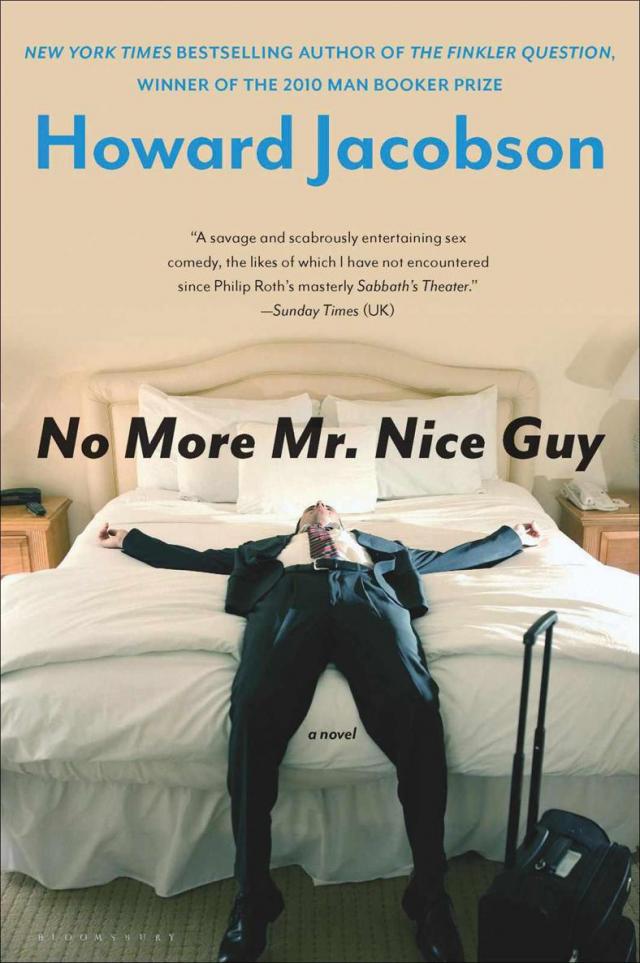


No More
Mr. Nice Guy
Praise from the UK for No More Mr. Nice Guy
“A savage and scabrously entertaining sex comedy, the likes of which I have not encountered since Philip Roth’s masterly Sabbath’s Theater.”
—Sunday Times
“Howard Jacobson is one of the funniest writers around … It’s hard to imagine a more entertaining book.”
—Observer
“Brilliant and funny … No More Mr. Nice Guy shows invention on every page, every paragraph. Jacobson is unique.”
—Evening Standard
“A very funny, very intelligent novel … How many of [Jacobson’s] contemporaries have described the male condition with such wry, unsparing honesty?”
—Sunday Telegraph
“Howard Jacobson is one of the funniest writers alive … His writing pulsates with nerve and edge; it is colossal in comic precision.”
—Daily Telegraph
ALSO BY HOWARD JACOBSON
Fiction
Coming from Behind
Peeping Tom
Redback
The Very Model of a Man
The Mighty Walzer
Who’s Sorry Now?
The Making of Henry
Kalooki Nights
The Act of Love
The Finkler Question
Nonfiction
Shakespeare’s Magnanimity (with Wilbur Sanders)
In the Land of Oz
Roots Schmoots: Journeys Among Jews
Seriously Funny: From the Ridiculous to the Sublime
HOWARD JACOBSON
No More
Mr. Nice Guy
A Novel
Contents
Cover
Title Page
One
Two
Three
Four
Five
Six
Seven
Eight
Nine
Ten
Eleven
Twelve
Thirteen
A Note On The Author
Imprint
For Peter Fuller
1947–90
ONE
‘GET OUT! JUST get out! Do it for yourself if you won’t do it for me. Take a holiday. Go away for a month. Go away for a year. You’ve had the best of my life. Can’t you find it in your heart to leave me to enjoy what little’s left of it?’
But what man can believe in his heart that a woman will enjoy her life without him?
‘Mel …’
‘Get out! Get the fuck out!’
He feels he is being attacked from the air. Buzzards are after him. Lean, ill-balanced, scraggy throated scavengers with torn wings and bleeding eyes.
Serves him right. Teach him to have loved the bird in the woman.
He sits in his study, his head on his desk, protecting his eyesight, amid the machinery indispensable to the smooth running of his life. The phones, the fax machine, the computers, the screens, the printer, the scanner, the photocopier, the batteries on charge, the tape recorder, the radio, the CD player, the strip-screen television, the laptop television, the VCRs, the manual typewriter in case of a power failure, the dictaphone in case of a manual failure. Only twelve months ago he had an electrician in to give him more sockets. ‘Enough to get me through to year fifteen of the new millennium.’ By which time civilisation will have discovered an alternative to electricity? No. By which time he will be dead. ‘Say two doubles on each wall?’ ‘Say three.’ Making eighteen in all, one wall being nothing but books. But already he needs more. Today every socket is in use, three with adaptors. Twenty-one plugs all warm and whirring at the same time.
‘Shut the fuck up or get the fuck out!’
The noise his room makes is part of the problem. He has the volume down on everything. The phones’ ringers are off. His laser printer is the quietest money can buy. He oils his office chair. He has rugs on his carpets. Nothing bleeps. If he is in his room when a fax is arriving – and when isn’t he in his room? – he throws a cushion over the machine to stifle the sound of the paper-cutter. He watches television all day. He can’t not watch television. Watching television is his job. ‘Wear fucking headphones, then!’ And he does. He sits in a creakless chair watching television all day, wearing fucking headphones, the gaps between his ears and the pads stuffed with tissues so that not a sound, not a squeak or a throb, can leak out and distract her from what’s left of her fucking life. If he could fit his halogen reading light with a silencer he would, God knows he would.
But the problem still isn’t solved. He fears that the problem can’t be solved. When she says he makes too much noise she means it ideologically. She can’t think with him in the house. She can’t think with him in her life. ‘Let’s face it,’ he says to her, ‘you can’t think with me in the fucking universe.’
‘Just try shutting your door,’ she tells him.
‘Ha!’ He laughs. As if one little door could fix it.
Everything is stopping her from concentrating. He is just part of the wider problem. It’s not personal. He can see that. Every adult female of her acquaintance feels as she feels. They can none of them think above the ceaseless racket of a masculinist universe: the humming of the spheres; the sizzle of static; the mad bleepings of car alarms – the assertion of men’s rights over men’s things.
But why can’t he just try shutting his door?
Ask him that and he’ll tell you that he’s keeping it open for her. So that she shouldn’t feel rejected by him. The truth is, though, that he’s the one who fears exclusion. He keeps his door open so that he can hear her moving about, hear her thinking, sighing. This isn’t jealousy. He isn’t straining his ears to catch her sighing for someone else. It’s devotion. Love. He’s fixated on her. He hears her breathe and he knows he’s alive. Close the door and he’s dead.
So that’s something else that’s preventing her from concentrating – the sound of him listening.
‘Stop that!’ she calls to him from her study.
‘Stop what?’
‘Stop listening to me!’
His point is that she couldn’t hear him listening if she weren’t so finely attuned herself. And by she he doesn’t just mean her, Mel, he means her sex.
‘You’ve turned yourselves into acoustic freaks,’ he tells her. ‘You’ve all got micro-hearing. You can hear yourselves fucking bleed …’
‘Bleed? Shows the age of the company you keep when you’re not at home. Women of my years don’t bleed.’
‘Doesn’t stop you listening.’
‘Frank, I’d leave the subject of blood if I were you.’
She’s starting to use his name. That’s how serious this is becoming.
‘Mel, you’re all out there tuning into the silent fucking spring. You can hear the grass grow. If I wasn’t here you’d be screaming at the fucking spiders for swallowing so loud.’
‘You go, I’ll deal with the spiders. I can tread on a spider.’
Go? Go where? Everything indispensable to the smooth running of his life is here.
She doesn’t use machines. Doesn’t hold with them. She writes her feministical-erotic novels long hand. When she’s interviewed about a book, which is rarely – since she finishes a book rarely – she says that slowness is of the essence. As with love-making so with prose-making. You can tell when a novel’s been written by mechanical means, she says. It lacks the pace of real life. The rhythm’s all wrong.
Like him. His rhythm’s all wrong. ‘In fact,’ she tells him, ‘you have no rhythm.’
‘You mean I don’t share yours.’
‘You don’t share anybody’s. When we first made love I used to wonder where you were. You seemed to be out there on your own, entirely solitary, going about your own private business.’
‘And later?’
‘What later?
He doesn’t say that her feministical-erotic heroines are all out there on their own, going about their private business, getting multiple orgasms as by right, without reference to whoever it is they’re getting them with. Or through. Or by. Or on. He doesn’t say that that’s the only thing that distinguishes them from pre-feministical-erotic heroines, who squandered their sexuality (whatever that fucking word means) fretting about what men wanted. That and the amount of inter-orgasmic intellectualising they do – these Serenas and Cybeles with cunts they can call their own and the conversation of Wittgenstein. It isn’t safe to talk about her work.
Just as it isn’t safe to talk about his.
‘What are you watching that crap all day for?’
He would like to say that it isn’t crap. That he doesn’t hold with snobbery about popular entertainment. But it is crap. And getting crappier. And he does hold with snobbery about popular entertainment. That’s the other reason for not looking beyond the year fifteen of the new millennium – there will be nothing left worth staying alive for.
He would also like to remind her that it’s his job. That he is the best television critic in the country. Or one of. That watching that crap all day is what pays the bills. That without his watching that crap all day she couldn’t afford the luxury of writing a hundred words a month. But that would take them back to talking about her work. Which isn’t safe. If he wasn’t sitting there with his door open watching that crap all day and listening to her listening to him listening to her, her output would be more like the hundred pages a month she was capable of before she knew he existed.
Nothing’s safe. Now they are fighting over towels.
They have towel rings in their bathroom, one above the other, to save space. On these they hang the identical chaste white dimpled French table napkins she insists on calling bath-towels. ‘What do you think it means,’ she asks him, ‘that in the twenty years I have known you I have always hung my bath-towel below yours?’
It is, of course, an ideological question. One that he knows better than even to attempt to answer.
She shakes her head, disgusted with herself, with her education, with her sex’s long connivance in the rituals of deference. ‘It’s utterly humiliating,’ she says. ‘I can’t assert myself sufficiently to put something of mine above something of yours.’
A string snaps in his brain. The buzzards have cut through a vein or an artery. He lurches past her, blood pouring out of his ears – blood must be pouring out of his ears; he can hear the rush – and pulls the towel from the higher ring. It is so light it floats like a rose petal before it lands. Even before it’s settled he is jumping up and down on it, treading it into a rag, mopping the bathroom floor with it like a curler sooping the ice. ‘OK?’ he says. ‘That better? That do? Or would you like to shit on it now?’
She wants to know why he is treating her towel like that.
‘What do you mean your towel? How can it be your towel? You’ve just seen me take it from the top ring.’
‘Exactly. That’s where mine has been hanging since this morning. I’ve started to assert myself.’
‘Started – !’ But he is not able to finish. A fax is coming through and he has to fly down the stairs to suffocate it.
He sits among his startled, twitching machines, like a shepherd calming his flock after a thunderstorm, and wonders whether it will be towels that finally do for the relationship – whatever that fucking word means. He considers himself hard done by around towels. When he steps out of a shower he doesn’t want to have to dab himself dry with a kitchen roll. Going from wet to dry should be a voluptuous experience. The towel he has always wanted wraps itself around you like a courtesan. In his mind’s eye he sees the towel he would have were he allowed a choice in the matter; it is as voluminous as a sail; it is as soft as a cloud; ribbed like an acre of Santa Monica beach; fluffed up like a Playboy bunny’s tail; the colour of a Pasadena sunset, all pouting carmines and molten golds …
‘To go with the gold chains around your neck …’
‘I don’t wear gold chains around my neck …’
But of course she means ideologically. Ideologically he is gross. A used-car salesman. An arriviste. A crap-watcher. His taste in towels proves it.
As does his taste in bathrooms. He would have liked a sunken bath. A spa system. A star’s dressing-room mirror, lit by a thousand winking bulbs. A Moorish tiled floor. Black silk blinds. And yes, yes, gold taps. What he gets is a Shaker chapel: plain white bath with its legs showing, hinges on the outside of the cupboards, tongue-and-groove walls, and communion cloths for towels.
But then he would have liked a penthouse or an apartment in a huddled mansion block to sink his Babylonian whirlpool in. Something with a Malibu terrace giving out on to the odours of the city, the fried food, the petrol fumes, the screams. Life. Life with a whiff of death in it. And what does he get instead? A whitewashed cottage on a village green in Dulwich. Dulwich! A garden. A wooden fence. Space. Death with a whiff of life in it.
So why doesn’t he assert himself?
‘Ha!’ Ask her. She knows. ‘You may not think it,’ she tells him, ‘but you are living, in every particular, the life you want. That’s why you stay. It’s what you understand. This is the domestic universe you were brought up in – you and the rest of your sex. A mad woman with an eating disorder hidden away in the bowels of the house, getting madder every minute, while you complain, bang your forehead, and get on with your work. You couldn’t live any other way.’
Couldn’t he?
Maybe he couldn’t. Maybe his know-all painstaking feminist pornographer of a companion, Wittgenstein-the-Fucking-Wise, is right: this is the only life he understands. There’s a deranged woman concealed in the attic, the bedroom, the kitchen, the scullery, the hen-house; there’s a lunatic loose – wasn’t that the terrible unspoken truth that the men in his family had passed down to him through the generations? He remembers his grandfather smiting his forehead whenever his grandmother opened her mouth. And didn’t his father do the same? Woman – mouth – speak; man – forehead – bang.
His father’s father’s brother, great-uncle Noam, used to rise from his rocking-chair, button up his waistcoat and leave the house the moment the mother of his children so much as gestured at him. As a young man he had enlisted to fight the Kaiser, took a wound in his knee and was photographed in gaiters. That gave him the right never to work again and never to be spoken to by a woman in his own home. Greataunt Isadora was permitted to clean for him, screw the heads off the chickens for him, raise sons for him, but not otherwise make a sound. Only let her look as though she might be thinking of saying something and Noam would put up his hand to indicate the desirability of silence, touch his head to denote the presence of craziness, and be gone limping through the door. Where did he go to every night? No one knew. Some said he had another woman. But who? A mute? Others claimed they saw him going into the local pub, and that he was known to sit over a single half pint of ginger beer and water, talking to no one, until closing time. Wherever he went, he went there every night of his married life for close to fifty years. And when Isadora died – with her lips sealed – it broke his heart. A month later he was dead himself. He couldn’t bear the loneliness.
Has he, Frank the crap-watcher, ever lived in a house, visited a house, heard of a house that doesn’t have a mad woman – a Mrs Rochester from whom you have to keep the matches, a Lady Macbeth from whom you have to hide the knives – sequestered away in it somewhere? These days it’s the keys to the drinks cabinet or the freezer you have to hide from them. The restaurant critic for his newspaper doesn’t leave for work until he’s marked the level of every bottle in the house with a hair plucked from his wrist, and even then he has to ring home from whichever eatery he’s scoffing in at fifteen-minute intervals, just to boost morale. ‘Hang on, sweetheart. Back soon. I don’t know, soon. Soon! All right, but only halfway up. Good girl. Love you.’ The books editor is herself a woman, never at home except at weekends. But she can do as much damage to herself on a Saturday morning in the kitchen before sun-up as any conventionally crazed Hausfrau can do in a week. Frank knows the hubby. Come Friday evening he has to remember to take the light bulb out of the fridge. ‘It doesn’t stop her,’ he explains to Frank, ‘but it slows her down.’
Woman – mouth – drink; man – forehead – bang. Alcohol, cigarettes, pills, penises, ice cream – if it fits into their mouth they’re in trouble. What does Mel weigh right now? Six, seven stones? Fresh out of Belsen. Her friends all look the same. Big staring eyes. Sunken cheeks. Rickety, uncertain limbs. Down in Mel’s kitchen, where they huddle, heroin-haggard, with their backs to the fridge, complaining about noise and shaking with hunger, it’s like Battersea Dogs’ Home. And last week they were all the size of Oliver Hardy.
He knows she is putting her finger down her throat again. The usual tell-tale signs. Blotches on her neck. Sinks clogging up. The liver-coloured nail polish on the finger in question corroding. But he doesn’t crack on he’s noticed. Live and let live is his philosophy. Which only underlines what she’s been saying: a house with a woman going mad in it is a perfectly acceptable phenomenon to him. He couldn’t live any other way.
And she’s right about his work, too. The further back into his room he is pushed, the quieter he is required to be, the better his column gets. Coincident with the finger going in and out of Mel’s throat, comes the award – Broadcasting Critic of the Year. Except that it’s no coincidence.