

Escape from manus prison, p.1
Escape from Manus Prison, page 1


Advance Praise for
ESCAPE FROM MANUS PRISON
‘Stunning. This book should be on every reading list in the country. Stateless, without papers and too often without a drop of water to drink, Jaivet Ealom escapes Myanmar and the Rohingya genocide that continues to destroy his people. From Jakarta to Manus Island, Papua New Guinea, in sinking boats and cargo planes, he lives by his wit. In this world, babies drop to the bottom of the ocean and men are caged, beaten, numbered. A chance reading of Viktor Frankl’s Man’s Search for Meaning restores his soul enough to get him, still undocumented, to Toronto. Ealom writes, “The choice of how I responded, or who I wished to be, was still my own to make.” We share Ealom’s world, and this choice is ours too. Read this book. Know who you wish to be.’ —Kim Echlin, award-winning author of Speak, Silence
‘An inspiring, eye-opening, harrowing, heartbreaking and triumphant journey that is testament to the resilience of the human spirit. The raw and vulnerable storytelling will touch you to your core and keep you spellbound till the last page. This book will restore your faith in the power of humanity that makes Canada the True North Strong and Free!’ —Samra Zafar, bestselling author of A Good Wife: Escaping the Life I Never Chose
‘This incredible, heart-stopping escape story is about shameful truths and spiritual authenticity; it’s about government sanctioned torture and it’s about redemption. Thank God Jaivet Ealom recorded his saga. From the merciless tactics of a government to the lyrical writing of a man who finds goodness in the face of evil, this book astonishes because it exposes the secret deals countries make to deny justice, and it takes you into the heart of a decent man. I couldn’t put it down and was almost breathless when I read the last page. My only unanswered question: Who will play Jaivet in the movie?’ —Sally Armstrong, bestselling author of Power Shift: The Longest Revolution
‘Jaivet’s memoir has all the taut propulsion of a thriller, yet devastatingly, this is a story all too real. Escape from Manus Prison offers a first-hand account of the brutal treatment of refugees at every turn, from exploitative smugglers to the xenophobic policies of foreign governments.’ —Camilla Gibb, bestselling author of Sweetness in the Belly and The Relatives
‘Art, culture and writing: these are gifts and they are weapons. I’m proud of Jaivet for speaking out—for history, and for all of those whom history would silence.’ —Behrouz Boochani, award-winning author of No Friend But the Mountains
It matters not how strait the gate,
How charged with punishments the scroll,
I am the master of my fate,
I am the captain of my soul.
William Ernest Henley, ‘Invictus’
VIKING
an imprint of Penguin Canada, a division of Penguin Random House Canada Limited
Canada • USA • UK • Ireland • Australia • New Zealand • India • South Africa • China
First published in Australia in 2021 as Escape From Manus by Viking, part of the Penguin Random House group of companies Published in Viking paperback by Penguin Canada, 2022
Copyright © 2021 by Jaivet Ealom
Epilogue © 2022 by Jaivet Ealom
All rights reserved. Without limiting the rights under copyright reserved above, no part of this publication may be reproduced, stored in or introduced into a retrieval system, or transmitted in any form or by any means (electronic, mechanical, photocopying, recording or otherwise), without the prior written permission of both the copyright owner and the above publisher of this book.
Some of the names of people in this book have been changed to protect their privacy.
www.penguinrandomhouse.ca
LIBRARY AND ARCHIVES CANADA CATALOGUING IN PUBLICATION
Title: Escape from Manus Prison : one man’s daring quest for freedom / Jaivet Ealom.
Names: Ealom, Jaivet, author.
Identifiers: Canadiana (print) 20210394757 | Canadiana (ebook) 20220132097 | ISBN 9780735245198 (softcover) | ISBN 9780735245204 (EPUB)
Subjects: LCSH: Ealom, Jaivet. | LCSH: Rohingya (Burmese people)—Biography. | LCSH: Rohingya (Burmese people)—Social conditions. | LCSH: Refugees—Burma—Biography. | LCSH: Refugees—Canada—Biography. | LCSH: Escaped prisoners—Australia—Biography. | LCSH: Escapes—Australia. | LCGFT: Autobiographies. Classification: LCC HV640.5.B93 E25 2022 | DDC 305.89140591092—dc23
Map of Jaivet’s journey by James Rendall
All photos courtesy of the author unless otherwise stated.
Cover design by Talia Abramson
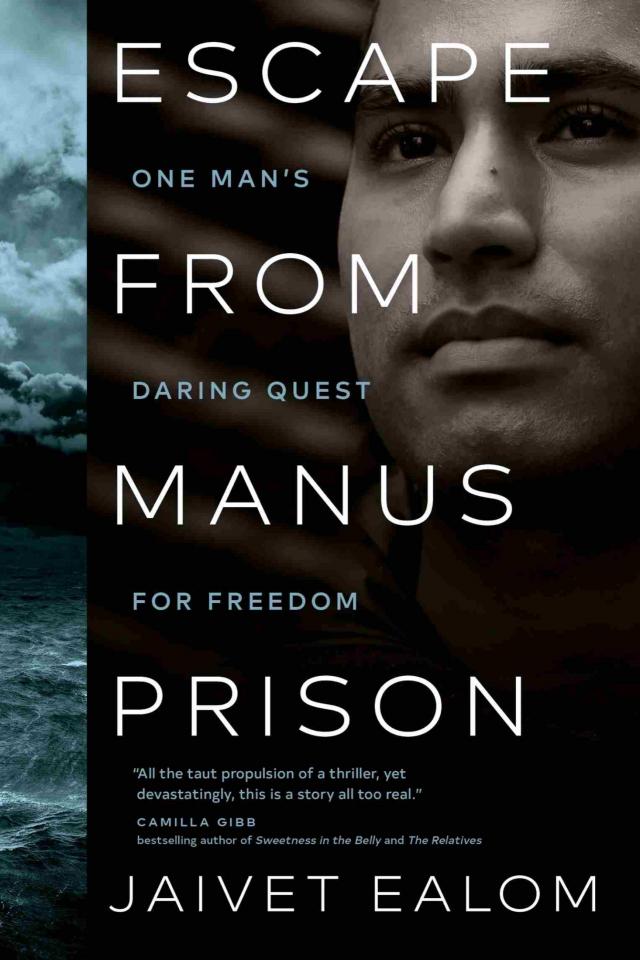
Cover images: (portrait of the author) © Cole Burston; (stormy ocean) © HadelProductions / Getty Images
Co-writer Craig Henderson
a_prh_6.0_140609986_c0_r1
Contents
Cover
Epigraph
Title Page
Copyright
Prologue
Chapter One
Chapter Two
Chapter Three
Chapter Four
Chapter Five
Chapter Six
Chapter Seven
Chapter Eight
Chapter Nine
Chapter Ten
Chapter Eleven
Chapter Twelve
Chapter Thirteen
Chapter Fourteen
Chapter Fifteen
Chapter Sixteen
Chapter Seventeen
Chapter Eighteen
Chapter Nineteen
Chapter Twenty
Chapter Twenty-one
Chapter Twenty-two
Chapter Twenty-three
Chapter Twenty-four
Chapter Twenty-five
Chapter Twenty-six
Chapter Twenty-seven
Chapter Twenty-eight
Chapter Twenty-nine
Chapter Thirty
Chapter Thirty-one
Chapter Thirty-two
Chapter Thirty-three
Chapter Thirty-four
Chapter Thirty-five
Chapter Thirty-six
Chapter Thirty-seven
Epilogue
Photo Insert
In Memoriam
Acknowledgements
About the Author
PROLOGUE
‘I’m going to die tonight. I’m going to die tonight.’
I was sad to realise I’d never feel the sun again. Most likely none of us would. It was past midnight and I’d had time to think things through. I accepted the finality. I was at peace.
Crouched around me in the darkness were a hundred men, women and children. The wind howled, and the air grew louder with the cries of desperate souls. Like me, they could see the world ending. Young families prayed together, united in their terror and grief. A mother clutched a baby close to her chest, looking at her child for perhaps the last time. A silent farewell.
Next to her, a group of men – fathers, sons, survivors – tried to project strength and calm. Others wept loud and long. They had made it this far, only to die on the relentless waves. Lost to history, soon to be forgotten. Their stories would never be written.
For all the desperation and pleas for help from God, it had fallen strangely quiet inside my head. I’d somehow managed to turn down the noise and switched off the lights, so I could have a final, frank conversation with my soul.
‘Have I been a good person? What is the measure of goodness?’
Staring straight at death made me look at my life. Twenty-one years on earth, and what had I done with them? Were my days just a waste of effort, or had I been a contributing member of the human race? Did I use my time here wisely? Had I made any difference at all?
I lifted my eyes to search for comfort in the permanence of the stars, but heavy clouds had muted the sky. The only light came from the wavering glow of a kerosene lamp and the glare of a couple of flashlights from the depths of the boat, where people took turns bailing out the rising water. They were fighting a losing battle. We were far from land on an angry sea and our broken vessel was sinking fast.
It had been three days since we’d all scrambled aboard the old fishing hulk off a far-flung beach near Kendari, Indonesia. The crew was supposed to sail us to Darwin, Australia where, according to a rumour that everyone had heard at one time or another, Australians opened their hearts and their country to people like us – those on the run from torture, persecution and death. We thought they were good and caring people, so different from the ones we were fleeing from.
The final maritime push in our gruelling odyssey toward salvation had been an almost comical study in human error. The agents we’d put our trust in turned out to be sneaky and unreliable. Alarmingly, they appeared to be incompetent as well.
The rickety boat they surprised us with – so unprepared for a long sea voyage – had bled oil and breathed smoke from the moment it departed. There was precious little food or water onboard, no navigational equipment beyond a compass, no radio and no life jackets. Now, seventy-two hours later, the hull had ruptured and we were sliding into the watery abyss.
That so many people – all of us strangers from different lands – would wager their lives on such a hopeless journey testified to our shared desperation. Each of us was fleeing conditions we considered harder to bear, on balance, than the possibili
Panic had swept across the deck earlier that afternoon when the bilge pump failed and the engine sputtered and drowned. An army of green waves pushed the boat sideways to the wind, and rocked it savagely. When word spread that its belly was filling with water, our belongings were dragged from the hold below and hurled into the sea.
Everything we owned, all the possessions we hoped to carry into our new life, was tossed out on the faint hope that we might survive the ordeal. My backpack was out there somewhere, bobbing along in the sad slick of our last worldly possessions. Not that mine amounted to much: some spare clothes, a few toiletries, and documents from Burma, the only place I’d ever known. Once my homeland, now the stage of a bloody genocide. It was with mixed feelings that I was leaving that life behind.
Whatever wasn’t nailed down eventually joined the sinking trail of luggage. Even the remaining diesel was drained from the fuel tanks and tipped overboard. The men took turns descending in small groups to bail sea water out of the hold using plastic containers. During my first shift, the water sloshed up to my knees. The next time I went down, at dusk, it lapped at my hips.
When night fell, our fears grew. It seemed the habit of the ocean to grow more combative once the sun had turned its back. Our timber hulk twisted in the peaks and valleys of unseen waves, each new swell promising to throw us overboard once and for all. We clung to the bucking, waterlogged boat with cold and aching fingers.
It was the end of our second day without food or water, and those of us who’d been scooping up buckets of the oily sea were worn out, as weak as kittens. It was around 11 pm when I last went below to help. Now the water was chest high. While I tried to stay strong, eventually my body gave out. As I dragged myself back to my place on the roof of the doomed boat, I knew what would happen next. ‘I’m going to die tonight.’
As someone who had always been a good believer, I was surprised the fear of God didn’t stir in me as I sat among the others and waited for the end. My shipmates were a mystery to me, and their hopes and the dreams they’d had would remain unknown.
For myself, I was fairly certain that death would come swiftly. Although I’d grown up near the coast I’d never learned to swim. I might have made peace with dying but I dreaded the thought of water pouring into my lungs. My only prayer was to ask God for a gentle end.
My thoughts turned homeward to Burma, where my younger brother Shahed would be waiting for an update on my journey to Australia. My cell phone hadn’t been in range of a signal for days, but I typed a message anyway: ‘Dear brother, tell Mom and Dad that I love them, and forgive me if I was not a good son. The boat is sinking. I didn’t make it. I’m sorry. Goodbye.’
I saved the message and pushed the phone into the pocket of my jeans. I hoped if my body washed up on the shore that maybe someone would find it, and somehow retrieve my dying words. Hungry, exhausted and balanced on the precipice of my remaining moments, I felt a wisp of sleep wrap around me like a blanket. As my eyes closed, I reminded God of my final wish.
‘Please let me die in my sleep.’
* * *
—
It wasn’t to be the last time I recited that prayer. On many a night in the years that followed – after I had finally made it to safety, and started an unexpected new chapter in my life – I begged God over and over again, ‘Please, kill me before I wake up.’
Eventually, the prayers would stop.
ONE
‘It will come: Humanity must perforce prey on itself.
Like monsters of the deep.’
William Shakespeare, King Lear, Act 4, Scene 2
‘You young guys are like tadpoles swimming in the hoof print of a bull.’ I’m not sure if it was my mother or grandmother who first explained my world to me in those terms. They were members of Burma’s Rohingya Muslim community, with the good fortune of being born in an earlier era of relative security. They remembered being able to travel wherever they liked, and live a life of freedom and choices. My brother Shahed and I – also born in Burma – did not.
Our world, growing up, was actually a roofless prison. Its boundary was a circle of land five kilometres wide and ringed with army checkpoints. My hometown was in the far north-west of the country, in Rakhine State (formerly known as Arakan and still referred to in that way by the Rohingyas). Maungdaw was a coastal trading city of about 400,000 – the majority of whom were Rohingyas – located near the border with Bangladesh. I was born a decade after Burma’s ruling military junta had stripped the Rohingyas of our legal existence and introduced increasingly draconian controls on our movements.
That town, just a dot on the world map, was the limit of my earthly existence. It was all I knew. I’d never seen a building higher than a two-storey village house, let alone a university or an airport. Not even the next town. Until I was seventeen years old I spent my entire life hemmed in, save for one emergency trip across the border to Bangladesh to see a doctor when my nose wouldn’t stop bleeding.
Our lives weren’t just constricted in a physical sense. Although it was a relatively busy trading hub, Maungdaw was anything but modern. A hostile government and inadequate planning had left us without the basics that other people might take for granted. Civil services were thin on the ground and households had to make do with just two hours of electricity every second day.
The region had been contested territory for generations. The Buddhist majority who controlled the country considered the Rohingyas to be illegal immigrants from Bangladesh, although our roots in Burma dated back centuries. The myth of our foreign origins, once invented and shared, was a sharp blade used to cut us from the national fabric.
By the time I was a toddler, the military rulers were well advanced in a focused, long-term program of oppression and harassment. Their campaign would eventually lead to the deaths of tens of thousands of my people, and the expulsion from our homeland of hundreds of thousands more.
Persecution and ethnic cleansing follow a cruel logic that is familiar from the history books. Now it was our turn. We lived under a kind of apartheid: our communities were segregated from Buddhist ones, and there were rules that applied only to us. We were forced to live in specified wards, register our houses with the regime and report how many people lived in each dwelling. Rohingyas were prodded, hounded and controlled. We couldn’t have an extra person stay as a guest in our home without written permission. Soldiers thought nothing of dragging terrified families out of bed in the middle of the night for a surprise head count.
We had our own language and customs, and the regime, eager to shore up its claim to legitimacy, used culture as a wedge to deepen the gap between the minority and majority. Our access to education was blocked through a government tactic of placing schools in Buddhist neighbourhoods and staffing them entirely with Buddhist teachers. School was a staging ground for abuse, and Rohingya kids wept with fear at the mere suggestion of leaving home for lessons. Children either didn’t attend or were so marginalised in classes that they were better off at home.
At school, as in the wider community, the Rohingyas were faced by a presumption of guilt. When a transgression or a perceived crime occurred, especially in a case of a Rohingya against a Buddhist, no investigation was required – the Buddhist always won.
There was no need to kill us outright, not at that point. The system was stacked against us: the laws, the media, the culture and the way people understood the world. It was the birthright of the Rohingyas to carry the blame and the shame.
Rohingyas of my generation were forbidden from joining the public service. In a nation entirely dominated by the government, this meant we were reduced to lives of menial employment: manual labour, fishing, farming or working in small shops.
To rise any higher was to ask for trouble. A Rohingya who swam against the tide and managed to become educated might be a target of the government and be thrown in jail on spurious grounds. I happened to be one such creature, a tadpole that managed to leap out of the bull’s hoof print and into a decent school.


