

Backwoods witchcraft, p.1
Backwoods Witchcraft, page 1


PRAISE FOR BACKWOODS WITCHCRAFT
“Wander the ways of witchcraft in the mountains of Appalachia! In Backwoods Witchcraft, Jake Richards presents a fresh perspective on the practices, lore, and magick of the hillfolk of Tennessee. Jake offers a plethora of charming tales from his family and upbringing as the reader is delighted to partake in a time-honored, homegrown, century's-old culture of ritual, spells, and beliefs from the American South.”
—CHRISTOPHER ORAPELLO, podcaster, artist,
and coauthor of Besom, Stang & Sword
“Jake has dug deep into the mountains and the land to share the wisdoms of his people, and he has done a wonderful job. He has shook the memory of this ole conjure woman and made me remember some things that I haven't thought of in years. I feel that this book is a blessing from the ancestors to draw forth knowledge that has been citified, changed, and lost. The land holds the memory, bones, and blood of the ancestors; and knowledge holds the key to unlocking what has been lost. I feel this book will help some to turn the key and open that door. Many blessings, Jake, and congratulations on a job well done!”
—from the foreword by STARR CASAS, author
of Old Style Conjure
“In Backwoods Witchcraft, Jake Richards shares his memories of growing up with Appalachian folk magic practices as they were passed on to him through generations within his family. In so doing, he offers a snapshot in time, recording and preserving a tradition of American folk practices, many of which are being forgotten in the post-industrial age. Richards presents family stories and experiences that came with learning the charms and formulas themselves. In doing so, he teaches the techniques in the context of the ideas behind the recipes, something that is often lacking in a lot of books on American folk magic. His writing comes across as humble, sincere, simple, and clear to follow. Backwoods Witchcraft is a great contribution to the writings on traditional folk magic.”
—MAT AURYN, author of Psychic Witch: A
Metaphysical Guide to Meditation, Magick, and
Manifestation
This edition first published in 2019 by Weiser Books, an imprint of
Red Wheel/Weiser, LLC
With offices at:
65 Parker Street, Suite 7
Newburyport, MA 01950
www.redwheelweiser.com
Copyright © 2019 by Jake Richards
Foreword copyright © 2019 by Starr Casas
All rights reserved. No part of this publication may be reproduced or transmitted in any form or by any means, electronic or mechanical, including photocopying, recording, or by any information storage and retrieval system, without permission in writing from Red Wheel/Weiser, LLC. Reviewers may quote brief passages.
Bible verses in the text are from the King James edition.
ISBN: 978-1-57863-653-2
Library of Congress Cataloging-in-Publication Data available upon request.
Cover design by Kathryn Sky-Peck
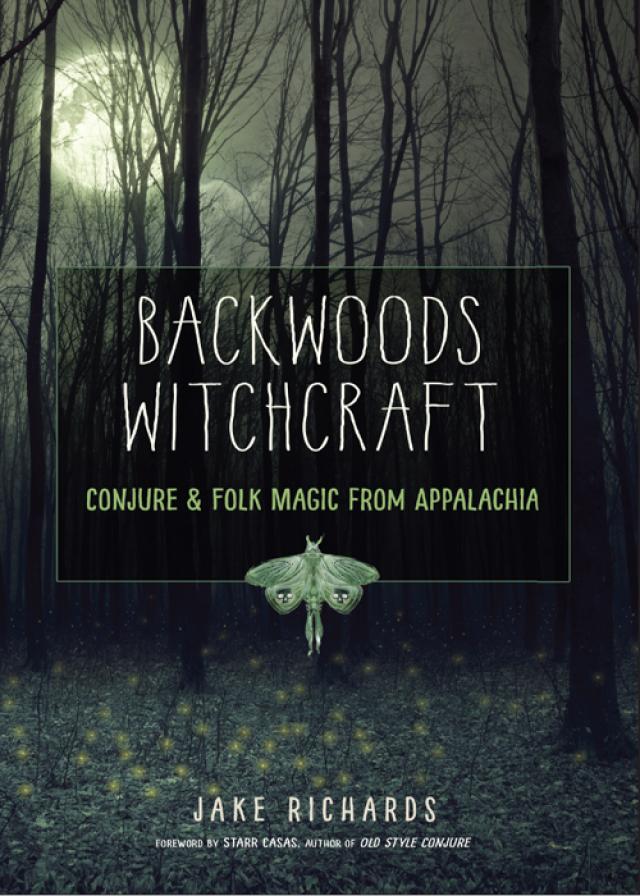
Cover photograph by BigStock / Moth art © Jake Richards
Interior by Maureen Forys, Happenstance Type-O-Rama
Typeset in Adobe Jenson Pro with Pinto and York Handwriting
Printed in Canada
MAR
10 9 8 7 6 5 4 3 2 1
www.redwheelweiser.com/newsletter
I will lift up mine eyes unto the hills,
from whence cometh my help.
PSALM 121:1
CONTENTS
FOREWORD
ACKNOWLEDGMENTS
PREFACE
INTRODUCTION
Through the Quilting Hoop
1
THESE ROOTS RUN DEEP
Terrain and Culture in Appalachia
2
DOWN DEVIL'S RUN
Stories and Superstitions
3
BAREFOOT WANDERING
Connecting with the Land
4
SOUP BEANS AND CORNBREAD
Ancestor Veneration
5
FROM THE EAST, FROM THE WES
Living by Signs and Omens
6
FOLK RITES OF THE MOUNTAINEER
Techniques and Methods of the Power Doctor
7
SAINTS ON THE RIVER
Spirits of Southern Appalachia
8
CASTING APPLE SEEDS
Spelling and Fortune-Telling
9
STOLEN FLOWERS
Tools and Supplies
10
WHEN THE ROOSTER CROWS
Appalachian Candle Magic, Doll Babies, and Other Trickery
11
PRAY THE DEVIL DOWN
Folk Recipes and Remedies
EPILOGUE
BIBLIOGRAPHY
FOREWORD
When I was first asked to read Jake's book, I'll be honest, I didn't really know what to expect. I thought to myself, I'm gonna read it with an open mind and go from there. I have to say I wasn't expecting some of the things he has shared in this book. These are things you don't see written about or talked about—the only way you know about them is if you were raised in a family who told the stories and lived the life. There are tons of hidden wisdoms within the pages of this book. You simply have to know what you are looking at to find them.
There was a time before the internet when charms and works were thought of as nothing more than ole wives tales and backward folks' superstition. Things have changed, and now folks are beginning to see and to understand just how powerful those superstitions and wives tales really are; because at the end of the day, they aren't just tales after all, but a strong foundation that some of us are lucky enough to build upon. I feel like the ancestors are pushing forward, they want the wisdom of past ages shared. Folks need the powerful foundation of these ole tales in today's world, and Jake has done a wonderful job of sharing his knowledge through this book.
Some knowledge about this work has been worn thin by writers and folks who found it online; Jake shares information that I have never seen anyone reach or write about anywhere. For instance, I have never seen anyone talk about a corncob over the door for protection! I know that work because of how I was raised, but I'm sure this is new to some folks. The reason it is good for protection is because of all the holes in the cob—the work would have to find its way through all of them to get to the house. It's a very powerful work. Then there is the potato work he gives—once again, only someone raised on the stories would know this is not information that is widely known.
This book is filled with useful knowledge, and I feel even the oldest worker will benefit from it. Jake has dug deep into the mountains and the land to share the wisdoms of his people, and he has done a wonderful job. He has shook the memory of this ole conjure woman and made me remember some things that I haven't thought of in years. I feel that this book is a blessing from the ancestors to draw forth knowledge that has been citified, changed, and lost. The land holds the memory, bones, and blood of the ancestors; and knowledge holds the key to unlocking what has been lost. I feel this book will help some to turn the key and open that door. Many blessings, Jake, and congratulations on a job well done!
STARR CASAS, author of Old Style Conjure
ACKNOWLEDGMENTS
I would like to dedicate this work firstly to my mother, Brandi, for always being the one who held everything together and for taking on the world for us growing up. I owe all my strength to you. You were also the one who encouraged me to go down this path and complete this book. You made me believe in myself when you didn't think you could go on another day. Thank you for giving me a way to see.
To my grandmother Margaret for always being my best friend, my second mother, and my partner in crime. Your wisdom and love has deepened my life and spirit more than you will ever know.
To my late grandfather Eugene for always being the highest point, in my mind, of mountain faith. You had your battles, but you won out in the end. Must run in the family. Although today we would have differing views on things, I hope I've made you proud in some way.
To my late great-grandmother Lois thank you for showing me to always look for the top of the mountain, no matter how low the valley I'm in may be. I will always cherish your memory.
To my late grandfather John Critchton who sadly did not get to see my first publication through. Thank you for instilling in me some of the sense it takes to get through this world and the humor to go along with it.
To my partner, Torrey. You've been by my side through more things than most people can stand for. You've seen me at my worst and my best, and always loved and supported me either way in everything I do. I cherish you for that.
And lastly, to all our ancestors, known and unknown, who depended on this mountain work and medicine to survive. Your trials and troubles are seen, you are understood, and you are remembered.
PREFACE
Now, most folks have heard of the hoodoo and folk magic practiced in Louisiana, Texas, and other ways out west. But ours is rarely spoken of, if at all remembered. The witchcraft of these hills is a culmination of the practices of different tribes and peoples who settled in these mountains long ago—people who just mixed into the roots and rocks of the hillside and called it home. Now those roots and rocks are becoming a grave.
Nestled here in some of the oldest mountains on earth, our people are a mixed breed of the Irish, Scottish, German, and other settlers who came to call these hills home. This mixture includes the folk practices brought up through the slave trade and the practices learned by the neighborin
The hollers of North Carolina, the valleys of Virginia, and the mountains of Tennessee have been witness to a system of witchcraft unique among its sister traditions of the Deep South and cold North as well as its child tradition of the Ozarks. This craft has been passed down through whispers over biscuits in the kitchen, seen in the hands of grandmothers sewing or spinning wool while entranced, and smelled in the chimney smoke carried up the mountainside. It's in the digging by sore hands and the churning of the mortar and butter churn. It's work and a way of life.
You may have heard this craft called granny magic, hill folks hoodoo, or mountain conjure, but it's all the same. Every name describes the same rooted ways of my ancestors and the lands they chose to lay their bones in. The old folks didn't call it much of anything, really; but back then those who knew these ways were called healers, tellers of tales, power doctors, and conjure folk—and yarb doctors by the Christian townsfolk.
Today, we call these workings and beliefs a multitude of things: Appalachian folk magic, Appalachian conjure, or simply trying. All terms denote the same practice, but each worker prefers a particular one—or maybe none at all. But back then it was just what you did or said when you needed something. It wasn't magic or spells: it was life and prayer.
I grew up in East Tennessee in the valleys below Buffalo and Roan Mountain. My family was mostly farmers in Virginia, Tennessee, and North Carolina, some going back a good three hundred years. I spent most of my childhood at my great-grandmother's house on the side of Big Ridge Mountain near Devil's Nest in North Carolina. My family always spoke of the old wives' tales and folk remedies; who could cure what or what to do if this or that happened. They were mountain people to the bone: hunters, farmers, blacksmiths, faith healers, preachers, and root diggers.
My family's history is filled with this work. Papaw Oscar was a water witch. Papaw Trivett never met his daddy, so he could cure thrush, stop blood, and “blow out” burns. Mama's a seventh daughter, a natural-born healer. Nana has the sight and dreams true. And the list goes on.
Most of the knowledge of these hills has been lost to the oppressions of time and poverty. Before, this knowledge was known only by memory, and now the elders are quickly passing or forget. My mother's mother has forgotten due to the Alzheimer's, but she still sees. Young folks are walking around not knowing they have some of these gifts. We need a new generation to keep these roots alive. I am of that generation, and I hope you will be too. This magic is more than a tale of the hills and the whispers of the autumn fog; it's the history of my blood and bones, and possibly yours.
INTRODUCTION
THROUGH THE QUILTING HOOP
The unique thing about Appalachian folk magic is that there's no one right way to do it. Depending on what mountain or holler your family is from, you might practice differently. These differences are due, in part, to the close clans of the Irish and Scottish who came here. Maybe those traditions were unique to the clan and the region they came from. These were further separated by oral traditions being passed down through generations in different regions and evolving over time. The way I prepare candles and tie knots is different from the way my friends do in Virginia.
The common links between the formulas are the practices, beliefs, and good sense. Some families prefer to use candles for rituals, while others prefer oil lamps (this all depends on how many kids you have and how likely it is the light will get knocked down). Some families hang corncobs over the door for good luck, while others use horseshoes.
What I'm presenting in this book is what I have learned from my own family and gathered in my conversations with other mountain workers. You'll learn the ways we watch the smoke, charm the fire, and stir the water to tell fortune and fates. You'll see how we work the candles and lamps, cure unnatural illness, and jab those who do us wrong.
Appalachian folk magic is by no means a complete tradition. It varies by location, family, and time. Of course, all folk magic traditions in these Highlands are but fragments of history, like a line of camera film with missing frames or indiscernible images. This is an heirloom passed down of the oral traditions, broken in places and with pieces missing.
The works and ways you will find in this book are both new and old. The roots to them are true and worn, with add-ons here and there from my own learning and my own making that I have found to work. Any additions are crafted by the same thought and needs, tied with the same cord of prayers, and blessed by the same name. This book is a partial reconstruction of a continued way of living and surviving.
This is my attempt at piecing together the lost works and ways that were once practiced abundantly on this red clay earth while bringing them into today's mind and wonderings, with the seams fitted to the new shape and dimension of a modern societal framework. This is my offering to the past, to the history of these hills and the future survival of our twisted roots.
I will do my best to explain these ways in great detail for those new to the practice. I can also promise you that I do not sell lies or speak on that which I do not know. Those who know me know that I have a no-nonsense attitude when it comes to this work, and I will keep that same mind-set here. You will not find rehashed practices of Wicca or other traditions that have been told and sold as Appalachian more times than you can count.
Instead, I'll teach you the charms and roots of my family, in exchange for your promise to uphold this tradition and preserve it as it is and was and will be. I am the only yarb doctor on both sides of my family now who actively does this work. Help me bear the candle, light your flame from mine, and let's continue this for a thousand more generations to come.
Now, I also know that I tend to ramble a bit, going from one thing to another. For your sake, I will do my best to not pull you down other trails. No guarantees, though. Because how else do you learn the mountain if you don't get lost a bit?
THE BIBLE AND GOD
Regardless of your own preferences or beliefs, the Bible plays a major role in Appalachian folk magic, as it is set into the religious traditions of the Southern Baptists and Protestants. The Bible is often used as a “spell book” of sorts, but those who grew up in a close-knit Baptist household in Appalachia understand that the Bible means more than just the Word of God. It's the cinnamon candy at the bottom of Nana's purse. It's the sound of bells and the stiffness of church clothes on Sunday morning. It's the sweat and tears of decades of preaching and testifying. It's the soul of our people.
In Appalachia, the family Bible was often used to record births, deaths, marriages, and other events. Important dates and names would fill the blank pages inside, as would makeshift family trees, pictures, certificates, and newspaper clippings, and locks of baby hair or a baby's hospital bracelet. These Bibles are a testimony to the history of the people, written by the people. I have a couple of my grandfather's Bibles that I continue to use the way he did.
In my family, it wasn't so much as you're going to hell for not following its teachings. My father once said, “It just makes sense. All your ancestors were Christian.” That's only somewhat correct, but what he meant hit me deeply. So, at least in my family, family tradition is as important as the Word of God, and they interconnect in many places.
With it being tradition, one would think the Bible was held to a high law, but it was actually followed quite loosely. Many folks will to this day get drunk on Saturday and go to church on Sunday to ask for forgiveness. These hills know the sins of its people, but they are understood. Christianity in Appalachia is a different flavor from the rest of the country—hell, the rest of the world. The harshness of biblical law was often softened by the oppressions dealt to Appalachian people. They were humble and isolated; alone except for the family on the mountain and the Man Upstairs. I presume God here became more of a parent than a king to be bowed to. He became company, family, and the refuge of these hills.


