

Bacon in moscow, p.1
Bacon in Moscow, page 1


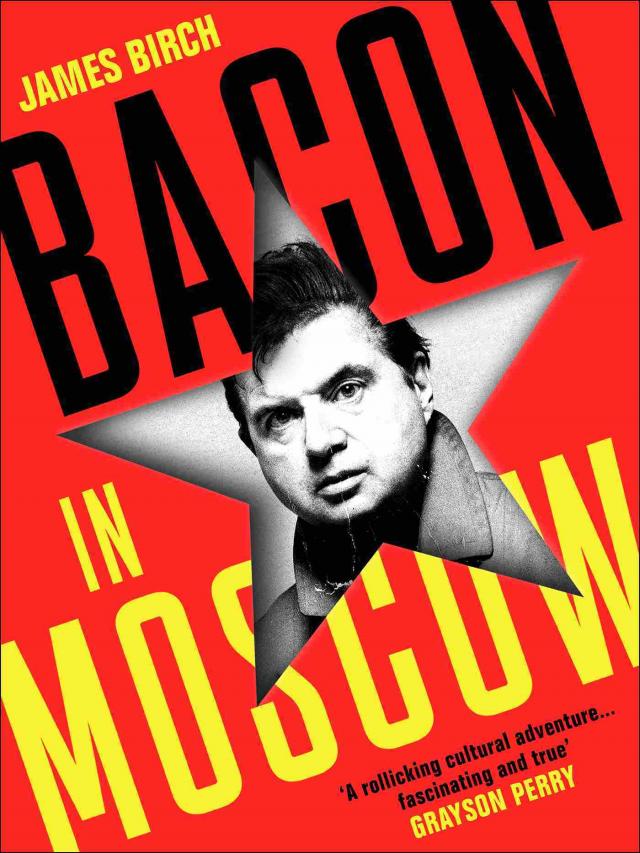
BACON IN MOSCOW
James Birch
with Michael Hodges
BACON IN MOSCOW
First published in Great Britain in 2022 by
Cheerio Publishing in association with Profile Books
www.profilebooks.com
www.cheeriopublishing.com
info@cheeriopublishing.com
Copyright © James Birch, 2022.
Design : Justine Bannwart
Cover design : Steve Panton
1 3 5 7 9 10 8 6 4 2
The moral right of the author has been asserted.
All rights reserved. Without limiting the rights under copyright reserved above, no part of this publication may be reproduced, stored or introduced into a retrieval system, or transmitted, in any form or by any means (electronic, mechanical, photocopying, recording or otherwise), without the prior written permission of both the copyright owner and the publisher of this book.
A CIP catalogue record for this book is available from the British Library.
ISBN 978 1 78816 9745
eISBN 978 1 78283 9484
For John Edwards
Glasnost :‘openness’ to policy reform.
Perestroika : ‘restructuring’, in this case restructuring of the Soviet political and economic system in an attempt to end the stagnation of the Brezhnev era.
‘We want bacon, not Francis Bacon’
(comment in the visitors’ book to the exhibition)
‘In one of Van Gogh’s letters he makes this statement :
“How to achieve such anomalies, such alterations and re-fashionings of reality that what comes out of it are lies, if you like, but lies that are more true than literal truth.”’
Francis Bacon, London, 04/06/1988 —
Contribution to the Catalogue to the Exhibition in Moscow.
‘I enjoyed Francis Bacon very much. I would like to study art with him.’
Chuporov Eugeniy, SCL09 No. 791, Form 2B, 8 years old
(comment in the visitors’ book to the exhibition)
AUTHOR’S NOTE
This story is written partly from memory but also with the help of detailed diaries that I kept from the date of meeting Sergei Klokov and Elena Khudiakova in Paris in 1985 until 1992.
I also created an archive of all correspondence I received during this time, including letters from Francis Bacon, telegrams from the Union of Artists in Moscow and all relevant newspaper cuttings and invitations.
I have drawn on all of this material while researching this book.
My ambition was to write a true and faithful reckoning of a brief but intensely interesting period in twentieth-century European history from a very personal perspective.
Any mistakes are my own.
James Birch
May 2021
I
In October of 1988 I took Francis Bacon to Moscow, an unimaginable intrusion of Western culture into the heart of the Soviet system. I was only 32 but I’d known the world’s greatest living artist since childhood. He was a friend and from my adolescence onwards I spent a lot of time in his company. I joined him for drinks at the Ritz and accompanied him on his champagne benders around Soho, dining with him in the Greek restaurant The White Tower, which he loved, and conspiring with him as we stood in the sticky corners of The Colony Room (he rarely sat).
But this does not fully explain how I found myself in the USSR just as it was teetering on the edge of its own destruction, under twenty-four-hour surveillance by the KGB and side-lined by the British establishment. More than that, I felt morally responsible for the thirty or so works of Bacon’s due to be shown in the exhibition, and I was falling in love with a beautiful Russian fashion designer.
I could say it was Sergei Klokov’s doing. He was the fixer, a man who knew how to make the impossible happen in Moscow and was willing to do almost anything to ensure that it did. It was Klokov who introduced me to the ravishing Elena Khudiakova. But the story doesn’t begin with Klokov.
It really begins with James Bond, when I started to read the Ian Fleming books as a boy. I loved the stories and I especially admired the book jackets designed by the British artist Dicky Chopping, their colours and imagery : bones, knives, guns, frogs, everything a child loves. They were of their time and without fully understanding, they ignited my lifelong interest in surrealism. I had unconsciously started collecting.
Art was the family affliction long before I came along. My parents met in Cambridge where my father was studying architecture, and he followed my mother to London where she was studying at the Chelsea School of Art. One of her tutors was Henry Moore. It turned out that my father couldn’t draw well enough to become an architect so he began to paint instead. After they married, they made a living painting murals together, though mostly for friends. My brother and sister, both born some years before me, went to art school in Florence.
JAMES BIRCH IN BATH. PHOTOGRAPH BY FRANCIS BACON.
When my parents visited my siblings in Italy I would go to stay with my grandmother in East Anglia. She lived in a Suffolk landscape of marshes, mud flats, tidal reaches and, at night, thousands of stars. All of which attracted flocks of wading birds and, because it was cheaper than London, artists.
Many of these visiting artists would come to lunch at my grandmother’s. I would also attend, sitting in wonder as a succession of exotic creatures graced the table. Many were well known at the time ; Cedric Morris, John Nash and, to my great excitement, Dicky Chopping, illustrator of the Bond novels, and his partner Denis Wirth-Miller.
Dicky and Denis lived nearby, and when my parents took a cottage in the area the couple became firm family friends. In turn they would often bring their friend, the painter Francis Bacon, to the house. On one occasion as a boy, I was having a bubble bath when the three of them came into the bathroom. Francis found a camera and took a photo of me. I still have it. No one in our household seemed scandalised by this, though a prevalent view of the time was that all gay men must be paedophiles. I do recall that a friend of my mother later asked, ‘What were you doing, letting Francis and Dicky and Denis bath him? How could you leave him with them?’ To which my mother replied, ‘Well, I trusted them completely.’
According to my sister, Jacqueline, they simply thought of me as an ‘angelic child’. Dicky and Denis were family to me and famously kind to the children of their many friends. Later as I grew up I was somehow allowed into the inner sanctum of their friendship with Francis. My dawning awareness of the separation between the man I knew and the great artist he had become began in 1971 at about the age of fourteen, when I bought a copy of Francis Bacon by John Russell. I pored over the pictures in the book and failed to see the nightmarish quality that so many people remarked on. Instead I was struck by the grand theatricality, the images, the vibrant colours and the structure of the work.
Denis and Dicky were Francis’s oldest friends. Francis was in his late forties when the couple introduced him to my parents. They had liked him from the beginning. Contrary to the popular legend of the unhappy, angry man that was suggested by the brutal and tortured imagery of his paintings, my parents found Francis to have a gentle disposition and charming manners.
Dicky and Denis’ Essex idyll at Quay House in the town of Wivenhoe suited Francis’s tastes well ; so well that he would later buy a house there, on Queens Road. Francis would come to paint and Dicky and Denis would bring him to our summer cottage. These visits continued throughout my childhood and into my twenties. I’d find the three of them sloshing down wine at lunch or dinner, or sometimes both. My parents were enthusiastic hosts and the meals often merged into one another. At parties in London, they would often put Francis into a taxi to send him back to 7 Reece Mews only for him to get straight out the other side and return to the throng.
Life in Wivenhoe wasn’t entirely domestic. There was an enticing military garrison at Colchester close at hand. Dicky and Denis treated Colchester like it was a sweet shop, frequently picking up squaddies from the town for casual sex. They would then snip off the brass buttons from their army uniforms as a trophy ; several boxes of buttons were found in Quay House after their deaths.
I knew nothing of these goings-on as a schoolboy but was very conscious then of the web of connections between us all. Dicky, Denis and Francis were, in effect, my uncles.
But Francis was in my life before it had even properly begun ; his story was already caught up in mine. In the 1950s, before I was born, Francis came to our house at Primrose Hill and offered my father two paintings. Francis’s career was really beginning to take off, but he still struggled with money. He was represented by Erica Brausen at the Hanover Gallery in Mayfair. Born in Dusseldorf, Germany, Brausen had helped refugee Republicans to flee from Franco’s Nationalist forces in Spain before, finally, arriving in England with little to her name. She survived through sheer determination and an ability to meet the right people at the right time and then magic money out of them ; key attributes if you are to make it in the art business.
Supported by American tobacco heir Arthur Jeffress, the Hanover opened in 1948 and rapidly became one of the most influential contemporary galleries in London. When later that year Alfred Barr, the founding director of the Museum of Modern Art in New York, walked in, Brausen persuaded him to look at a startling work by a new figurative artist Francis Bacon.
The work, Painting 1946 is now regarded by many critics as the moment when Francis stumbled upon a style that captured the existential fears of a Europe that was contemplating both the reality of the Holocaus
Barr paid £150 for the painting and perhaps the price stayed in Francis’s mind for he suggested the same figure to my father when he came to Primrose Hill, and that was for two paintings, not one. Definitely a bargain, but £150 was a lot of money in those days and my father had to say no.
Barr had no such financial worries and he became an early and enthusiastic supporter of Bacon’s work ; in 1957 he wrote to Brausen describing Bacon as ‘England’s most interesting painter’. But to me he was the nice man who Dicky and Denis would bring to the house ; a man who was interested and kind to me.
LETTER TO JAMES BIRCH FROM FRANCIS BACON
When I was young, I was obsessed with a TV series called Rawhide, so much so that it became my nickname. This tickled Francis’s sense of humour and he sent me a letter addressed : ‘TO RAWHIDE. WITH ALL BEST WISHES, FRANCIS BACON’. I was thrilled. And like all the things I value, I still have it.
In my teens, on journeys to East Anglia, I would often encounter Francis on the platform at Colchester Junction station, waiting to catch the connection to Wivenhoe, and sometimes we would travel together.
Thanks to the open house policy of both my grandmother and my parents, my sense of what artists are like, how they should be handled, how prickly they can be, how fragile their egos are and above all, how wonderful are the things they create, was formed in my childhood. But I didn’t want to be a painter, I wanted to show paintings ; I wanted to have my own gallery.
By 1983, my childhood dream had become my profession and obsession and, much to the surprise of my family, who had put up with various schemes and plans which ran to greater or lesser success, I had my own gallery at Waterford Road, a street at the far, very unfashionable Fulham end of the King’s Road, miles away from the centre of the art world in Mayfair’s Cork Street and Bond Street in the West End.
Below World’s End the King’s Road was mostly made up of antique dealers, but it was rare for their customers to enter the gallery. There was also a Coral betting shop next door. We opened Monday to Friday. Saturday was pointless because just a few streets away there were football matches at Stamford Bridge stadium, and boozed-up Chelsea fans would stick their heads in and ask, ‘What’s all this fucking shit, then?’
It wasn’t shit to me. I was enamoured of British surrealists and the more experimental contemporary artists who had a similarly esoteric approach to art, especially the Neo Naturists, a group centred around four mercurial young artists, sisters Jennifer and Christine Binnie, Wilma Johnson and Grayson Perry. They were all good but Perry, an angry young man from Essex, a transvestite who also wore black leather motorcycle gear and made fantastic pots and plates in the tradition of English ceramics but with images of teddy bears, sex scenes and motorbikes, fascinated me. They were like nothing I had ever seen. The Neo Naturists would appear at night clubs, galleries or parties wrapped in long coats and then at some point in the evening suddenly disrobe to reveal naked bodies hand-painted with flora, faces or abstract patterns. In 1985, they had issued a manifesto of sorts proclaiming, ‘The Neo Naturists like taking their clothes off for the sake of it.’ But their performance art was more than that, they were an anarchic counterpoint to the increasingly money-driven atmosphere of the London art world. I admired their idealistic anti-materialism. The problem was, if I wanted the gallery to survive, I needed some money coming my way.
In short, I needed to sell art. I needed to discover new artists and build my own stable, and I needed to create events to spark interest in their work from a buying public. This was Thatcher’s Britain and the prevalent mood was, to quote a Pet Shop Boys’ hit of the time, ‘Let’s make lots of money.’ I didn’t want to be rich but I needed to survive, and perhaps that put me at odds with the prevailing spirit but Jennifer and Christine, Wilma and Grayson represented the things that excited me most about art. I wanted to spread the word, I wanted people to know about them and their work. But London was bursting with shows and if I wanted the exhibitions I mounted to compete I had to pursue a share of the limited press attention available.
I hosted numerous promotional parties at the gallery but they brought in little money. Jennifer’s dream was to ride naked on a white horse down the King’s Road, so for the opening of her second show, she did just that. It made the pages of the Evening Standard and the Hammersmith and Fulham Gazette, but that was about it.
It was in November of 1985 that my friend Frances Welsh, who was working on the Standard’s diary pages, and the artist Pandora Monde, a bohemian aristocrat, came up with an idea : they threw a party specifically to introduce people who didn’t know each other.
As much fun as this was supposed to be, I wasn’t sure how it would work out in practice, but I understood the power of meeting people and making connections. So, taking a young artist I was showing at the time, a shaven-headed street poet called David Robilliard, we shut up the gallery and made our way to the venue in Campden Hill Road. We arrived at the house to find an uproarious room crammed with people who hadn’t met each other before but were becoming better acquainted by the minute. I passed through the throng feeling rather shy, unable to see Frances. David had been immediately swallowed up by the crowd. So it was a relief when I recognised Bob Chenciner struggling towards me. An impish and prematurely balding academic who occasionally came into my gallery, Bob was in the fine carpet business, hunting for ‘dragon rugs’ and bringing them into the West from the Soviet Central Asian republics and Caucasus, and more generally he had a keen eye for art and architecture.
He described himself as a ‘cultural entrepreneur’ and regularly visited the USSR where earlier that year Mikhail Gorbachev had become General Secretary of the Communist Party of the Soviet Union. I was aware from the news that Gorbachev had started to talk of two supposedly epoch-making policies, glasnost and perestroika : openness and reconstruction. But as we drank Pandora’s champagne, Bob spoke of a vast, half-starved Soviet empire that had yet to embrace openness or restructuring and remained a terrifying KGB-run country where the ridiculous and the deadly often went hand in hand. Bob had just returned from Ashgabat, capital of the Turkmen Soviet Socialist Republic, 1,597 miles south-east of Moscow.
‘I was dancing in the only nightclub in the entire city,’ Bob hooted in my ear, ‘and my minder, this very eccentric guy called Klokov, said to me, “The KGB have been watching you dance and they’ve just told me that you are doing it with too much enthusiasm. We have to go now !”’ Bob expanded on his theme. ‘James, wherever we went, at some point Klokov would stop me and say, “Bob, we have to go now.”’
That was the first time I heard Sergei Klokov’s name. Though I didn’t yet know it, little in my life would be the same again.
‘So, what exactly does Klokov do?’ I asked.
‘Officially, he’s a diplomat with a special responsibility for culture,’ said Bob. ‘But,’ he paused dramatically, ‘he has other powers.’
These other powers, it seemed, were as much an expression of Klokov’s personality as they were of his shadowy status in the security apparatus. They had, according to Bob, most recently manifested themselves at an airport outside Moscow.
As Bob told it, he and his party were nearing the end of the interminable journey from London to Turkmen and had missed the last onward flight to Ashgabat by a matter of minutes. Klokov took immediate action. ‘He commandeered a military vehicle, put us in the back and drove it out onto the runway, right in front of the plane as it was taxiing for take-off,’ Bob laughed. ‘The pilot stopped, opened the window and shouted down, “What do you want?” Klokov stood up in the back of the jeep, pointed at us and he shouted back up, “This is a cultural delegation !” So they dropped down the steps and let us on the plane.’
I was amused by the idea of this unlikely, plane-stopping servant of the Party, but before our conversation became lost in the growing bedlam, I had my own story to tell. For months a potentially money-making idea had been consuming me, a plan to introduce ten exciting new British artists to the happening art scene in New York.


