

The boy in the suit, p.1
The Boy in the Suit, page 1


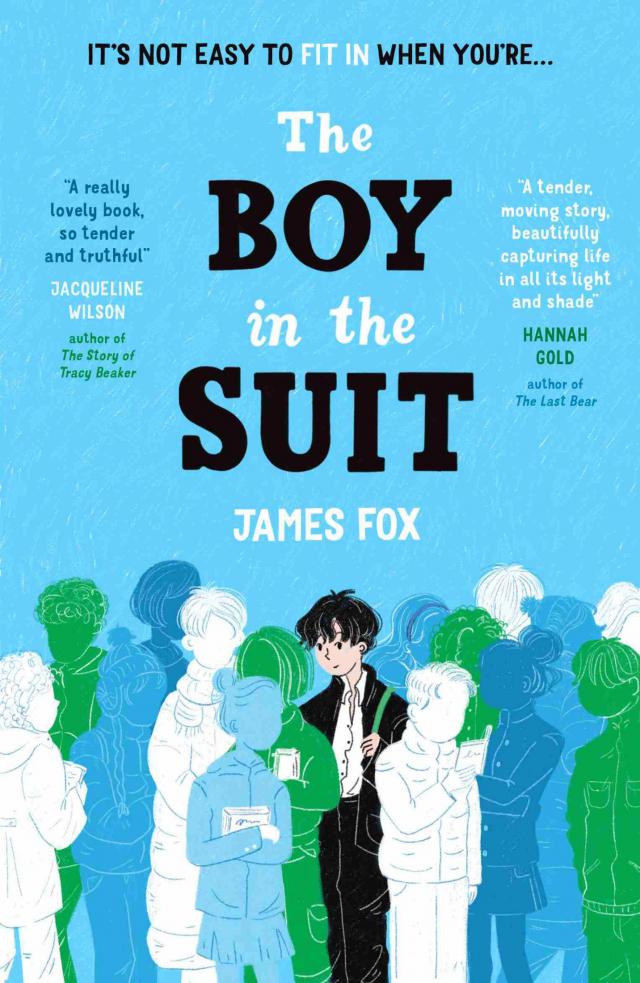
Everyone is talking about
“It’s a beautiful, heartfelt gem of a book – I loved it”
Tom Vaughan, author of
Hercules: the Diary of a (Sort of) Hero
“This story is full to the brim with heart”
Helen Rutter, author of
The Boy Who Made Everyone Laugh
“A wonderful story… It moved me to tears”
Jen Carney, author of
The Accidental Diary of B.U.G.
“A tender, moving story, beautifully capturing life in all its light and shade”
Hannah Gold, author of Waterstones Children’s Book Prize Winner
The Last Bear
“A really lovely book, so tender and truthful”
Jacqueline Wilson, author of
The Story of Tracy Beaker
“A moving, unsettling and thought-provoking story. Solo’s voice is so clear and strong that you root for him right from the start. I will carry this with me. Terrific writing!”
Cath Howe, author of
Ella on the Outside
“I really enjoyed this book as it taught me a lot about how some people’s lives are impacted by the cost of living crisis. It’s a really powerful book as it shows how love can make such a difference.”
Chloe, aged 9
“A touching, funny debut”
The Bookseller
“A perfect book for prompting discussions on what life can be like for some people and how being kind can make a huge difference”
Read for Good
“The Boy in the Suit is a book with heart and a likeable main protagonist whose experiences encompass the problems far too many families are currently struggling with”
School Reading List
“Empathetic, sensitive and honest, this book is one that will stay with readers long after the book is finished”
Scope for Imagination
To the interlopers.
And to my family.
CONTENTS
CHAPTER 1
CHAPTER 2
CHAPTER 3
CHAPTER 4
CHAPTER 5
CHAPTER 6
CHAPTER 7
CHAPTER 8
CHAPTER 9
CHAPTER 10
CHAPTER 11
CHAPTER 12
CHAPTER 13
CHAPTER 14
CHAPTER 15
CHAPTER 16
CHAPTER 17
CHAPTER 18
CHAPTER 19
CHAPTER 20
CHAPTER 21
CHAPTER 22
CHAPTER 23
CHAPTER 24
CHAPTER 25
CHAPTER 26
CHAPTER 27
CHAPTER 28
CHAPTER 29
CHAPTER 30
CHAPTER 31
CHAPTER 32
CHAPTER 33
CHAPTER 34
CHAPTER 35
CHAPTER 36
CHAPTER 37
CHAPTER 38
CHAPTER 39
CHAPTER 40
CHAPTER 41
CHAPTER 42
CHAPTER 43
CHAPTER 44
CHAPTER 45
CHAPTER 46
CHAPTER 47
CHAPTER 48
CHAPTER 49
CHAPTER 50
CHAPTER 51
CHAPTER 52
CHAPTER 53
CHAPTER 54
CHAPTER 55
CHAPTER 56
ACKNOWLEDGEMENTS
FURTHER INFORMATION
ABOUT THE AUTHOR
CHAPTER 1
Another day, another party in a grotty pub function room. I’d started to get used to going to so many parties. The chatting, the music, the getting nice and clean, and dressing up smart in my suit. I was becoming a proper party person.
Even after so much practice, I still got a weird feeling in the pit of my stomach just before I went inside. It was a sickly mixture of excitement and nerves, but mostly it was because I was hungry. Luckily, there’s always food at parties.
“Look at me,” Morag said as we approached the door. We stopped and she straightened my collar and adjusted my tie. “There we go. Looking nice and respectful. Nobody will suspect a thing.”
I screwed up my face in anticipation. Usually Morag found some grubby stain or mark somewhere and tried to rub it away with her fingertips. But this time there was no stain because I had been sure to wash my face thoroughly. I braced myself for Morag’s usual pre-party pep talk.
“So,” she said, peering in through the steamy window, “it doesn’t seem like anything out of the ordinary. Buffet to the left, bar to the right. Seating area in the middle. That’s where we’ll meet if anything goes wrong – got it?”
“Got it.” I nodded like a soldier receiving orders. Morag’s my mum, so I had to do everything she said, apparently.
A small group of partygoers appeared behind us, so we stepped off the path to let them through. My feet squelched in the mud. They nodded at us politely but didn’t say anything.
“How do I look?” Morag asked.
“You look really nice,” I said. “Like always.”
Morag was wearing her favourite party outfit: a black leather jacket, black hat with lace that partially covered her eyes, smart black skirt with black tights, and black boots that came up to her knees.
“Thanks,” she said, patting herself down nervously. “Same procedure as usual. Quick in-and-out job – no drawing any attention to ourselves. Remind me what you’re not going to do?”
“I’m not going to talk to strangers,” I droned robotically. “Unless they talk to me first.”
“Good. Anything else?”
I rolled my eyes. “I’m not going to have too much fun or make a scene.”
One time I got too enthusiastic with the chocolate fountain and Morag would never let me live it down. She said it made us look suspicious and not sad enough. We couldn’t go back to that particular church hall for a few weeks afterwards because they might have recognized us.
“And what will you do if anyone starts to ask you tricky questions?” said Morag.
“Go and find you,” I recited. “In the seating area.”
“Great, sounds like we have a plan.” Morag began to walk towards the door. “Oh, I nearly forgot. We’d better check the name before we go in.”
A sign had been placed on a wooden easel outside the entrance. It featured a black-and-white photograph of a smiling old lady with a cloud of wispy white hair on her head. She was surrounded by delicate illustrations of flowers, bumblebees and butterflies.
In Loving Memory of Ursula Grimsworth
1927–2023
“Poor sweetheart,” Morag tutted. “Wasn’t far off a hundred, bless her. Could’ve had a letter from the king.”
This bit always made me feel weird, but we had to check whose funeral it was in case anyone sussed us out and asked us what we were doing there. That was the scariest part about not being invited, the risk of getting caught.
“Still,” said Morag, “ninety-six – not a bad innings. Have you got the bags?”
I patted my pockets, and the plastic food bags rustled inside.
“Magic.” Morag pushed open the heavy wooden door. “After you, Solo.”
It wasn’t the best funeral buffet we’d been to. The mini quiches were all cold and wobbly and white – I’m not sure they’d even been cooked properly. But it’s like Morag always said: free food is free food, and beggars absolutely can’t be choosers.
Morag was always going on about stuff like that. She reckoned there were people all over the world who would be grateful for a nibble at my leftover crumbs.
I poked at one of the squidgy quiches on the buffet table with my finger, trying not to throw up at the thought of the egg mashing between my teeth. It looked like cold, eggy sick served in a pastry cup. Quiche of any size, in fact, sat right at the top of my Official Top Five Worst Funeral Foods Ever list:
1. Quiche of any size, as I’ve mentioned. It looks, smells, tastes and feels like puke. There’s nothing nice about quiche.
2. Olives. The sneakiest funeral food of all. They pretend to be innocent grapes, then ambush you with a mouthful of bitter grossness. Stuff can be hidden inside them too, like raw garlic and chilli. Horrible little secrets that only make them worse. Come to think of it, olives reminded me a bit of my dad, Jason.
3. Salmon and cream cheese on tiny crackers. These are at every wake without fail. It’s not the taste that I hate, more the mess they made in my pockets when we tried to sneak them home.
4. Carrot sticks and that boring beige dip. Need I say more?
5. Oysters. You only find these at posh funerals, the ones with horses and carts that bring the coffin to the church. Morag once gave me an oyster and it tasted like slimy seawater mixed with snot. All the grown-ups were guzzling them as if they were delicious, like chocolate or pizza. I think Morag only pretended to enjoy the oysters. She always made a face when she has them, just like me.
“Either take that quiche or leave it, but don’t play with it, for heaven’s sake,” I heard somebody hiss like an irritated alley cat.
My eyes jolted up to see an old lady waiting beside me at the buffet, her empty plate in hand. She was dressed in black from head to toe, with spectacles as thick as window glass. Her hair was curled into tight grey snail shells.
“Sorry.” I quickly dropped the mini quiche on to my plate, even though it made me want to gag. “I wasn’t sure I
The old lady tutted and shook her head. Old people were always mean, especially at funerals.
I shuffled down the table, investigating which of my funeral favourites were waiting to be scoffed. I clocked all the usual suspects: sausage rolls, pizza slices, even sushi. Then I saw it. An untouched Mount Everest-sized pile of golden-brown breaded mozzarella dippers. Beside it, a glistening lake of sweet chilli sauce.
Here’s the thing: breaded mozzarella dippers always get eaten first at funeral buffets. It’s because they’re factually proven as the best food ever. Plus everyone’s sad, so they get really hungry.
I approached the breaded mozzarella dippers carefully, with a plan: I skip all the other foods and try to fit as many dippers as possible on to my plate, forming a foundation. Then I circle the buffet again, covering the first layer with stuff like pizza. Finally, I add another layer of dippers, which everyone else thinks is my first helping. I think it’s kind of smart.
As I picked up the first mozzarella dipper with the metal tongs, the old lady shuffled next to me again, and sighed. Abort Mission Dipper. Abort.
“I can’t say I have much of an appetite,” she croaked. “It’s just such a sad occasion. It feels wrong to be eating a finger buffet like we’re at a birthday party.”
I didn’t know what she was going on about. There’s always food at funerals – that’s the whole point.
“Well, you should try to eat something,” I said. “It’s what Mrs Grimsworth would have wanted.”
The lady smiled weakly and plopped a lonely cocktail sausage on to her paper plate. “Yes, yes, you’re right. Ursula was always a generous host. Why stop now? Her platters of club sandwiches were so tall they would almost scrape the ceiling when she brought them through to the sitting room!”
“Sounds nice.” I grinned. “I love sandwiches.”
“Just because she’s –” the lady paused – “dead, I don’t suppose today has to be any exception.”
“Exactly. Someone’s paid good money for this buffet,” I said, parroting Morag. “You might as well fill up while you’re here. Make the most of it.” I piled more mozzarella dippers on to my plate.
The old lady let out a small, sad laugh. “Well, it cheers my spirits to see a lad with such a healthy appetite.” Her voice sounded faraway and wispy. “You remind me of my boys when they were small. Oh, how time flies.” She took a crinkled tissue out of the end of her sleeve and started dabbing around her eyes.
“I’m having a growth spurt,” I replied. “That’s what everyone says, anyway.”
“Life’s one constant growth spurt when you’re young like you,” she said. Her eyes were all shiny as if made of glass. “I’m afraid I’ve grown so old the reverse is happening to me. I’ve started shrinking, would you believe?”
“I think you’re the perfect height,” I said. “Easily transportable.”
She laughed then, properly loud, like it came from deep inside her belly.
“Did you know her well?” she asked me.
“Know who well?”
“Why, Ursula, of course. Ursula Grimsworth?” She gestured around the room, at the guests, the food, all of it.
“Ah.” I hesitated, about to grab a handful of miniature sausage rolls. What was our backstory again?
Whenever Morag and I went to a funeral, we always had a backstory. The trouble was, it changed every time. It got a bit confusing remembering which story went with which funeral.
“Morag!” I remembered out loud. “Yes, Morag. Morag knew her. Morag knew her really, really well.”
“Morag?”
“Yes, Morag’s my mum. She was a … distant niece of Mrs Grimsworth,” I recited, just as we’d practised on the bus on the journey there. “They were estranged.”
Morag always told me to use the word estranged. It freaked people out, apparently. Made them stop asking questions.
“Hmph, how bizarre.” The old lady raised a thin, pencilled eyebrow. “I didn’t think Ursula had any family to speak of.”
“Oh, yes,” I said, nodding. “Morag loved her very much, and they spent lots of time together.”
I swallowed and glanced nervously at Morag across the room, to check she wasn’t spying on me like she sometimes did.
I watched as she not-so-sneakily tipped an entire plate of ham-and-cheese sandwich triangles into the empty plastic tub she kept inside her handbag. Nobody saw her, but she needed to be more careful.
I turned back to the old woman. “They used to spend Christmas together every year!” I blurted out of nowhere, trying to stop her from looking over and noticing Morag.
“Is that so? But I thought you said they were estranged?”
“Um, yes…” I swallowed. I did say they were estranged, but that didn’t mean I actually had any idea what estranged meant.
Morag said I wasn’t any good at keeping secrets, but I knew that wasn’t true, because I’d kept so many secrets for her. She always said I’d sell my deepest, darkest secret for a chicken nugget, given half a chance.
“They used to send each other cards and presents too,” I said, the words pouring out of my mouth uncontrollably like sick. “Every birthday, Christmas and sometimes Easter!”
The old lady’s face dropped its polite smile and shifted into a deeply wrinkled, concerned frown. I often had that effect on people. Suddenly she didn’t seem so friendly any more.
“Well, I must acquaint myself with this so-called niece Morag,” she sputtered. “I find it difficult to believe that Ursula never mentioned her to me, not once in forty-seven years of friendship and embroidery club!”
“Oh, that is strange.” I felt my face starting to glow.
The lady put down her plate and scoured the crowd. Morag, perfectly timed, slipped between two groups of chatting mourners and disappeared into the milling crowd. Dressed in black, she blended in perfectly.
“Curious,” the lady said. “Very curious.”
I felt the blood draining from my head like somebody had pulled the plug out of me. Was she on to us? Did she know that Morag and I hadn’t been invited?
“Anyway, I should go.” I pointed to the bathroom.
“I’d better see where my mum has got to. She’ll be worried about me.”
“Indeed.” She scowled. “Indeed you had.”
I felt the old lady’s eyes glaring into the back of my head as I shuffled away and merged into the mass of people. I needed to tell Morag that somebody was on to us.
Morag always vanished somehow. One minute she was right in front of you, the next she was gone without a trace. It happened everywhere: the supermarket, the beach, the bus station in town. She should have been a magician. I would try not to panic, but the longer she was gone, the more my head started to pound.
It was even worse when she did a disappearing act at a funeral. Trying to distinguish Morag from the countless grown-ups in drab black funeral outfits was practically impossible. Often I would hear her cackling laugh before I saw her, but now I couldn’t hear that either.
I checked everywhere: outside the ladies’ toilets, inside the ladies’ toilets, in the wet and stinky smoking area, under the little kids’ slide out in the pub garden. She wasn’t even in the seating area where she’d said she would be.
Just when I was about to give up, I found her at precisely the last place I wanted her to be: the bar. A weird feeling trickled from my head and down to my toes. This wasn’t good.
I watched as Morag picked a glass of wine from a teetering pyramid of glasses that was stacked on the counter. Then, opening her throat like the pelicans I’d seen on the telly, she tipped it right to the back of her neck without even tasting it.
“Morag?” I tugged on the back of her leather jacket.
“Solo!” she said, so loudly that a few people turned and looked. She planted a big sloppy kiss on my cheek, probably leaving a lipstick stain like always. “Solo, my beautiful, darling boy. Are you having fun? This is a good one, don’t you think?”
“No, Morag,” I whispered. “I’m not having fun. And be quiet. You’re talking really loud.”
“Oh, shush, you,” she gabbled. “Don’t be so boring for once! You always try to act so perfect. Your mother’s having some fun. You ought to try it sometime!”
“You don’t understand,” I said under my breath. “Somebody knows, Morag.”
“You what? Somebody knows what?” She stumbled back and nearly knocked over a bar stool. It rocked on its long legs like a basketball circling the hoop.


