

Beyond the wall, p.1
Latigo 2, page 1


The Home of Great
Western Fiction
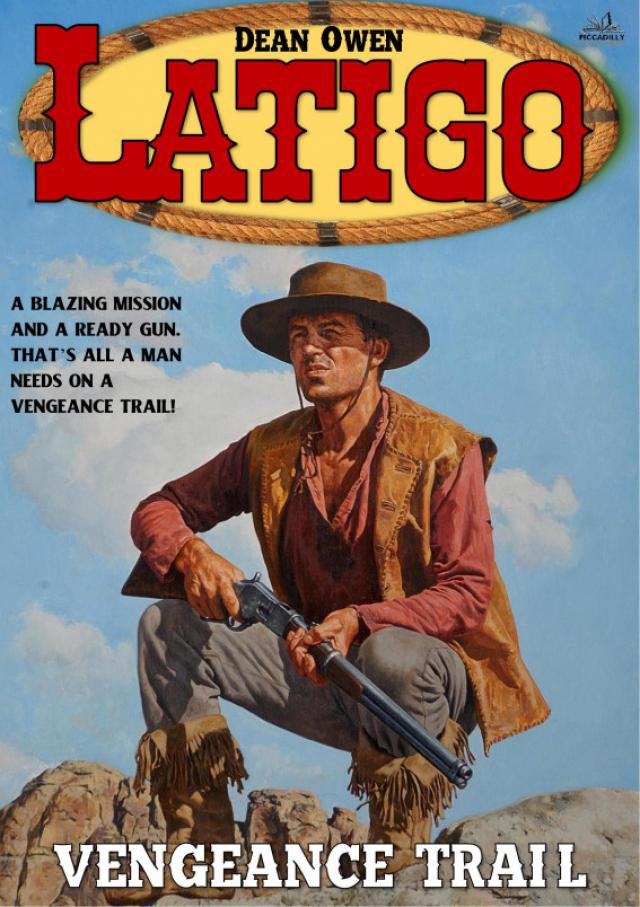
On one side, a ruthless railroad king and the coldest-blooded killers in the West. On the other side, one man—Latigo—a proud-hearted rover with just one thing on his mind—revenge.
Now, in the sprawling, rough-and-tumble frontier country where what’s right and what’s wrong are measured by the fast draw of cold steel, a woman is about to hang for a murder she didn’t commit. Latigo has been summoned to her rescue. And, at last, the trap is set for him.
LATIGO 2: VENGEANCE TRAIL
By Dean Owen
Based on LATIGO, the cartoon strip by Stan Lynde.
First published by Fawcett Popular Library in 1981
Copyright © 1981, 2023 by Dean Owen
This electronic edition published July 2023
Names, characters and incidents in this book are fictional, and any resemblance to actual events, locales, organizations, or persons living or dead is purely coincidental.
You may not copy, store, distribute, transmit, reproduce or otherwise make available this publication (or any part of it) in any form, or by means (electronic, digital, optical, photocopying, recording or otherwise), without the prior written permission of the publisher. Any person who does any unauthorized act in relation to this publication may be liable to criminal prosecution and civil claims for damages.
This is a Piccadilly Publishing Book
Text © Piccadilly Publishing
Editor: Ben Bridges
Published by Arrangement with the Golden West Literary Agency.
Visit www.piccadillypublishing.org to read more about our books.
Prologue
FIRST SNOWS HAD begun to whiten the high country when the startling news of Cole Cantrell’s death reached into far corners of the frontier. Latigo had become such a legendary figure, had so many times outwitted those sent to kill him, that he was believed to be invincible. News of his violent end saddened friends. Enemies slept soundly.
Many people at first refused to believe he had died, but there had been an eyewitness. Cantrell had been shot to death on a lonely mountain road by a man named Bill Cutter.
When Burley Quint heard of Cantrell’s passing, he threw his hat into the air and shouted, “I’ll buy that Bill Cutter a gallon of the best whiskey in Denver. Hear that, Jeff? Cap’n Cantrell got his head blowed off!”
“I hear.” Jeff Crowder backed against one of Quint’s freight wagons to steady his legs. He rubbed at his graying beard and thought back to the war when he as corporal and Quint as sergeant had served under Captain Cantrell.
Quint broke into an exuberant jig. Shortly after Appomattox, Quint had come within an inch of beating his former captain to death at a place called Eaganville, only to be soundly whipped himself.
“The son-of-a-bitchin’ cap’n ain’t no more!”
Ex-corporal Crowder, now a swamper on Quint’s freight line, thought his towering boss looked foolish dancing around like an arm-swinging girl at springtime.
“I always liked our captain,” Crowder muttered. Fortunately for Crowder, with Quint shouting his pleasure, the comment was unheard ...
At a lonely mining claim outside of El Dorado Gulch, Helen Holmes was shoveling gravel when she heard about Cole Cantrell. It stunned her, and she wept, tears streaking her pretty face. No matter what she might have been in the past, it was Cole Cantrell who had handed her a new life ...
And across the mountains where rails were pushing westward, the pockmarked Al Dain, who had in turn hunted and been hunted by Latigo, muttered, “Now I won’t never have my chance to even up with the bastard for killin’ my friends!”
Across the continent in New York City, Dain’s former associate, Doak Lancer, was reporting for work when he read of Cantrell’s demise in a lengthy telegram.
“I always thought I could outgun Cantrell if we ever met face to face,” Lancer mused aloud. “Now I’ll never know for sure.”
At that moment he heard the thump of his employer’s walking stick on the marble staircase of the Python Building. As if on signal, a pale middle-aged secretary sprang up from his desk and threw open the ornate double doors of the Python office.
“Good morning, Mr. Max,” he said timidly.
Claudius Max, a power in New York finance and Washington politics, stormed in, all bulk and swagger.
Doak Lancer thrust out the telegram.
Max’s small eyes scanned the message that had come from Python’s western office at the foot of the Rockies.
A great rumbling laugh shook Max’s belly. “At least one of my men was finally able to silence that thorn in my side!”
He pointed his walking stick at the secretary, who was just closing the doors. “Lackman!”
“Y—y—yes, Mr. Max ...?”
“Bill Cutter apparently has disappeared after the shooting. I want him found! I intend to bring him to New York and personally hand him ten thousand dollars in gold for killing that son of a bitch!”
Lackman licked his lips. “I ... I will try to find him, Mr. Max!”
“Find him!” Max whirled on Doak Lancer, who stood at ease. “You worked with Cutter. Where is he likely to hide out?”
“It’s not like him to run. He must have a good reason. But he’ll show up sooner or later.” Doak Lancer with his fiery red hair and pale skin had been brought east to serve as bodyguard for Claudius Max. He was about thirty, a man of scant conscience and uncanny ability with a gun.
“Doak, you had your own chance at Cole Cantrell out west. But he outfoxed the lot of you,” Max reminded him.
“He had a run of luck,” Doak Lancer replied quietly. “It was bound to run out. And it did.”
“But not before he gunned down Sam Stark and Ed Lewt. I tell you, Doak, I thought for a time he was going to whittle away till he got Al Dain and then you and Cutter. Christ, five of you against one man and you couldn’t nail him.”
The bodyguard’s pale-blue eyes were expressionless. He tolerated Max’s frequent tirades. Python, of which Max was the head, paid extremely well for services rendered.
“And that’s not to mention the other less important members of our company that he cut down,” Max thundered on. “The violence, the rage in that man ...”
“Understandable, Mr. Max.”
Max fixed him with a cold stare. “Understandable? Just how is it understandable?”
“You forgetting that we ... eliminated Cantrell’s family?”
“Hmmmmm. Well, yes.” Then the great chest began to shake with silent laughter.
Lancer said, “Everything would have gone all right if Sam Stark hadn’t got drunk and raped that prostitute. Then he had to go and brag to her about the killings.”
“You were in charge, Doak. Why in hell did you let it happen? That’s what I could never understand.”
“Creed had put Sam Stark in charge, remember.”
“Still can’t understand why my empire was threatened by an ex-army captain. And by a common whore who might start shouting about murders at any time ...”
“I admit to shooting the girl after Stark and the others got through with her. To shut her up.” Doak Lancer spoke in a voice he might use in discussing boots or weather. “My only mistake was in not making sure she was dead.”
“Why couldn’t the girl have been found and ... eliminated?” Max demanded.
“It’s all right there in the telegram!”
Max glared. Across the room Lackman, behind his desk, looked as if he might faint. Few men ever talked up to Mr. Max as Doak Lancer did. Even if he spoke in a soft voice. Lackman was deathly afraid of the wicked-looking gun Doak Lancer wore under his coat.
Claudius Max looked at the telegram again. “Yes, it is all here,” he grunted.
“Ed Lewt and Cutter were on their way to silence the girl at long last,” Doak Lancer said patiently. “Creed had finally learned she had married and was going under the name of Helen Holmes. She and her husband and his two kids live out of El Dorado Gulch on a gold claim. In Santa Fe she went under the name of Cindy Lou. That’s why it took so long to find her.”
“Creed bungled from the minute I sent him west. Even after I demoted him he still bungles.” Max thumped his walking stick against the thick carpet.
“Creed tried this time,” the bodyguard said.
“Tell me how he tried,” Max said through his teeth.
“Creed sent four men after her. Lord knows what went wrong. Ed Lewt was found dead along with the two new men. Creed thinks they blundered into Cantrell. That Cutter was the only one to get away. Then he laid a trap for Cantrell.”
“Thank God for Bill Cutter!” Max threw walking stick, hat, and cloak on a chair for his secretary to care for, then strode across the office. As he approached a large flat-topped desk adorned by a bust of Julius Caesar, he mused, “I wonder how Theodora will react to the news of Latigo Cantrell’s death.”
Even though he spoke to himself, the rumbling voice carried to bodyguard and secretary. They exchanged glances at the rather strange remark.
Theodora was the startlingly beautiful Mrs. Claudius Max.
Cole Cantrell’s death had been reported in late fall.
It was the following spring at a way station near Mulligan Flats that Cole Latigo Cantrell returned from the grave. But on the trail back from the dead he had acquired a new personality. And he used a gun in a manner foreign to all that was remembered of him in the previous lifetime.
On the spring evening of his return, five wagons of the Great Mountain Freight Lines, Burley Quint, prop., were pull
The owner of the way station, Simon Gibbs, bald and hound-eyed, kept a fresh bottle on the table. With the frontier whiskey and the tension of the game, Crowder’s pretty wife began to drift back into that special closet in his mind that most of the time he kept curtained off.
He had married young and lost his bride after two years. That was back in ’58. He was still suffering when war came. He joined the New York Volunteers when they wore fez and sashes. But Reb sharpshooters found the brightly colored uniforms to be splendid targets. The army switched to blue. He had gone into the fighting never expecting to come out alive. He took chances. Many of those fighting alongside of him were prudent. They died. He was reckless and lived.
Because he was rootless as a widower, he had attached himself to a solid slab of human cliffside known as Burley Quint. Quint was mean and vindictive, but he was the anchor Crowder needed. After the war they came west, where Burley Quint’s cousin was in the freight business.
Crowder became his second in command, as he had been in the war. Quint was generous with his money, but Crowder found it hard to stomach some of the things he did. Such as Quint euchring his cousin out of the freight business.
But before that, on the last day of the war, Quint had come close to hanging a captured Rebel lieutenant, claiming he was a spy. Quint really wanted to go through with it because he had an intense hatred of all officers.
Captain Cantrell came riding up just in time to keep Quint from hanging the lieutenant. Which pleased Crowder, because he kind of liked Lieutenant Sateen and would have hated to see him jerk his life away at the end of Quint’s rope. But Quint, who already hated Cantrell on general principles, became maniacal on the subject.
And now at the Mulligan Flats way station, Crowder had just won over a hundred dollars on three tens and was raking in the pot when two masked men appeared in the doorway.
“Gents, any of you even breathes hard is dead!”
The spokesman was fairly tall, in buckskin shirt and dark-blue pants. He and his shorter companion wore bandanna masks with eyeholes. Each held a cocked pistol.
Gibbs, behind his short bar, lifted his hands. “For Gawd’s sake, boys, don’t shoot!”
The one in the doorway gave orders to his confederate. All were to empty their pockets, carefully. The confederate wore a yellow slicker even though it wasn’t raining. He carried a leather sack in addition to the revolver.
The one in the doorway laughed when the miners wailed that the money being collected represented over a year’s hard work.
The one in the yellow slicker said, “Looks like we got crybabies here, Latigo.”
“Yeah,” said the one in the doorway. “I like to see your tears, boys. You’ll sure remember Latigo Cantrell, now won’t you?”
Crowder’s jaw dropped. He was sitting on the far side of the table, facing the door. The wick of one lamp was turned low and the other lamp was smoking. He stared hard. The man in the doorway was tall enough, for sure, and now that Crowder looked closer he saw the man’s dark-blue hat, the kind worn by cavalry officers. And by God he was wearing moccasins instead of boots. That was the way they said Latigo Cantrell always dressed after the war.
Crowder shook himself. But Cantrell was dead, gunned down late last fall in the wild mountains over east. And yet ...
“Clean out the money box behind the bar,” the one in the blue hat ordered.
Gibbs looked as if he might faint as the bandit in the slicker emptied the box into his bulging sack.
“Got it all, Latigo,” said the confederate.
“Latigo Cantrell thanks you boys for the money.”
Crowder blurted, “Cap’n, sir ... it’s me, Jeff Crowder. Your corporal, don’t you remember ...?”
“Corporal, you tell those hombres I’m a damn good shot. Anybody sticks his head out that door will have a hole between his eyes. Latigo Cantrell at your service, boys.” Laughing, the two men ducked out. There was a sudden pounding of hooves as they galloped away into the darkness. The miners wanted to go after them.
“There’s a thousand places they can hole up in these mountains,” Gibbs said shakily. “Hell, they’ll blow us apart we get too close.”
The miners began shouting, banging fists on the table. They turned on Crowder, accusing him of being in league with the two bandits.
“You knowed him!” shouted a big brown-bearded man. “He sure knowed you!”
Crowder sat shaking his head slowly from side to side. “I can’t believe it ... not our cap’n.”
Burley Quint came in from the freight wagons, yawning, scratching his huge chest. “What the hell’s all the yellin’ for? You woke me up.”
Crowder told him.
Quint took a moment to reflect on it, then stomped so hard on the floor Crowder expected his boot to break through the planking. “Cap’n Cantrell alive!” His broad face began to turn purple. “You sure, Jeff?”
“Jeezus, he looks like him, he stands like him. He sounds like him....”
Gibbs said, “He sure called himself Cantrell. Latigo Cantrell.”
Before the week was out a party of travelers was held up by the same pair. By the end of the month there were more holdups, more money taken. One victim was slightly wounded.
Cole Latigo Cantrell had returned from the grave with a vengeance.
Chapter One
COLE LATIGO CANTRELL had intended to take another month in his long convalescence. Now it was impossible. An impostor had been robbing outposts and travelers. This blackened not only Cole’s own name, but the names of his late father and mother, Badger Cantrell and White Elk. Cole personally had consigned their bodies, in the fashion of the plains Indians, to the land of shadows. That was nearly two years ago.
On this spring morning, Cole emerged from the lodge that had been his sanctuary since the shooting. He sniffed the good pine-scented dawn air, thankful to be alive. Along the swiftly flowing creek a morning haze lifted into the trees. The Crow camp was astir. Dogs in chorus welcomed the new day, and the shrill voices of children could be heard.
It was a day of excitement. Late yesterday afternoon a great herd of bison had been sighted. There would be a hunt. And it was Cole’s chance to repay the camp for providing food and shelter.
Smoke from cookfires already curled into the sky. An aroma of broiling antelope permeated the camp. Cole stood tall, black-haired, pale from his ordeal that had begun in late fall. He was thinned down, his clothing fitting better than a month ago but still loosely. He tilted his dark-blue cavalry officer’s hat so he could watch the rim of the sun. The sun was a luxury. For so long, death had been but a whisper away.
A tall Indian in breechclout and leggings approached Cole. The Indian had returned to the Crow camp that morning after a long absence.
“Kahay,” he greeted. “Tonight come to my lodge, Two Trails,” he said, using Cole’s Crow name. “We will smoke together. Eat plenty buffalo. Ba-Rush’pe Ahuk!”
Cole said, “A-ho, Wolf That Walks! Once plenty buffalo. Not now.”
The eyes of Wolf That Walks glittered as he acknowledged the truth of this. Drying racks should have been filled, but there was little buffalo meat. For the first time Cole could remember, food was scarce in the Crow camp. They both knew the reason.
Professional hunters were decimating the buffalo herds, mostly for hides. The meat was left to rot.
“Today we hunt buffalo,” Wolf That Walks said.
“I go with you.”
“They say you are still too weak, Two Trails.”
“I am strong.” Cole placed a hand at the place on his chest where a bullet had almost taken his life.
Wolf That Walks seemed pleased. Then his gaze clouded. “They say you will soon return to the camps of the white man. They are different from us, my brother. Different from you.”


