

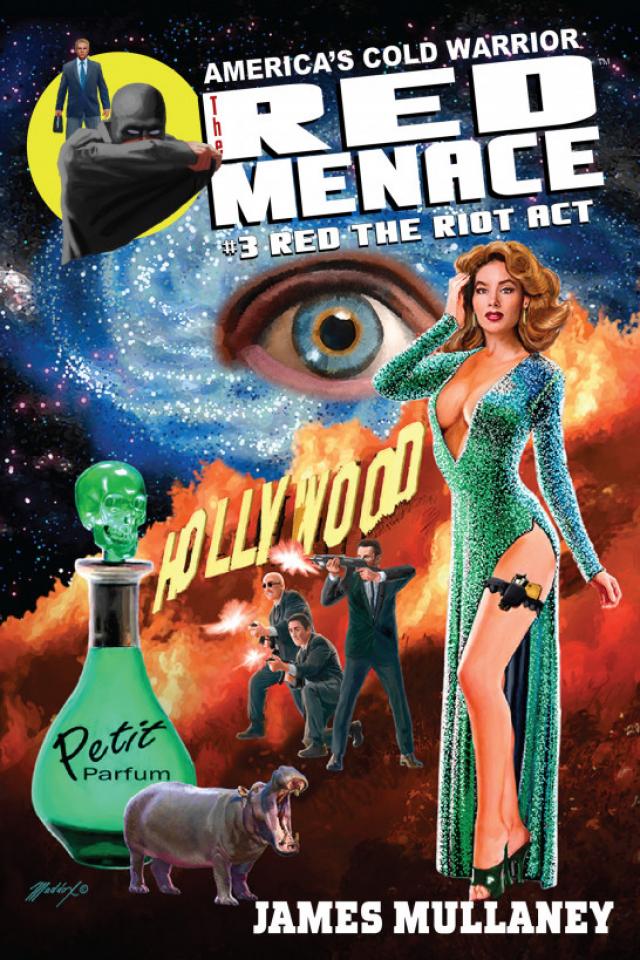
The red menace 3, p.9
The Red Menace #3, page 9


Although the mere act of joining the church was proof that one was clear of the swarm, in order to weed out Rectium spies, the church required that new members liquidate all their assets and donate every penny to the church.
“Just as a precaution, mind you,” Hallifax insisted at every orientation over which he personally presided. “The Rectiums are the origin of the seven deadly sins. Each member of the swarm is comprised of seven body parts, one for each sin. To donate all you have to the church is proof you’re not greedy and, therefore, not a Rectium.”
What started for Hallifax as a blend of scam, confusion and delusion soon evolved in his fragile mind to cloudy fact, as nebulous as the planet-destroying Rectium Assembly from the ancient birth of the universe.
Mr. Grax died the year after the church was founded, shedding his corporeal form to join the select few on the Earth Mothercraft, a large spaceship where the life forces of the worthy were stored after death. Three months later, Hallifax packed up his church and moved his world headquarters to Southern California. There it thrived.
The generation that came of age in the 1960s was in the process of rejecting everything that had gone into fashioning a great and thriving modern society. The deification of self that lay at the heart of Realtopianism appealed to many young people born into the most selfish generation America had ever produced.
As more and more followers came to view him as a god, as wealth insulated him and his nonprofit church status made him rich; as the illness of his brain took firmer hold, the nagging doubt that it was all one big, crazy fraud cooked up during a three-week coffee binge faded in the rearview mirror for R. Gunn Hallifax.
By the early 1970s, the Realtopian Church of America, as the domestic branch of the fast-growing religion came to be called, was raking in so much cash that Hallifax’s accountants recommend he diversify his assets. Among his many acquisitions were a regional cola manufacturing company, an NFL team, eight congressmen, two senators and a perfume company on the verge of bankruptcy.
Hallifax had no idea that his silent, majority partnership in Petit Perfumes would pay off so handsomely. Leslie Petit had just wanted to sell lots of perfume when he came to Hallifax’s money people looking for cash to finance his trip to that jungle island. The natives had warned that the gland of the hippo could cause some kind of blood madness.
For R. Gunn Hallifax it was not a sign from God, it was a sign to God. The synthesized power of that last island hippo’s gland would help the god of the Realtopian Church finally realize a dream that had been percolating in his brain for years.
That was, if the mortal screw-ups he was unfortunately stuck with as followers didn’t ruin the whole plan before it even got started.
* * *
“Why did this Baxil have so much of the stuff?” High Star Admiral R. Gunn Hallifax demanded.
Stan Morrix, Junior Grade Ensign, gave a helpless shrug. “He was one of the first to get it. We didn’t know how potent it would be in open spaces, so he got extra. After the first test at that campground in Arizona we realized we didn’t need as much, so everybody from then on out got less. We just forgot to get it back from Baxil.”
The test at San Jacinto State Prison had worked perfectly, and like all the other tests it looked as if they were home free. Unfortunately, they had just received a report from a church member that Baxil had gone crazy and shot up his entire apartment building with canisters of the compound. According to early reports, everyone inside was dead and the place was swarming with police. The only good news in the catastrophe was that Baxil had killed himself.
“This is your fault, Junior Ensign Morrix,” Hallifax accused. “Baxil was a First Level Swabbie. That’s barely above a C-Rank Tadpole. No one below a First Grade Ensign should be entrusted with the substance. This could be a disaster.”
They were interrupted by the sound of a delicate, hesitant knuckle rapping wood. Hallifax looked up to find Leslie Petit standing in the doorway. The perfumer was wearing a lavender pantsuit accented by a beige belt fastened with a huge silver buckle. Hallifax’s two massive bodyguards stood silent sentry on either side of the door.
“Excuse me?” Petit sang. “My office, after all, and I have simply scads of work to do before I toddle off for the day.”
Hallifax was sitting comfortably behind Petit’s glass-and-chrome desk at the Los Angeles headquarters of Petit Perfumes. Hallifax was mostly bald, but for thin white hair that stretched like wispy cotton candy across his age-speckled scalp. Except cotton candy would have had the decency to stay stuck. Strands of wild hair stuck out in every direction and when Hallifax tried to brush it back into place, clouds of dandruff fell to his shoulders. He brushed each shoulder off in turn and it was suddenly snowing in the office. Leslie Petit’s face was appalled as he watched the crushed velvet chair he’d had custom built and flown in from Switzerland grow thick with dandruff flakes.
“Get in here,” Hallifax commanded. “You’re in this now too.”
“Would prefer not, darling, if it’s all the same to you,” Petit sang.
He scarcely had time to plug his ears with his fingers and trill a few “la-la-la’s” before, at a nod from Hallifax, the bodyguards were yanking the fingers out and shoving Petit into the room. “Oh, fine, just go on then,” the perfumer huffed.
“Just stand there and shut up, fag,” Hallifax ordered.
“I wouldn’t be so quick to judge me, dearie,” Petit snapped. “I’ve heard what floats your boat, so to speak.”
Petit noted that Morrix’s face was blank, with those dull cow eyes that were standard-issue for all Realtopian cult members. Perhaps there was a moment of confusion that flickered across his bland, pale face, but nothing more. Hallifax, on the other hand, gave the perfume company CEO a glare so evil that it chilled Petit’s blood.
Petit cleared his throat, and in the ensuing, awkward silence there came the sound of a power saw screaming somewhere in the distant bowels of the building. Petit was never more grateful to a sweaty laborer with power tools, and considering the blissful two months he’s spent with a darling young Mexican carpenter two summers before, that was saying something.
“I simply love what you’re doing with this old place,” he offered, weakly flashing his pearly whites. “All the alterations you’re making to the building. Love it.”
The tension was broken. Hallifax turned his attention back to Stan Morrix, and Leslie Petit hissed a soft sigh of relief and a silent prayer of gratitude to the sweaty laborer with the saw who had saved him from the murderous gaze of the cult leader.
The hammering and sawing went on practically nonstop these days. Leslie Petit’s perfume business wasn’t even his own any longer. The building was staffed now exclusively with cult members who bowed and scraped whenever Hallifax passed by. The Realtopians were in the process of mass-producing the special compound, although for what reason Petit had no idea. He was aware that there had been some human tests out in the world, but they weren’t in Paris or San Francisco or even Fire Island so they were in no place that interested Leslie Petit.
“I think we’re safe with Baxil,” Morrix was saying to Hallifax across the room. “Tests confirm the substance is almost undetectable once it dissipates. Certainly it’s untraceable. I mean, there’s nothing like it on this planet. Even if the government can figure out what its chemical composition is, they won’t be able to use that to trace it back here, High Star Admiral.”
Petit was looking out his office window where the motionless rotor blades of Hallifax’s helicopter drooped. The helicopter had become a common sight at Petit Perfumes these past two months.
“Sigh,” Petit said, announcing the word to the room.
“If we’re boring you, too bad,” Hallifax snapped at the perfume manufacturer. “We’re not just partners in perfume, you’re a partner in all of this. Remember, you stood back and let us dispose of all the bodies from your lab.”
“What was I supposed to do?” Petit whined. “You marched in here and took over like some big manly man. What could helpless little moi do?”
“Report me to the police,” Hallifax said. “But you didn’t, so this is your problem too.”
“It certainly is. You’ve fired my entire staff and installed all your own people here. You don’t have any idea how creepy they are, with those blank stares and the way they sashay up on the roof and chant at the stars at dusk. And not one of them has ever gone in the men’s room. Don’t they ever heed the call of nature?” This fact was evidently particularly upsetting to Petit. “So sigh, you high holy stick-in-the-mud. Sigh, sigh, sigh and sigh another thousand times,” he said, folding his arms angrily across his chest. He blew off one of his pantsuit forearm tassels that had flipped up into his face.
“You don’t need to agree with me,” Hallifix said, “you just need to know that your fate is intertwined with ours.”
“Oh, don’t I know that, honey,” Petit groused. “I just want to sell perfume.”
“When the time comes we’ll have the market cornered on absolutely everything,”
Hallifax assured him.
Hallifax did not like doing business with the unconverted. Mortals could be so hostile. He turned his attention from Petit, who was glaring out at the helicopter once more, and focused back on Morrix.
“These were supposed to be simple tests,” Hallifax said. “Places where humans expect outbreaks of violence so that no one would notice. Slums, local jails, that sale on bridal gowns in Boston. But your prison guard may have screwed everything up.”
Morrix hesitated for an instant. “There is some other news,” he offered reluctantly. “We did have a couple of tadpoles on the scene. That’s how we found out about it so fast. One was a guard from the prison. He got to the apartment too late, but he did let us know that he spotted two MIC agents there who were also at the prison.”
“What’s MIC?”
“Just some archaic agency nobody pays attention to any longer.”
“How old? As old as the Rectium Swarm?”
“Newer. Maybe twenty years old. They’re a relic from the start of the Cold War. We don’t know much about them. They’re just a spy agency footnote. When the two men left the apartment they took one of the empty gas cans Baxil fired. They were the only ones at the prison to examine the spot where the tear gas went off.”
“They could be trouble,” Hallifax said. “Track them down and kill them.”
“We don’t need to track them down, High Star Admiral,” Morrix said, puffing his chest out. “I had them followed. They’re being tailed right now.”
“What do you want, a medal? End this screwup now, Morrix,” Hallifax commanded.
“Yes, High Star Admiral.”
“Sigh.”
“And get that faggot out of my office.”
8
“We’re being tailed.”
Podge had caught sight of the car in the rearview mirror a few minutes after they’d left Baxil’s apartment. He waited over a mile just to be sure it was a tail, and he was a little insulted that whoever was following him thought he wouldn’t notice a lemon yellow DeSoto weaving in and out of downtown Los Angeles traffic behind them.
“You remember that ugly yellow number that was parked next to us in the prison parking lot?” Podge said. “I think it’s that car. How many DeSotos the color of sick dog urine are tooling around the streets of L.A.?”
“You mean that rhetorically, but in Los Angeles, Patrick, gaudy cars are as numerous as grains of sand on the beach. I’ll guess a trillion.”
Podge turned quickly off the main thoroughfare and onto a busy, tree-lined side street. He took the corner so fast that the tires of his rental car squealed and Wainwright grabbed onto the dashboard with both hands. Behind him, Podge saw smoke from burning rubber as the big DeSoto flew around the corner. A silver hubcap popped off and bounced to the sidewalk and a woman carrying grocery bags had to jump from its path.
The heavy foot of the yellow car’s driver ate the distance in a heartbeat and the DeSoto was suddenly on Podge’s bumper.
“I don’t do car chases,” Podge said, and promptly slammed on the brakes.
The tires on his rental car shrieked, there came an echoing shriek from the tires of the trailing DeSoto and the two cars met in a sickening crunch of metal. Their rental lurched forward and Podge and Wainwright were thrown forward in their seats.
When it was over an instant later, Wainwright was rubbing his left wrist where he’d struck the dashboard and Podge was grinning.
“Make that a trillion minus one,” Podge said, springing the door. “You coming?”
“No, I think I’ll just stay here and nurse my whiplash,” the doctor droned.
“Suit yourself,” Podge said, hopping out of the car.
The nose of the 1956 DeSoto Firedome looked largely undamaged, but for a crack in the grille and a V-shaped dent in the bumper. The bulk of the damage had apparently been internal if the smoke rising from beneath the hood and the driver’s desperate attempts to restart the dead engine were any indication.
When they saw their quarry approaching their car, the two men in the front seat leaned down to desperately crank up their side windows.
“Good afternoon, ladies,” Podge called to the men, who were now trapped inside with the eighty degree L.A. heat and whispering desperately to one another. “When you’re ready, we’re going to need to exchange license and registration information.”
The men continued to whisper. Podge could see they were unarmed.
“You know, interesting thing about glass.” He rapped a knuckle on the closed window. “It’s actually made out of something called glass, which means you can crank these up to the moon and I can still see you two dummies. You’d better not be talking about me in there. I get self-conscious.”
Podge saw them argue and saw their increased panic when he tried to tug open the locked driver’s side door. He saw them whisper a little bit more, and then he saw something come out of the glove compartment. It glinted silver in the sunlight.
Podge recognized the modified version of the canister he and Wainwright had just retrieved from Robert Baxil’s apartment building. Podge was yelling, running, and already diving for the pavement as the passenger yanked out a shiny ring on the neck of the silver canister.
“Grenade!”
Wainwright had been stepping onto the sidewalk from Podge’s rental, rubbing his neck and taking inventory to see if there were any broken bones. The instant Podge shouted, the doctor instinctively jumped to safety in front of the car. Podge made it to the asphalt in front of the car in a flying leap, rolling to a stop and nearly knocking Wainwright back out into the open in the process. He grabbed the older man’s shirt collar one-handed and yanked him back to safety.
They heard not an explosion, but a pop.
It was soft. Barely audible. It sounded almost like the gas finally catching fire in a faulty propane barbecue.
When they peered out from behind the safety of Podge’s rental car, they saw that the DeSoto was still intact. Which was more than could be said for the men inside.
The car was flooded with a hazy yellow fog, making it difficult to make out anything but indistinct shapes inside. They saw one shape dart madly at the other, they saw the second shape drop back, then they very clearly saw several streams of crimson blood shoot across the inside of the front windshield.
The car rocked crazily on its shocks, and all at once the door sprang open and the driver’s body fell backwards into the street. The passenger who had pulled the pin on the grenade leapt over the dead man. Thin mist poured out of the car and evaporated on contact with the warm California afternoon air.
Podge had already vaguely recognized the passenger in the car as one of the guards at San Jacinto who had been loitering in the cigarette smoke-clogged room outside the prison’s personnel department. The man had changed his uniform shirt but still wore his blue-striped trousers.
“It’d help you figure out what the hell is going on if you caught one of them alive, wouldn’t it?” Podge asked Wainwright.
“Substitute you for me in that sentence, and yes,” Wainwright replied.
Podge took a deep breath and darted out from behind the car.
Too late.
The crazed prison guard had spied a teenaged boy and girl walking hand-in-hand on the sidewalk across the street. With a demented yell he darted into traffic, straight into the front of an oncoming eighteen-wheeler.
The truck slammed on its breaks but not before the prison guard was stuck full-force and disappeared beneath the cab. The wheels didn’t even bounce as they drove over the body, and when the truck finally stopped and the guard emerged from the far end, he was little more than a pulverized pulp of blood-covered flesh and protruding bone.
Podge and Wainwright hurried over to the body.
Wainwright was taking blood and tissue samples when two Los Angeles police cruisers pulled up to the scene, lights flashing and sirens blaring. It took Podge’s MIC identification and a little verbal tap dancing, plus a call back to their station, but the officers took over crowd control and rerouting traffic while the two MIC men finished with the body.
“I’m through here,” Wainwright said, five minutes later. He dropped the samples he’d collected in his bag and snapped it shut.
“What’s that?” Podge asked. He indicated a shiny object half-obscured on the prison guard’s torn collar.
Wainwright cleaned the blood off with a cotton swab, revealing a lapel pin.
It had been dented in the accident, but the image on the round, white pin was still visible. In the center was the swirling funnel cloud of a tornado, and around the edges of the badge was the legend, “Live Life in the Eye of the Storm.”
“I know that,” Podge said. “Where do I know that from?” He snapped his fingers. “It was on a book cover, I think. On an ad on TV.”
“It must be an excellent book if its advertised on television,” Wainwright said. “Many’s the time I picked up another copy of the complete works of Shakespeare after I saw a commercial sandwiched between dog food commercials.”


