Blood mountain, p.4
Blood Mountain, page 4
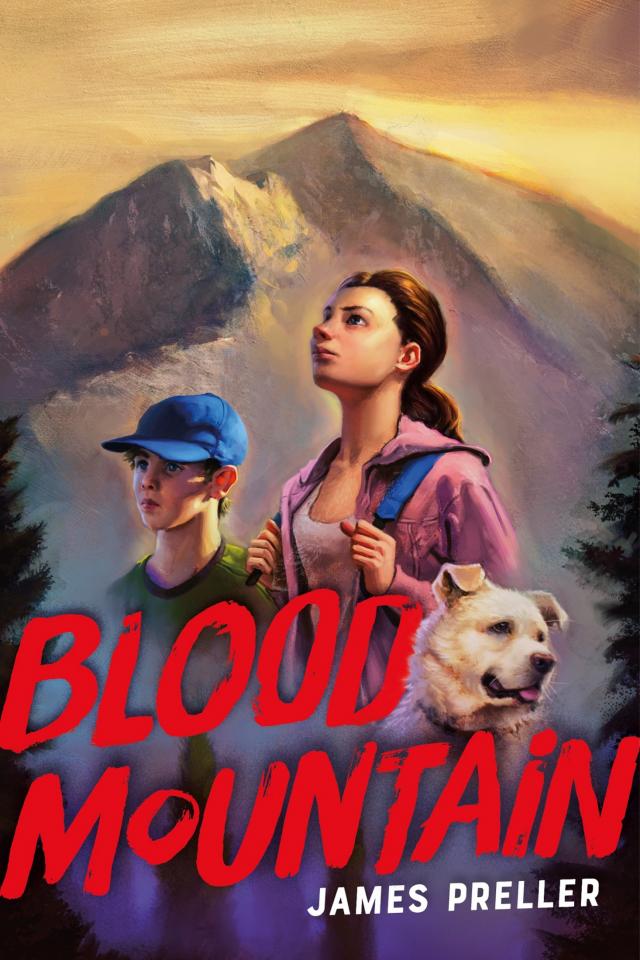


They walk back in the direction from where they came. At fifty yards distance, they stop.
“You okay?” she asks.
“Yeah.” He nods. Looks at her. There’s new resolve in his eyes. “It’s just…” He doesn’t finish his sentence. There’s no need.
“This was a mistake,” Grace admits. “It’s like we came down the wrong side or something.”
Carter looks up at the steep incline ahead of them. Back the way they came.
“It sucks, but I think we have to—”
“Go back up,” Carter agrees.
“I just think if we can, like, get to a summit where we can see,” Grace says. “Then maybe.”
Carter’s face is covered with muddy streaks, pale semicircles under his eyes. He looks thin, undernourished. Even the dog, Sitka, seems spent. Grace considers the five energy bars she has tucked away in her pack. Not yet, she decides. Maybe later she can “find” one without revealing the entire stash. Instead, they drink water. “We have no choice,” Grace states. “You going to be okay?”
“Like you said, there’s no choice,” Carter retorts. He turns and takes the lead, bushwhacking back up the hill, following the drainage rock bed, hoisting themselves up by using branches and slender, young trees.
“Hey, look,” Grace says. “A frog.”
They pause to look at it. The small frog jumps once, twice. Sitka lunges for it, bites and chomps three times, swallows.
“Oh, that’s so gross, Sitka!” Grace yelps.
Carter pats the dog’s hips admiringly. “Good job, Sitka,” he says. “Now find me a hamburger.”
“With cheese,” Grace adds.
“And bacon!” Carter snorts.
They continue their arduous trek, heads pitched forward, eyes focused on the ground. Grace allows Carter to set the pace, content to follow. She internally recites a little four-line poem in rhythm to their steps.
No food, no place, no here, nowhere.
She says it over and over again.
Step by step.
No food.
No place.
No here.
Nowhere.
No food no place no …
And then through a break in the canopy, a shaft of sunlight slices to the earth like a silver sword. Grace looks up: a patch of blue sky. Bluer than she’s ever seen before. And beyond that, the jagged outline of a ridge.
“See that?” she squeals. “That’s what I’m talking about, Carter! We’re almost there! You’re awesome—you know that? You are freaking awesome!”
An unexpected surge of adrenaline comes over her. Grace starts bouncing like a rabbit, bounding from rock to rock, joyous and giddy, slipping and falling and laughing. Sitka joins in for the first time all day, mouth open, bounding excitedly, too. She barks, a couple of short, sharp, playful yaps. Pounds the ground with two front forelimbs, butt high, tail wagging.
16
[RECONNAISSANCE]
The hikers don’t seem to know where they are going, which makes them challenging to follow. Hard to predict in their obliviousness. Hiking through the bush, deeper into the wilderness, farther from roads or the lake or the main trails. Makes no sense.
On the other hand, they are clumsy and loud, breaking sticks and crashing through branches, talking, sneezing, complaining.
They are, he realizes, two lost kids.
And a dog.
The dog presents a difficulty. An obstacle to overcome.
He knows they could surely die. People make mistakes out here, and nature does not forgive. Not his problem. But they may bring searchers, dogs, helicopters. The chopping sound he still hears in his dreams, the bird’s blades churning the air. The more pressing issue is they appear to be wandering into Zone D, not far from a buried cache of supplies. He does not want the attention.
He pulls on his beard abstractedly, deep in rumination. He’s like a cow masticating on the side of the road, pondering life’s infinite possibilities. The boy reminds him of someone. A broken body from a faraway land. The man pictures a boy kicking a ball in the dusty streets. Laughing, smiling.
He shakes those sun-hazed memories from his mind, grazes on a pocket of dried fruit and almonds. How long can these kids keep up their energy? Can’t have much food. Fear and panic will carry you only so far. Mistake upon mistake upon mistake.
He wonders, What to do, what to do?
He decides on nothing.
Nothing is often best.
Trust nature. Let it take its course. It could be they’ll remain forever lost. They’ve already strayed far off any maintained trails. Mistakenly followed a deer track for too long, lost their way and kept going.
Lost.
The word sings to him: lost, lost!
Lost is a state of being.
Lost is a place in his dream.
The last, lost world.
Escape from everything.
Until the self evaporates.
He loses his name, his attachments, his burdens.
He lives no place and every place.
Finally free.
He munches on a dried apricot. The park is so big, a million places to hide. Maybe the searchers won’t ever find them, not a trace, not even their sun-bleached, scattered bones.
He pops an almond into his mouth. He decides to head back to his main camp, catch up with these two tomorrow. The way they walk, at this meandering pace, it won’t be hard to pick up their trail.
Sleep tight, he wishes to the wandering, mud-streaked urchins. Don’t let the bedbugs bite.
17
[FALL]
Fueled by wild hope and a weird kind of ecstasy, Grace and Carter attack the slope and climb, climb, climb. It is wearying and difficult, yet somehow the vision of that uppermost ridge, backed by blue sky, has revitalized them. Nearing the top, just twenty more yards to go, Grace accelerates.
And she’s off, scrambling recklessly on hands and feet, creating her own pathway over loose stones, rock slabs, and dirt. She arrives first. Sitka at her feet. Carter instantly sees it in her face. Bewilderment, disappointment. They have reached a false summit. There is no magical view, no golden road to lead them back home. Grace looks like a kid who didn’t receive a promised gift for her birthday. No shiny new bicycle after all.
Carter slips on a slick rock, bangs his knee. He looks up, and she is waving to him. No, her arm is rising, reaching. Grace is tilting, leaning away from him. The expression on her face is one of surprise at the moment it disappears from view.
“Grace!” he cries.
Carter reaches the top in seconds, propelled by sheer panic. He sees Grace tumbling down a scree of loose rocks. Her weight carries her backward. Thirty feet down the steep slope, Grace blasts through a tangle of plants and scrawny bushes. Sitka bounds after her, as if it’s a game. Grace crashes into and off a large boulder. There is a muffled cry and the meaty sound of flesh meeting rock, followed by the crack of bone on stone. Grace’s arms desperately reach for air, thrashing like a drowning swimmer, her hand reaches for the trunk of a tree, fails to hold its grip. She rolls in somersaults, trying to find some purchase, anything to slow her downward trajectory. Her heels kick in the air, her foot gets snared in the cleft between two rocks, her head bounces, her eyes roll back into her skull and ligaments shred; she keeps hurtling hopelessly downward. Sitka follows, barking. Carter sees there’s a ledge below, the edge of a parched waterfall, and Grace is a river that spills helplessly to the edge … and Grace screams … and she’s gone.
18
[GRACE]
Carter hears the muffled, meaty thud a moment later.
“Grace!” he cries.
A silence that lasts a lifetime. In reality, just a second or two. And then she calls back to him—not words, not instructions. The sound of a wounded animal, piercing the air.
Sitka scrambles to the edge, looks down, prepares to leap.
“Sitka, no!” Carter commands. He follows behind, crab-walking feetfirst, careful not to lose his traction. “I’m coming!” he calls to Grace.
The dog bolts to the right, circling down and around. Near the edge, Carter glances down. Grace is sprawled on the ground below, a distance of less than fifteen feet, but a long way to fall. There’s blood on the rock near her head, which is turned to the side. Grace’s right foot seems turned in an unnatural way. She doesn’t move. Carter follows Sitka’s path.
Sitka arrives, nosing her, licking Grace’s face, pacing anxiously, whining.
Carter finds a way down, leaps the final five feet, rolls to the ground. He stands paralyzed for a few seconds, staring at her. “Grace?” he says.
He doesn’t know what to do.
Her eyes open; she nods her head. “I’m okay,” she says. “Just a little…” Her eyes close. Her face contorts in pain.
Carter kneels at her side, takes her head in his hands, pushes loose strands of hair from her face. He scans her body. Her ankle looks bad. Her arms and legs are scratched and bloodied. There’s a deep gash on the meaty part of her right calf, a chunk of loose flesh hanging off. He touches it, pushes the skin more or less back in place. A large bruise is already forming on the side of her face. He gently probes it with the tips of his fingers, wondering if her cheekbones might have been shattered. Grace’s bottom lip is cut, already swollen. She wheezes, coughs, reaches across her stomach. “My ribs,” she says. She coughs again, turns her head, spits blood.
“You’re alive,” he says.
Grace gives the softest of snorts. Her eyes close and open. She nods. “So far,” she says. She spits again. A small blob of blood. There’s a taste on her tongue she can’t place. What is it? Grace wonders. Not saliva, not blood. Something else, something bitter, the aftertaste of panic.
Carter repeatedly strokes her hair, nervous and afraid. His fingertips lightly touch her nose, her eyelashes, her face. “I saw you go over…,” he says, shaking his head. A shiver causes his body to tremble. “Oh, Grace.”
“I’m okay,” she says in a fragile, timorous voice. She laughs, moans, and spits again. “Just, you know, maybe you can get the first aid kit. Start patching me back together again.”
19
[ESCAPE]
Wi-Fi is spotty at best in parkland, and nonexistent in remote sections, so rangers commonly communicate via portable radios. Before climbing back into her patrol vehicle, a massive Ford Super Duty F-250 truck, Makayla reports to her immediate supervisor, Lieutenant Frank Watkins. Frank is a good guy with a big job. Like the conductor of a sprawling orchestra, Frank stays abreast of all ranger activities over a vast, five-million-acre park.
“So how you doing this afternoon?” Frank asks in his cheerful, grandfatherly manner. “That was good work you did today.”
Makayla smiles. “Yes, a good outcome.”
Frank says, “You must be beat. When’s the last time you took a day off?”
“Don’t start,” Makayla warns. “I don’t want to think about it.”
“Okay, Brooklyn. So what’s next on your agenda?” Makayla grins to herself. Frank always called her Brooklyn, ever since he got wind of her city roots. A world away. Fire hydrants and apartment complexes. Concrete and people everywhere. “Depends if you’ve got anything for me, Frank. We’re done here, safe and accounted for. I thought I’d check in on a few campsites on my way back. Call it a day.” She adds, “There’s been reports of bear activity. And campers get sloppy.”
“Some do,” Frank replies. “Look, we’re all overworked and understaffed. But you are trying to do the work of three rangers. Just do what you can, Brooklyn—I can’t ask for more than that. Hey, none of that’s why I called. Did you happen to hear about the trouble down in the valley? It was on TV today.”
“I don’t watch much television,” Makayla reminds her supervising ranger.
“Well, shoot, I’d be lost without my baking shows,” Frank says. He is deadly serious about his apple cobbler.
In the driver’s seat, Makayla checks the rearview mirror. She flips a switch, puts the radio on speaker, shifts into reverse, executes a three-point turn out of there. “Do I have to beg, Frank? Or are you going to tell me what was on TV?”
“You sitting down for this?”
“I’m in the truck, Frank. I always sit down when I drive,” Makayla jokes.
“So there’s this fellow named Ernest Billingsworth. One of those well-heeled gentleman farmers. You know what I’m saying? Wall Street type, made a killing managing hedge funds, retired young. He bought a nice chunk of land up here. Turns out, Mr. Ernest Billingsworth has a thing for exotic animals.”
Makayla shakes her head. “Oh no, I can see where this is going.”
“I bet you can’t,” Frank replies. “Because our friend Ernest especially likes big cats. Cheetahs, panthers, mountain lions. He has his own private zoo in a barn behind the main house.”
“Did something happen to those animals?” Makayla asks.
“You sound more worried about the animals than poor Mr. Billingsworth,” Frank says.
Makayla doesn’t deny it.
“It appears one of his mountain lions got loose,” Frank says.
“Get out!” Makayla exclaims.
“Yep. The cat’s flown the coop.”
“How’d that happen?” Makayla wonders.
She could almost hear Frank shrug through the airwaves. “I’d ask Mr. Billingsworth personally, but he got his skull crushed. That’s how they kill, you know. A mountain lion bites its prey at the base of the skull. They have very powerful jaws. It’s impressive. Can crush bones the way I’d crumple a red velvet cupcake.”
“Where’s the lion now?” Makayla asks.
“That’s the main thing,” Frank replies. “Nobody knows. It’s out, footloose and fancy-free. The cage door was open when the police got there.”
Makayla drives the narrow dirt road, jostled by ruts and bumps, thinking it over. “So you’re saying there’s a mountain lion somewhere around here—could be near town, could be up in the mountains—and it’s already killed a man?”
“That’s the size of it,” Frank answers. “The story gets worse.”
“Worse?”
“That lion breakfasted on a fair-size chunk of Mr. Billingsworth’s intestines and inner right thigh. Must’ve been hungry. Or maybe that wild cat just didn’t like being owned. So, yeah, it has tasted human flesh.”
Makayla was familiar with stories of illegal pet owners. They were sprinkled all over the country. Strange types who often didn’t know what they were getting into, didn’t have the resources or temperament to properly care for the animals. Amateur zookeepers. Idiots, every one. She didn’t feel too badly about the fate of Ernest Billingsworth. “Any signs of cruelty?”
“Well, I suspect so. Undernourished, abused. We got a Humane Society rep over at the place now, taking inventory. She’s got to organize transfers to authorized zoos and whatnot. We’ve put all the available hounds on the cat, a crew of our best volunteers, even aviation assistance, but I’m not optimistic. The first priority has to be with the security of the local community. People are mainly worried about livestock and pets and small children on backyard swing sets. The mayor is screaming. I suspect that cat will head for the hills. They don’t call ’em mountain lions for nothing.”
Makayla sighs. “You need anything from me?”
“No, we got this covered,” Frank says. “So, Brooklyn, you’ve got your gun, of course?”
Makayla’s eyes reflexively go to her hip holster. “You bet.”
Frank says, “Be extra careful out there if you’re running trails. We’ve put out a general alert, but it’s an enormous park. These cats don’t generally attack people…”
“But you never know,” Makayla replies.
“Nope, you don’t,” Frank agrees. “A woman got killed by a cougar in Oregon not long ago. It happens. There’s no knowing what this mountain lion will do out in the wild.” His tone changes, becomes more urgent. “You come across it, Brooklyn, don’t hesitate. Take it down. A mountain lion’s not going to wait around for you to make up your mind.”
“I won’t think twice,” Makayla says, nodding to herself as she drives. “Keep me posted, Frank.”
“Sure thing,” Frank said.
“Thanks, old man,” Makayla replied. “Don’t get too fat sitting behind that desk all day.”
“I walk to the coffeepot six times daily for exercise,” Frank says, rubbing his belly.
“And no doughnuts,” Makayla orders.
“Too late!” Frank chortles.
“Okay, catch you later.”
“Over and out,” he answers, and clicks off.
That’s what Makayla loved about her impossible job. There was always something new.
Where in the world could that big cat be now?
A mountain lion wandering free in the wilderness, likely for the first time in its life. Just a matter of time before it kills again. They are intensely private animals, rarely spotted in the wild. Makayla had read about isolated attacks on humans in the past, but few and far between. The attacks were most often on children. The experts figured that the mountain lions mistook the children for small prey.
But this one here? It had already killed a man. If it has been mistreated, Makayla theorizes, this mountain lion might not like humans very much. She takes a deep breath. It might go after a camper or hiker.
She remembers a story out of Zanesville, Ohio. Maybe ten years back. The owner of an exotic-animal park had killed himself, but not before releasing almost sixty animals, including a grizzly bear, a baboon, a bunch of monkeys, more than ten lions, and eighteen rare Bengal tigers. Beautiful animals. A crew of sheriff’s deputies with high-powered rifles spent the night gunning them down. A slaughter. Had to be done, but the thought of it gave Makayla a sick feeling in her stomach. Some people are the absolute worst, she thinks.
20
[FIRST AID]
Carter pulls out the first aid kit. He makes a rapid study of its contents: sterile wipes, Advil, Band-Aids, moleskin, tweezers, a pair of small scissors, a whistle, aloe vera, butterfly bandages, hydrogen peroxide, ChapStick, Q-tips, square gauze pads, and a roll of gauze wrap. Also: superglue and duct tape.