

Union general daniel but.., p.1
Union General Daniel Butterfield, page 1


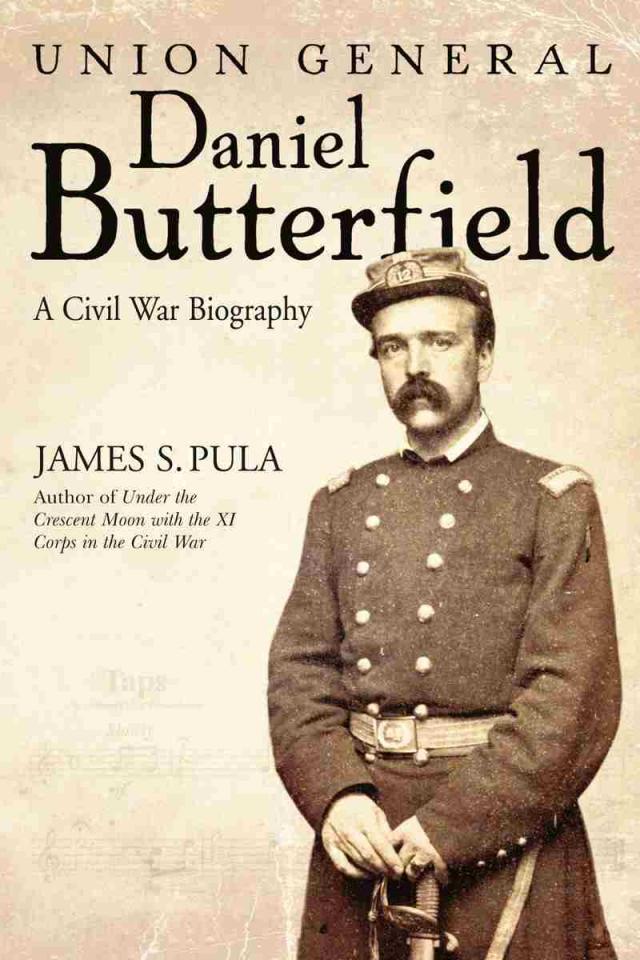
Union General Daniel Butterfield
A Civil War Biography
James S. Pula
© 2024 James S. Pula
All rights reserved. No part of this publication may be reproduced, stored in a retrieval system, transmitted, in any form or by any means, electronic, mechanical, photocopying, recording, otherwise, without the prior written permission of the publisher.
Names: Pula, James S., 1946- author.
Title: Union General Daniel Butterfield: A Civil War Biography / by James S. Pula.
Description: El Dorado Hills, CA: Savas Beatie, [2024] | Includes bibliographical references and index. | Summary: “Dan Butterfield played a pivotal role during the Civil War—led troops in the field at the brigade, division, and corps level, wrote the 1862 Army field manual, composed “Taps,” and served as the chief of staff for Joe Hooker in the Army of the Potomac. Butterfield was also controversial, not well-liked, and tainted by politics. Award-winning author James S. Pula unspools fact from fiction to offer the first detailed and long overdue treatment of the man and the officer” — Provided by publisher.
Identifiers: LCCN 2023053785 | ISBN 9781611217001 (hardcover) | ISBN 9781611217018 (ebook)
Subjects: LCSH: Butterfield, Daniel, 1831-1901. | Generals—United States—Biography. | United States. Army—Biography. | United States. Army of the Potomac—Biography. | United States—History—Civil War, 1861-1865—Campaigns.
Classification: LCC E467.1.B9 P74 2024 | DDC 973.7092 [B]—dc23/eng/20231211
LC record available at https://lccn.loc.gov/2023053785
First Edition, First Printing
Savas Beatie
989 Governor Drive, Suite 102
El Dorado Hills, CA 95762
Phone: 916-941-6896 / sales@savasbeatie.com
www.savasbeatie.com
Savas Beatie titles are available at special discounts for bulk purchases in the United States. Contact us for more details.
To My High School Teachers
Richard Dunn who taught me to question.
Charles Hoffman who taught me to write.
Henry McCann who taught me that learning can be fun.
Daniel Butterfield as colonel of the 12th New York State Militia in 1861. Library of Congress
Table of Contents
Acknowledgments
List of Abbreviations
Introduction
Chapter 1: “A Plain Duty to Prepare” Life Before the War
Chapter 2: “I Have Sworn to Obey the Constitution” The Defense of Washington and Northern Virginia
Chapter 3: “A Splendid Commander and a Good Model” The Peninsula Campaign
Chapter 4: “Strong Qualities as a Soldier and a Commander” Second Bull Run and Fredericksburg
Chapter 5: “A Model of Neatness and Dispatch” Chancellorsville
Chapter 6: “I Hardly Know How I Should Have Gotten Through” Gettysburg
Chapter 7: “We Cannot Well Spare You” The Tennessee and Georgia Campaigns
Chapter 8: “Gallant and Distinguished Services” Peace and Retrospection
Chapter 9: “Unexcelled Devotion and Tireless Energy” The Postwar Years
Bibliography
About the Author
List of Maps
Battle of Hanover Court House
Peninsula Campaign
Battle of Gaines’ Mill
Battle of Malvern Hill
March to Second Bull Run
Second Bull Run
Battle of Fredericksburg
Chancellorsville Campaign
Gettysburg Campaign
Chattanooga
Battle of Wauhatchie
Atlanta Campaign
Battle of Resaca
List of Illustration
Daniel Butterfield as colonel of the 12th New York State Militia in 1861
John Butterfield ca. 1860
Believed to be Elizabeth “Lizzie” J. Brown Butterfield
Butterfield with his pointed “English” style mustache as he appeared in early 1861
Officers of the 12th New York State Militia in Camp Anderson
Butterfield’s regiment leads the way across Long Bridge over the Potomac into Virginia
Butterfield portrait by Matthew Brady
Gen. Fitz John Porter
Gen. George W. Morell
The gun Butterfield’s 17th New York captured at Hanover Court House, Virginia
Bugler Oliver Norton, 83rd Pennsylvania
“Taps” and the Scott Tattoo (1835)
Butterfield’s Medal of Honor
Robert Tilney, 12th New York Infantry
Butterfield with his staff in 1862
Lt. Stephen Minot Weld, Jr., 18th Massachusetts Infantry
Secretary of the Treasury Salmon P. Chase
Lt. Edward Hill, 16th Michigan Infantry
Charge of Humphrey’s Division at Fredericksburg
Senator Zachariah Chandler, a Butterfield confidant
Gen. Joseph Hooker
Major Henry Tremain, aide-de-camp
Gen. John Sedgwick
Hooker and his staff at Falmouth, Virginia, in June 1863
Gen. George G. Meade
Meade’s council of war on July 2
The shell fragment that wounded Butterfield at Gettysburg
Gen. Daniel Sickles
Gen. Joseph Hooker and his staff in Lookout Valley
Gen. George Thomas
Gen. William Tecumseh Sherman
Col. Benjamin Harrison, 70th Indiana Infantry
The guns captured by Butterfield’s division
Capt. Paul A. Oliver ca. 1875
Butterfield presents the New York State colors to Governor Fenton
Senator Henry Wilson, chair of the Committee on Military Affairs
Julia Lorillard Butterfield
The Craigside estate in Cold Spring, NY
Butterfield and his wife Julia in Egypt
Veterans at Lookout Mountain
Monument to the 12th and 44th New York Infantry regiments at Gettysburg
The 25th anniversary Gettysburg reunion
The monument Butterfield erected to the Fifth Corps at Fredericksburg
Butterfield in 1890
Butterfield’s Tomb at West Point
Butterfield’s Monument in Sakura Park on Riverside Drive in New York City
Acknowledgments
The author wishes to thank the following individuals and institutions for their assistance with his research: Brian Howard, Rebecca M. McLain, Mary Pat Connors, Janice Reilly, and Pat Kelly of the Oneida County History Center, Utica, NY; Susan Anderson and Elizabeth Bunton of the Interlibrary Loan Office at Purdue University Northwest in Westville, IN; John Heiser, Stuart R. Dempsey, and Steven Floyd at the Gettysburg National Military Park; Cassie Ward of the Putnam History Museum, Cold Spring, NY; Luanne Morse and Johanna Reinhardt of the Julia L. Butterfield Library, Cold Spring, NY; Donald Wisnoski, Chadwicks, NY; Cheryl A. Pula, New York Mills, NY; Thomas J. Ryan, U.S. Department of Defense, retired; Timothy J. Orr, Old Dominion University, VA; Frank Tomaino, Utica, NY; Kathy Snell, New Hartford, NY; Josh Caster at the Library Archives of the University of Nebraska; the U.S. Military Academy Archives; the U.S. Army Heritage Education Center; the Library of Congress; Andrew Brethauer of the National Archives and Records Administration; and Meredith Mann at the New York Public Library. A special thank you to Hal Jespersen for his excellent conversion of my vague scratching into the beautiful maps appearing on the forthcoming pages.
Much appreciation also goes to Theodore P. Savas and the staff at Savas Beatie, including Sarah Keeney, Sarah Closson, Lisa Murphy, Donna Endacott, Veronica Kane, Rebecca Hill, and Lee Merideth for their excellent work in bringing this study to fruition.
List of Abbreviations
BPBL: Butterfield Papers, Julia L. Butterfield Library, Cold Spring, NY
GNMP: Gettysburg National Military Park
LC: Library of Congress
MOLLUS: Military Order of the Loyal Legion of the United States
NARA: National Archives and Records Administration
OCHC: Oneida County History Center, Utica, NY
OR: The War of the Rebellion: A Compilation of the Official Records of the Union and Confederate Armies. Citations are as follows: Series, Volume, Part, Pages. They appear as 1/21/2:153-54. All references are to Series 1 unless otherwise noted. They will appear as 21/2:153-54. If there is only one part, the citation reads 21:153-54.
RG: Record Group
USAHEC: U.S. Army Heritage Education Center, Carlisle, PA
USMA: United States Military Academy, West Point, NY
Introduction
Daniel Butterfield, declared an editor writing in a special issue of the centennial publication New York State and the Civil War, “was beyond argument the ‘fightingest’ general this state had given to the Civil War.” Yet, he marveled, “the name of Butterfield is not conspicuous in the Civil War literature.” More than a half century later, this dearth of attention remains.
Butterfield led troops in battle at the regimental, brigade, division, and corps levels through some of the more important theaters of the war, including the 1862 Peninsula Campaign, Second Bull Run, Fredericksburg, and the Atlanta Campaign, earning in the process the Medal of Honor and praise from his commanding officers and subordinates alike. He served in the crucial role of chief of staff of the Army of the Potomac at Chancellorsville and Gettysburg, and in a similar
Such a prominent resume would normally merit the attention of historians. Although he is often mentioned in passing in books and articles, few authors have examined any of his various roles in detail. The only treatment in any depth was a memorial publication prepared by his wife that included a general overview of his life and a selection of correspondence and other documents. The purpose of this work is to remedy this serious deficiency in Civil War literature.
My focus is the protagonist’s role during those tumultuous years. To add context, the first chapter provides some background on his early life through 1860, while the final chapter briefly covers the years following the war and a summary analysis of his military career. The balance of the chapters present a narrative and analysis of his wartime contributions, the first such exploration undertaken by any author. Organized in a generally chronological order, the text relies heavily on original primary sources, which serve as evidence for the conclusions offered. Wherever possible, I have allowed the participants in these events to speak with their own voices.
Chapter 1
“A Plain Duty to Prepare”
Life Before the War
Hundreds of people crowded into St. Mary’s Episcopal Church in Cold Spring, New York, many more than a normal Sunday morning, let alone for a Saturday. This was anything but a typical July morning.
At the conclusion of funeral services, the cortège passed through streets lined with people, the town’s flags lowered to half-staff as the procession made its way to a dock for transport on a steamer across the Hudson River to the United States Military Academy. There, the 12th New York State Militia provided an escort for a line of march that included members of the Grand Army of the Republic Lafayette Post 140 from New York City, the Military Order of the Loyal Legion, and veterans of the Army of the Potomac. Cavalry, field artillery, a battalion of cadets, along with friends and relatives of the departed, completed the lengthy line of mourners. As the discharges of a thirteen-gun artillery salute echoed from the surrounding hills, the caisson carrying the deceased reached the cemetery where the mortal remains were lowered into their final resting place with full military honors, including the haunting musical notes of “Taps.”1
Interred not far from the grave of the distinguished Gen. Winfield Scott, amidst a sea of graduates of the academy and career military personnel, the deceased possessed neither of these characteristics. A civilian for most of his life, he was a businessman who had never attended the academy or any other military college. He even had to secure special government permission to be laid to rest on the Academy’s grounds. Despite this, today he rests beneath a towering marble monument, standing at a remarkable 35 feet in height. Its base is said to have been “the largest and heaviest block of pure white marble” quarried in the United States at that time. The monument’s size and elegance dwarf the surrounding headstones and memorials. Who was this individual who commanded such respect from so many people and what had he done to earn these honors?2
* * *
The story begins at the mouth of the River Taute near Carentan in Normandy, France, where the Bouteville family maintained their estate. Most genealogists place the family’s arrival in England in the twelfth century, supported by records confirming land ownership by Robert de Buteville in Bedfordshire and John de Buteville in Buckinghamshire. Other family members seemingly joined them, leading to various spellings of the surname as it adapted to English usage. The first known descendant to arrive in North America was Benjamin Butterfield, who was born in Halifax, England, around 1611. He, along with his wife Ann, migrated to Charlestown in the Massachusetts Bay Colony in 1638, initially as an indentured servant. He later appears as a free man in Woburn’s town records in 1643. His descendant, Timothy Butterfield, served in the American Revolution, and at least three of his close relatives also joined the cause. His son Daniel was born in the year the United States declared its independence.3
The years following the Revolution marked the start of a significant westward migration as residents from New England and other eastern states sought fertile, affordable lands in the west. Embracing this trend, Daniel settled in Berne, located in the Helderberg Escarpment west of Albany, New York. Here, he and his wife, Catherine, welcomed their son, John, into the world on November 18, 1801. Like many young individuals growing up in small rural communities during that era, John received limited formal education. He compensated for this by demonstrating a keen intellect and a strong determination to succeed. As soon as he reached an appropriate age, he found employment as a stagecoach driver for Thorpe & Sprague in Albany. This occupation continued when he was hired by Theodore S. Faxton for a new business venture, formed in collaboration with Jason Parker, who held a contract for transporting the U.S. mail between Albany and Utica.4
With his new position, Butterfield moved to Utica about 1818, then a town of 420 homes with an assortment of stores, churches, banks, taverns, printing offices, and 2,861 inhabitants. Genesee Street, the main thoroughfare, was lined with small businesses but remained unpaved, subject to mud when it rained and clouds of dust when sunny and dry. But the town’s position along the main east-west trade route through the state offered the potential for growth as transportation improved. That began in 1819 with the completion of the section of the new Erie Canal between Utica and Rome, the first revolution in transportation that would lead to business and industrial development and attending population growth. This dynamic environment presented opportunities for ambitious entrepreneurs astute and energetic enough to take advantage of them. Arriving in the city, Butterfield spent his time “picking up passengers from the taverns and boats for Parker’s stages.” Frugally saving some of his wages, he purchased a horse and coach with which he opened a livery business. Prosperity followed, due in no small measure to his determination, but also to a mind continually open to any new ideas and opportunities. An admirer referred to him as “one of the class of men who illustrate the pluck and ability which win success,” a person who “possessed indomitable will, conspicuous ability and the intelligence which is far-seeing.”5
With his future looking bright, Butterfield married Malinda Harriet Baker in February 1822. Daniel Adams Butterfield arrived in Utica, the fifth of the couple’s eight children, on October 31, 1831. Not much has been preserved about his youthful years, but Ellis H. Roberts, a future Treasurer of the United States, recalled “He was active in sports and all youthful undertakings, with a certain dash and audacity which were a presage of his future career.” Because his own early education was lacking, the father determined his son would not have the same disadvantage. Educated in local schools, Daniel was prepared for entry into college at the private Utica Academy. Conceived in 1813 when a group of prominent citizens petitioned the New York State Board of Regents for approval of their proposal, the school benefitted from the hiring of trained teachers imported from outside the city for that purpose. With a classical program including Greek, Latin, and mathematics, its standards were considered high and its graduates found their qualifications “exceeding the collegiate standard.” After completing his foundational studies in Utica, Daniel enrolled in Union College in Schenectady. There, he became a member of the Sigma Phi Society, only the second Greek collegiate fraternal organized in the United States and the first to establish branches on other campuses. A biographical article recalled he “maintained an excellent standing, especially devoting himself to studies and outside reading productive of a generous culture. His genial bearing and gracious offices endeared him to his mates, and he had a certain dash and audacity in sports, presaging his future career.”6


