White papers, p.1
White Papers, page 1


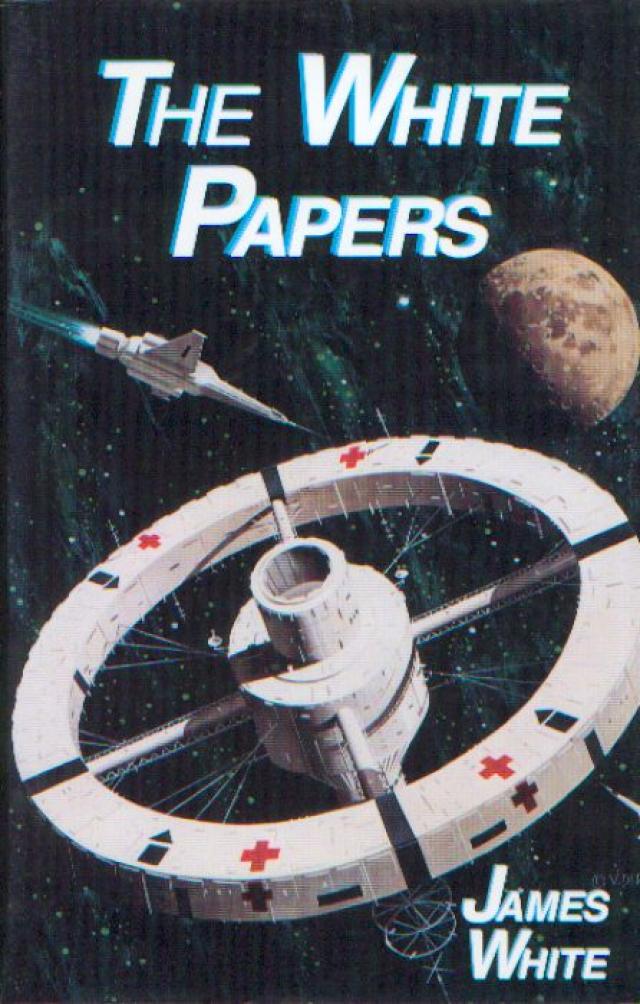
The White Papers
(1996)**
James White
Contents
Introduction by Mike Resnick
James White by Walt Willis
Custom Fitting
Commuter
House Sitter
Sanctuary
Christmas Treason
The Secret History Of Sector General
Accident
Medic
Countercharm
Visitor At Large
Fan Writing
More About Sector General
Sector General Timeline
Notes On The Classification System
The Classification System
Book Information
Introduction
by Mike Resnick
I'M ABOUT to make public a secret vice. Its name is James White, and for well over a third of a century I have been searching for a James White book or story that I could put down before finishing.
I haven't found one yet—and I've read every word of science fiction he's written to date. I even stopped by a British book store to buy Underkill, the one novel he didn't sell to the United States.
The strange thing is that each time a new White book comes out, I look at the cover blurb and say, "This time you've done it, James my boy. This time you've picked a subject even you can't make interesting."
I must confess that over the years I've learned to say it very softly, because he makes a liar out of me every time.
I DO A lot of speaking at conventions, and I write some columns about science fiction, and one of the things I keep pointing out is that there is really no need for five-book trilogies, that good writers can usually say what they have to say in one well-conceived and well-executed book. I take great pride in the fact that I turned down a StarTrek novel and a Star Wars trilogy in the same calendar year.
That said, I must point out that there are exceptions to every rule—and I publicly promise that if James White ever stops writing his Sector General books, I will personally break one of his knees each day until he relents. And if it takes him more than two days to give in, I'll go to work on his elbows.
If White is addictive (and he is), then beware the tales of this fabulous hospital in space, because once they grab hold of your sense of wonder you will be hopelessly hooked for life. And like any addict, you'll find that you don't mind in the least.
THE STORIES are populated by the most memorable crew of aliens ever created—and that includes every creature from Stanley Weinbaum's to (insert the author of your choice here). The four-letter biological classification system is a marvel, and has been swiped—well, let's be generous and say built upon—more than once. The tapes that each surgeon carries around inside his head are another touch of genius. The problems O'Mara and Conway and the empath Prilicla and the elephantine Thornnastor and the rest of the crew must face in each story are always fascinating, and the solutions are both logical and fair.
The books began as simple—well, actually, incredibly complex—medical problems in the brilliantly realized Sector General, but as the series has continued, the focus has become more serious and mature. By the time of The Genocidal Healer, White was dealing with themes as important and powerful as any writer in the field—and handling them better than most.
White didn't exactly create the sub-genre of Medical Science Fiction, but I don't think there's any doubt in anyone's mind at this late date that the Sector General stories define it.
I DON'T want you to get the idea that James White is a one-shot artist, a guy who lucked out on the Sector General stories and didn't do much else worthwhile.
Take, for example, The Escape Orbit. Here's a good old-fashioned science fiction problem story. There's a war. Human prisoners are dropped onto a planet that possesses no metals and no fissionable materials. The enemy ships never land.
Okay—how do you plan an escape?
White not only plans it and pulls it off, he has you believing it. The only problem I have with the book is why Hollywood hasn't bought it, adapted it, and made umpteen gazillion dollars at the box office with it.
Then there's All Judgment Fled, my personal favorite. I never knew quite how to describe it until Rendezvous with Rama came out and won the 1974 Hugo. Now I just tell people that if they want to read Rama done right (sorry, Arthur), pick up All Judgment Fled.
Like Rama, this one has a mysterious space vehicle approaching the Earth, and, like Rama, a human crew goes out to investigate it.
But unlike Rama, the solution to the multitude of frustrating puzzles is logical and satisfying—and you don't have to hunt up the sequel(s) to find out what it is.
WHAT CAN I tell you about Lifeboat except to say that it's a totally fresh and intriguing handling of an old theme. Too bad Hitchcock didn't make this one instead of the mundane one about a bunch of men and a Tallulah duking it out in an ocean liner's lifeboat.
Deadly Litter? It's a notion so unique, so out and out brilliant that I use it whenever I'm lecturing beginners about what science fiction actually deals with when it's done properly.
The Watch Below? Fabulous story. In fact, two fabulous stories that dovetail beautifully by the end of the book.
HOPEFUL science fiction writers could learn a lot about then craft by studying White's various novels and short stories. No one presents a wider selection of consistent, believable aliens. But just as important, I consider him without peer in creating alien environments.
He's not so bad on human environments, either, Once he's described a room, or a ship, or a hospital for that matter, you feel like you've been there. He doesn't content himself with physical outlines, but adds textures as well.
Perhaps the most distinctive thing about him—it runs through every story, never intrusive but always there—is his devout belief in a benevolent, ultimately reasonable, universe. Like Clifford D. Simak before him, James White believes in the decency of all intelligent beings.
So why (I hear you ask) do I, who can most charitably be termed cynical, and whose endings are not always the happiest, have such admiration for James White?
First, because the man's a craftsman and an artist, and I have unbounded respect for both traits.
And second, and perhaps more importantly, because while I may write about my universe, I wish I could live in his.
James White
by Walt Willis
THIS IS not the first such piece I have written. The very first one was written at the request of a now almost forgotten fan called Henry Oden, before James started his professional career and while he was known only as Art Editor of our fanzine Slant. Each of us wrote a brief description of the other, and I wrote the following in response to James's picture of me dashing off the tennis court to supervise the printing of Slant.
THOSE KEEN-minded, or crossed-eyed, readers who have been reading between the lines of that account may have conjured up a mental picture of James spending the long summer evenings slaving over a hot press turning out Slant while I enjoy myself in the sunshine, tanning my knobbly face and thin sensitive knees. They may even have got the impression that James does all the real work on Slant while I collect all the egoboo.
Nothing could be nearer to the truth. With real feminine intuition, Lee Hoffman, without ever hearing directly from James, summed him up as follows: "I've always had a special sense of affection for James White, partly because he is—so far as one can tell—so quiet. He seems to go quietly about his tasks, performing them all with efficiency and dispatch, and never gets so much as a nod or a thank you for doing them." This is very true indeed. James puts more into fandom and gets less egoboo out of it than anyone I know. Each issue of Slant is more his work than anyone else's, and yet he is so quiet and unassuming that even me and Bob Shaw, who like and respect him more than anyone we've met, are inclined to overlook the fact that he is the mainspring of Irish fan publishing, the power behind the zines. Nevertheless, it is quite true to say that without James, Slant would not be what it is today, nor even exist at all. Apart from the linocuts, where without any previous training or experience he has worked up a technique which puts most professionals to shame, every issue represents hours of patient work by him setting type and working the press. We all look up to James here, and not just because he is about 6 1/2 feet tall.
That piece for Henry Oden wasn't quite the first published writing by James. That distinction belongs to a disclaimer "These views on the great Smith are not those of the typesetter, J. White" diffidently but stubbornly inserted after a disrespectful reference to E.E. Smith in Clive Jackson's column in Slant 4. More important was a report James wrote on the London Convention of 1951. It was too long for Slant ... after 24 closely hand-written pages it had reached only 8:30 p.m. on the night before the convention started. They don't write convention reports like that nowadays. However I persuaded him to send an extract from it to Vince Clarke, who duly published it in his SF News under the title "The Unconventional Fan." Bob Shaw and I were determined that this debut shouldn't pass unnoticed, and for weeks Vince was getting letters of comment like these:
Dear Sir,
I have been writing to fanzines for 74 years now, yet I have never read one before. But something drove me to read James White's story in the current SFN. I was profoundly stirred, as if I had swallowed an eggbeater. This story, Sir, is a masterpiece. It will stand the test of time. Indeed I venture to say that when the ephemeral scribbles of lesser authors ... Heinlein, Van Vogt, even Willis ... are forgotten, this story will live on, bringing inspiration to countless thousands. When I read this story first I was unable to contain myself, and pored over it again and again. But now I am exhausted and can only offer these pithy comments.
Yours thintherely,
Prof. Harold Urine (No. 1 Fan)
Or this, on the back of a picture postcard of Windsor Castle:
Dear Mr. Clarke,
We were amused by the story about the UNCONVENTIONAL Fan by Mr. White. This is one of our favourite Subjects.
X This is Our room.
My grandmother's postcard album wasn't restricted to British scenery:
CAPETOWN. Great. Colossal. Goshwowboyoboy. This guy White is terrific. Why doesn't he try for Slant? Don't let Gold get him. Throw out all those other hacks of yours and let White fill the whole magazine. Give him his head. What are you doing with it anyway?
Yours for more White A White Fan
(A Caucasian Winnower, Mr.)
Dear Vincy-wincy,
I have just read your cute little SFN. I love every line of it. Would you do a little girl like me a b-i-g favour. You would! Oh you dear boy. Just send me the address of James White who wrote that adorable story. I feel we are soul mates. I can just imagine him—dark, strong, and ever so brutal. I must meet him—that super-duper story convinced me. It was great! So vital, don't you think?
Yours sincerely,
Lava Firestone (Miss)
Meanwhile the crack of doom was about to sound for our little fanzine. We were printing it on the cheapest available printing press, an Adana, which consisted of nothing more than a steel box with a cast iron lever designed to force the lid, holding the paper backed by a cork table mat, against the type, held in the box. It was a very elementary machine, designed for little more than printing letterheads and visiting cards, certainly not whole pages of type. I noticed after a while that the steel bed for the type had become quite convex, but also noticed that, through some merciful dispensation of Providence, the lid had fortunately become correspondingly concave. Admittedly it seemed to be getting more difficult to get an even impression, but really there wasn't much a few little pieces of type could do when levered against a cork table mat by an enthusiastic fan. We just seemed to go through a lot of table mats; literally.
James had the job of operating the press because he is bigger and heavier than I am. He had the process down to a fine art, if you can describe as a fine art anything so awesomely brutal. Having closed the press, he would take a deep breath, grasp the lever firmly with both hands, and push himself into the air, where he would remain for a moment before returning to the floor. I estimate he had made this ascent twelve thousand times, and the first 25 pages of Slant #3 were stacked neatly in the corner of the room, when disaster struck. We had set up and proof-read the last page, the back cover, and were ready to run it off. The time was about 10 p.m. The page we were printing was even more crammed with type than usual, and James realised that an even greater effort than usual was called for. Besides, this was the last page of an issue to which we had devoted our entire spare time for six months, he was going to finish the job properly. He eyed the press grimly, making sure it was firmly based. Then, retreating about three feet, he reached forward for the lever. Grasping it firmly in his two large hands, he bent at the knees and launched himself upwards in a parabolic arc, descending on the printing press from the vicinity of the ceiling like some heavyweight avenging angel. We cowered in anticipation of the crunch of half a square foot of type being rammed halfway through a cork table mat; but instead there was an ear-splitting CRACK! Pieces of shrapnel ricocheted off the walls as James fell heavily onto the table and slid to the floor still clutching a stump of lever.
At the time there was still a blacksmith to be found in the suburb, formerly the village of Ballyhackamore, where I lived, and he willingly produced a substitute lever. But it was never the same. It bent when James tried to use his full strength. Our publishing problems were finally solved when an American fan, Manly Banister, crated up his printing press and sent it to us by boat, but I always felt that an era had come to an end with the explosion of the old lever.
So, I think, did James, and I tend to look on that episode as marking the beginning of his career as a professional writer. His first sale was of a story called "Assisted Passage," to the British magazine New Worlds, but to us his real apotheosis took place with the publication in Astounding of a story called "The Scavengers," in October 1953. I remember vividly the evening in May of that year when James arrived at my house, on his bicycle from the Lower Falls on the other side of Belfast, clutching a letter from John W. Campbell Himself disclosing that he was willing to pay $285 for the story. This was a fabulous sum, but more important was the glory which had settled on our little fan group, born and nurtured on Astounding. It was like a country vicar who receives a pale blue tablet of stone announcing that his sermon last Sunday had found so much favour from on high it was henceforth to be included in the Bible.
The letter said that James had to get his signature on the contract witnessed by a Notary Public, and his problem was that this form of life did not seem to exist in the United Kingdom. Momentarily sobered by my responsibilities as leader of the fan group, I deduced our equivalent might be a Commissioner For Oaths, and even remembered seeing a brass plate with those words on it on a gate down the road. So we walked down the Upper Newtownards Road, disturbed an amiable gentleman called Norwood, and got him to sign his name to a statement that James's signature was genuine. Having assured James's immortality, I felt quietly proud for having encouraged him as a writer and insisting he send that story to Astounding. After we had put in some serious gloating, James cycled home again and I hurried to the nearest public telephone kiosk to send a telegram to Chuck Harris with the great News.
The next few years were studded with similar pleasant surprises, as when Groff Conklin anthologised "The Conspirators" from New Worlds of July 1954 for his Adventures in Mutation, and James sold his first pocketbook to Don Wollheim for Ace, and the Sector General stories began to make their appearance, but there were always two things you could rely on in anything written by James. First, it would be as honest and true as he could make it. Despite his admiration for E.E. Smith, he himself belonged more to the school of Hal Clement.
Second, you yourself were always a better person for reading a James White story. Without lecturing his readers, he always made clear what was the right way to behave in any circumstances, and why. And in his recent, and, I think, his greatest work, The Silent Stars Go By, he tackles head-on the greatest question humanity has yet faced, namely, what is the role of the individual in history. Can one individual really make a difference? This has become a burning issue with the worldwide discrediting of the communist theory that the course of history is determined by factors arising from economic classes. One deduction commonly made from the theory of economic determinism is that people are not really responsible for the consequences of their actions, or conversely that individual decisions are not really important.
The Silent Stars Go By, however, is based on the quite different assumption that certain events, arising out of moral decisions made by individual human beings in the distant past, can lead to a probability world quite different from our own, in this case one in which a Celtic superstate runs Western civilisation, according to quite different moral principle. Such unpredictable consequences of human actions are quite normal, according to modern students of chaos theory, but James White, so far as I know, is the first author to explore the implications of chaos theory for human history, and readers of his work are, to my mind, at the cutting edge of human intellectual development. This may be temporarily obscured by the fact that The Silent Stars Go By is also a rattling good story.
Custom Fitting
FOR MANY years Hewlitt had been in the habit of spending half an hour sunning himself at the entrance to his shop when the sunlight was available in sufficient strength, the period was determined by the length of time it took for the sun to clear the eaves of the buildings on his side of the street and to move far enough out to necessitate his pulling out the shop's awning so that the cloth on display would not fade. He spent the time watching the passersby—hoping that some of them wouldn't—and anything else of interest. Usually there was nothing interesting to see, but today was an exception.