Earl on the run, p.1
Earl on the Run, page 1


Thank you for downloading this Sourcebooks eBook!
You are just one click away from…
• Being the first to hear about author happenings
• VIP deals and steals
• Exclusive giveaways
• Free bonus content
• Early access to interactive activities
• Sneak peeks at our newest titles
Happy reading!
CLICK HERE TO SIGN UP
Books. Change. Lives.
Copyright © 2022 by Jane LeCompte
Cover and internal design © 2022 by Sourcebooks
Cover design by Dawn Adams/Sourcebooks
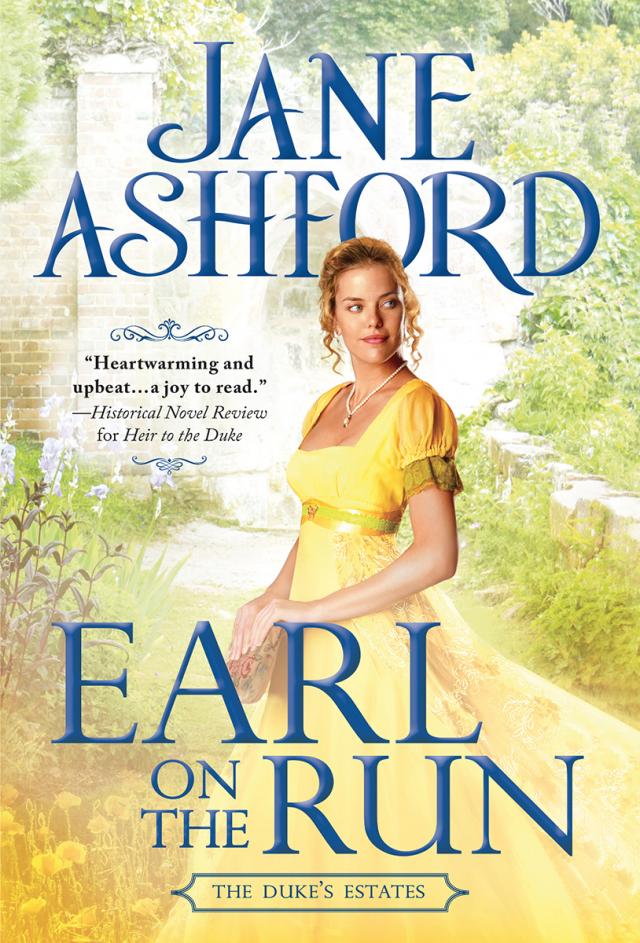
Cover illustration by Aleta Rafton/Lott Reps
Sourcebooks and the colophon are registered trademarks of Sourcebooks.
All rights reserved. No part of this book may be reproduced in any form or by any electronic or mechanical means including information storage and retrieval systems—except in the case of brief quotations embodied in critical articles or reviews—without permission in writing from its publisher, Sourcebooks.
The characters and events portrayed in this book are fictitious or are used
fictitiously. Apart from well-known historical figures, any similarity to real
persons, living or dead, is purely coincidental and not intended by the author.
Published by Sourcebooks Casablanca, an imprint of Sourcebooks
P.O. Box 4410, Naperville, Illinois 60567–4410
(630) 961-3900
sourcebooks.com
Contents
Front Cover
Title Page
Copyright
One
Two
Three
Four
Five
Six
Seven
Eight
Nine
Ten
Eleven
Twelve
Thirteen
Fourteen
Fifteen
Sixteen
Seventeen
Excerpt from The Duke Who Loved Me
One
About the Author
Back Cover
One
Jonathan Frederick Merrill, apparently the thrice-damned ninth Earl of Ferrington, known to himself and his old life as Jack, encountered the Travelers on the third day after he left London. They were ambling along the road he was walking, and he caught up with their straggle of horse-drawn caravans and swarm of children when the sun was halfway down the western sky. The sight of them was the first thing to lift the black mood that had afflicted him since he’d fled the city. “Grãlt’a,” he said to the man apparently serving as the rear guard.
This produced a ferocious scowl and a spate of words he didn’t understand. “I only know a few words of the Shelta,” he replied, naming the language these traveling people spoke among themselves. The adult men had begun to gather around him, looking menacing. “My mother was born to an lucht siúil, the walking people, over the sea in America,” Jack added. “She left them to marry my father, but many a tale she told me of life on the road.”
The first man surveyed the landscape around them, an empty stretch of forest. “You have no horse?” he asked contemptuously.
Jack had thought of buying a horse. He had a sizable sum in a money belt, his passage home and more. But he’d put it off, thinking he would soon be leaving England. “Only my own feet and a bit of coin in my pocket. I’m happy to work for my keep, however.” Nobody needed to know the extent of his funds.
The group scowled at him. Jack had already noticed that his accent puzzled the people here. They were accustomed to judging people by the way they spoke, but his mixture of North American with the intonations of his parents didn’t fit their preconceived notions.
“Perhaps we just beat you and take your coins,” the man said.
Jack closed his fists. “You could try, I suppose.”
A wizened old woman pushed through the circle of men. Leaning on a tall staff, she examined Jack from head to toe.
Jack stiffened. He wouldn’t be enduring abuse from another crone. He’d had his fill of that and more from his newfound great-grandmother. She’d discovered nothing to like about him. His brown hair, dark eyes, and “undistinguished” face were nothing like her noble English get, apparently. A poor excuse for an earl with the manners of a barbarian, she’d said. Though how she could tell about the manners when she’d hardly let him speak a word, he did not know.
“We are not brigands,” said the old Traveler woman to her fellows. “No matter what they may say of us.”
“Nay, fine metalworkers and horse breeders, or so my mother told me,” Jack replied.
“Did she now?” Jack caught a twinkle of good humor in the old woman’s pale eyes. Perhaps she wasn’t like the ill-tempered Lady Wilton after all.
“She did,” he replied. “And inspired me to be footloose. I’ve been a frontier explorer, a bodyguard, and a sailor.” He’d been told he had charm. He reached for it as he smiled at the small woman before him.
“And now you are here.”
Jack nodded. He wasn’t going to mention inherited earldoms. That would be unwise. “Seeing the world,” he answered. “I don’t care for sitting still.”
This yielded nods of understanding among his audience.
“Might I walk along with you?” Jack dared. “I’m headed north, as you seem to be.” The truth was, Jack was lonely. He was a sociable man. He’d had many friends back home. Why had he left all that at the behest of a stuffy Englishman? He should have known that any legacy from his feckless father would be tainted.
“North to what?” the old Traveler woman asked.
It would be as unwise to mention estates as to reference an earldom, though Jack had decided to take a look at this Ferrington Hall he was supposed to inhabit. “North until I decide to turn in some other direction,” he replied jauntily.
One man laughed.
“The road is free to all,” said the woman.
“It is that. But companionship is a gift beyond price.”
She laughed. “You have a quick tongue. If you wish to walk with us a while, we will not turn you away.”
“Maa’ths,” said Jack, thanking her with another of his small store of Shelta words. He was surprisingly glad of the permission.
The caravans started up again. Jack walked along beside them. But with this matter settled, his thoughts began drifting back to the scene that had driven him from town. Much as he’d like to forget it, he could not.
Until the high-nosed Englishman had shown up in Boston with his astonishing summons, Jack had only half believed his father’s stories of a noble lineage. His Irish mother claimed Papa bragged about being an earl’s son before they wed, but once they were, he wouldn’t take the least advantage of it. He refused to lift a finger to introduce Jack, his only child, to his rich relatives before he drank himself to death. And so she’d decided it was all a lie. Jack wished she’d lived to see the arrival of that “man of business” who’d lured him back here. He’d come partly because of her. How she would have reveled in the idea of her son as an earl.
His mother would not have stood for one single insult from his scold of a great-grandmother, however. She’d have scratched the harpy’s eyes out.
Jack had been taken before this Lady Wilton as if he was a package to be dropped in her lap. And she’d received him like a delivery of bad meat. Facing her distaste, he’d actually felt as if he smelled. The small, gnarled woman with snow-white hair and a nose seemingly designed for looking down on people had proceeded to deplore his appearance, his lowborn mother, his upbringing, his accent, and the sins of his scapegrace father, whom she’d never expected to hear of again after she packed him off into exile. But there was no help for it, she’d declared at the end of this tirade. Jack was now the earl. She would have to force him onto Society. It might just be possible if he followed her lead in every respect and kept his mouth shut.
Of course, Jack had rebelled. No red-blooded man would stomach such words, particularly about his mother. The mixture of motives that had brought him across the sea evaporated in an instant. He had no interest in joining any society that included people like Lady Wilton.
Bruised and resentful, Jack had nearly boarded a ship and returned to Boston right after that meeting. But he hadn’t quite. He’d set off north instead. Only when he’d been walking for a full day did his anger cool enough to acknowledge he was hurt as well as outraged. The truth was, he’d been drawn here by an idea of family, a homely thing he’d never had. He’d read stories about domestic tranquility and seen glimpses of it among his friends, but his childhood had been fragmented and contentious. His parents couldn’t seem to agree on anything except their tempestuous reconciliations after a shouted dispute. Jack had been audience or afterthought, often left to fend for himself.
When the summons to England came, he’d actually imagined a welcome by a circle of kin, a place where he belonged. He’d found disdain instead, rejection without any chance to show his worth. It was painful to be the unwanted earl, the bane of his father’s kin. The inner bruise had been expanding rather than fading as time and distance separated him from London.
“Are you a dreamer?” said a voice near his knee.
“What?” Jack looked dow n to find a girl of perhaps six or seven trudging along beside him. Tiny, dark-haired, and bright-eyed, she peered up at him.
“You didn’t hear what I said three times. That’s a dreamer.”
“I beg your pardon. I was thinking.”
“About what?”
“My great-grandmother.”
“Do you miss her?” asked the little girl.
“No, she thinks I’m a disgrace.”
“What did you do?”
That was the point. He’d done nothing but be born into Lady Wilton’s precious bloodline. Half into it. His mother’s lineage was not to be mentioned. Jack hadn’t asked to come here or be an earl. “Not a thing.”
The little girl took this in solemnly. She seemed to decide to believe him. “You’re too old to be scolded.”
“A man might think so.”
“How old are you?”
“Twenty-four.”
“I’m nearly eight. My name’s Samia.”
Jack stopped walking, doffed his hat, and gave her the sort of elegant bow he’d learned from his wayward father. He had absorbed a good deal from the man, whatever his great-grandmother might think. “Jack…” He hesitated. His last name might be better concealed. Lady Wilton was no doubt furious at his disobedience and perfectly capable of organizing pursuit. “At your service, Miss Samia,” he added. “Very pleased to make your acquaintance.”
She giggled, then looked around to see if any of her friends had noticed his bow. They had. Samia preened as they walked on, and she assumed a proprietary air as other children joined them and Jack told them tales of another continent.
When the group stopped for the night in a clearing well off the road, Jack helped gather wood for the fires and carry water. Borrowing some lengths of cord, he set snares that might yield a rabbit or two by morning. He was given terse thanks and a tattered blanket to augment his meager belongings.
Later there was shared stew and music around the central fire. When he rolled up in the blanket and pillowed his head on his arm, Jack felt the first stirrings of contentment. He went to sleep in the pleasure of companionship, wondering only how he might best contribute to the group and earn his meals. His snares gave a partial answer to that question in the morning, yielding several rabbits for the pot. He vowed to discover more.
Jack fell easily into the Travelers’ erratic schedule. Some days the caravans moved; others they stayed in a place to sell objects the Travelers crafted or offer repairs to the people of a village or farmstead. The old lady sometimes read fortunes for those who came to inquire. Jack didn’t mind the slow pace. There was no particular hurry to see his ancestral acres, and he enjoyed the rhythm of the road. He did have wandering feet. He began to make—not friends, for this was a closed group, but cordial acquaintances. Some exhaustive conversations had established that his mother was not directly related to any of these Travelers, so he couldn’t claim kin right. But similarity of spirit created bonds. He enjoyed them, along with the certainty that his continuing absence must be infuriating his noble great-grandmother. That was a solid satisfaction. He would see what others he could find as time passed.
***
“Not that you would know anything about that,” declared the fat, choleric-looking man taking up the entire front-facing seat in the traveling carriage.
“No, Papa,” said Harriet Finch’s mother meekly.
Harriet gritted her teeth to keep back a sharp retort. She’d had years of practice swallowing slights and insults, so she wouldn’t let anything slip. But hours in a coach with her grandfather had tried her to the limit. From the less comfortable rear-facing seat, she looked at her mother’s father, Horace Winstead. Winstead the nabob. Winstead the all-knowing, according to him. She’d never spent so much time with him before. They hadn’t been thrown together like this during the months of the London season. Now that she’d endured a large dose of his company, she was afraid their new living arrangements were a mistake. How long would she be able to hold her tongue?
She hadn’t met her grandfather until this year because he had so disapproved of her parents’ marriage that he disowned his daughter. More than disowned. He’d vengefully pursued the young couple, ruining her new husband’s prospects by saying despicable things about him. Horace Winstead had consigned Harriet’s family to genteel poverty for her entire life. And then, suddenly, after the death of a cousin she’d never met, he’d turned about and declared he would leave his immense fortune to Harriet, now his only grandchild.
The reversal had been dizzying. New clothes, a lavish house in London for the season, a changed position in society. Young ladies who’d spurned Harriet at school when she paid her way with tutoring pretended to be bosom friends. Young men suddenly found her fascinating. A thin smile curved Harriet’s lips. They found her prospective income fascinating. Some hardly bothered to disguise their greed.
Harriet was expected to receive this largesse with humble gratitude. She couldn’t count the number of people who’d told her how lucky she was. She was not to mind her grandfather’s “abrupt” manners or ever lose her temper in his presence. He was to be catered to like a veritable monarch lest he change his mind and eject them. It was nearly insupportable. And one of the hardest parts of all was her mother had felt redeemed.
Harriet glanced at her sole remaining parent and received an anxious look in response. Mama knew she was annoyed, and her eyes begged Harriet not to let it show. Years of worry had carved creases around Mama’s mouth and added an emotional tremor to her manners. She continually expected disaster, and she’d often been quite right to do so. Brought back into the fold of her youth, she’d been so happy. Had she really thought Grandfather had changed? He still treated her with something close to contempt, even though she agreed with everything he said.
Harriet gave Mama a nod and a smile, silently promising she wouldn’t add to her burdens. Harriet might sometimes wish her mother had more fire, but Mama’s youthful rebellion had brought her years of scrimping, an early grief, and very little joy. She deserved some ease and comfort now. Harriet could not take it from her.
She sat back and watched the landscape passing the carriage window. She took deep breaths to ease her temper, a method she’d learned at an early age. At least she could revel in the knowledge that she resembled her father, Harriet thought. Her grandfather must notice it every time he looked at her. She’d inherited her red-blond hair, green eyes, and pointed chin beneath a broad forehead from her papa. He’d been a handsome man, though bitterness had marred his looks as he aged. His fierce drive to support his family, continually thwarted, had broken his health. Harriet could not actually prove that her grandfather’s meanness had killed her father, but she thought it. And this made her present life a painful conundrum.
“The countryside here is very fine,” said the old man. He pointed out the window. “That is Ferrington Hall, the principal seat of an earl. A neighbor of mine.”
Harriet perked up at this name and leaned forward to look. She’d heard of Ferrington Hall while in London. An acquaintance, Lady Wilton, had complained that its new owner, her great-grandson, was missing. Peering through a screen of trees, she could just see a sprawling stone manor. “Is the earl in residence?” she asked.
“Not at present,” replied her grandfather.
She could tell from his tone that he knew nothing about it. Harriet remembered her friend Charlotte Deeping saying, “We will unravel the mystery of the missing earl.” How she missed her friends! She’d been allowed to invite Sarah and Charlotte for a visit later in the summer. She couldn’t wait.
Ferrington Hall disappeared as they drove on, and in another few miles, they came to her grandfather’s country house, the spoils of the fortune he’d made in trade. But Harriet was not supposed to think of that, let alone ever mention it. People in society despised business, and those who benefited from commercial success hid it like a disreputable secret. It seemed ridiculous to Harriet. Everyone knew. And how was it any better to have gained lands and estates with a medieval broadsword?
“Here it is—Winstead Hall,” said her grandfather. “I changed the name when I bought it, of course.”
Of course he had. Horace Winstead put his stamp on anything he touched. Or, if he could not, he demeaned it.