Inevitable, p.1
Inevitable, page 1
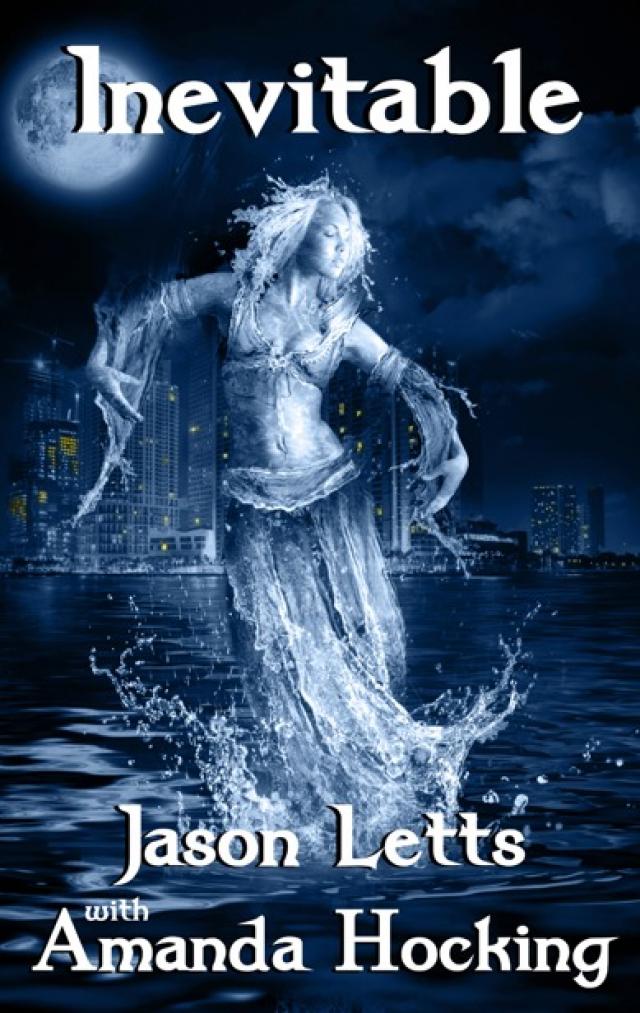


Inevitable: A Paranormal Romance
By: Jason Letts
Edited by: Amanda Hocking
© 2011 by Jason Letts
All rights reserved: no part of this book may be reproduced by any means without written permission from the author.
This book is a work of fiction. Any resemblance to any actual person, living or dead, is purely coincidental.
*
Chapter 1
All of this already happened, every possibility played out in a universe of its very own, but by changing the past of one I got trapped within it, and now there’s no going back. And it was all because of a boy.
Which is strange because I’m not even human. I exist only in the space between cause and effect, action and consequence, that determines the outcome of every choice every person ever made.
Outside of time, the threads of fate passed through me as I orchestrated the unfolding of human life. But I am a capricious spirit, and I love nothing more than to fill their lives with contradiction, to dash the false hopes of the proud and grant the fervent wishes of the fearful.
But some fears are too paralyzing to help, and there are some hopes too pure to be denied, and that’s what led me to an eighteen-year-old boy named Nathan Wheeler, just one Nathan Wheeler out of the countless that exist.
A high-spirited, endearing teddy bear of a young man, this Nathan called to me with a hope so true and a sacrifice so selfless that I couldn’t resist. While many Nathans didn’t lose their mothers to Huntington’s disease, this one did. Many Nathans didn’t choose to quit college to support a younger sister, Cammie, and the elderly grandmother in whose custody she was placed, but this one did. And to support them, a few Nathans took the only job available, a position at a cement factory that would cost one Nathan his life just a year after the death of his mother.
In an office trailer beside the rust-colored factory, that Nathan sat in a folding chair and stared at the employment contract on the table before him. He ran his hand through his bed-headed brown hair and scratched his scruffy cheek trying to understand what all these words were for. Not a particularly bright boy, he had barely made it into college in the first place, and now an impatient foreman urged him to hurry up and sign so he could get back to work.
One part of the contract made all too much sense though. It read, “Fatal Accident Insurance Coverage,” and it would mean one million dollars to his sister Cammie almost a year after he wrote her name as the beneficiary. Cammie, a witty, brilliant fourteen-year-old, would have no problem paying for graduate degrees in biochemistry, which she would use to begin a career fighting to find a cure for the very disease that had taken her mother.
The money gave her a beautiful home by the lake with a man she would come to love. And even then, when there was still so much left, some would go to charity to improve the conditions for factory workers. These are the things Nathan Wheeler’s death bought.
But it would be a long time coming before the accident on September 15th, and that year would wear on Nathan’s soul in a way that stripped him of his high spirits and a good deal of his hope. Not long after his mother’s funeral, his high-school sweetheart, a sharp and ambitious young woman, dumped him. He struggled every day to keep his family’s house and provide enough for his sister and grandmother.
The stress kept him awake at night, putting bags under his eyes. He became a tormented soul, plagued by doubt and insecurity.
Months passed, and the monotonous, backbreaking work at the cement factory allowed him to scrape by. He grew more introverted, reclusive even, which alarmed his sister. Sometimes they fought over the likelihood of having Huntington’s disease. Nathan hadn’t experienced any sign of symptoms, not the slightest jerk or twitch, but he said he felt like he just knew he had it, and that the end was coming for him.
The end he dreaded would come not from any disease but rather his company’s decision to put a new roof over the cement factory.
On September 15th, Nathan dropped Cammie off at school before going to work, like any other morning. He had plans to go see a movie with Cammie that night, but he would have to break those plans when one of his supervisors begged him to stay late that day.
This supervisor, a tall and sleek businesswoman who managed operations, caught him in the parking lot when he was just about to climb in his truck. She reminded him so much of his ex-girlfriend, both the way she looked and her serious, sly demeanor. He was never quite sure if she was being honest or trying to take advantage of him.
“You think you’re the only one here with a family?” she implored, rejecting his objections. “All of these guys have people waiting for them at home, but they understand we need to get this roof on if we’re going to get production back on schedule.”
When she looked into his brown eyes, he felt that she needed him, and being needed by a woman in that way was something he sorely missed. He’d always been someone who could be counted on to help, and he held onto that even though he’d taken so many blows to his confidence. Sighing, he tossed his lunch pail into the back of his truck and turned for the factory.
“Thank you,” she chirped. Any sense of deep emotion vanished into a plastic smile. “Maybe you can catch a late showing or something.”
“Just a couple more hours,” Nathan grumbled, already regretting his decision.
Leaving the parking lot, he approached the massive cement factory towering above him. The new roof already had a frame and now cranes were lifting giant slabs of iron into place. The largest part of the plant, a cylindrical “batching plant” where the cement was mixed, peeked through the gaps in the roof. The workers casually referred to it as the silo because it looked like something that belonged on a farm. It was suspended in the air by thick pipes and supports above conveyor belts and ducts, always looming over them.
Crossing the gravelly ground, he passed one of the crane operators, a portly man named Manny who looked snug in his seat inside his little chamber. He unscrewed the cap of a bottle and took a sip.
“I hope that’s just soda in there!” Nathan called above the noise of jackhammers.
“Like soda’s going to do anything for my arthritis!” Manny laughed, bringing the bottle up for another drink and stretching his fingers. After causing the accident that would take Nathan’s life, Manny would swear off alcohol forever but only hold to it for six months.
Nathan wasn’t particularly close to any of his coworkers. They were decent enough guys, but they were all at least ten years older than he was and had kids of their own. When they complained of their wives and shoveling the same stuff they’d been shoveling for years, it struck Nathan that he was looking into his own grim future. Nothing would change, he would just get older and harder, and he’d forget about all the dreams he had for himself long before he could ever realize they never came true.
The only guy in the factory who really reached out to Nathan was Willy. A black man who somehow hadn’t been worn down by this place, he sensed Nathan’s mood with just a look.
“We’ll find a way to make it,” he shrugged, a little glimmer in his eye. Things weren’t so bad when Willy was around. He always had something to say that spoke subtly of optimism and resilience. He must’ve been asked to stay late too, which meant he wouldn’t have much time to spend with his son that day.
While Willy managed the loading docks and waved on the trucks, Nathan manned a forklift and carted containers and construction materials around the factory floor. He worked around the imposing silo that consumed the center of the room. They’d encased it in scaffolding to protect it, but they were about to find out how little it would do.
A great chain of events was then set in motion, leading to something mystifying and transcendent, and I never would’ve believed it if I hadn’t already known it was coming. The bone-chilling crack of metal scraping metal ripped through the air as the inept crane operator slipped up, and a colossal iron slab struck the roofing frame. The building shook while the iron broke loose of its cables and plummeted into the silo, tearing its side open and forcing it to teeter against the scaffolding.
The ensuing chaos of panicked workers desperate to escape reverberated into the stratosphere. In the precious seconds before the silo collapsed, most everyone rushed for the exits, yelling and screaming. The falling slab crashed against the floor, and the leaking silo spewed cement onto the machinery. Judging by the tipping silo’s height, even those who made it through the doors had no guarantee of safety.
In that instant, when Nathan watched the slab tumble against the silo and collide against the shaking ground, he saw an opportunity, one he could not deny. The towering metal cylinder lurched against the brittle scaffolding, promising to destroy those who were helpless in the face of it. But if he acted fast they could be saved, even if it meant abandoning his own chance for survival.
Slamming his feet against the pedal and gritting his teeth, Nathan gripped the wheel and turned his forklift for the silo.
“Run!” Willy yelled. The alarm on his face doubled when he realized what Nathan was doing, but in a second he had fled out of sight, leaving Nathan with nothing more than the tipping steel monstrosity in view.
“Tell my sister I’m sorry!” he screeched, his eyes and face red, no longer even sure anyone could hear him. Ramming his heavy load into the scaffolding, he did it hoping his coworkers would survive, his sister would have a better life, and so that the hardships he had endured would finally have a purpose. His wishes called to me, and for his sacrifice I would bend fate to bring them into reality.
The force of his forklift supported the silo just long enough for his coworkers to escape, then the shredded tube of metal came down upon him, spilling its contents and breaking through the factory wall. When everything finally came to rest, debris and wreckage littered the ground, appearing as though a giant arm had cut through the factory.
In his last moment, Nathan realized that more good would come from his death than his life. His ultimate sacrifice, a perfect act of selflessness, could not go unrewarded. But it was not enough for me to see that his wish of a brighter future for his sister be fulfilled.
I had to go back, promising to improve the excruciating last year in the life of Nathan Wheeler, a young man who would inevitably give up everything for the ones he loved.
Chapter 2
Nathan and Cammie Wheeler sat next to each other on the Victorian-style chaise in the middle of a funeral home. It was September 15th, and the body of their mother, Miriam, waited for them in the next room. Cammie wore a long black dress, glasses over her brown eyes, and had her hair back in a ponytail. Nathan’s suit jacket, just a bit too small, stretched over his muscular shoulders, which were the perfect size for a head to rest on. On the verge of weeping, Cammie couldn’t resist, and soon she was leaning against him.
“Mom never would’ve died if she’d known she’d be putting us through this,” she groaned.
Miriam’s fellow nurses, her friends and of course their grandmother, Gladys, had all come to pay their respects. They mingled, chatted, signed the guest book, paid their respects to Miriam, and tried their best to support her children. But Nathan and Cammie chaffed under the attention, feeling awkward and even embarrassed to be the center of attention for such an unhappy reason.
Another visitor appeared before them. “I’m so sorry about your mother, Nathan. She was good people, and I mean that. Cammie, do you think you’ll win the state science championships again? You take after her so much. Let me know if there’s ever anything you need,” the acquaintance said.
An apology to Nathan, a compliment about Miriam, and mention of Cammie’s academic accomplishments. It was as though everyone had been handed a script before they came in. The best Nathan could do was purse his lips and nod, trying to make it clear that what they needed right now more than anything else was a little space.
“Is it really a good thing to say that you take after someone who just died of a genetic disease?” Cammie sniped as soon as they were left to themselves again.
“They’re trying to be nice. Just because you’re feeling bitter and irritable doesn’t mean you have to take it out on them,” Nathan whispered, putting his arm around her and giving her a squeeze.
“Of all days, can’t I at least take it out on them today?” she begged.
“It’s my mother’s funeral, I can cry if I want to, cry if I want to, cry if I want to,” Nathan sung in a low voice, jostling Cammie into a smirk. “Come on, let’s do what we came here to do.”
Four years and a foot in height separated Nathan from his sister Cammie, and both became apparent as they went to say their final goodbyes. Turning into the viewing room, Nathan, who had a distressed look on his gentle face, put his hand on his sister’s back. Soon he was pushing her forward despite her visible attempts to flee. She was actually walking backward by the time they made it to the casket, and she had her hands over her face.
“It’s ok. Let’s do this together. Mom’s done so much for us. This is the least we can do for her,” Nathan urged. Reluctantly, Cammie removed her hands, revealing tears streaming down her cheeks.
Miriam Wheeler wore a ruby dress and appeared peaceful, elegant even. Her features were a little puffy, but it was still easy to imagine a kind smile dawning on her face. Nathan choked up, and Cammie held her knuckles to her mouth.
Miriam had died of Huntington’s disease, a degenerative genetic disorder that has a fifty-percent chance of being passed down to the next generation. The difference between a lifetime of suffering before an early end and remaining healthy for Nathan and Cammie came down to a simple coin flip. Both of their coins were still up in the air, for now.
After saying their goodbyes, they returned to the chaise in the adjoining room. Cammie took a few deep breaths and held herself still. It wouldn’t be long until they went out to the cemetery for the funeral and burial services. They’d chosen to do it all outside and have it all done at once because of Miriam’s fondness for nature.
The door to the funeral home flew open, and Sasha rushed in. A thin young woman looking even more slender in a simple black dress, she carried a small black bag and cut through the room on her way to Nathan. Once she found him, she took a moment to put her hand to her chest and catch her breath before jerking down to kiss him on the cheek.
“I’m so sorry I’m late,” she huffed, straightening out her shoulder-length black hair that curled inward just a bit at the tips. She had a no-nonsense kind of pretty, and her eyes were always focused. “But my study group just got out, and it’s a two-hour drive.”
“Yeah, how awful it would have to be to miss a study group,” Cammie scoffed, rolling her eyes. Cammie hated Sasha and never failed to find an opportunity to take a shot at her. Sometimes she begged Nathan to break off his relationship, calling her a soulless witch, but he always came back with something about being faithful to those you love.
Sasha shot Cammie a hard look, one that softened suddenly before she bent down and touched the young girl’s knee.
“Of course. You must be going through something very hard right now. Just like how your mother has inspired you to greatness, she’s always been someone I’ve looked up to too. I’m so sorry for your loss, sweetheart,” she added, turning to Nathan. “Remember that I’m here for you, whatever you need.”
“I know. Thank you so much for coming,” Nathan said. “I appreciate that you’re here.”
Rising, Sasha stood about awkwardly for a few moments, crossing her arms in front of her middle. Soon Gladys broke away from her own friends and crept over, using a cane and moving slowly but surely. All three of them gave her a hug.
“I think we’re about to move this outside,” the elderly woman warbled, her hair as white as snow. “I believe you were going to say a few words, Nathan. Is that still alright?”
“Absolutely. I’d be honored,” Nathan nodded, his eyes down at his shoes.
A brief service was conducted in the sprawling cemetery. The trees had begun to turn shades of orange and red, providing a nice contrast with the dark clouds sweeping in above them. It would almost certainly rain, and a few people had umbrellas, but they would push on nonetheless.
It came time for Nathan to take the small wooden podium facing the casket, the grave in which his mother would be buried, and those who had assembled to watch it happen. He gripped the podium’s sides, casting his eyes around. Scratching his bare neck, he inhaled and exhaled deeply.
“First of all, I’d like to thank everyone for coming. My mother, wherever she is, appreciates it very much. All of you made sure to mention her qualities when we spoke today. You talked about her hard-working nature, her passion for learning, and her refusal to quit. We’re all able to remember those parts of her, which she carried with her every day of her life. But in case there’s even a shadow of a doubt, let me say they made it into her parenting too.
“Being a single parent was tough, but somehow she managed, always making time for us and making sure we had enough. Mom was caring, thoughtful, dedicated, selfless, the list goes on and on. If I’m ever lucky enough to be a parent, I hope I’m able to do half as much as she did for me. I struggled in school, but I still remember her spending hours next to me, helping me work through it,” he recounted, suddenly breaking down. His red eyes grew watery, and his chin quivered just a bit. Clearing his throat, he tried to press on.
“Sorry about that. She never gave up on me, always putting her loved ones before herself, and that’s a part of her I hope I can take to heart. She was a great nurse, caring for sick and wounded patients all the way up until she became a patient herself. Huntington’s disease knows no mercy, and it slowly took hold of her, reminding us every time we saw her that this day would come. Even as she got close to the end, she never lost her dignity, and for her we never lost our love and respect. Even though this is my last goodbye, I love you, Mom, and that’s everlasting.”