

Nightmares, p.1
Nightmares!, page 1


This is a work of fiction. Names, characters, places, and incidents either are the product of the authors’ imaginations or are used fictitiously. Any resemblance to actual persons, living or dead, events, or locales is entirely coincidental.
Copyright © 2014 by The Jason Segel Company
All rights reserved. Published in the United States by Delacorte Press, an imprint of Random House Children’s Books, a division of Random House LLC, a Penguin Random House Company, New York.
Delacorte Press is a registered trademark and the colophon is a trademark of Random House LLC.
Visit us on the Web! randomhousekids.com
Educators and librarians, for a variety of teaching tools, visit us at RHTeachersLibrarians.com
Library of Congress Cataloging-in-Publication Data is available upon request.
ISBN 978-0-385-74425-6 (trade) — ISBN 978-0-375-99157-8 (lib. bdg.) — ISBN 978-0-385-38403-2 (ebook)
Random House Children’s Books supports the First Amendment and celebrates the right to read.
v3.1
To Al, Jill, Adam, Alison, and my friend R.B.
—J.S.
Contents
Cover
Title Page
Copyright
Dedication
Chapter One: The Stepmonster’s Lair
Chapter Two: The Magic Tower
Chapter Three: The Midnight Meeting
Chapter Four: The Witch
Chapter Five: Monsters
Chapter Six: Times of Trouble
Chapter Seven: Nowhere to Hide
Chapter Eight: Midnight Snack
Chapter Nine: Carried Away
Chapter Ten: The Bunker
Chapter Eleven: The Intruder
Chapter Twelve: Clown Down
Chapter Thirteen: Meduso
Chapter Fourteen: The Gladiator
Chapter Fifteen: Alfie’s Secret Power
Chapter Sixteen: The Stone Garden
Chapter Seventeen: The Cave Dweller
Chapter Eighteen: The Guinea Pig
Chapter Nineteen: Who’s Afraid of the Dark?
Chapter Twenty: Late to Dinner
Chapter Twenty-one: Nightmare School
Chapter Twenty-two: The Great Escape
Chapter Twenty-three: Home, Sweet Home
Chapter Twenty-four: Charlie’s Worst Nightmare
Chapter Twenty-five: No Escape
Chapter Twenty-six: The Turtle Swims
Chapter Twenty-seven: The Test
Chapter Twenty-eight: Alone with the Dark
Epilogue
About the Authors
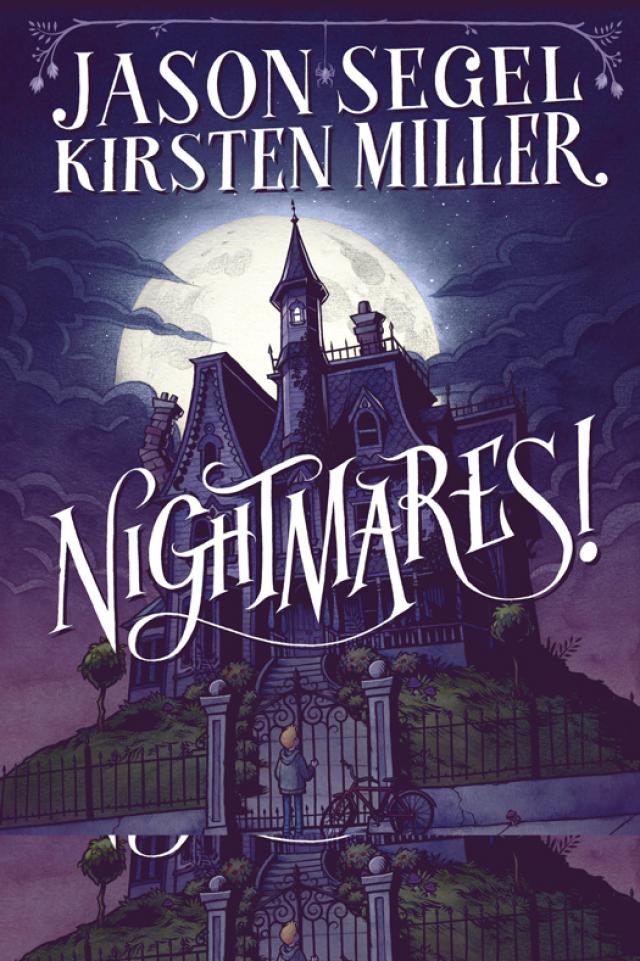
It was five minutes past midnight, and a boy was gazing down at Cypress Creek from the window of an old mansion on the town’s highest hill. It was an odd-looking building. The front porch was overrun by a jungle of potted plants. Thick green vines crept up columns, and lady ferns and blood flowers fought for every patch of moonlight. An octagonal tower sprouted straight from the house’s roof, and the entire structure was painted a dreadful shade of purple. Anyone who saw it might assume that the mansion’s occupants were a bit on the strange side—and yet the boy at the window appeared perfectly normal. He had sandy blond hair and no visible tattoos, scars, or hideous warts. But judging by the miserable expression on his face, something was terribly wrong.
His name was Charlie Laird, and he’d lived in Cypress Creek all twelve years of his life. He and his little brother, Jack, had grown up in a house just down the street. In fact, Charlie could see the old place from his new bedroom window. A different family of four owned it now. Every night, Charlie watched the lights in his former home go out and imagined the kids snuggled up nice and safe, tucked into bed by their mother and father. He would have given almost anything to trade places with them. It had been three months since he’d moved to the purple mansion on DeChant Hill with his brother and father. And it had been three months since Charlie Laird had gotten a good night’s sleep.
Charlie took a step back from the window and saw his reflection in the glass. His skin was the color of curdled milk, and dark bags sagged beneath his red-rimmed eyes. He sighed at the sight and turned around to start his night’s work. Thirty-eight heavy boxes sat in the center of the room. They were filled with video games and comic books and Little League trophies. Charlie had unpacked nothing more than a few changes of clothes. The rest of his belongings were still stowed away in their cardboard boxes. And every night, before he lay down in his bed, he would move them. Nineteen boxes were used to block the door to the hall. The other nineteen were pushed against the bathroom door, though that often proved quite inconvenient.
It would have seemed ridiculous to anyone else. Even Charlie knew the barricades couldn’t stop his bad dreams. But the witch who’d been visiting him every night for three months wasn’t like other nightmares he’d had. Most dreams faded, but he couldn’t forget her. She felt just as real as the nose on his face. So when the witch swore that one night soon she’d come drag him away, Charlie figured he should take her threats seriously. He just hoped all the boxes could keep her out of his room.
She’d already gotten as far as the hallway. The first time he’d heard someone sneaking through the house, Charlie had just woken up from a nightmare. The sun’s rays were peeking over the mountains, but the mansion was still and quiet. Suddenly the silence had been broken by the creak of rusty door hinges opening. Then the floorboards groaned and there were thuds on the stairs. The footsteps were heavy enough to be an adult’s. But when Charlie worked up the nerve to investigate, he found his father and stepmother still asleep in their bed. A few nights later, he heard the same thing again. Creak. Groan. Thud. His father said that old houses make noises. His brother thought the place might be haunted. But Charlie knew there was no such thing as ghosts. He’d been searching for almost three years, and if they’d existed he would have seen one by now. No, Charlie Laird had far bigger problems than ghosts.
The thirty-eight boxes were waiting. Charlie stared at the daunting task in front of him and wondered where he’d find the energy to complete it. His nightmares had gotten worse—and every night he fought a losing battle against sleep. Now his eyelids were drooping and he couldn’t stop yawning. As usual, he’d stood by the window until midnight, waiting for his father and stepmother to go to bed. He didn’t want them to hear him sliding the boxes across the floorboards or grunting as he stacked them against the doors. But staying up was growing harder and harder. He’d tried taping his eyes open, but Scotch tape was too weak and duct tape pulled out his eyebrows. Pacing just made him dizzy. And while he’d heard that a full bladder could keep sleep at bay, every time he tried chugging water at bedtime, he ended up frantically shoving nineteen boxes away from the bathroom door. So a few weeks earlier, when all else had failed, Charlie had taken his first trip to the kitchen for a cup of cold, leftover coffee. It always made him gag, and sometimes he had to hold his nose just to get it all down—but the coffee was the only thing that kept him awake.
Charlie tiptoed to his bedroom door, opened it slowly so the hinges wouldn’t squeal, and took a peek outside. He was relieved to see that the hallway was dark. He preferred it that way. The walls were lined with old paintings that were far creepier when the lights were on. He listened closely for signs of movement and then sock-skated awkwardly toward the stairs. Past his brother’s room. And his father and stepmother’s. He was almost outside the last door on the hall when he heard it—a high-pitched laugh that nearly sent him sprinting back to his bed. Behind the last door lay the stairs to the tower. And at the top of those stairs was a room known in the family as Charlotte’s Lair. The door was open a crack, and Charlie heard the sound of a fat cat’s paws padding down the wooden staircase. A pale golden light leaked out into the hall.
His stepmother was still awake.
Long before Charlie had become a prisoner of the purple mansion, he’d been bewitched by its tower. The mansion sat in the center of sleepy Cypress Creek, perched on top of a hill. Below it lay streets lined with tasteful houses painted white and beige. Downtown, there were flower-filled parks and charming shops. It would have been a picture-perfect village if not for the purple mansion’s tower. No matter where you were in Cypress Creek, you could always glance up and see it. With wooden shingles like dragon’s scales and a steep, pointy roof that resembled a witch’s hat, the tower would have been right at home in a fairy tale. It had two windows—one facing north and one facing south. Neither had a curtain or shade. And at night, when the rest of the house disappeared in the darkness, the tower windows appeared to glow. It was a faint and flickering glimmer. Charlie’s little brother, Jack, used to joke that someone must have left a night-light plugged in. Charlie had a few ideas of his own.
Whenever Charlie walked around town, his eyes were drawn to the tower. He was certain that some kind of magic was taking place there each night. The house was supposed to be empty, but late one evening, he thought he saw a figure standing at one of the windows. After that, his fascination was mixed with fear. At school he wrote stories about the tower. At home he drew pictures of it. His father taped the drawings to the refrigerator and said Charlie had been blessed with a vivid imagination. He couldn’t understand what his son found so interesting. And as far as Charlie was concerned, that was the strangest thing of all. Most people thought the purple mansion and its tower were just eyesores—warts on the face of Cypress Creek that they did their best to ignore. But not Charlie. Charlie knew better.
There had been one other person who’d known about the towerâ €™s magic. Every time a new drawing appeared on the family fridge, Charlie’s mom had seemed a little more worried. Then one day, when he was eight years old, his mother confessed that she had visited the purple house several times as a kid. In those days, she’d said, the tower room had belonged to a girl her age.
“What was the tower like?” Charlie had asked breathlessly. “Was it creepy? Was it cool? Was it haunted, was it …”
“It was … unusual,” his mom had replied, and her skin went pale, which told Charlie there had to be more to the story—something dark and dangerous. He pleaded for details, but his mom would only say that the mansion was probably best avoided. Charlie must have looked heartbroken when his mom wouldn’t reveal more, because she sat him down and made him a promise. She said she would tell him everything she knew about the tower when he got a bit older. But that ended up being a promise Charlie’s mom couldn’t keep. She fell ill a few months later—and died four days and three hours before Charlie turned nine.
After his mom passed away, Charlie’s fascination with the tower had continued to grow like a noxious weed. He asked his teachers about it. He interrogated the town librarian. He even cornered the mayor at the town’s annual radish festival. But no one in Cypress Creek seemed to know much about the old purple mansion—aside from four simple facts:
1. The mansion was older than the rest of the town.
2. It had been built by Silas DeChant, a millionaire hermit and notorious grouch.
3. Silas’s wife had painted the house purple herself.
4. The mansion had been vacant for years.
Charlie’s dad said that the last person to live there had been an elderly woman. A teacher claimed that an old lady dressed in purple used to hand out grape-flavored lollipops on Halloween. One of Charlie’s neighbors said he’d heard that the mansion’s owner had gone to live with her daughter in a faraway state. The neighbor’s wife swore that the old lady in question had to be at least 110.
One Saturday morning, Charlie discovered that the purple house was the talk of the town. The postman delivered the big news with the mail: the mansion’s elderly owner had passed away. Remarkably, she had died just two days short of her 111th birthday from injuries she sustained in a gin rummy accident.
At the coffee shop where the Lairds went for pancakes, a waitress told Charlie’s dad that the old lady’s granddaughter had inherited the mansion and was moving in. And a man at the next table knew that the new owner’s name was Charlotte DeChant—and he’d heard she was opening a store on Main Street. The way folks gossiped about Cypress Creek’s newest resident, Charlie figured Charlotte DeChant might turn out to be interesting. And the first time Charlie laid eyes on her, he was certainly not disappointed.
It was a cool autumn day, and Charlie was riding his bike to his friend Alfie’s house when he saw a moving van pull up in front of the purple mansion on the hill. A tall, wiry woman climbed out of the driver’s seat. She had bright orange hair with curls that seemed to be blowing in a breeze—even though the air was perfectly still. Her black skirts billowed and swirled around her boots. She wore a white T-shirt emblazoned with a logo in blood-red and forest-green. It read HAZEL’S HERBARIUM.
The woman opened the back door of the van, and from where Charlie had stopped, he could see that there were no boxes inside. Only plants. In fact, it looked like an entire garden had been uprooted, potted, and driven to Cypress Creek.
“Hey, you! Give me a hand with this stuff and I’ll give you five dollars,” the woman called down to Charlie.
Against his better judgment, Charlie walked his bike up the hill for a better look. “What is all that?” he asked.
“An enchanted forest,” the woman replied matter-of-factly.
“What?” Charlie took a step back. It was an odd thing for an adult to say. She was probably joking, but it did look like the van could hold a few gnomes and a wood sprite or two.
The lady’s laugh took him by surprise. It was high-pitched and unpleasant—more of a cackle than a chuckle. “Don’t you know when someone’s pulling your leg? It’s just a bunch of plants. I’m opening a shop downtown.”
Charlie and his friends had wondered about the shop opening up next to the ice cream parlor. They’d seen workmen painting the interior multiple shades of green. His friend Paige thought it might be a place to buy seeds and unusual vegetables. Rocco was hoping it would be a reptile emporium. “So it’s going to be a plant store?”
“More like a magic shop,” the woman replied, and Charlie perked up. Then she pointed at her shirt. “It’s going to be called Hazel’s Herbarium. I’m an herbalist. That means I use plants to treat sick people.”
For a moment Charlie felt a surge of hope. Then his heart fell when he remembered that his mom was long past treating.
He looked back up to find the strange woman studying his face. “What’s your name?” The way she asked made Charlie wonder if she already knew. He glanced down at his bike. His gut was telling him it was time to leave. This woman was not normal—at least, not the kind of normal he’d ever met. But he laid down his bicycle and held out a hand.
“Charlie. Charlie Laird,” he’d said. The woman took his hand, but she didn’t shake. Instead, she held it between her palms as if it were a little creature she’d been clever enough to capture.
“Charlie Laird,” the woman repeated, her lips stretching into a toothy smile. “I’m Charlotte DeChant. I’ve been looking forward to meeting you.”
A chill ran down Charlie’s spine, and he pulled his hand away. “Why?” he asked a little too quickly. How could she have been looking forward to meeting him? She shouldn’t have known he existed.
“If I’m not mistaken, you must be related to Veronica Laird,” Charlotte continued.
It felt like the woman had shoved a hand into his chest, grabbed his heart, and squeezed. “She’s my mom.”
“I knew her once, a long time ago,” Charlotte said. “I was sorry to hear that she passed away.”
“It’s okay,” Charlie said. Though it wasn’t. And it never would be. He wished the lady would change the subject. He could already feel his cheeks burning.
And just like that, it seemed as if Charlie’s wish had been granted. Charlotte raised her eyebrows and nodded at the moving van. “So what do you say? Want to earn a few bucks?”
“I don’t know.…” Charlie hesitated. He’d always been warned not to talk to strangers—and this woman with her blazing orange hair and portable jungle was nothing if not extremely strange.
Charlie looked up at the house behind her, his eyes drawn as always to the tower. The lady was weird, but he hadn’t been this close to the mansion in years. Everything he’d always dreamed about was on the other side of the front door. It would be torture to simply walk away.
“Then maybe I should sweeten the offer,” Charlotte said with a sly grin. “Five bucks—and I throw in a tour of the house.”
It was like she’d read his mind. Charlie’s curiosity was an itch he was desperate to scratch. Was the house as ugly inside as it was on the outside? Why did the tower glow at night? And who was the person he’d seen standing at the window? A thousand questions bounced around in his brain.
“What’s in the tower?” Charlie asked eagerly.
Charlotte cackled again, and Charlie had to resist the urge to stick his fingers in his ears. “Things that go bump in the night.”
Charlie should have turned away as soon as he heard that. He should have hopped on his bike and hightailed it to Alfie’s house and never looked back. He’d never had such a bad case of heebie-jeebies before. But Charlie didn’t leave. He couldn’t. He didn’t know if it was curiosity or some kind of magic that pulled him inside, but he moved the woman’s plants to the porch. He accepted five dollars for his trouble. And then he followed Charlotte inside for his tour.
An overfed tabby cat met Charlie at the door. It took one look at him, hunched its back, and hissed. Charlie stepped over the orange beast and caught up to Charlotte just as she was pointing out the mansion’s parlor and library. The heavy old sofas and sagging armchairs in both rooms were upholstered in lilac, magenta, or mauve. Even the shelves in the library were painted the color of ripe eggplant.


