

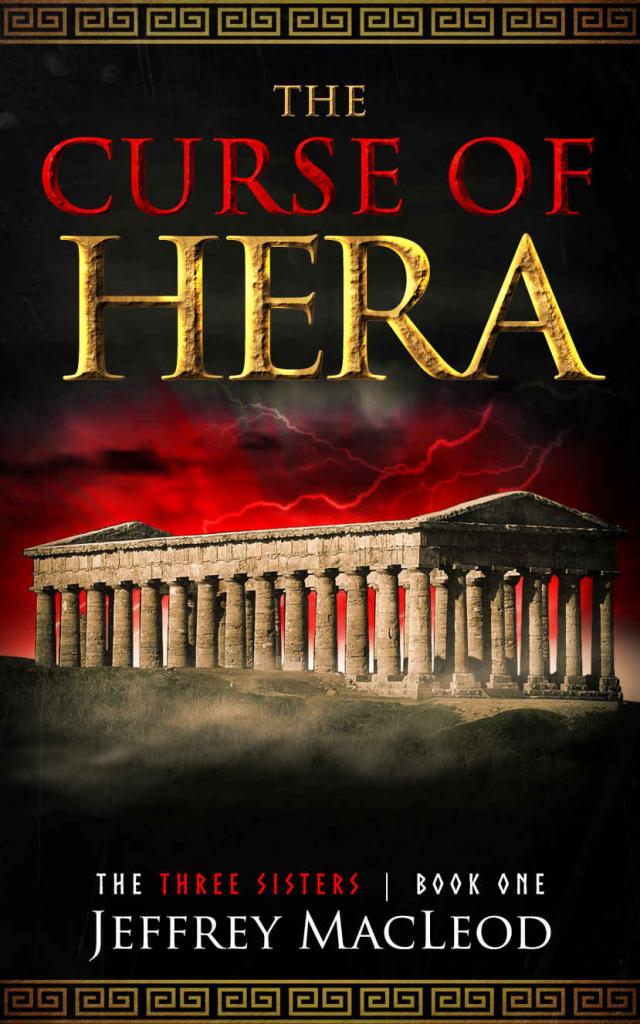
The curse of hera, p.1
The Curse of Hera, page 1
part #1 of The Three Sisters Series


Synopsis
Three heroines, their mythical beauty so exquisite that even the Gods are overcome with desire;
Three souls cursed eternally to be reincarnated into lives of misery;
Three sisters born into the 21st Century;
Finally, they have a chance of redemption.
But even this is part of an Olympian’s game.
The Gods are dangerously divided – some will assist, some will oppose. Zeus, Apollo, Hera, Athena – all have chosen their sides. And if the Three Sisters fail, another Trojan war could engulf humanity.
Accompanied by their father, Ilia, Danae and Leda embark upon their desperate quest to redeem their souls. Aided by divine gifts and guidance, they range across the ruins of the ancient world, from Rome and Syracuse to Paestum, from Mount Olympus and Pompeii to the Palace of King Minos in Crete, exploring the present and the past, in search of the fabled relics that may aid them.
The Three Sisters is not only an epic adventure set against the backdrop of the World of Greek and Roman Mythology, it is also an educational Odyssey for lovers of travel, classical history, legends and art. But above all, it is a tale of paternal devotion and sororal unity, and the bonds of familial love that cannot be broken – not even by the wrath of the Gods.
The Three Sisters
Book I
The Curse of Hera
By Jeffrey MacLeod
“Gods often contradict
our fondest expectations.
What we anticipate
does not come to pass.
What we don't expect
some god finds a way to make it happen.
So with this story”
– Euripides, Medea
When parents separate, the greatest fear of the father is to lose the love of his children. To my darling daughters, thank you for your forgiveness.
These pages are my sleeve, these words are my heart; this is my thanks, my confession, my apology and my dedication.
To my darling daughters, the Three Sisters, from your loving Dad. I hope that this preserves eternally some of the magical moments we have spent together.
Remember: drink life to the lees and never rest from travel.
Index
Prologue
Chapter IThe Etruscan Stone
Chapter IIGods and Gelati
Chapter IIIThe Slayer of Men
Chapter IVAn Artist’s Playground
Chapter VThe Sun God
Chapter VITiberius’ Leap
Chapter VIIThe Queen of Olympus
Chapter VIIIDivine Providence
Chapter IXThe Sleeping CIty
Chapter XA Paternal Comedy
Ilia
Danae
Leda
The Three Sisters
Prologue
If Stones could speak…
– Saying attributed to Jesus; Luke 19:37-40
No celebration, pomp or ceremony had marked the passing of that stone's 2768th birthday yet, in a manner of utterly disappointing obscurity, it had passed nonetheless. In truth, in itself it felt little different from the day that it had first been cut and, with the annoying conviction of the justifiably vain, it believed that its appearance had changed minimally over the long and unremarkable centuries. However, the retort to such vanity accentuates the adjective unremarkable, as there is no defence for so many years of inactivity. Stones are, as a general rule, lazy in a manner that other objects can only fantasise about, and this particular stone was an archetypal example of the quintessentially slothful. However, with the ripe old age of 2768, it had indeed passed a milestone and it was high time that its ancient destiny was finally fulfilled. But fulfilment is a term applied only when the pre-ordained path is recognised with adequate notice so, oblivious to the divine intent that underpinned its existence, it was natural that the three simple souls that were to bring about the designs of the Fates thought their own actions were inspired by nothing other than an innocent curiosity.
In short that stone was very, very old and had been waiting a long, long time for its life to become interesting; the three girls who found that stone were about to make its life very interesting indeed. Conversely, the same stone was going to impact on their lives in a way that had not happened for several hundred reincarnations of their sweet souls.
At 15 Ilia was the eldest, although her soul was the youngest. In her dreams she occasionally recalled the high stone walls and a great wooden horse. There also echoed the war-cries of desperate men; but it was the receding wail of babies falling from the walls that roused her most from a sweat-drenched slumber, unusual in one so young. Mostly she dreamed of the twin babies and their changing faces as they grew to men, and a new walled city on the seven hills by a river. Whether it was the many ordeals of her previous lives that had shaped her personality, or the infinite complexity of her genetic coding, she was by nature a sweet and sensitive girl with a great sense of responsibility. She had a grumbling temper that rarely manifested in more than a sharp, angry word, and her mood was quickly turned by laughter. Touched by Athena her sense of Justice was intense – sometimes overly so – and it was most often something she deemed unfair that fuelled her veiled fury. Tall and slender, she had fine features and clear blue eyes that she hid too often under her flowing caramel hair; indeed she was a rare beauty.
Danae was 14 and many attributed her feistiness to middle-child syndrome, however, this quality was more easily explained by an event in a previous life, in which she had been locked in a coffin with her baby son and condemned to death at sea. In this life she was a character and a survivor. She had the special talent of being able to warm a cold heart with her Cheshire Cat grin or, equally, to bring on audible thunder with a glowering look under furrowed brows. In her beautiful oval face her dark, flashing eyes engaged and locked your gaze and her wicked humour varied from side-splitting to cruel. She trailed her older sister only a little in height, but was squarer in the shoulders and was naturally athletic. The strength of Zeus was in her, which she utilised by humiliating older boys in arm-wrestling – something she greatly enjoyed. His thunder and lightening had helped shape her personality as she was quick to open anger and did not easily forgive. She would be desired but unreachable when she was older, even by the Olympians. She was confident and content in herself, except that she lamented having her father's sturdy feet.
Finally, at eleven-years-old there was Leda. Is there an archetype for the youngest child? If there is then Leda was probably it. She was the darling, the little princess and, on occasion, still played skilfully on being the baby of the family. Her cheeky grin and chameleon face contorted her appearance into a thousand adorable and contrasting expressions that she would use to entwine people around her little finger with apparent innocence. But, although this was one tool within the vast repertoire of her personality, it was one she really did not need. For, in her own right, she was sharp of wit and had a surprisingly mature sense of humour for her age – so much so that it could bring children and adults alike to tears of laughter. And, despite priding herself in her "crazy" façade, her mind was agile and quickly adapted to any problem, generating resolutions with equal speed. She was very small for her age but well-knit, light of feet and unexpectedly strong. Like her sisters she had cascading hair that came straight out of a shampoo commercial, and the beauty that had ultimately given birth to the Trojan war could already be seen reborn in her petite face.
All three would be equally beautiful in different ways when they grew up. Paris, had he seen them, would have indeed been glad that such an impossible dilemma was not presented to him yet again. Together the three were strong and loving, intolerant of each other but, at the same time, inseparably loyal, and in the mix of their personalities and skills the countless reincarnations that had drifted through the currents of the many centuries had finally aligned to generate the synergistic potential that would eventually save the human race.
That is, these three girls were destined to save the world, and it would all start with the Etruscan stone.
Corfu
Chapter I
The Etruscan Stone
Man becomes aware of the sacred because it manifests itself, shows itself, as something wholly different from the profane. To designate the act of manifestation of the sacred, we have proposed the term hierophany.
– Mircea Eliade, The Sacred and the Profane
If there is one thing better than having good friends, it is having good friends with nice country houses who ask you to come and visit. Margaret – or Margo – is one of the latter. She is the best type of British aristocracy for, just as she has turned her back on her somewhat regal Christian name, she has also turned her back on her class and decided to make irreverence the cornerstone of her personality. She loves to converse with friends nearly as much as she likes to laugh and, in her colourful conversation, she often oscillates from shocking to sensitive in a single sentence; as such one can never be sure whether they will next need tissues or proficiency in the Heimlich manoeuvre. She is a wonderful entertainer and fantastic cook that enjoys company over lavish feasts of traditional foods done exceptionally well. Every morsel must be sloshed down with a great gulp of a local ruby-red wine – at least that is the rule Dad seemed to adhere to when there, quoting his host's insistence as justification, although no one else had ever heard it confirmed by the woman herself. However, it was the sort of rule she might have introduced and Dad was in good company when he behaved in this manner at Margo's. Out of sheer politeness of cou
It would be misleading to say that Margo is an amateur singer, because she has a truly magnificent and well-trained voice and has been paid to sing on many occasions. She trained as an opera singer and has both the talent and presence to have been hugely successful but, as with many areas of human endeavour, the final ingredient that is the difference between anonymity and fame is Fortune and, just as She is depicted in the ancient world, Fortune is blind. Singing, therefore, is not Margo’s main source of income, and she often performs concerts in churches and cathedrals for the pure enjoyment of making classical music sound wonderful in such exotic and historical settings. She is also good enough that she does not feel the need to quasi-perform around her friends on a day-to-day basis – as much as anything else, this could be to avoid the awkward situation of trying to extract an audience fee from them afterwards. Be that as it may it is Margo's intimacy with exceptional music that partly explains her country abode.
Margo's house – Le Viste – is in the rising heights of the Apennines, the great mountainous spine of Italy that splits the geographical boot into east and west. Her large stone farmhouse is nestled high over San Sepolcro on the very fringe of Tuscany, amidst stony olive groves and wildflower-clad fields that are filled with butterflies in the summer. During July and August, it is hot and dry and blistering and the quivering blue sky hurts your eyes and black scorpions scuttle among the stones. At that time, one must retreat into the shade of her stone house with its high ceilings and thick cool walls, as the olive trees and scrubby forest afford little genuine shade and the hot air engulfs you, enfolding you in heat like a stifling blanket. But, at a thousand metres, it is cold and bleak there in winter and snow often remains in the shadowed hollows late into Spring. The open position, that affords such a magnificent vista across Italy, leaves it exposed to an icy wind that is chilled as it rides blustering over the broken hilltops and whistling through rocky gullies. At these times her large farmhouse, with its 12 bedrooms, can be cold and the huge open fires become by necessity the central focus for the huddling residents. Understandably there is a rapid shift in the Spring and Autumn between these extremes of weather.
Many years ago, Margo had bought this house to develop as a singers' retreat and the huge stone barn, with its wonderful acoustics, had been converted into a hall for echoing song. Vocalists with performance issues and stage-fright would come there to overcome their hesitations, but they had not come for many years and the house was more often filled with guests than musicians. When she was not there, Margo rented the house to tourists who had large occupancy requirements, but it remained her special place and an extension and reflection of herself.
Margo had invited the girls and their dad there this summer. She had her own experience of the complexities of relationships and the impact on family and children, and her own daughter was due to arrive in the next week for her summer break with mum. For the moment though, it was just the five of them and they had long hot days punctuated by simple excellence that required no elaborate preparation. For lunches there was milky buffalo mozzarella and basil drizzled with the fruitiest locally-sourced olive oil, tossed among peppered, bleeding tomatoes that made you realise that, up until that moment, you had never eaten a real tomato. The most exquisite peaches were in season and the girls and Dad enjoyed daily "peach-fests" that required napkins on-hand to catch the juice that ran liberally down their chins. Crusty bread and oil, pastas and more tomatoes and chilled white wine in frosting ceramic jugs accompanied all. Margo had a real life there at Le Viste, however, so was often away and, during these quiet times, the girls and Dad would play cards or read. Daily they would walk along stony paths across the endless hilltops, exploring any suspicious undulations in the earth that to the observant eye betrayed long forgotten houses, whispering of the families that had enjoyed similar summer pursuits in ages past. In the afternoons Dad would snooze or read in the shade and the girls would chase the many and varied elusive butterflies with nets.
There was a certain path that wound through the hills that they would often walk, pausing at the sudden openings on either side that offered sweeping views off into the distance of dry, forested slopes and criss-crossing gullies and monastery-crowned crags. This one afternoon the Fates had spun their web to an intricate convergence that saw the three girls decide to walk this path, while Dad dozed in a hammock shaded by an overhead trellis knotted with bee-infested grapevines thick with blossom. They walked along the familiar path, chattering and fooling and laughing and arguing. In a sort of competition, they scoured the edges of the road for the ultimate walking sticks, boasting to their siblings each time they found a new one that they believed surpassed all others. They stopped and threw small stones into a gully and the clattering got louder as the stones got larger until Ilia, who had been protesting all along, finally convinced them that, having started a small landslide, they had gone quite far enough. Danae laughed it off and scowled at Ilia's rebuke:
“Stop trying to be Mum Ilia!”
They walked on in silence for a while, their sandals becoming more and more dusty from the road, when Ilia suddenly stopped and said as a form of statement:
"What's that?"
…There is the ancient stone in those hills, a building block that their father had seen several years before and christened The Etruscan Stone. It is an unusual stone, not because of its size – which is decidedly average for an ancient building block – but due to its shape. He had seen a building stone of this shape only once, many years previously, when he had travelled with his uncles in Italy and they had taken him to an excavated Etruscan city. He did not remember where it had been – somewhere in Tuscany probably, although this had morphed over the years to a memory near Naples – however he did remember vividly the unusual shape of the blocks used to build the city wall, and also that his uncles had said it was characteristic of Etruscan building in particular. With Margo he had discussed what it might mean, that lone and unusual stone lying isolated and forgotten in the hills of the Apennines. Had there been an Etruscan settlement nearby? If so Margo – who was good with the local history – had heard nothing of it. It was a stone that could not easily be moved, requiring perhaps three or four men of our day to shift, and it would require a sturdy cart to transport it. So, unless there was a ruin immediately nearby, Dad had mused, someone must have brought it here. But why would they, considering the effort involved? Because Dad did not know the stone’s history, its location made no sense.
The Stone had been cut in the year that brutish thug Romulus had killed his brother – 753BC. It was a deed totally undeserving of the eternal fame that has followed it; it is not now remembered but Remus had been unarmed and his brother had set upon him with a type of ancient roncola – a short heavy blade used for pruning and clearing undergrowth. Apparently, that was the sort of heroism required to found the greatest city on earth. Romulus had dragged his brother's corpse to a low precipice and shoved him off onto the rocks below. He had then returned to his plough and with it turned his brothers congealed blood into the soil.
To the north the Etruscan kings ruled in a more civilized manner, as those in power can when they are unchallenged. Apollo was already known and worshipped among the Etruscans, and The Stone had been cut by a Master Mason for a temple that the Romans, some centuries later, had destroyed. The ruins had been pillaged over the ages for building materials. A local farmer had dreamed a dream and, following the instructions he believed he had received, with his neighbours' assistance mounted this stone on a cart and drove it up a winding path into the hills and there deposited it.
The farmer had not been wrong in interpreting his dream, but he did not live to see the purpose behind his instruction. On his way back to his farm he was killed by a great She-wolf and devoured. The stone was unharmed and had lain forgotten for over two millennia, awaiting the fulfilment of its purpose.


